Recovery is decided in the kitchen as much as in the gym. You can follow a perfect program, but if Tuesday’s dinner after squats is a bowl of cereal and Wednesday’s lunch is a vending machine, Thursday’s session will feel like wading through wet sand. A fitness meal plan for training and recovery gives your hard days, easy days and rest days the food each one needs, planned before the week starts.
This guide is for people who train regularly, at home or in a gym, and want a practical eating plan rather than a sports science lecture. You will get three plate templates, a worked training week, a list of recovery snacks to keep stocked, and a look at spreadsheet, printable and tablet planners that hold workouts and meals together.
No special supplements. No complicated timing windows. Just ordinary food arranged around your training.
Quick picks: planners that link training to meals
| Product | Best for | Price | Link |
|---|---|---|---|
| Lift & Thrive Workout Planner Spreadsheet | Lifters who want logs and meal totals in one file | $9.99 | View |
| Steady Strides Weight Loss Planner | Printable and fillable food and fitness pages | Original price was: $4.49.$1.19Current price is: $1.19. | View |
| Lighter Days Digital Weight Loss Planner | Tablet users who log daily | Original price was: $4.75.$1.09Current price is: $1.09. | View |
| Sage & Clay Printable Life Planner Bundle | Fitting training and meals into family life | Original price was: $12.99.$6.99Current price is: $6.99. | View |
What a recovery-friendly meal plan has to cover
Most training meal plans fail because they are written for an imaginary athlete with a private chef. Yours only has to get four things right, week after week.
- Protein at every meal. Not one giant steak at dinner. Spread across breakfast, lunch, dinner and a snack. Eggs, yogurt, beans, chicken, fish, tofu, cottage cheese.
- More carbs on harder days. A long run or a heavy lifting session uses fuel. Rice, potatoes, oats, bread and fruit refill it.
- Fluids you can see. A water bottle with a line drawn on it at 10 am, 1 pm and 4 pm works better than a vague goal.
- A meal soon after training. If your session ends at 7 pm, dinner should be ready by 7:30, not an hour of chopping away.
Sleep belongs on the list too, even though you cannot cook it. A late, heavy meal at 10 pm can spoil a night’s rest, so the plan should keep hard-day dinners at a sensible time.
If you have specific targets from a coach, doctor or dietitian, write those in your planner and build around them. The templates below are a practical starting point, not a prescription.
Three plates for three kinds of day
Rather than counting every gram, many people find it easier to give each type of day its own plate shape. Write these three on a sticky note inside your planner.
Hard training day
Half the plate starchy carbs, a quarter protein, a quarter vegetables. Think chicken, a big scoop of rice and stir-fried peppers. Add a snack with carbs and protein within an hour or two of training, like a banana and a glass of milk.
Easy or skill day
A third carbs, a third protein, a third vegetables. A yoga class, a 30-minute walk or a light technique session does not need the same fuel as a heavy leg day.
Rest day
Half the plate vegetables, a quarter protein, a quarter carbs. Protein stays steady because your body is still repairing. This is also the best day for a recipe that takes longer, since you have the time.
That’s the whole system. Three shapes. You will be surprised how quickly you stop thinking about it.
A training week, planned meal by meal
Here is a sample week for someone lifting three days, running twice and resting twice. Swap any food for one you like; keep the shape.
| Day | Session | Breakfast | After training | Dinner |
|---|---|---|---|---|
| Monday | Heavy lower body | Oats with milk and banana | Yogurt and granola | Chicken, rice, stir-fried veg |
| Tuesday | Easy 5 km run | Eggs on toast | Apple and cheese | Leftover chicken in wraps with salad |
| Wednesday | Upper body | Oats with peanut butter | Chocolate milk | Salmon, potatoes, green beans |
| Thursday | Rest | Greek yogurt and berries | None | Bean and vegetable soup with bread |
| Friday | Full body | Bagel with eggs | Banana and a protein yogurt | Beef or lentil pasta bake |
| Saturday | Long run, 10 km | Toast with honey before, eggs after | Rice pudding pot | Leftover pasta bake and salad |
| Sunday | Rest and prep | Pancakes with cottage cheese | None | Roast chicken and vegetables |
Notice the leftovers on Tuesday and Saturday. Those are the nights after a session when cooking feels like a chore. Planning them as reheat nights is what keeps the plan going in week three.
Recovery snacks worth keeping in the cupboard
The gap between training and the next meal is where good plans leak. You get home starving, open the cupboard and eat half a packet of biscuits. So keep these stocked and write them on your grocery list every week.
- Bananas and apples
- Single-serve yogurt or cottage cheese pots
- A carton of milk or a plant milk you like
- Rice cakes and peanut butter
- Boiled eggs, cooked six at a time on Sunday
- Canned tuna or a pack of hummus with crackers
- A bag of oats for overnight oats
A shopping list sorted by aisle makes stocking these quicker; our guide to a grocery list by aisle shows how to set one up so you get round the store in one lap.
Planning training and meals in a spreadsheet
If you already log sets and reps, a spreadsheet that also handles meals saves you juggling two files. Change Monday from a rest day to legs, and you can see straight away that Monday’s dinner needs more carbs.
Lift & Thrive Workout Planner Spreadsheet
Price: $9.99 | Best for: lifters who log sets and plan meals
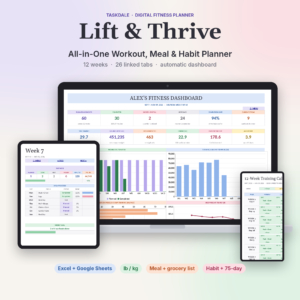
One workbook for Excel and Google Sheets with 12 weekly workout tabs, a 139-exercise library, automatic volume, personal records and estimated 1RM, plus a dashboard with charts. The meal side has a meal setup for your usual dishes with calories, protein, carbs and fat, a weekly meal planner with daily totals and a water tracker, and a grocery list that builds itself by aisle. Enter your five go-to meals first, then plan this week.
A neat trick: add your recovery snacks as meals in the meal setup. Then they show up in the daily totals and on the grocery list without you remembering them. If you are new to logging lifts, our post on tracking workouts in a spreadsheet explains PRs and progressive overload in plain words.
Planning on paper with a fillable backup
Some people think better with a pen. A printable planner with a meal planner, a food diary and a workout log keeps everything on the desk, and a fillable PDF version lets you type when that is quicker.
Steady Strides Weight Loss Planner
Price: Original price was: $4.49.$1.19Current price is: $1.19. | Best for: people who like writing meals and workouts by hand
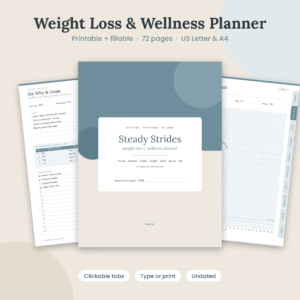
A 72-page undated PDF you can fill in on a laptop or tablet or print in US Letter or A4. It includes a calorie and water needs worksheet, a weekly workout planner, workout log, weightlifting planner and running log, a weekly meal planner with prep and shopping lists, a daily food diary with calories and macros, plus sleep and habit trackers. Fill in the calorie worksheet first, then plan your training week and meals on facing pages.
Although it is labelled as a weight loss planner, the pages work just as well when your goal is performance. The sleep tracker is the one many people skip and later wish they had used.
Logging recovery on a tablet
A tablet planner suits people who already carry an iPad everywhere and want quick daily logs: what you trained, what you ate, how you slept.
Lighter Days Digital Weight Loss Planner
Price: Original price was: $4.75.$1.09Current price is: $1.09. | Best for: tablet users logging daily food and training
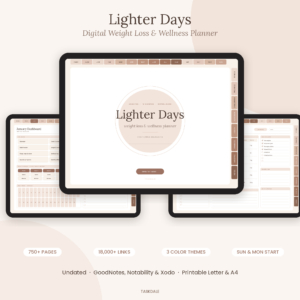
An undated hyperlinked PDF for iPad and Android note apps with monthly dashboards, 60 weekly spreads with a fitness plan, meal plan and grocery list, and 372 daily pages that hold weight, sleep, steps, workout, meals with calories and protein, and water. Printable US Letter and A4 pages are included. Start by filling one weekly fitness plan and its meal plan side by side.
The daily page takes about two minutes. Sleep and workout sit at the top, so a poor night next to a flat session is easy to spot.
A Sunday batch cook for a training week
Ninety minutes on Sunday covers most of the week above. Here is the order that keeps the oven and the hob busy at the same time.
- Oven on. Roast a tray of chicken thighs and a tray of mixed vegetables.
- Rice on the hob: cook enough for four portions.
- Boil six eggs while the rice cooks.
- Make four jars of overnight oats.
- Start a pot of bean soup for Thursday and freeze half.
- Portion everything into boxes and label them with the day.
That’s it. By Monday evening, after a heavy session, dinner is a box and a microwave. The relief of that first easy evening is what convinces most people to do it again.
Fitting meals around the time you train
The clock matters as much as the food. The same person eats very differently on a 6 am session than on a 7 pm one, so plan by training time as well as training type.
Early morning sessions
Many people cannot face a full meal at 5:30 am. A small carb snack before, like half a banana or a slice of toast with jam, then a proper breakfast after. Put the after-breakfast in the plan as the main meal: eggs, toast, fruit, yogurt. Overnight oats in a jar save ten minutes when you are rushing to work.
Lunchtime sessions
Train at 12:30, eat at your desk at 1:30. That only works if lunch is packed. Plan a bigger lunch on these days, such as a rice bowl from Sunday’s batch, and a snack mid-morning so you do not train on empty.
Evening sessions
Here the risk is a late, rushed dinner. Eat a decent snack around 4 pm, train, then reheat something already cooked. Keep the after-training dinner lighter on fat and heavy sauces if a full stomach keeps you awake.
Adjusting the plan when you feel flat
Some weeks your legs feel heavy on Wednesday and your sleep has been patchy. Look at the planner before blaming the program. Three questions usually find the problem.
- Did hard days get enough carbs? Check Monday’s and Wednesday’s plates. A salad after a heavy leg session is a common culprit.
- Was protein spread out? If breakfast and lunch were mostly toast and coffee, fix those slots first.
- How was sleep? Two nights under six hours will flatten anyone, and no meal plan fully covers that.
Change one thing next week, not five. Then look again on Sunday.
Who this approach does not suit
Competitive athletes cutting weight for a weigh-in, or anyone working to precise numbers set by a sports dietitian, need more than plate shapes. Use a planner to record those numbers, but follow the professional’s plan. The same applies if you have a medical condition that affects what you eat. For everyone else training for health, strength or a local race, the simple approach above covers the ground.
Recovery eating mistakes that sneak in
- Same plate every day. Rest days and long-run days do not need the same fuel. Use the three plates.
- Skipping breakfast before an early session. Even a banana helps. Plan it the night before.
- Protein only at dinner. Split it across the day so each meal pulls its weight.
- Forgetting fluids on rest days. Keep the water bottle routine going all week.
- No plan for late sessions. Write a reheat meal for every training night that ends after 7 pm.
Frequently asked questions
What should I eat after a workout?
Something with protein and carbs, ideally within a couple of hours. Yogurt with fruit, a glass of milk and a banana, or simply your next planned meal if it is close.
Do I need a different meal plan on rest days?
Slightly. Keep protein steady, ease back on starchy carbs, and add more vegetables. Rest days are also good for longer recipes and batch cooking.
Can I use a weight loss planner for muscle gain?
Yes. The pages for meals, workouts and progress are the same. Just set your own targets and treat the weight graph as a record rather than a goal to push down.
How many meals a day for training?
Three meals and one or two snacks works for most active people. What matters more is that protein shows up at each one and hard days get enough carbs.
Should I track calories for recovery?
You do not have to. Plate shapes and a weekly plan cover most needs. If you have a specific target, a spreadsheet or food diary page makes counting easier.
How far ahead should I plan meals for a training block?
One week at a time works best. Training plans change with how you feel, so plan the next seven days each Sunday and keep a list of favorite meals to pull from.
Your next step
Write your training days for next week, label each one hard, easy or rest, and give each dinner the matching plate. If you lift and want the sums done for you, set up the Lift & Thrive Workout Planner Spreadsheet and enter your five go-to meals tonight.