Young children using crayons need pages with lines as thick as a crayon tip, one big subject and almost nothing else. A two-year-old’s scribble is all arm. A four-year-old can start to aim. Neither of them can color a ladybug’s spots the size of a lentil, and a page full of tiny shapes tells them, before they even begin, that they are going to get it wrong.
Bold-outline coloring pages fix that. A thick black line acts like a fence the crayon bumps into, and a big open shape gives a small hand room to move. This guide is for parents, grandparents, childminders and preschool teachers choosing pages for children from about two to six. You will see what bold really means on paper, how to match a page to an age, which crayons suit small hands, and how to print and set up so coloring time ends with a proud grin rather than a torn page.
Quick picks for little hands
| Product | Best for | Price | Link |
|---|---|---|---|
| Little Explorers Preschool Coloring Book | Ages 2 to 5, animals, vehicles and early learning | $3.49 | View |
| Farm Animals Coloring Book | Cows, pigs and barns with thick outlines | $3.49 | View |
| Roar to Z Dinosaur Coloring Book | Dinosaur fans with big-shape preschool pages | $4.49 | View |
| Bold Florals Flower Coloring Book | Big petals for kids who love flowers | $3.49 | View |
What bold outline actually means on a page
Lots of pages call themselves easy. Fewer are easy for a three-year-old. Here is how to tell them apart in about ten seconds.
Line thickness
For children under four, the outline should be roughly as wide as the crayon tip, around three to five millimeters. Hold a crayon against your screen or a printed page. If the line is thinner than the crayon point, it will vanish under the first scribble.
Number of shapes
Count the closed shapes. A good page for a toddler has somewhere between five and fifteen. A puppy with a body, a head, two ears, a tail and a ball is plenty. Forty shapes is a page for an eight-year-old.
Empty space
Look for white space around the main picture. A cluttered background of grass blades and flowers turns into a brown smudge in small hands. A plain background lets the child see their own colors clearly, and that is the reward.
Recognizable subject
Little ones color things they can name. A cat, a truck, a sun, a fish. Abstract patterns are lovely for adults but rarely hold a toddler’s attention past the first minute.
Matching pages to age
Children change fast between two and six. A page that bored your four-year-old last month might be just right for the two-year-old next door.
Around age 2
Expect scribbles, and celebrate them. One huge shape per page is ideal: a ball, an apple, a smiling sun. The child is learning that a crayon makes a mark and that marks can be different colors. Staying inside the lines is not the goal yet.
Around age 3
Many three-year-olds begin to color toward a shape on purpose. Pages with one animal and one or two props work well. They might color the whole cow purple and leave the grass blank. Perfect.
Ages 4 to 5
Now the thick line starts to matter as a fence. Children aim for it, overshoot, and try again. Give them pages with a main subject and a simple scene: a duck by a pond, a fire engine on a road. They enjoy choosing a different color for each part.
Age 6
Most six-year-olds want a bit more to do. Keep the bold outlines but allow more shapes and a small background. This is also a good age for alphabet and fact pages, where coloring sits beside early reading.
For a set that covers the toddler-to-preschool stretch in one download, start with a book made for that age.
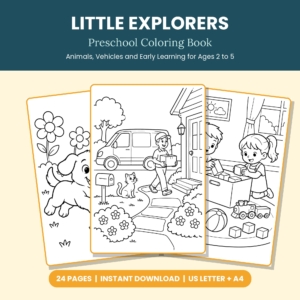
Little Explorers Preschool Coloring Book
Price: $3.49 | Best for: toddlers and preschoolers ages 2 to 5
Little Explorers has 24 simple pages with thick outlines and open spaces, split into Friendly Animals, Busy Vehicles and Early Learning themes, from a puppy chasing a ball to a digger and a counting-ducks page. It comes as US Letter and A4 PDFs plus every page as a 300 DPI PNG. Print the Playful Garden Puppy first and hand it over with three jumbo crayons.
The best crayons for small hands
The page is only half of it. The wrong crayon can make a perfect page frustrating.
- Jumbo round crayons. Thick enough for a full-fist grip, which is how most two-year-olds hold them. They snap less often than standard crayons.
- Triangular crayons. The flat sides stop them rolling off the table and nudge fingers toward a better grip over time. A good pick from about age three.
- Egg or palm crayons. Shaped to sit in a cupped hand. Great for the very youngest scribblers, though the marks are broad and less precise.
- Standard crayons. Fine from around four or five, once the child holds a crayon between fingers rather than in a fist.
One safety habit worth keeping: under-threes put things in their mouths, so throw away small broken crayon stubs rather than leaving them in the tub. Washable crayons also save a lot of scrubbing when color ends up on the table, the wall or the cat.
Keep the choice small. Five or six crayons in primary colors plus green and brown is more than enough. A box of 48 turns coloring into a sorting game, and the page never gets finished.
Animals: the theme that keeps them coloring
Ask a room of four-year-olds what they want to color and most will say an animal. Farm animals are especially good, because children know the sounds and can talk while they color. A cow page becomes a mooing page. A pig page becomes a story about mud.
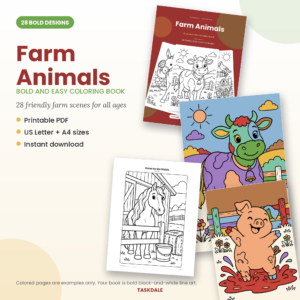
Farm Animals Coloring Book
Price: $3.49 | Best for: young kids who love barnyard animals
Farm Animals has 28 bold scenes with thick outlines and large shapes: a cow in a meadow, a pig in a puddle, a hen with eggs, a duck family at the pond and a rooster at sunrise. Each design is its own page in US Letter and A4 files. Start with the pig in a puddle and let your child pick the mud color.
Some pages in a book for kids and adults will have more going on than others. That is fine. Pick the simpler scenes for the youngest and save the busier farmyard pages for a five- or six-year-old, or for a grown-up coloring alongside.
For more animal sets sorted by age, our guide to animal coloring books for toddlers lists what to look for.
How to print bold pages so lines stay dark
A page can be drawn with a lovely thick outline and still come out of the printer gray and faint. Then crayon wax covers it and the fence disappears.
- Print at actual size or 100 percent. Fit to page shrinks the design a little, and the line shrinks with it.
- Choose the best or high quality setting. Draft mode saves ink by printing lighter. Bold pages need full black.
- Use black ink only if your printer offers it. Some printers mix black from color inks, which can look brownish.
- Print on slightly heavier paper. 24 lb or 28 lb paper does not wrinkle when a toddler presses hard. Cardstock is even sturdier for pages you plan to keep.
A small trick for the youngest: if a page has a few thin details you want to soften, trace over the main outlines with a thick black marker before you hand it over. Two minutes of tracing can turn a medium page into a toddler page.
Setting up a calm coloring time
How you set up matters as much as what you print. A good session for a three-year-old might last eight minutes. That is a success, not a failure.
- Tape the page down. Two pieces of masking tape at the top corners stop the sheet sliding. Small children press hard and the paper skates away otherwise.
- Use a low table. Feet flat, elbows at table height. Kneeling on a dining chair works too.
- Offer one page at a time. A stack of five feels like a chore. One page feels like a treat.
- Color your own page beside them. Children copy what they see. They will slow down when you slow down.
- Stop before they are bored. End while they still want more, and the next session starts with a smile.
What to say while they color
Words shape how children feel about their work. Gentle, specific comments help far more than general praise.
Try describing what you see: “You used so much red on that tractor.” Ask about choices: “Why did you pick blue for the sun?” Name colors as they use them, which builds vocabulary without a lesson. Avoid fixing anything. If a child colors a duck green, it is a green duck. The point is the doing, and a child who feels judged at three may stop coloring at four.
Effort deserves notice too. “You kept going until the whole cow was colored” teaches more than “beautiful” ever will.
Coloring that sneaks in early learning
Bold pages are a natural place for first letters, numbers and facts. A child coloring a big letter D next to a dinosaur hears the sound, sees the shape and colors both. Nobody calls it a lesson.
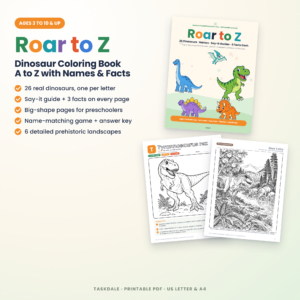
Roar to Z Dinosaur Coloring Book
Price: $4.49 | Best for: dinosaur fans from preschool up
Roar to Z runs from Ankylosaurus to Zuniceratops, one dinosaur per letter, each with its name in big outline letters, a say-it guide and three short facts. It includes a big-shape section with extra-thick outlines for little ones, plus games and detailed landscapes for older kids, in US Letter and A4 PDFs. Start your preschooler on the big-shape T. rex and read the say-it guide out loud together.
Flower pages work the same way for children who prefer gardens to dinosaurs. Count the petals together, name the colors, find the biggest flower. Thick-lined designs like those in our round-up of preschool coloring pages in PDF make these little games easy.
Common mistakes with young colorers
- Printing adult easy pages for toddlers. Easy for a grown-up can still mean 60 shapes. Count before you print.
- Too many crayons at once. A full box overwhelms. Five or six is plenty.
- Standard crayons for a fist grip. Thin crayons snap under a two-year-old’s grip. Go jumbo.
- Expecting neatness. Coloring outside the line is normal until five or so. Bold lines help, but they do not work miracles.
- Long sessions. Ten minutes for a three-year-old is a real achievement. Do not push for twenty.
- Hiding finished pages. Put at least one on the fridge each week. Seeing their work on display makes children want to do more.
When bold pages are not the right fit
Some children outgrow bold outlines early. A detail-loving five-year-old may find a single big apple boring and wander off. That is a sign to move up, not a problem. Offer pages with more shapes but the same thick lines, then gradually thinner lines over the following months.
Other children are not ready for coloring pages at all. A two-year-old who only wants to scribble on blank paper is doing exactly what two-year-olds should do. Keep blank sheets around too. Pages with outlines can wait a few months.
Frequently asked questions
What age should children start using coloring pages?
Many children enjoy simple bold pages from around two, though they scribble rather than color shapes. Staying near the lines usually starts between three and five. Follow the child’s interest rather than a set age.
How thick should outlines be for toddler coloring pages?
Roughly the width of a crayon tip, about three to five millimeters. Thinner lines disappear under crayon wax and stop guiding small hands.
What crayons are best for 2-year-olds?
Jumbo or egg-shaped washable crayons. They suit a fist grip, break less, and are easier to hold than standard thin crayons. Throw away small broken pieces.
How do I print coloring pages with darker lines?
Print at 100 percent, choose the best quality setting rather than draft, and use black ink only if your printer allows. You can also trace main outlines with a thick black marker before coloring.
Should I correct my child’s coloring?
No. Describe what you see and ask about their choices instead. Children who enjoy coloring keep doing it, and the skill follows.
Your next step
Print one page from the Little Explorers Preschool Coloring Book at full quality, tape it to the table, and set out three jumbo crayons. Sit down with your own page and color beside your child for ten minutes. Then put their finished page somewhere they will see it every day.