A good coloring sheet does two jobs at once. It keeps small hands busy, and it slips a real skill into the gaps: counting ten frogs, hearing the “s” in sun, putting a caterpillar before a butterfly. For children aged 3 to 6, that mix of doing and learning is often what makes a lesson stick.
This guide is for parents, homeschool families and early years teachers putting together coloring sheets for learning. It is organized by subject, so you can jump to math, reading or science. For each one you will see the types of sheets that work best, how to use them, and which Taskdale printable sets cover that ground. At the end, there is a simple way to build a learning binder that lasts a whole year.
Quick picks by subject
| Product | Best for | Price | Link |
|---|---|---|---|
| Hop to Ten Color by Number for Kids | Math: numbers 1 to 10, early sums | $4.49 | View |
| Letter Parade Alphabet Coloring Book A to Z | Reading: letters, sounds, tracing | $3.99 | View |
| Crayon Campus Preschool Learning Coloring Worksheets | Science plus shapes, numbers and colors | $4.99 | View |
| Little Explorers Preschool Coloring Book | Toddlers: talk-and-color first steps | $3.49 | View |
How coloring sheets help children learn
Coloring is not magic. On its own, a page of a cat teaches very little. What makes a coloring sheet useful for learning is the small task built into it, plus the talk that happens around it.
Three things are going on when a child works through a good learning sheet:
- Repetition without boredom. Counting the same number of apples on a sheet is less dull than counting them aloud five times. The coloring breaks it up.
- Hand strength and control. Coloring inside a shape builds the same small muscles a child will use to hold a pencil and write their name.
- Time to think. A child coloring slowly has time to process what you just told them. “A frog starts as an egg.” Color, color. “Then it becomes a tadpole.” Color.
So the sheet is the frame. Your conversation is the lesson. Keep both in mind and even a simple page goes a long way.
Math coloring sheets
Early math is about number sense: knowing what “6” looks like, knowing it means six things, and knowing it is one more than 5. Coloring sheets are brilliant for this because the child has to touch and color each object, which links the number word to the actual amount.
Types of math sheets that work
- Count and color: “Color 6 fish.” The child counts as they go.
- Ten frames: color the right number of boxes in a 2 by 5 grid. Great for seeing that 7 is 5 and 2 more.
- Color by number: match numbers in a picture to a crayon key. Lots of numeral reading in one page.
- Color by answer: each space shows a sum like 2+3, and the answer tells you the color.
- Count and graph: color one box per animal in a simple bar chart. Children see “more” and “fewer” at a glance.
Worked example
A four-year-old who can count to 5 starts with color by number using only 1 to 5. After a week, they move to 6 to 10. By week four, they are on mixed numbers. Around age five and a half, color-by-answer pages with sums like 1+2 and 3+4 appear. That slow climb keeps them confident. For more on this kind of progression, see our guide to color by number pages for preschool learning.
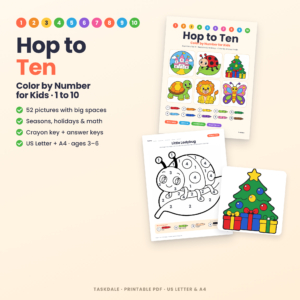
Hop to Ten Color by Number for Kids
Price: $4.49 | Best for: ages 3 to 6, number practice
Fifty-two color-by-number pictures using only 1 to 10, arranged from 1 to 5, then 6 to 10, then mixed, then seasonal pages and color-by-answer addition and take-away within 10. Two number practice pages add ten frames and number words. Full-color answer keys are at the back of the 72-page US Letter and A4 PDFs, and one teacher may print for their own class.
Common math mix-ups to watch for
Watch for a child who counts the same object twice, or skips one. A finger on each object as they color fixes most of it. Also watch for 6 and 9 confusion, which is very common. A small line under the 6 on homemade sheets helps until they settle. Neither is a worry at four. They are just signs to slow down and count together.
Reading coloring sheets
Reading starts long before a child reads a word. It starts with knowing letters, hearing the sounds inside words and noticing that print carries meaning. Coloring sheets can support each step.
Types of reading sheets that work
- Letter pages: one big letter to color, a picture starting with that sound and a row to trace.
- Beginning sounds: color every picture that starts with “b”. Ball yes, cat no.
- Uppercase and lowercase match: draw lines between A and a, B and b.
- Rhyme pages: color the pictures that rhyme with “cat”. Hat, bat, mat.
- Color by sight word: for older five- and six-year-olds, each space has a word like “the” or “and”, and a key tells them which color to use.
The four-part letter routine
The most useful habit is simple. Color the letter. Say its sound. Color the picture. Trace the letter. Do it with one letter a week and by the end of the school year your child has met all 26, slowly and properly.
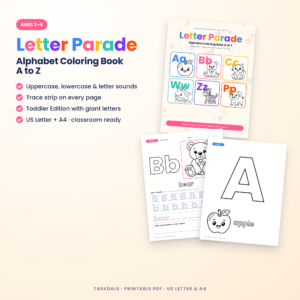
Letter Parade Alphabet Coloring Book A to Z
Price: $3.99 | Best for: letter of the week, ages 2 to 6
Twenty-six pages that each pair a big uppercase and lowercase letter with a picture (apple, bear, cat and on to zebra), the word in hollow letters and three trace rows. Extras include match big and small pages, letter hunts and an alphabet chart. A Toddler Edition with one giant letter per page comes too, all in US Letter and A4.
A child who can find three things starting with “m” around the kitchen after their M page is doing real phonics work. Praise that. It is the moment the sheet turns into reading.
Science coloring sheets
Science for young children is mostly about observing and sorting. What does a plant need? Where does a fish live? What comes after a caterpillar? Coloring sheets give that observation a shape and an order.
Types of science sheets that work
- Life cycles: four stages to color and number, such as seed, sprout, plant, flower, or egg, tadpole, froglet, frog.
- Weather watch: color today’s weather, then draw what you would wear.
- Parts of a plant: roots, stem, leaves, flower, each a different color.
- Animal homes: match a bird to a nest, a bee to a hive, a fish to water.
- Land, water or sky: sort animals by where they live.
- Seasons: one page per season, with clothes, trees and weather to color.
Make it real
Every science sheet should have a real-world partner. Color the plant page, then plant a bean in a cup. Color the weather page, then step outside and check. Color the butterfly life cycle, then look for caterpillars on the hedge. The sheet becomes a plan, and the activity becomes the proof.
Children also love to “report back”. After coloring a weather page in the morning, ask them at teatime whether the weather changed. A five-year-old who tells you it was sunny at breakfast and cloudy by lunch is doing what scientists do: watching, noting and comparing.
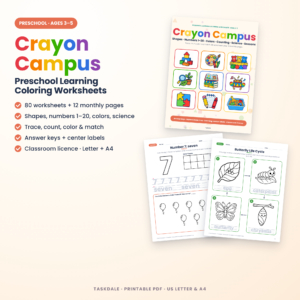
Crayon Campus Preschool Learning Coloring Worksheets
Price: $4.99 | Best for: ages 3 to 5, mixed subjects
Eighty worksheets in seven sections, including 12 simple science pages: weather watch, dress for the weather, parts of a plant, what plants need, four life cycles, sequencing, animal babies, animal homes and land, water or sky. It also covers shapes, numbers 1 to 20, counting, colors and matching, plus 12 monthly seasonal pages, answer keys and learning-center labels.
Before worksheets: learning through pictures for toddlers
Two- and three-year-olds are not ready for instructions like “color 4 apples”. They are ready for talk. A simple picture of a duck family gives you a counting chance: “One, two, three ducks!” A picture of big and small elephants gives you size words. A rainy day scene gives you weather words.
At this age, choose pages with thick outlines and one clear idea. Then narrate. The child colors, you talk. That is the whole lesson, and it lays the ground for every worksheet that comes after.
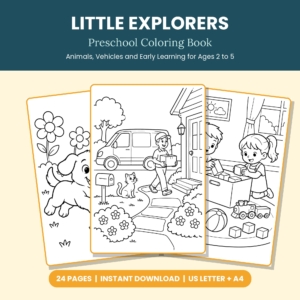
Little Explorers Preschool Coloring Book
Price: $3.49 | Best for: toddlers and young preschoolers
Twenty-four thick-outline pages in three themes: friendly animals, busy vehicles and early learning (counting ducks, a shape playground, a bead pattern, big and small animals, feelings balloons, animal homes, a rainy day). You get US Letter and A4 PDFs plus each page as a PNG, and the files can be used for personal, family and classroom use.
A sample week across all three subjects
Mixing subjects through the week keeps things fresh. A child who did numbers yesterday comes to letters today with fresh eyes. Here is a week for a four-year-old, about 15 minutes a day.
| Day | Subject | Sheet | Real-world follow-up |
|---|---|---|---|
| Monday | Reading | Letter S page | Find 3 things starting with “s” at home |
| Tuesday | Math | Color by number, 1 to 5 | Count 5 spoons into a bowl |
| Wednesday | Science | Parts of a plant | Look at the roots of a weed from the garden |
| Thursday | Math | Ten frame for 7 | Set 7 places at the table with blocks |
| Friday | Reading | Beginning sounds, “s” pictures | Read a picture book and spot the S words |
Notice the follow-ups take two or three minutes and cost nothing. They are what turn the sheet into real understanding. A child who counts seven blocks onto the table after coloring a ten frame has done the same math twice, in two different ways, and that is how it sticks.
Build a learning binder for the year
Loose sheets get lost under the sofa. A binder keeps everything in one place and shows progress at a glance.
- Get a 2-inch ring binder and five dividers. Label them Math, Reading, Science, Seasonal and Finished.
- Print one month at a time. About 12 sheets: four math, four reading, three science, one seasonal.
- Add a skills checklist at the front. Tick off “counts to 10”, “knows letters A to F”, “names 4 weather types”.
- Move finished sheets to the back. Date them. In June, flip back to September and see how far your child has come.
That last step is the one families love. Seeing a wobbly September “A” next to a neat May “A” is a lovely moment for parent and child alike. If you are juggling more than one child, our guide to a homeschool planner for multiple kids shows how to keep each child’s plan straight.
Matching sheets to your child’s level
Every child moves at their own pace. A few signs tell you when to step up or step back.
Ready to move on
- They finish the sheet quickly and accurately three days in a row.
- They start explaining it to you, or to a sibling.
- They ask for “a harder one”.
Time to step back
- They guess instead of counting or sounding out.
- They rush to scribble and finish.
- They find reasons to leave the table.
Keep a pencil note on the back of each sheet: the date and one word, such as “easy”, “okay” or “tricky”. After a month, the pattern jumps out. You might see that number sheets are always “easy” while letter sheets are “tricky”, which tells you where to spend next month.
Stepping back is not failure. Going from 1 to 10 back to 1 to 5 for a week often gives a child the confidence boost they need to leap forward again.
Printing and prep tips
Print learning sheets in black and white. It saves ink and keeps the page about the skill, not the decoration. Use “Actual size” or 100% so tracing lines stay the right height. Pick US Letter in the US and Canada, A4 almost everywhere else.
For sheets you will use again and again, such as a ten frame or an alphabet chart, slide them into clear sheet protectors and use dry-erase crayons. One printed page then lasts all year. Teachers should check the license on each set before copying for a class; all four sets here allow use in your own classroom.
Frequently asked questions
What are coloring sheets for learning?
They are coloring pages with a small task built in, such as counting objects, tracing a letter or ordering a life cycle. The coloring keeps children engaged while they practice a skill.
Which subjects work best with coloring sheets?
Early math, letters and phonics, and simple science such as weather, plants and animals all work well for ages 3 to 6.
How many learning sheets should a preschooler do a day?
One or two is plenty. Short, happy sessions of 10 to 15 minutes beat long ones.
Do coloring sheets help with handwriting?
Yes, indirectly. Coloring inside shapes builds hand control, and sheets with trace rows give direct practice forming letters and numbers.
Can I use these sheets for homeschool?
Yes. They slot easily into a homeschool week as warm-ups or as the main activity for younger children.
Should I correct mistakes on learning sheets?
Gently, and not every time. Ask a question instead, such as “Let’s count those together,” so the child finds the answer themselves.
Your next step
Grab a binder and five dividers this week. Print four math sheets, four reading sheets and three science sheets for the month ahead, then start Monday with the first number page from Hop to Ten.