Premade bullet journal pages ready to print give you the bit of bullet journaling people love, the calm, tidy spreads and colorful trackers, without the bit that makes many people quit: two hours with a ruler every month-end. You print the habit tracker, the monthly calendar and the mood page, then spend your time actually using them.
This guide is for anyone who likes the idea of a bullet journal but not the setup. Maybe you tried a dotted notebook in January, drew a beautiful February, and never reached March. You will learn which pages are worth printing and which are better drawn by hand, how to keep the bullet journal method working with printed spreads, how to print and bind pages at home, and a 20-minute monthly routine.
Printing your spreads is not cheating. It is just a shortcut to the useful part.
Quick picks
| Product | Best for | Price | Link |
|---|---|---|---|
| Joyful Days 2027 Journal Bundle | Trackers, monthly pages and calendars to color | $19.99 | View |
| 2027 Cozy Doodle Journal | Dated 2027 weekly spreads and collections | $21.99 | View |
| Attic Letters Printable Journal Pages | Vintage dot grid, lined and blank spreads with pockets | $2.89 | View |
| Strawberry Meadow Junk Journal Kit | A themed summer journal with writing spreads | $4.99 | View |
What premade pages change, and what they do not
A bullet journal is two things at once. It is a method: quick bullet notes, a symbol for tasks and events, moving unfinished tasks forward, an index so you can find things. And it is a look: hand-drawn spreads, lettering, doodles, colorful trackers.
Premade pages replace the drawing, not the method. You still write tasks as short bullets. You still mark them done, moved or dropped. You still review at the end of the month and carry forward what matters. The only difference is that the habit tracker grid was already there when you sat down.
That saves real time. A typical monthly setup by hand, with a calendar, a habit tracker, a mood tracker and a few lists, can easily take an evening. Printing the same pages takes ten minutes, and you can spend another ten coloring them in if you like. Same result on the desk. A lot less frustration.
Who premade pages suit, and who they do not
Printed spreads are a gift for some people and a poor fit for others. It helps to know which camp you are in before you print a stack.
They suit busy people who want the structure without the craft time. A nurse working rotating shifts, a parent of three, a student in their final year. They also suit anyone who has stopped a bullet journal because their drawing never matched the photos online. A printed grid is straight every time, and that removes a surprising amount of pressure.
They suit colorers, too. Line-art pages turn the monthly setup into a calm half hour with pencils, which many people enjoy more than drawing from scratch.
They suit people less well if the drawing is the point for you. Some bullet journalers find that laying out a new spread each month is their favorite part, a creative hour that clears the head. If that is you, keep drawing your main spreads and print only the fiddly grids, like a 31-day habit tracker. A printed page in a hand-drawn journal still looks right, especially if you color it in your own palette.
Which pages to print and which to draw
Not every page is worth printing. Pages with lots of lines and boxes are tedious to draw and easy to print. Pages that are mostly free writing work fine in a plain dotted notebook or on blank sheets.
| Page | What it does | Print or draw? |
|---|---|---|
| Year at a glance | All 12 months on one page for key dates | Print. Tiny calendars are painful to draw. |
| Monthly calendar | Appointments and events for the month | Print. Saves ruling 35 boxes. |
| Habit tracker | A grid of habits by day | Print. The grid is the hard part. |
| Mood or pixel tracker | One square or shape a day, colored by mood | Print, especially the illustrated ones. |
| Weekly spread | The week’s plans and tasks | Print if you like structure; draw if your weeks vary. |
| Daily log | Running bullet list of tasks, events and notes | Draw, or use dot grid sheets. |
| Collections | Books, films, gift ideas, bucket list | Print popular ones; draw the quirky ones. |
| Index | Page numbers for finding things later | Either. A simple lined page works. |
The pattern is clear. Print the grids. Write the words.
Trackers: the pages most worth printing
Trackers are where premade pages shine. A habit tracker for 14 habits across 31 days is 434 little boxes. Nobody should have to draw that on a Sunday night.
Start with three trackers at most. A habit tracker for four or five daily habits. A mood tracker. And one fun one, such as books read or a savings jar you color in as you put money aside. Too many trackers in month one is the classic way to burn out by month two.
Illustrated mood trackers are a lovely middle ground between tracking and art. Each day you color one numbered space in your mood color. By the 31st you have a little picture of your month: a heart, an apple, a rose window. People who would never keep a spreadsheet of their moods will happily color a gumball machine.
A bundle with lots of tracker designs gives you room to swap things around each month.
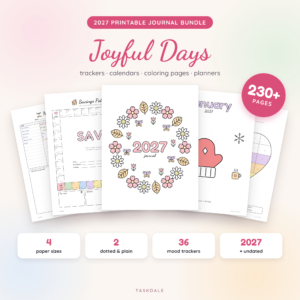
Joyful Days 2027 Journal Bundle
Price: $19.99 | Best for: bullet journal fans who skip the ruler
Joyful Days has 230+ line-art pages in US Letter, A4, Half Letter and A5, each in dotted and plain versions. You get 17 year-in-pixels trackers, 36 mood tracker designs, 36 month openers with matching 2027 calendars, 12 undated calendars, a 14-habit monthly tracker, sleep, water and spending trackers, a savings jar and a 52-book reading challenge, with a clickable contents page. Print this month’s habit tracker and one mood tracker first.
For ideas on which habits to put in that first tracker, see these 30-day habit tracker challenge ideas.
Weekly spreads and monthly calendars
Weekly spreads are where bullet journalers split into two camps. Some love a fixed layout: seven boxes, a to-do column, a notes corner. Others prefer to draw a new layout every week to fit what is coming.
If your weeks look broadly alike, printed spreads save a lot of time. A dated set is even quicker, because the dates and holidays are already filled in. You just tear off the next one, or turn the page.
If your weeks vary wildly, try a mix. Print the monthly calendar, then keep the weekly pages as plain dot grid sheets you lay out by hand. A busy exam week might need a timetable. A quiet week might need just a list.
For a full year of dated weekly pages that match their monthly calendars, a dated journal bundle is the simplest route.
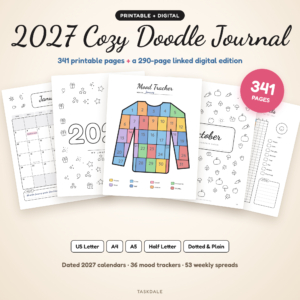
2027 Cozy Doodle Journal
Price: $21.99 | Best for: people who want dated weekly spreads
The 2027 Cozy Doodle Journal has 341 printable pages in clean line art, in US Letter, A4, A5 and Half Letter, each dotted and plain, plus a 290-page hyperlinked digital edition. It includes 53 dated 2027 weekly spreads, 48 dated monthly calendars in Sunday and Monday start, 44 Year in Pixels trackers and yearly collections such as My Bookshelf, Bucket List and Places to Go. Print January’s calendar and the first two weekly spreads to test the size.
Collections and lists
Collections are the bullet journal’s secret strength. A collection is any list you want to keep across the year: books to read, gift ideas, places to visit, recipes to try, films watched. They turn a planner into a small archive of your life.
Premade collection pages are handy for the common ones. A 52-book reading challenge. A 40-item bucket list. A birthday tracker. Print them once in January and add to them all year.
Draw your own for anything quirky. “Things my son said this year.” “Every café in town ranked.” “Garden experiments.” Those odd, personal collections are often the pages you love most at the end of the year.
Whatever you choose, add each collection to your index with a page number. That one line is how you find the gift list again in November.
Adding character with vintage and themed pages
Printed spreads can look a little uniform. Some people mix in a few decorative pages to give the journal more personality: a vintage dot grid sheet for a monthly brain dump, a pocket page for ticket stubs, a themed spread for a holiday or a season.
This is where bullet journaling and junk journaling meet. You keep the practical pages printed and tidy, and slip in textured sheets, tags and pockets for memories. A concert ticket goes in a pocket beside the week you went. A pressed leaf goes on the October brain dump. It turns a planner into something you will want to keep.
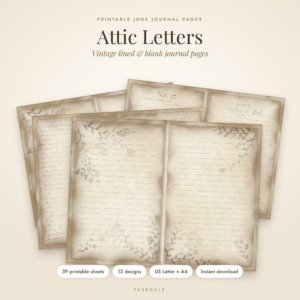
Attic Letters Printable Journal Pages
Price: $2.89 | Best for: journalers who like a vintage look
Attic Letters has 39 printable sheets in US Letter and A4, each folding into two pages, in warm parchment with faded rose, fern and postmark stamps kept near the edges. You get 12 designs in lined and blank versions, mixed spreads, 2 graph and 2 dot grid spreads for lists and trackers, a cover spread and five sheets of matching ephemera with cards, tags and pockets. Print a dot grid spread for this month’s brain dump first.
If folding and binding pages is new to you, this guide on how to print, age and bind printable journal kits walks through it step by step, and this junk journal for beginners guide covers the supplies.
Printing and binding at home
A few choices make printed pages feel like a real journal rather than a pile of printouts.
Size
A5 is the classic bullet journal size and fits most dotted notebooks if you want to glue pages in. Half Letter is close to A5 and suits US binders. US Letter and A4 give more room and suit a desk binder.
Dotted or plain
Dotted versions feel more like a traditional bullet journal and help you write in straight lines. Plain versions look cleaner and print a little lighter. Try one of each before printing a month.
Paper
Standard 80gsm paper is fine for pencils and ballpoints. For markers or gel pens, step up to around 100 to 120gsm so the color does not bleed through to the next page.
Binding
Three easy options: a ring binder with punched pages, a discbound system that lets you move pages around, or folded sheets stitched into small booklets for each month. Discs are the most flexible, because you can add a new collection page anywhere.
A 20-minute monthly setup
On the last weekend of each month, give yourself twenty minutes and a cup of tea.
- Review last month (5 minutes). Look at the habit and mood trackers. Note one thing that went well and one to change.
- Migrate tasks (5 minutes). Move unfinished tasks to the new month, or drop the ones that no longer matter. Be honest. A task moved four times is usually a task to delete.
- Print and place (5 minutes). Print the month opener, calendar, habit tracker and one mood tracker. Punch or slot them in.
- Fill and color (5 minutes). Add fixed dates to the calendar, write this month’s habits, and color the opener if you enjoy it.
That is it. No ruler, no smudged ink, no starting over because a line went wonky. And a quiet feeling of a fresh month ready to go.
Mistakes to avoid
Printing everything at once
A 300-page bundle is a menu, not a meal. Print one month at a time and only the pages you will use.
Forgetting the method
Pretty spreads with no daily log and no migration are just decorations. Keep the bullets, the symbols and the monthly review.
Too many trackers
Start with three. Add one a month if you want more.
Skipping the index
Once the journal has 60 pages, you will want to find things. Number your pages and keep the index current.
Frequently asked questions
Can you buy premade bullet journal pages?
Yes. Printable bundles include ready-made monthly calendars, weekly spreads, habit and mood trackers and collection pages. You download them, print the ones you want and bind them in a binder or notebook.
What size are printable bullet journal pages?
Most come in several sizes, commonly A5, Half Letter, A4 and US Letter. A5 matches the classic bullet journal notebook. Check the listing before you buy.
Should I print dotted or plain journal pages?
Dotted feels closer to a traditional bullet journal and helps with lettering. Plain looks cleaner. Many bundles include both, so print a test page of each.
What paper is best for printing journal pages?
Regular 80gsm printer paper is fine for pencils and pens. For markers or heavy coloring, use 100 to 120gsm paper to stop bleed-through.
Is using printed pages still bullet journaling?
Yes. The bullet journal is a method of rapid logging, migrating tasks and reviewing. Printed spreads simply save you the drawing time.
Can I glue printed pages into a dotted notebook?
Yes. Print at A5, trim the edges, and use a glue stick or double-sided tape along the margins. Thin 80gsm paper adds less bulk if you plan to glue in many pages.
Your next step
Pick three pages for next month: a calendar, a habit tracker and one mood tracker. Print them on slightly heavier paper, add your fixed dates and three habits, and keep a dot grid sheet beside them for your daily log. For a full set of trackers and calendars to choose from, start with the Joyful Days 2027 Journal Bundle.