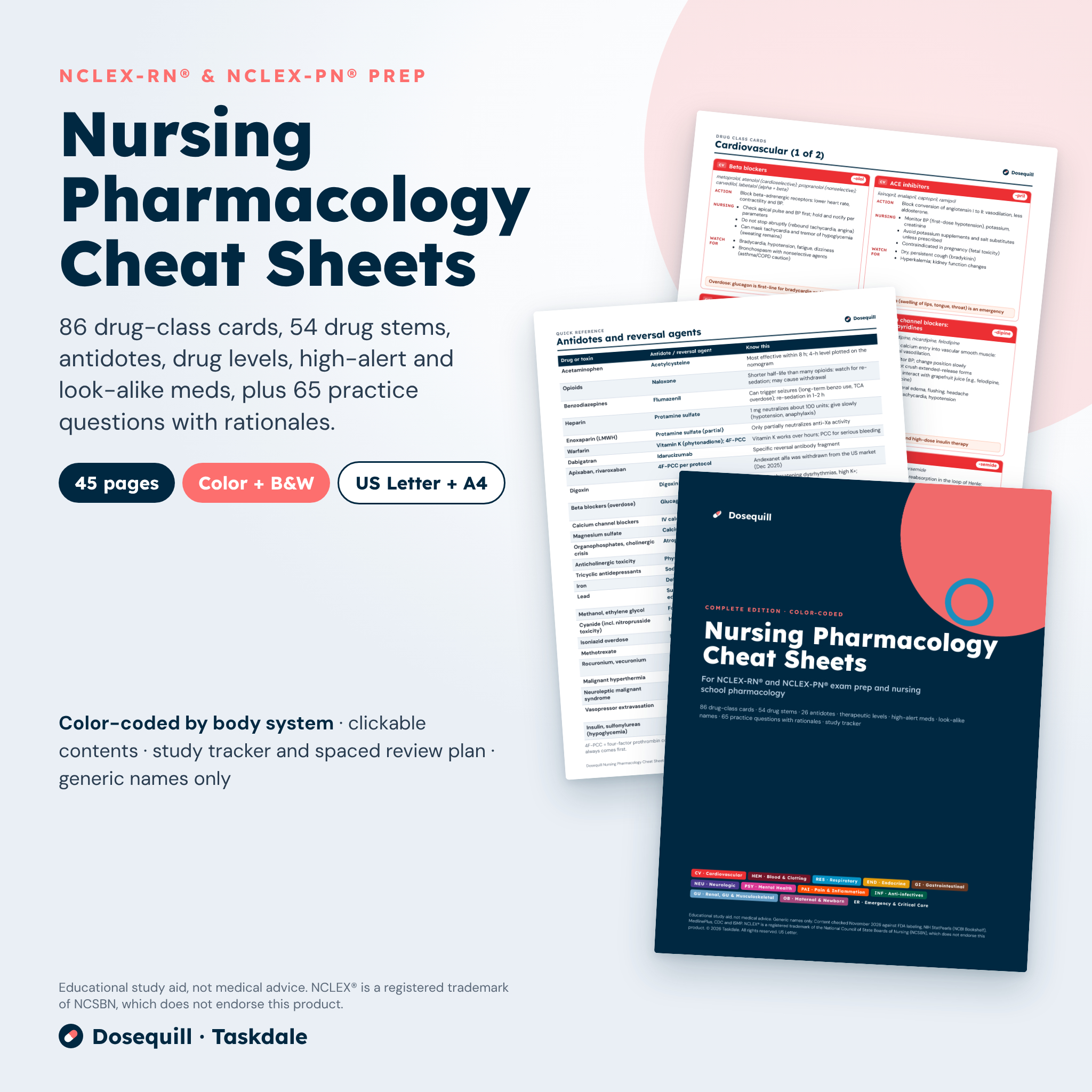
Pharmacology is the subject most nursing students say they dread, mostly because it looks like hundreds of unrelated drugs. These nursing pharmacology cheat sheets turn it into patterns you can learn: drug stems that tell you the class, one card per class, and the safety rules that exam questions test again and again. Use them for nursing school pharmacology, med-surg exams and NCLEX-RN® or NCLEX-PN® prep.
What the Nursing Pharmacology Cheat Sheets Include
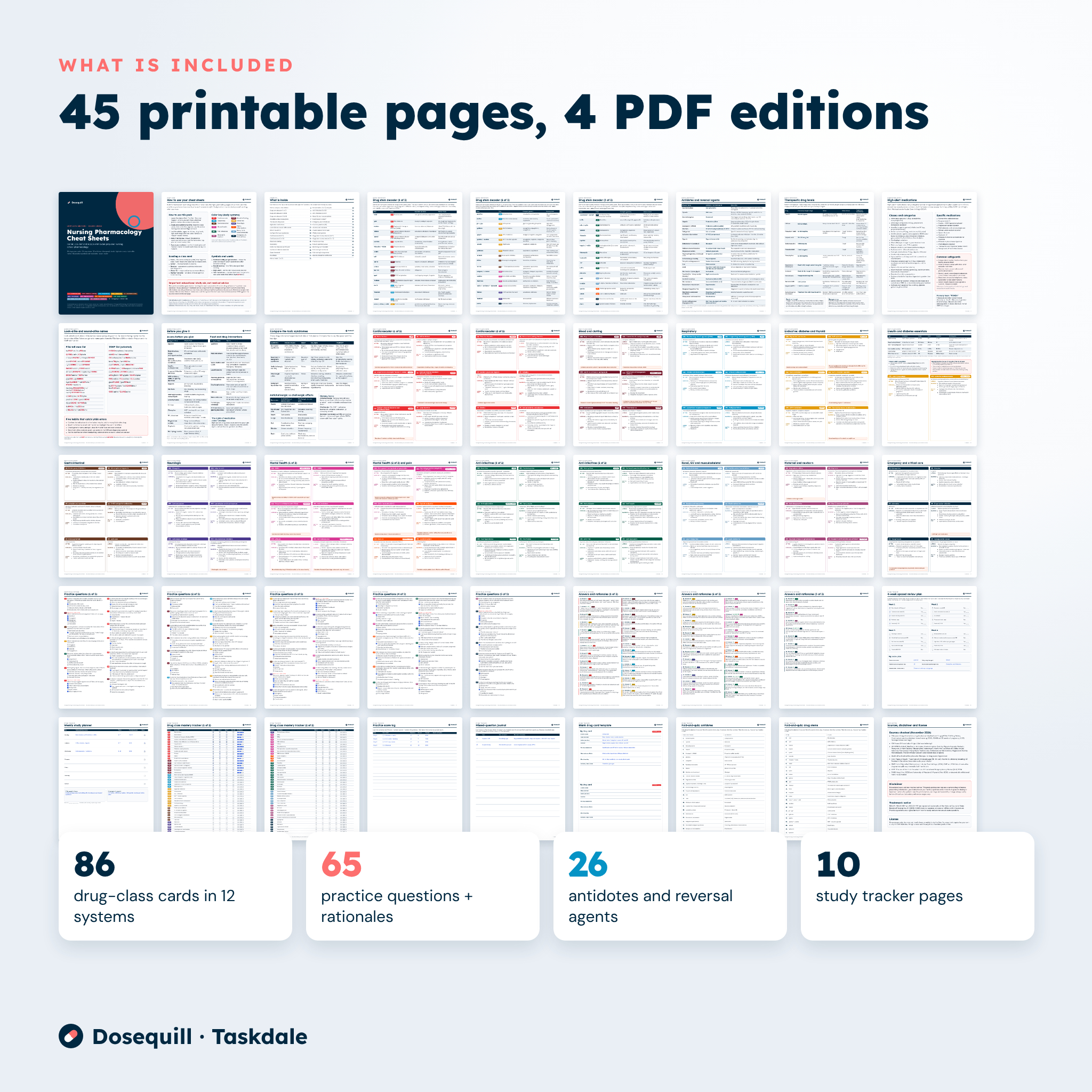
You get a 45-page printable study pack in four PDF editions: full color and ink-saving black-and-white, each in US Letter and A4. Every page was written for fast review and checked in November 2026 against FDA labeling, NIH StatPearls (NCBI Bookshelf), MedlinePlus, CDC and ISMP. Generic names are used throughout.
Quick-reference pages
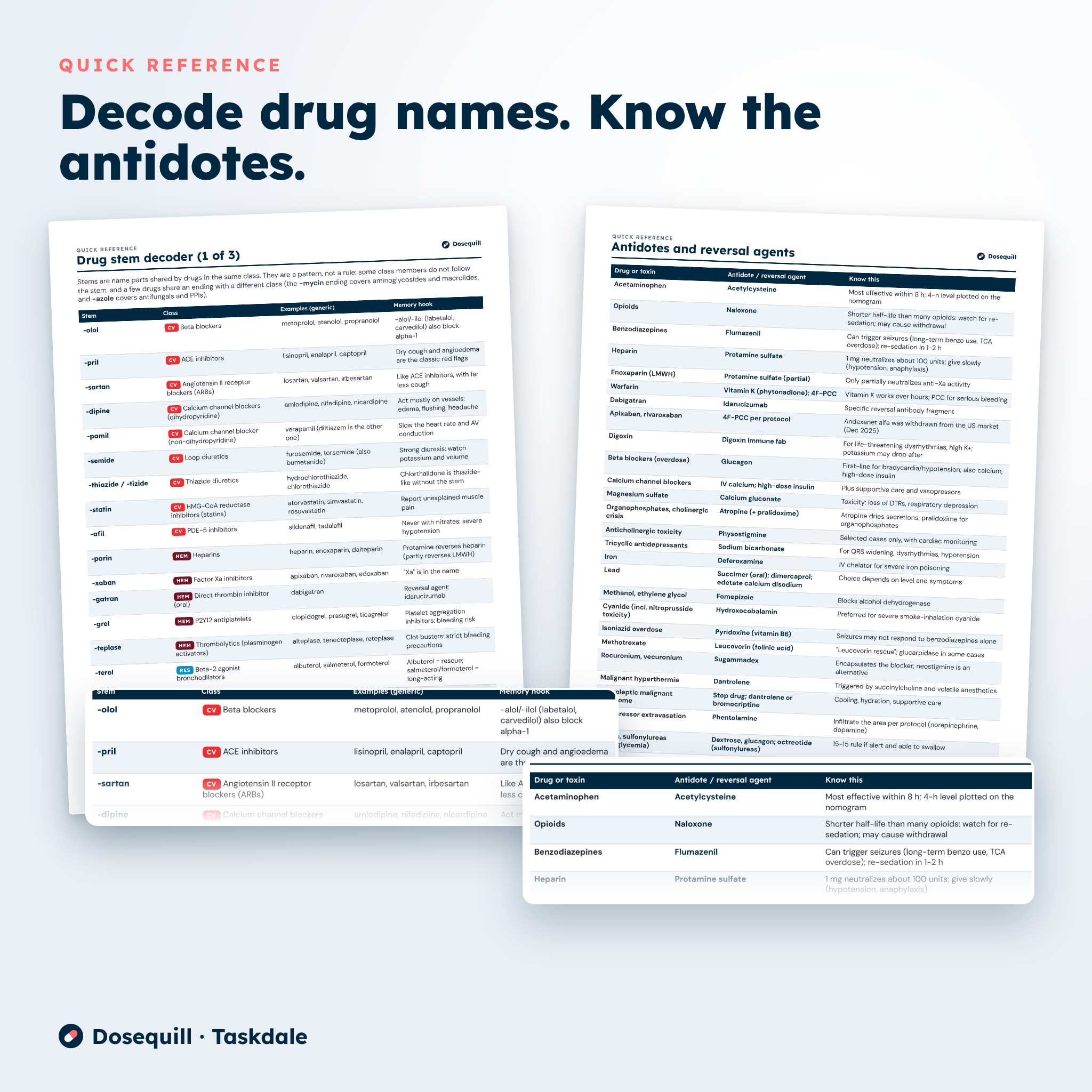
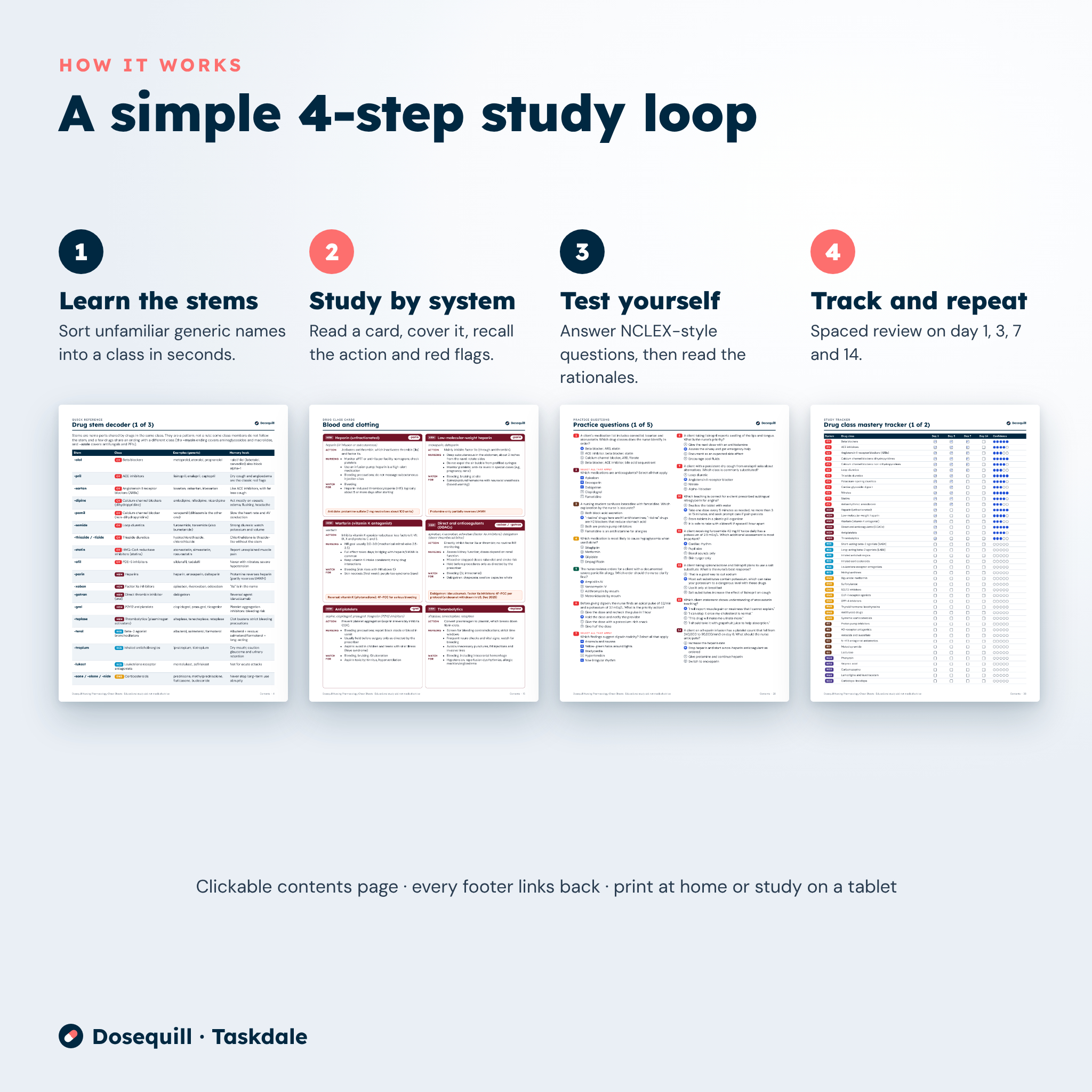
- Drug stem decoder (3 pages): 54 stems and prefixes such as -olol, -pril, -sartan, -xaban, -gliflozin and cef-, with the class, generic examples and a memory hook. Common exceptions are flagged.
- Antidotes and reversal agents: 26 pairs, from acetylcysteine and naloxone to idarucizumab, sugammadex and dantrolene, with the one fact to remember about each. Updated for the December 2025 US withdrawal of andexanet alfa.
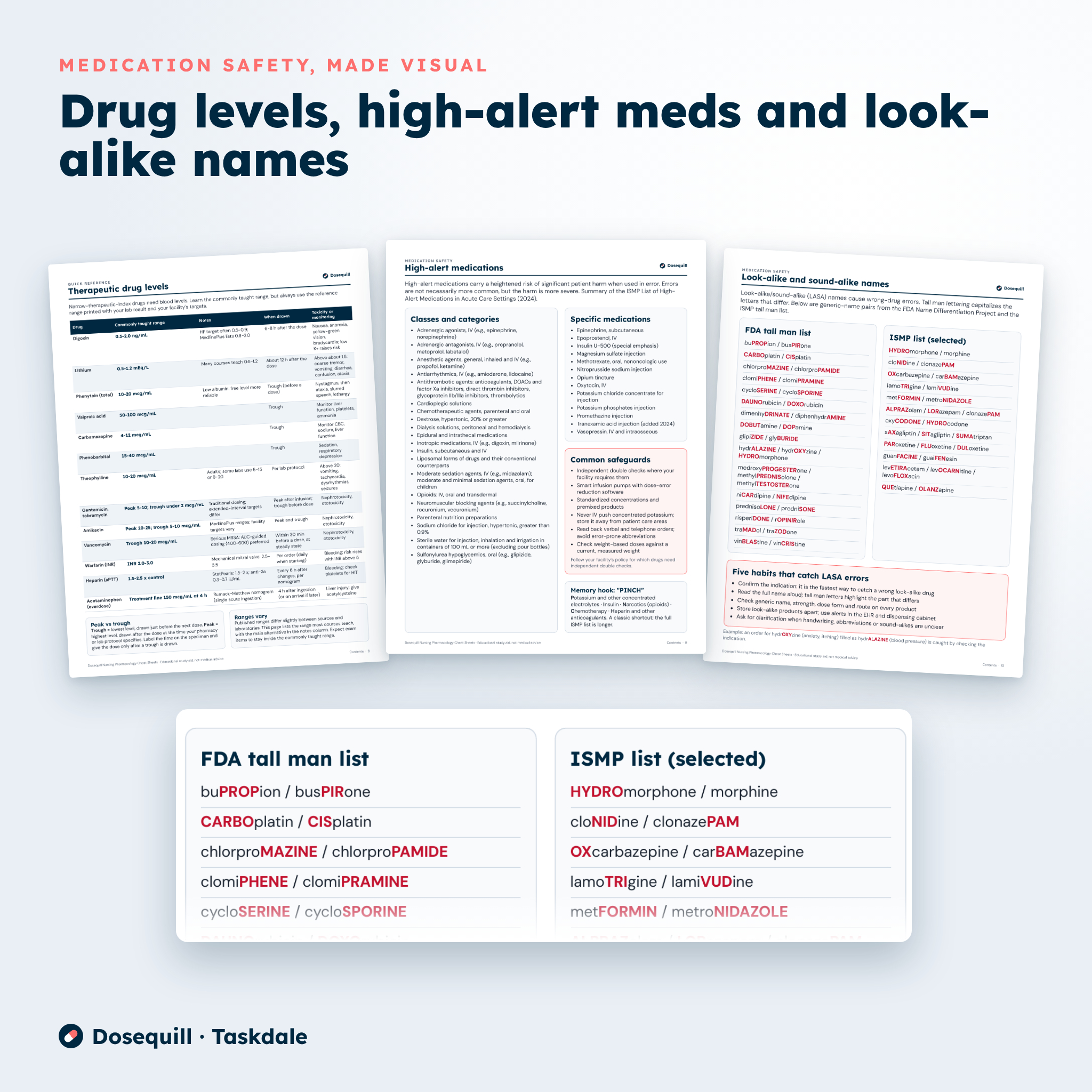
- Therapeutic drug levels: digoxin, lithium, phenytoin, valproic acid, carbamazepine, phenobarbital, theophylline, aminoglycosides, vancomycin, INR and aPTT, with when the level is drawn and the toxicity signs.
- High-alert medications: a summary of the ISMP 2024 acute care list, common safeguards and a memory hook.
- Look-alike and sound-alike names: generic pairs from the FDA and ISMP tall man lists, such as hydrOXYzine and hydrALAZINE.
- Before you give it: what to check before common drugs, plus food and drug interactions such as tyramine, vitamin K and grapefruit juice.
- Toxic syndromes compared: serotonin syndrome, neuroleptic malignant syndrome, anticholinergic toxicity, cholinergic crisis and malignant hyperthermia, plus an anticholinergic vs cholinergic table.
86 drug-class cards in 12 color-coded systems
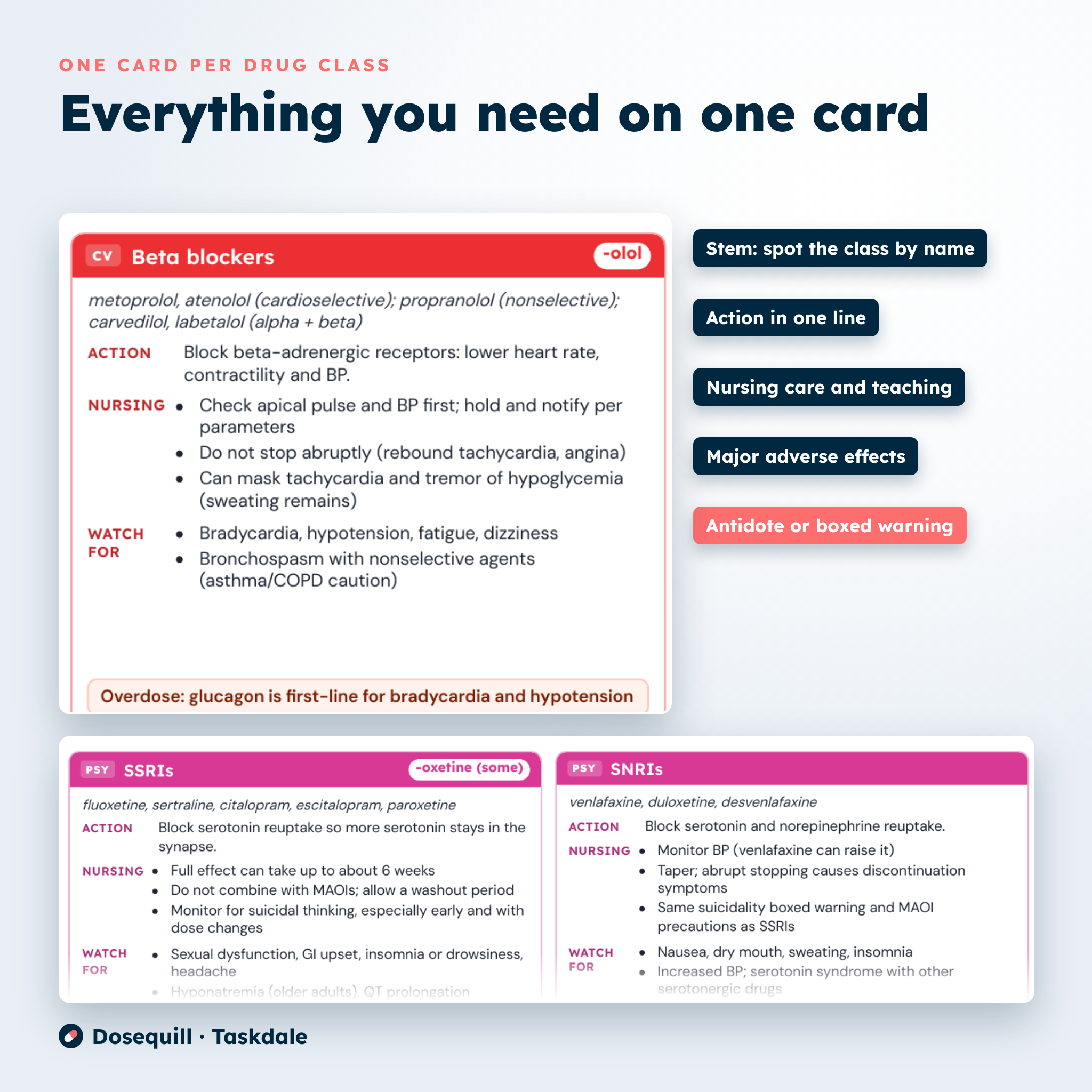
Cardiovascular, blood and clotting, respiratory, endocrine, gastrointestinal, neurologic, mental health, pain, anti-infectives, renal/GU/musculoskeletal, maternal and newborn, and emergency care. Each card shows the stem, examples, the mechanism in one line, nursing considerations, major adverse effects and a highlighted strip for the antidote, reversal agent or boxed warning. An insulin page adds onset, peak and duration for every insulin type and the 15-15 hypoglycemia rule.
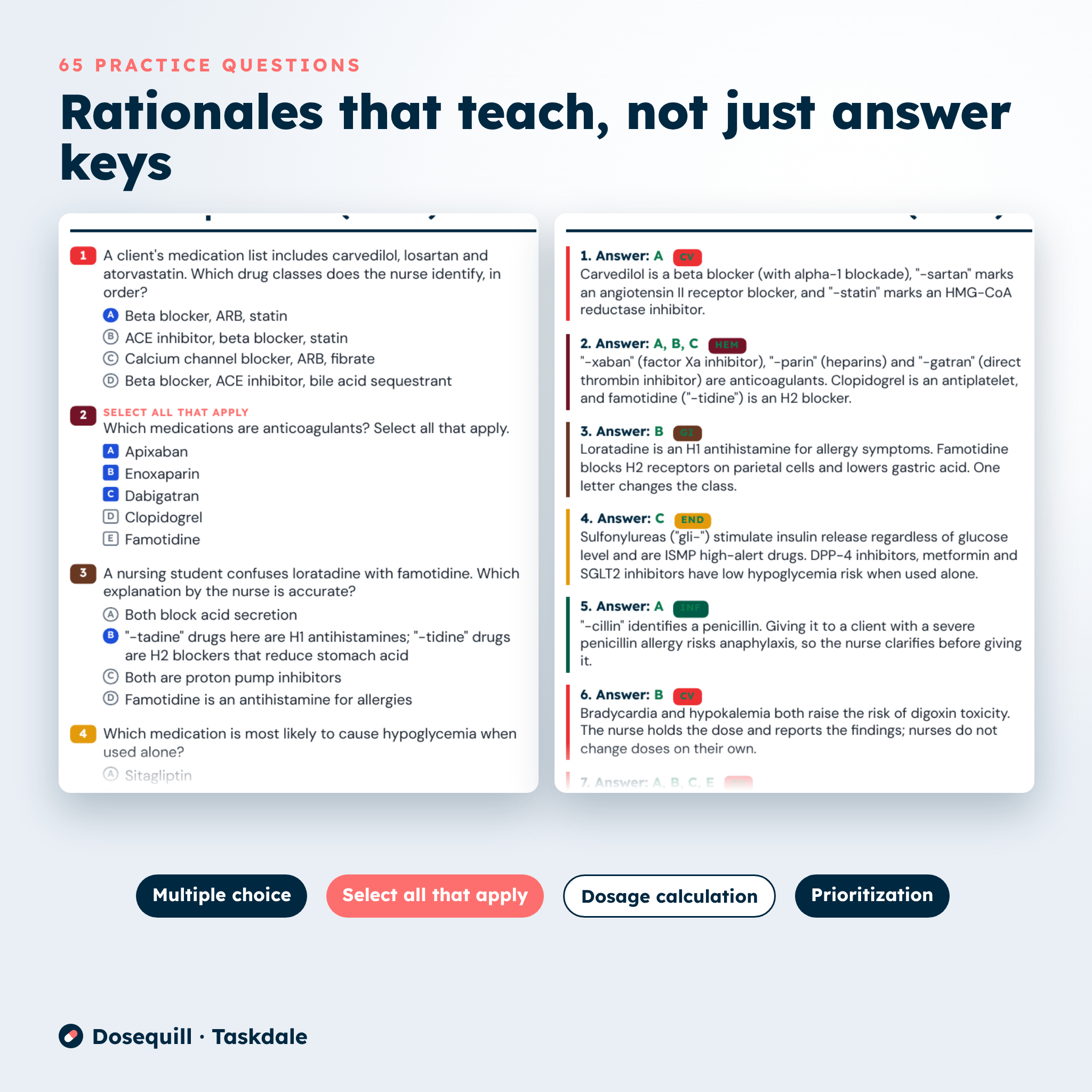
65 NCLEX-style practice questions with rationales
Original multiple-choice and select-all-that-apply items cover every system, including prioritization, safety and a dosage calculation. Each answer comes with a rationale that explains why the right answer is right and why the others are not.
Study tracker
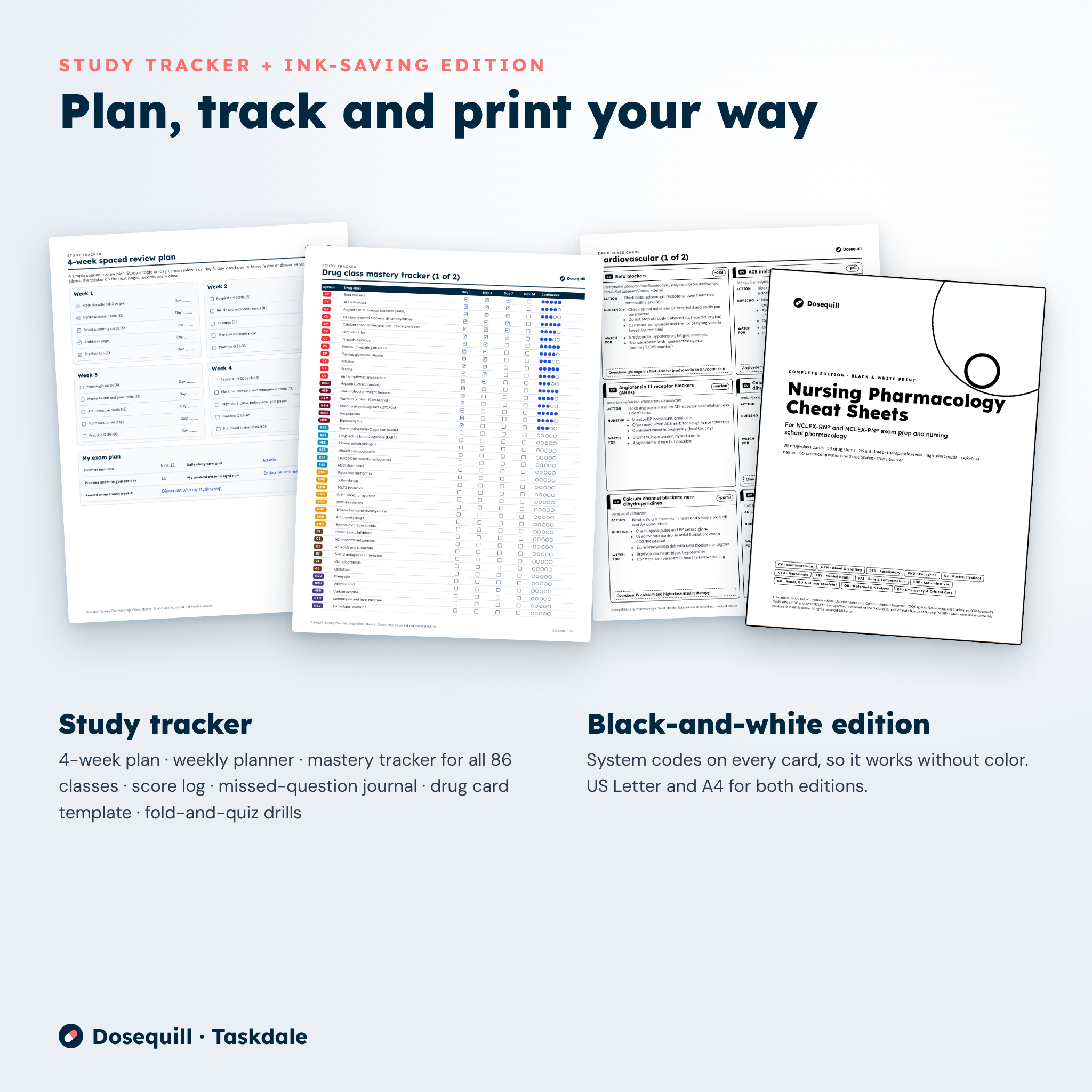
A 4-week spaced review plan, an undated weekly planner, a mastery tracker for all 86 classes, a practice score log, a missed-question journal, a blank drug card template and two fold-and-quiz drills for antidotes and stems.
Who These Pharmacology Study Sheets Are For
- RN and PN students taking pharmacology, fundamentals or med-surg
- Graduates preparing for the NCLEX-RN® or NCLEX-PN® exam
- Students returning to school or retaking a pharmacology course
- Tutors and study groups who want a structured personal review sheet (each person needs their own copy)
Why This Pharmacology Cheat Sheet Is Different
- Patterns first. Stems and class cards let you reason through drugs you have never seen.
- Safety up front. Antidotes, levels, high-alert drugs and look-alike names sit at the front, where they belong.
- Rationales that teach. Every practice question explains the reasoning.
- Current and sourced. A sources page lists the references checked, and ranges note where sources differ.
- Prints well. Color-coded for study, with system codes on every card so the black-and-white edition still works.
How It Works
- Download the PDFs and print the edition and paper size you prefer, or study on a tablet or laptop.
- Learn the stems, then work through one body system at a time using the class cards.
- Answer the practice questions, read the rationales and log your score.
- Follow the 4-week plan to review each class on day 1, 3, 7 and 14, and drill the fold-and-quiz pages.
Use Cases
- Reviewing the night before a pharmacology unit exam
- Building a daily NCLEX study routine with a printed tracker
- Keeping antidotes and drug levels on one sheet for quick self-quizzing
- Running a study group session where everyone works the same question set
File Formats and Requirements
- 4 PDF files (color US Letter, color A4, black-and-white US Letter, black-and-white A4), 45 pages each
- User guide in Word format (.docx)
- Opens in any PDF reader, including free Adobe Acrobat Reader; clickable contents page and footer links
- Prints on any home printer at actual size
Customization
Print only the sections you need, mix color and black-and-white pages, write on the tracker pages, or annotate the PDF in a tablet note app. The blank drug card template lets you add drugs your course emphasizes. The fact pages are finished study sheets rather than editable templates, so the content stays accurate.
Digital Download
This is an instant digital download. No physical item ships. You can download the files right after purchase and print as many copies as you need for your own study.
FAQ
Is this an official NCLEX product?
No. It is an independent study aid. NCLEX®, NCLEX-RN® and NCLEX-PN® are registered trademarks of the National Council of State Boards of Nursing (NCSBN), which does not endorse this product.
Are brand names included?
No. The cheat sheets use generic names only, which is how most courses and exam items refer to drugs.
How many drugs does it cover?
86 drug classes with several generic examples each, 54 drug stems, 26 antidotes and 13 drug level entries.
Can I use it for the NCLEX-PN?
Yes. The content is core pharmacology shared by RN and PN programs.
Can I print it in black and white?
Yes. A separate black-and-white edition shows system codes on every card, so nothing depends on color.
Is it a clinical drug reference?
No. It is an educational study aid, not medical advice. Always follow current references, your instructor and facility policy.
Can I share it with classmates?
The license is for personal use only. Please ask classmates to buy their own copy.
Educational study aid, not medical advice; always follow current references and facility policy. NCLEX® is a registered trademark of NCSBN, which does not endorse this product. Personal use only; you may not resell, share, or redistribute the files.
Reviews
There are no reviews yet.