Money is one of the top things couples argue about, and splitting bills is where it usually starts. Should you go 50/50? Split by income? Throw everything into one pot? This guide walks through how to split bills as a couple in a way that feels fair to both of you, with real numbers. You can also grab our free fair-share bill split calculator below and try every method on your own pay.
Fair-Share Bill Split Calculator for Couples (Free Sample)
Free Excel and Google Sheets calculator that splits shared bills between two partners by income, 50/50, equal leftover or a custom percentage, with per-paycheck amounts and a comparison chart.
Want everything unlocked?
The free file is a sample. The full version has every page, tab and feature, plus the user guide.
See the full versionThe 4 ways couples split bills
There is no single right answer. There is only the answer that fits your incomes and how you think about money. Here are the four methods most couples end up choosing between.
1. Split 50/50
Each of you pays half of every shared bill. It is simple and easy to explain. It works well when your take-home pay is close.
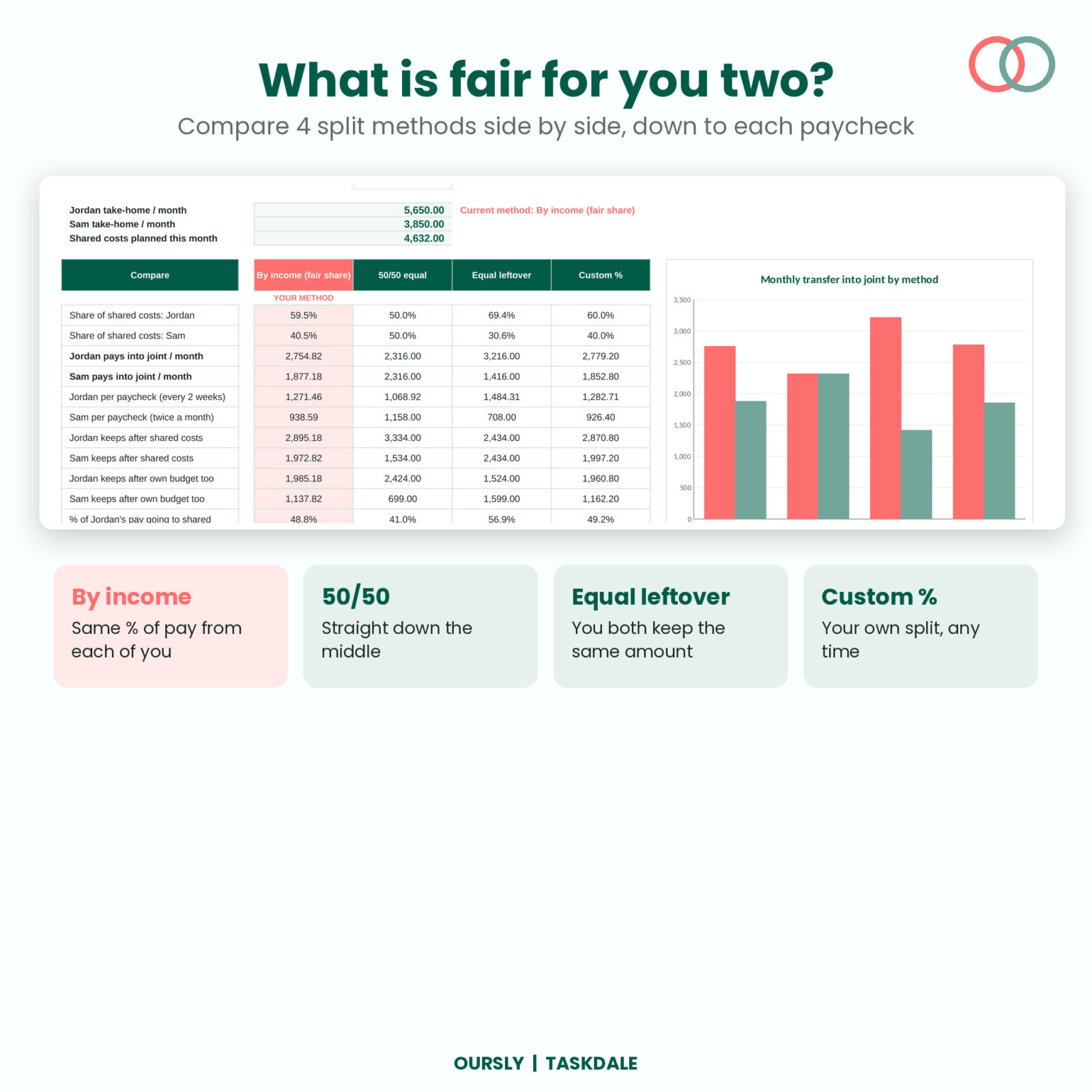
The catch shows up when incomes are far apart. Say rent, food and utilities come to $3,293 a month. If one partner takes home $5,650 and the other takes home $3,850, a 50/50 split costs the first partner 29% of their pay and the second partner 43%. Same bills, very different pressure.
2. Split by income (the fair-share method)
Each of you pays the same percentage of your income. Using the numbers above, the household earns $9,500. The first partner brings in 59.5% of that, so they cover 59.5% of the shared bills: about $1,958. The second partner covers the other 40.5%: about $1,335. Both of you put roughly 35% of your pay toward the life you share.
This is the method most money coaches suggest when incomes differ. Nobody gets punished for earning more, and nobody gets left behind for earning less.
3. Equal leftover
Contributions are set so you both keep the same amount after shared bills. With our example, the higher earner pays about $2,547 and the other pays about $747, and each of you keeps $3,104. Couples who see all income as “ours” often like this one. If the income gap is bigger than the bills, the higher earner may end up covering everything.
4. Custom percentage
You pick the split yourselves, for example 70/30 while one of you is in school or on parental leave. It is flexible, and you can change it as life changes.
How to split bills with your partner, step by step
- List your shared bills. Rent or mortgage, utilities, internet, groceries, insurance, shared subscriptions and anything else you both use. Convert yearly and quarterly bills to a monthly figure (a $1,260 yearly insurance bill is $105 a month).
- Use take-home pay, not salary. What lands in your accounts after tax is what you actually have to spend.
- Compare the methods side by side. Look at what each of you pays, what each of you keeps, and how big the gap is. The free calculator above does this in one table and a chart.
- Turn it into a per-paycheck transfer. If one of you is paid every 2 weeks and the other twice a month, divide accordingly. Then set up automatic transfers to a joint account so nobody has to remember.
- Agree when to review it. Once a year, or whenever one of you gets a raise, changes jobs or has a baby.
Yours, mine and ours: the setup that makes it work
Most couples who split by income use three accounts. Each of you keeps your own account for personal spending. A joint account handles the shared bills. Payday comes, each of you moves your share into joint, and the bills come out of there.
It sounds tidy. Then real life happens:
- One of you buys groceries on a personal card because the joint card was at home.
- Somebody uses the joint card for a haircut by mistake.
- You pay for your partner’s concert ticket and they say they will pay you back.
- One of you gets a raise in July and the split should change from that month on.
After a few months of this, nobody is quite sure who is ahead. That is where most bill-split arguments come from: not the split itself, but the fuzzy math afterward.
Tips to keep it fair (and keep the peace)
- Decide what counts as shared. Write it down. Is takeout shared? A gym membership? Gifts for each other’s families?
- Give each person some no-questions money. A personal budget you never have to justify takes a lot of tension out of the joint account.
- Keep a small cushion in joint. A few hundred dollars stops a surprise bill from turning into a fight.
- Track who fronted what. If you pay a shared bill personally, it should count toward your share.
- Have a monthly money date. Fifteen minutes, a drink, and the numbers. Settle up, then talk about goals.
Free calculator vs the full Oursly Couples Budget
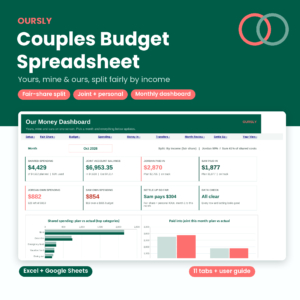
The free calculator answers the first question: how much should each of you pay? The Oursly Couples Budget Spreadsheet runs the whole system for you, month after month.
| Feature | Free calculator | Full Oursly |
|---|---|---|
| Compare 4 split methods | Yes | Yes |
| Per-paycheck transfer amounts | Yes | Yes |
| Shared bills | 12 | 40 categories + personal budgets |
| Joint and personal account balances | – | Yes |
| Fronted bills and personal IOUs | – | Yes |
| Settle Up: one payment squares the month | – | Yes |
| Monthly dashboard with charts | – | Yes |
| Pay raises mid-year | – | Yes |
| Month Review, Year View and savings goals | – | Yes |
What the full workbook adds
Oursly is built around the yours, mine and ours system. Every purchase gets two quick answers: which account paid, and whose cost it was. From those, the workbook keeps the joint balance, each partner’s own balance and personal budgets up to date.
Paid a shared bill on your own card? It counts toward your share. Used the joint card for something personal? It comes off what you put in. Bought something just for your partner? It becomes an IOU. At your money date, the Settle Up tab nets it all into one line, like “Sam pays Jordan $303.99”, and you are square.
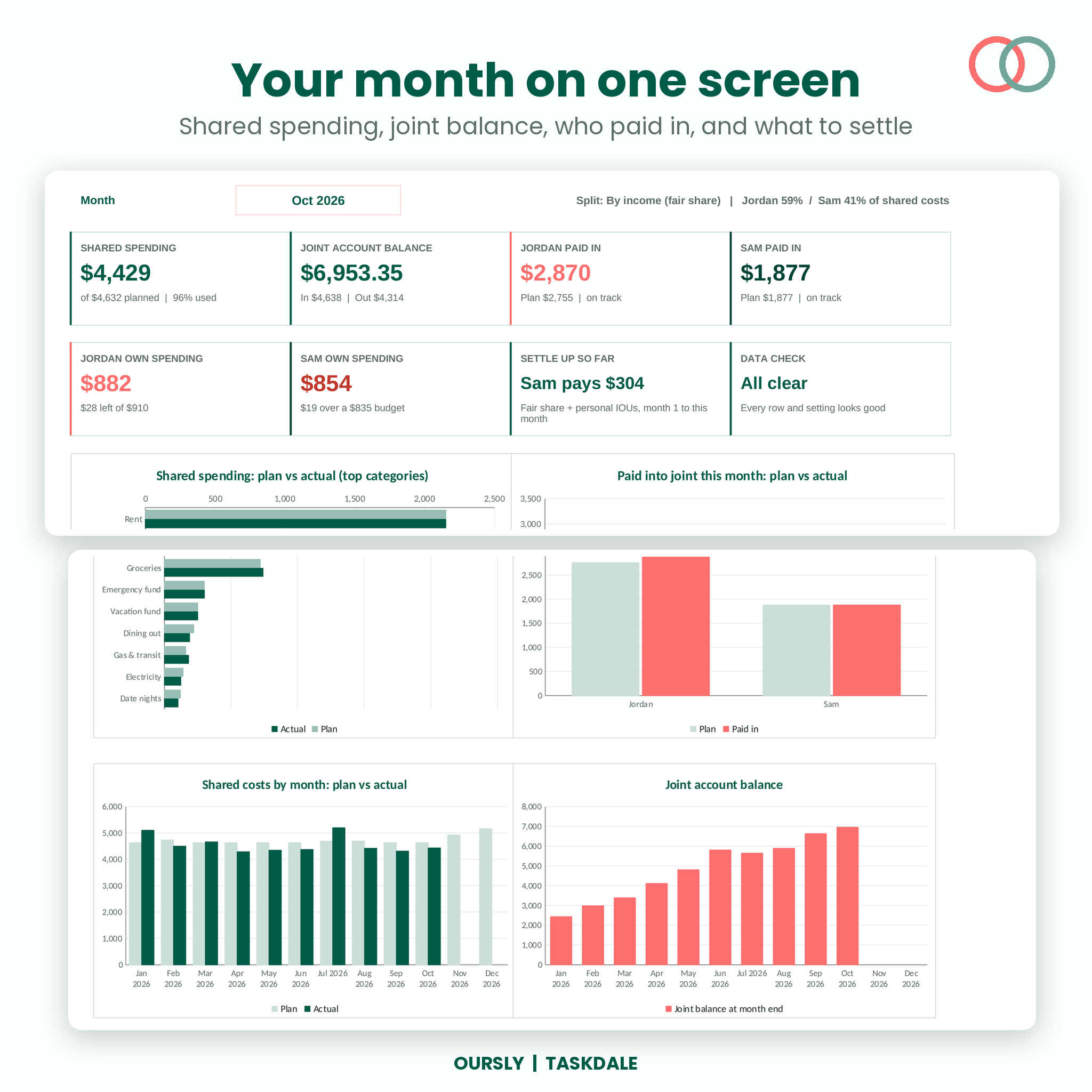
Pick any month on the dashboard to see shared spending against your plan, the joint balance, what each of you paid in, personal spending and four charts. It works in Excel, and in Google Sheets when you upload it to Google Drive. A step-by-step user guide is included.
Frequently asked questions
Is it fair to split bills 50/50 if one partner earns more?
It can be if your incomes are close. When the gap is big, a 50/50 split takes a much larger bite out of the lower earner’s pay. Many couples switch to an income-based split for that reason.
Should we split bills before or after tax?
After tax. Take-home pay is the money you actually have, so it gives the most honest split.
Do we need a joint bank account?
No, but it makes life easier. Without one, track who paid each shared bill and settle up monthly.
How often should we settle up?
Monthly works for most couples. It keeps the amounts small and the conversation short.
Ready to try it on your own numbers?
Download the free fair-share bill split calculator, then upgrade when you want the full system.