Retirement changes the shape of your money. The paycheck stops, and in its place come a few fixed deposits: a Social Security check, maybe a pension, maybe a withdrawal from an IRA or 401(k). The amount barely moves from month to month. What moves is everything else: a new prescription, a premium that went up in January, a property tax bill that only shows up twice a year.
A retirement budget worksheet puts all of that on one page so you can see, in plain numbers, whether the money coming in covers the money going out. Below you can download a free large print retirement budget worksheet, then follow a step-by-step guide to filling it in, even if you have never kept a budget before.
Free Large Print Retirement Budget Worksheet (Fillable PDF)
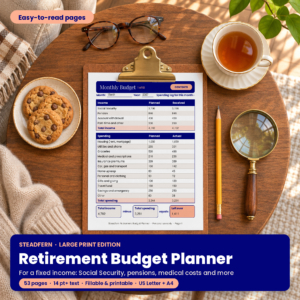
5 large print pages from the Steadfern planner: Income Sources, a Monthly Budget, a Spending Log and a Prescription List. Fill in on screen or print on US Letter.
Want everything unlocked?
The free file is a sample. The full version has every page, tab and feature, plus the user guide.
See the full versionThe free download is a fillable PDF in large print. You can type into it on a computer or tablet using the free Adobe Acrobat Reader, or print it on US Letter paper and fill it in with a pen. Body text is 14 pt or larger, rows are tall, and the colors are dark navy on white, so it is comfortable to read.
What is in the free retirement budget worksheet
The free sample has five working pages taken straight from the full Steadfern planner:
- Income Sources. One row for each check: two Social Security lines, two pension lines, account withdrawals, an annuity, part-time work, rental income and spare rows. You write whose income it is, the monthly amount, the day it arrives and the account it lands in.
- Monthly Budget. Planned and received income at the top, then 12 spending categories with planned and actual columns. A strip at the bottom closes the month: total income, minus total spending, equals left over.
- Spending Log. 17 lines for the date, what it was for, the category and the amount.
- Prescription List. Every medicine you take, with the dose, doctor, pharmacy and what it costs you each month.
- A welcome page with quick instructions for typing on screen or printing.
That is enough to run one full month and see how it feels. If you like it, the full planner has all 12 months and the pages most retirees end up needing: medical costs, insurance premiums, yearly bills and savings for travel and gifts.
Why budgeting in retirement is different
Budget advice is usually written for people with a paycheck. Retirement turns several of its rules upside down.
Income is fixed, but not always simple
Social Security usually arrives once a month on a set day. A pension may arrive on a different day. Withdrawals from retirement accounts might be monthly, quarterly or once a year. Part-time income can vary. Writing each source on its own line, with the day it arrives, stops the common mistake of counting money before it lands.
It also helps to write the amount that actually reaches your bank account. If your Medicare Part B premium is taken out of your Social Security check, the deposit is smaller than the benefit amount on your statement. Budget with the deposit.
Health costs move more than anything else
For many retirees, health care is the line that changes most: prescription copays, dental work that Medicare does not cover, hearing aids, a new pair of glasses. These costs rarely arrive in neat monthly amounts, which is why they deserve their own pages rather than a single “medical” guess.
Yearly bills feel like emergencies
Property tax, homeowners insurance, car registration, an annual membership and holiday gifts can easily add up to several thousand dollars a year. None of them shows up in a normal month, so they get forgotten until the bill arrives. Spreading them across the year turns a shock into a routine.
There is no next paycheck to fix a bad month
When you are working, an overspent month gets absorbed by the next paycheck. On a fixed income, an overspent month usually comes out of savings. A simple monthly check-in is the best defense, and it only takes about 15 minutes.
How to fill in a retirement budget worksheet, step by step
Step 1: List every income source
Open the Income Sources page and work through your statements. Write each check on its own row: your Social Security, your spouse’s Social Security, each pension, any regular account withdrawal, part-time pay and anything else that arrives regularly. Use the amount that reaches your bank account. Add up the monthly total at the bottom. Multiply it by 12 and you have your yearly income, which is a useful number to keep in mind.
Step 2: Write down the bills you already know
Housing, utilities, phone, internet, insurance premiums and subscriptions are the easy part because they are mostly the same every month. Pull last month’s statements and write the real amounts into the Planned column of the Monthly Budget.
Step 3: Give health costs their own line
Fill in the Prescription List first. Adding up the monthly cost of each medicine gives you a solid starting number for the “Medical and prescriptions” line. Add a little for copays and dental visits based on last year. If you are not sure, look back through three months of bank statements and pharmacy receipts.
Step 4: Turn insurance premiums into monthly amounts
Some premiums are monthly, others are quarterly, twice a year or yearly. To compare them fairly, convert each one to a monthly cost:
- Yearly premium: divide by 12
- Twice a year: divide by 6
- Quarterly: divide by 3
Add the monthly amounts together for the “Insurance premiums” line, even if some of those bills are not due this month. Setting the money aside every month is what keeps the big ones from hurting.
Step 5: Plan for once-a-year costs
List every yearly or occasional cost you can remember: property tax, car registration, insurance renewals, memberships, birthdays, holidays, home repairs. Add them up and divide by 12. That is how much to set aside each month. In the full planner, the Annual Expenses Calendar does this with a page for every month and a “divided by 12” box at the end.
Step 6: Estimate everyday spending
Groceries, gas, personal care, clothing and household items are the categories people most often underestimate. Use the Spending Log for one month without changing your habits. The real number is far more useful than a hopeful guess.
Step 7: Plan the good stuff too
A retirement budget is not only about cutting back. The “Travel fund” and “Gifts and giving” lines are there on purpose. When a trip or a grandchild’s birthday has its own line, you can enjoy it without worrying about where the money came from.
Step 8: Close the month
At the end of the month, add up each category from your Spending Log and copy the totals to the Actual column. Fill in the strip at the bottom: total income, minus total spending, equals left over. A positive number can go to savings or next month’s travel fund. A negative number tells you exactly which line to look at.
Example: a retirement budget for one month
Here is how one couple’s month might look on the worksheet. The amounts are an example in dollars, not a recommendation.
| Line | Planned | Actual |
|---|---|---|
| Social Security (both) | 3,196 | 3,196 |
| Pension | 846 | 846 |
| Account withdrawal | 400 | 400 |
| Part-time and other | 300 | 260 |
| Total income | 4,742 | 4,702 |
| Housing | 1,050 | 1,050 |
| Utilities and phone | 285 | 301 |
| Groceries | 520 | 498 |
| Medical and prescriptions | 210 | 236 |
| Insurance premiums | 389 | 389 |
| Car, gas and transport | 160 | 142 |
| Home upkeep | 80 | 45 |
| Personal and clothing | 90 | 72 |
| Gifts and giving | 100 | 120 |
| Travel fund | 150 | 150 |
| Savings and emergency | 250 | 250 |
| Other | 60 | 38 |
| Total spending | 3,344 | 3,291 |
| Left over | 1,398 | 1,411 |
Two things stand out. Medical costs came in above plan, which is common, and utilities crept up. Neither is a crisis, but both are worth watching next month. Because the couple planned a travel fund and savings line, the left over money is a bonus rather than the only cushion they have.
EDITOR’S PICK · THE FULL PLANNER
Steadfern Large Print Retirement Budget Planner
The free worksheet covers one month. Steadfern covers the whole retirement money year, in the same easy-to-read 14 pt print.
- 12 undated monthly budgets, each with its own spending log
- Income Sources, a Monthly Deposit Checklist and an Account Withdrawal Log
- Prescription list, refill log, medical cost log and yearly medical totals
- Insurance premiums turned into monthly costs, with a payment checklist
- Annual expenses calendar with a monthly set-aside box
- Travel fund, trip planner, gifting fund, gift list and donations log
- Yearly summary and year in review
- 53 pages in US Letter and A4, fillable on screen or printable, plus a user guide
Free worksheet vs the full Steadfern planner
| Feature | Free worksheet | Steadfern full planner |
|---|---|---|
| Large print, 14 pt and up | ✓ | ✓ |
| Fillable and printable PDF | ✓ | ✓ |
| Income Sources page | ✓ | ✓ |
| Monthly Budget and Spending Log | 1 month | 12 undated months |
| Prescription List | ✓ | ✓ |
| Important contacts | ✗ | ✓ |
| Monthly deposit checklist and withdrawal log | ✗ | ✓ |
| Bills list and bill payment checklist | ✗ | ✓ |
| Prescription refill log and medical cost log | ✗ | ✓ |
| Yearly medical costs with deductible tracking | ✗ | ✓ |
| Insurance premiums and payment checklist | ✗ | ✓ |
| Annual expenses calendar | ✗ | ✓ |
| Travel fund and trip planner | ✗ | ✓ |
| Gifting fund, gift list and donations log | ✗ | ✓ |
| Yearly summary and year in review | ✗ | ✓ |
| Paper sizes | US Letter | US Letter and A4 |
| User guide | ✗ | ✓ |
Retirement budget categories that work
These are the 12 spending lines in the worksheet and the full planner, with what usually goes in each:
| Category | What goes in it | Quick tip |
|---|---|---|
| Housing | Rent or mortgage, HOA fees, property tax set-aside | Include the monthly share of property tax so it never surprises you. |
| Utilities and phone | Electric, gas, water, trash, phone, internet, TV | Check these against last winter and summer, not just last month. |
| Groceries | Food and household basics | Log one month honestly before you set a target. |
| Medical and prescriptions | Copays, prescriptions, dental, vision, hearing | Start from your Prescription List total. |
| Insurance premiums | Part B (if paid separately), drug plan, supplement, home, auto, life | Use monthly amounts for every policy. |
| Car, gas and transport | Gas, maintenance, rides, transit | Tires and repairs belong in the annual calendar. |
| Home upkeep | Repairs, yard, cleaning supplies | Set a small amount aside even in quiet months. |
| Personal and clothing | Haircuts, toiletries, clothes | Easy to underestimate. Track it for a month. |
| Gifts and giving | Birthdays, holidays, church and charity | Pair it with a gift list so nobody is forgotten. |
| Travel fund | Saving for trips and visits | A small monthly amount adds up faster than you expect. |
| Savings and emergency | Cushion for the unexpected | Even a modest amount each month helps. |
| Other | Anything that does not fit above | If “Other” grows, give it a proper name. |
Why large print matters for a budget
A budget only works if you use it, and you only use it if it is easy on the eyes. Many printable planners use 9 or 10 pt type and rows less than a quarter inch tall. That is hard to read and harder to write in, especially with arthritis or after an eye appointment.
The Steadfern worksheet uses 14 pt and larger text, rows tall enough for normal handwriting, and dark navy on white for strong contrast. Alternating sand-colored rows help your eye follow a line from the label to the amount. When you type on screen, your entries also appear at 14 pt.
Practical ways to make a fixed income stretch
The worksheet shows you where the money goes. These ideas help many retirees free up room once they can see it:
- Review subscriptions twice a year. Streaming services, magazines and apps renew quietly. Cancel what you no longer use.
- Compare prescription prices. The same medicine can cost very different amounts at different pharmacies or through mail order. Your Prescription List makes this easy to check.
- Ask about senior and loyalty discounts on utilities, phone plans, transit and everyday shopping.
- Review your drug plan during open enrollment. Your medicines may change from year to year, and so do plans.
- Set aside yearly costs monthly so a big bill never forces a withdrawal you did not plan.
- Keep one planning day each month, such as the day your Social Security arrives.
More Taskdale tools for retirement and household money
| Taskdale product | Best for |
|---|---|
| Copaynest Medical Expense Tracker Spreadsheet | Tracking claims, deductibles and HSA or FSA receipts in Excel or Google Sheets |
| Kettlefund Sinking Funds Tracker | Saving ahead for yearly bills, car repairs and holidays |
| Leftnote If Something Happens to Me Binder | Writing down bills, accounts and documents so family can find them |
| NestEgg Runway Retirement Planner Spreadsheet | Bigger-picture retirement numbers in Excel |
| Encore Years Retirement Life Planner | Planning the life side of retirement: goals, routines and checklists |
| Wordnook Large Print Word Search | A relaxing large print break once the budget is done |
Frequently asked questions
What should a retirement budget include?
Every source of income (Social Security, pensions, account withdrawals, part-time work), regular bills, health and prescription costs, insurance premiums, a monthly share of yearly expenses, everyday spending and savings for things you enjoy, like travel and gifts.
Is this retirement budget worksheet really free?
Yes. Enter your email in the download box and the PDF is yours to use at home. It includes five pages from the full planner.
Can I fill it in on my computer or iPad?
Yes. Open the PDF in the free Adobe Acrobat Reader, click a box and type, then save. Some browser viewers display the boxes but do not save what you type.
Does the worksheet add up totals automatically?
No. It is a fillable and printable form, not a spreadsheet, so you add the totals with a calculator and write them in. Many people like seeing every number themselves.
How is the full Steadfern planner different?
It has 12 monthly budgets and spending logs plus pages for contacts, deposits, withdrawals, bills, prescriptions, medical costs, insurance premiums, yearly expenses, travel, gifts and a yearly summary. It comes in US Letter and A4 with a user guide.
Is the planner dated?
No. Both the free worksheet and the full planner are undated, so you can start any month.
Start with one month
You do not need to budget the whole year today. Fill in your income, plan one month and log what you spend. By the end of the month you will know more about your money than most people ever do. Download the free large print retirement budget worksheet and start this week. When you are ready for the full year, Steadfern is waiting with every page in the same easy-to-read print.