Taskdale makes the coloring books featured in this article. When you buy one, you support the site.
A reverse coloring book flips the usual idea. The color is already on the page, usually as soft watercolor washes, and you add the lines. No outlines to stay inside. You look at a blob of blue and pink, decide it’s a jellyfish (or a hill, or a cat), and draw it in with a pen.
Below are reverse coloring book examples you can picture or copy, how to do it, how to make your own pages at home, and who it suits. We’ll also be upfront: Taskdale doesn’t sell a reverse coloring book. We’ll point you to the line-art books we do make if you like the relaxed side of it.
Quick answer: what is a reverse coloring book?
- The page: abstract color first, usually watercolor washes, with no lines.
- Your job: draw lines on top with a pen to turn the color into shapes, patterns or scenes.
- What you need: a fine pen. That’s really it.
- The appeal: no wrong answers and no staying inside the lines.
The best-known example is The Reverse Coloring Book by artist Kendra Norton, published by Workman. Its publisher describes it as 50 single-sided, perforated pages of unfinished watercolors, and says a pen is all you need. Prices change, so check current listings if you want a copy.
Reverse coloring book examples
Every page is different, but most fall into a few recognisable types. Here’s what you’ll typically see and what people tend to draw.
1. The soft blob
A single loose patch of color, maybe teal fading to green. Draw a fish around it. Or a leaf with veins. Or a mountain with a winding path. The same blob becomes something different in every pair of hands, which is the whole charm.
2. The color stripe or horizon
Bands of color running across the page: warm orange at the top, deep blue at the bottom. Most people see a sunset over water and add a boat, a pier or a row of rooftops. Others turn the bands into layers of rock with fossils tucked inside.
3. The scattered dots
Small round spots of color spread across the page. These make great balloons, bubbles, flowers, planets or the spots on a giant ladybird. Some people just connect them with looping lines and add patterns.
4. The overlapping wash
Two or three colors bleeding into each other. Where they overlap you get new shades, and those overlaps often suggest edges. Trace along them and you’ll find petals, feathers or waves without trying.
5. The pattern-ready field
A big, even area of one color. This one’s for doodlers. Fill it with zigzags, scales, stripes, tiny houses or repeating circles. It’s closer to pattern drawing than picture making, and many people find it calming.
How to do a reverse coloring page
- Look first. Turn the page around. Squint. The shape you spot upside down might be better than the one you see right way up.
- Start with one line. Outline the most obvious shape. Don’t plan the whole page.
- Let the color lead. Follow the edges of the wash. Where the color fades, your line can fade too, with lighter strokes or dots.
- Add detail inside. Patterns, textures, eyes, windows. This is where a blob becomes a character.
- Stop before it’s crowded. White space and loose color are part of the look.
Which pen?
A fine black pen is the standard choice because it shows clearly over light washes. A brush pen gives you thick-and-thin lines. A white gel pen is fun over darker patches. Test any pen on a corner first, because some inks smear on watercolor.
Make your own reverse coloring pages at home
You don’t need to buy a book to try this. A sheet of watercolor paper, a cheap paint set and a pen will do.
- Wet the paper lightly with a brush.
- Drop in two or three colors and let them spread. Don’t try to make anything.
- Let it dry fully. Overnight is ideal.
- Next day, pick up a pen and start finding shapes.
Making a few at once is fun with kids. They paint on Saturday and draw on Sunday, and often swap pages so nobody knows what the other “meant”. If you don’t have paint, colored pencil scribbles or highlighter blobs on printer paper work too.
Ideas when you’re stuck
Blank-mind moments happen to everyone. Try one of these prompts on your next page:
- Turn every patch of color into an animal, however odd.
- Make the whole page one city seen from above, with roads between the colors.
- Draw only faces. Each blob gets eyes and a mood.
- Use just one pattern (dots, stripes or scales) across the whole page.
- Pick a theme for the week: sea, space, food, houses.
Prompts take away the “what should I draw” pressure and leave you the fun part.
Reverse coloring vs regular coloring
They scratch different itches. Here’s the short version.
- Reverse coloring: you decide what the picture is. Better for people who like to doodle, invent and play. Fewer tools needed.
- Regular coloring: the picture is decided, you decide the colors. Better for people who want to switch off and follow the lines. You get a finished, detailed scene at the end.
Plenty of people enjoy both. A reverse page when you feel creative, a line-art page when you just want to fill shapes and let your mind wander.
If you prefer line art: two Taskdale books to try
Taskdale doesn’t make a reverse coloring book yet. What we do make are printable line-art books, and two of them suit the same relaxed, creative mood that draws people to reverse coloring.
| Coloring book | Pages | Best for | Price | |
|---|---|---|---|---|
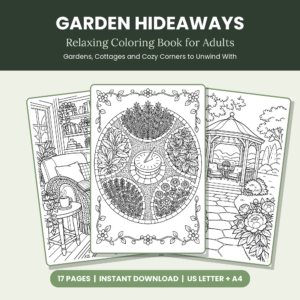 Garden Hideaways |
17 | Adults who color to relax | $2.99 | View book |
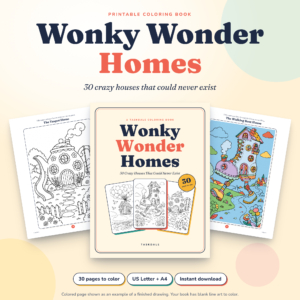 Wonky Wonder Homes |
30 | Teens and adults who like whimsical, cozy scenes | $3.99 | View book |
Garden Hideaways: calm pages for adults
17 pages in three moods. Cozy corners (a fireside reading nook, a rainy window seat, a moonlit attic bedroom), detailed serene gardens (a wisteria path, koi lily pond, rose arch, herb garden) and simpler peaceful gardens (a garden bench, a birdbath, a cottage gate). Watercolor fans can print on heavier paper and paint the garden pages with loose washes, then go over details with pencil. It’s a nice halfway house between the two styles.
Taskdale pick · Adults who color to relax
Garden Hideaways Relaxing Coloring Book for Adults
17 calm garden and cozy-corner pages for adults who color to relax. Print on thick paper and try loose watercolor washes for a reverse-coloring feel.
17 printable pages · Instant download · US Letter + A4
Wonky Wonder Homes: whimsical houses
30 fantasy house pages of crooked cottages, odd towers and storybook homes. If the part of reverse coloring you love is the playfulness, this is the closer match. Wonky lines, strange shapes and no “correct” colors. Made for kids and adults, so it works as a shared activity too.
Taskdale pick · Teens and adults who like whimsical, cozy scenes
Wonky Wonder Homes Printable Coloring Book
30 crooked cottages and storybook towers with no right or wrong colors. A playful pick for anyone who likes the freedom of reverse coloring.
30 printable pages · Instant download · US Letter + A4
Every Taskdale coloring book comes as a US Letter PDF, an A4 PDF and single-page 300 DPI PNGs, with an instant download after checkout.
Who reverse coloring suits
It’s a good fit for doodlers, people who find regular coloring a bit passive, and anyone who wants to practise drawing without the pressure of a blank page. Older kids and teens often enjoy it because it feels more like art than a coloring book. Some people find it harder at first, though. If staring at a blob makes you freeze, start with a regular page and come back to reverse coloring later.
For more ideas, see our guides to coloring pages for adults, mindfulness coloring pages and coloring pages for teens. Our hub for printable coloring pages covers every age, and you can browse every title in the Taskdale coloring books collection.
Ready to print something tonight?
Garden Hideaways Relaxing Coloring Book for Adults is $2.99 and downloads the moment you check out. Or browse every book in the Taskdale coloring collection.
Frequently asked questions
What is a reverse coloring book?
It’s a book where the color comes first, usually as watercolor washes, and you draw the lines on top. You decide what each patch of color becomes.
What do I need for reverse coloring?
Mainly a pen. A fine black pen is the usual choice, and a white gel pen or brush pen adds variety.
Does Taskdale sell a reverse coloring book?
Not at the moment. Taskdale sells printable line-art coloring books, such as Garden Hideaways and Wonky Wonder Homes.
Can kids do reverse coloring?
Yes. Many kids love it because there are no lines to stay inside. Making your own pages with paint first is a fun two-day project.