Botanical pages are the gardener’s way into coloring. Leaves with every vein drawn in, petals layered like silk, a fern unrolling at the edge of a glasshouse. Adult coloring book pages with nature and botanical designs reward a patient hand, and they also look lovely framed on a wall, which is more than you can say for most coloring.
This guide walks you through the main botanical styles, how to color leaves and petals so they look alive instead of flat, how to get the look of an old botanical print, and how to turn finished pages into a small gallery wall. You will also find four printable books on Taskdale, from bold, easy florals for beginners to intricate conservatories and animals woven through flowers.
Quick picks for botanical coloring
| Product | Best for | Price | Link |
|---|---|---|---|
| Botanical Animals Coloring Book | Animals woven through flowers and leaves | $3.49 | View |
| Botanical Gardens: An Intricate Coloring Collection | 50 conservatory and garden scenes | Original price was: $9.99.$2.99Current price is: $2.99. | View |
| Bold Florals Flower Coloring Book | Beginners and anyone who wants big petals | $3.49 | View |
| Wildflower Meadows Coloring Book | Detailed meadows with hidden objects | $3.49 | View |
Four kinds of botanical design
Botanical is a broad word. Before you choose a book, it helps to know which style you are drawn to, because each one asks for different tools and a different mood.
| Style | What it looks like | Best tools | Time per page |
|---|---|---|---|
| Bold florals | Big blooms, thick outlines, few small spaces | Markers, crayons, any pencils | 30 to 60 minutes |
| Garden scenes | Paths, fountains, glasshouses, beds of flowers | Sharp colored pencils | 3 to 5 hours |
| Botanical animals | Creatures surrounded by or made of plants | Pencils and fine-liners | 2 to 4 hours |
| Wild meadows | Layers of grasses, wildflowers and small wildlife | Sharp pencils, white gel pen | 3 to 6 hours |
Most people have a favorite after two or three pages. Many end up keeping one bold book for tired evenings and one intricate book for slow weekends, which is a nice balance.
Coloring leaves that look alive
Leaves are the backbone of every botanical page, and they are where most pages go flat. One green, pressed evenly across fifty leaves, turns a garden into wallpaper. A few simple habits fix that.
Use three greens, not one
Pick a light yellow-green, a middle grass green and a dark blue-green. Use the light one where the leaf catches the sun, the middle for most of the leaf, and the dark near the stem and where one leaf tucks behind another. That alone adds depth.
Leave the veins lighter
Color around the central vein rather than over it, or go over it very lightly. Pale veins against a darker leaf look natural and crisp. On large leaves, add a slightly darker line along one side of each vein for a subtle raised look.
Vary leaves across the page
Real plants are not uniform. Make some leaves warmer, a few nearly olive, one or two turning yellow at the tips. The eye reads that variety as life.
Petals that glow
Petals are thin, so light passes through them. That is why real flowers often look brightest at the edge and deepest at the center. Copy that and your blooms will glow.
- Center to edge. Start with the deepest shade where the petal meets the flower’s middle, then fade outward to a lighter tone or almost white.
- Shadow the overlap. Where one petal sits behind another, add a touch of a darker or cooler shade.
- White flowers. Do not color the petals white. Leave them as paper, and color only the shadows in pale grey, lilac or blue. The flower will look whiter than any white pencil could make it.
- A pop of center. Stamens and seed heads look great in a contrasting color: mustard in a violet flower, deep red in a pale pink one.
Animals in bloom
Botanical animal pages mix two joys: the rhythm of petals and leaves, and the personality of a creature. A fox curled among ferns, an owl framed by moonflowers, a hare made of blossoms. They are a good choice if pure flower pages feel a bit samey after a while.
A tip for these pages: decide early whether the animal is the star or part of the garden. If it is the star, give it warmer, stronger colors than the plants around it. If it should blend in, color it from the same palette as the flowers so it looks grown rather than placed.
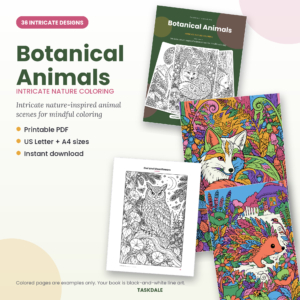
Botanical Animals Coloring Book
Price: $3.49 | Best for: adults who love flowers and animals together
Botanical Animals has 36 detailed scenes that blend creatures and plants: a Fern Fox, an Owl and Moonflowers, a Hummingbird Hibiscus, a Stag in Wildflowers, a Rabbit in a Teacup Garden and a Foxglove Fox Mandala. Pencils, pens or markers all work. You get US Letter and A4 PDFs of 47 pages each, for personal use. Start with the Fern Fox to practice the three-green leaf method above.
Garden and glasshouse scenes
Full garden pages are a step up. A conservatory with ferns pressed against the glass, a rose garden fountain, a Japanese footbridge, a labyrinth of hedges. There is a lot going on. The trick is to treat them like a landscape painter would: foreground, middle, distance.
- Color the focal point first, such as the fountain or the bridge.
- Then the foreground plants, in your strongest colors.
- Then the middle ground, slightly softer.
- Finally the distance, paler and a little bluer. Things far away always look lighter and cooler.
That last step is what makes a garden page feel deep instead of flat. It is a small change with a big payoff.
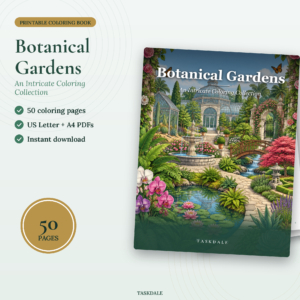
Botanical Gardens Coloring Collection
Price: Original price was: $9.99.$2.99Current price is: $2.99. | Best for: patient colorists and plant lovers
Botanical Gardens has 50 detailed garden scenes, including The Grand Conservatory, Fern House, Rose Garden Fountain, Water Lily Pond, Japanese Garden Footbridge, Cactus Collection, Bonsai Exhibition and a Botanical Leaf Mandala. Many pages have a clear focal point to color first. You get US Letter and A4 PDFs plus a Word guide, for personal use. The Fern House is a great page for practicing distance and depth.
For meadow lovers, Wildflower Meadows has 30 intricate scenes of flowers, grasses and gentle wildlife, from a Foxglove Fox to Bee and Poppies, with hidden objects in every meadow.
The vintage botanical print look
Old botanical illustrations, the kind found in antique plant books, have a soft and slightly faded charm. You can recreate that look on almost any botanical page with a few choices.
- Mute your palette. Swap bright greens for sage and olive, reds for brick and dusty rose, yellows for ochre.
- Use light pressure. Two gentle layers rather than four heavy ones. Let a little paper show through.
- Print on cream paper. Ivory or natural-tone cardstock instantly ages the page.
- Add a label. Write the plant’s name in neat italic at the bottom with a brown fine-liner.
- Tint the edges. A whisper of tan or raw sienna pencil around the border looks like age.
Pages finished this way look wonderful framed in plain wood. They suit a kitchen or a hallway far better than you might expect from a coloring page.
Bold florals for beginners and tired eyes
Not every botanical page needs to be intricate. If you are new to coloring, have low vision, or simply want to finish a page in one sitting, bold florals are a joy. Big petals, thick outlines, a sunflower that fills the page. You can blend, shade and experiment with color without squinting.
Bold pages are also the best place to practice the petal and leaf techniques in this guide. Big shapes show every blend clearly, so you learn faster. Once you can make a big rose glow, small ones come easily.
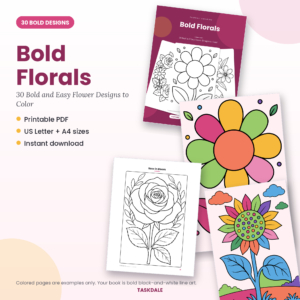
Bold Florals Flower Coloring Book
Price: $3.49 | Best for: beginners, seniors and marker fans
Bold Florals has 30 simple flower designs with thick outlines and big petals: a Smiling Daisy, a Rose in Bloom, a Sunny Sunflower, a Tulip Pair, a Peony Blossom and a Flower Pot Garden. The listing names beginners, seniors and adults who find detailed floral books too fussy. You get US Letter and A4 PDFs, for personal use. Start with the Gerbera Close-Up to practice a center-to-edge petal blend.
If flowers are your favorite subject, our roundup of flower coloring pages and printable books covers more styles and tips.
A small toolkit for botanical work
You do not need an expensive set to color plants well. You need the right handful of colors and a way to keep points sharp.
- Five greens: yellow-green, grass, olive, sage and a deep blue-green. Greens do more work on a botanical page than any other color.
- Two browns: one warm for stems and soil, one cool for shadows.
- Your flower colors: a light and a dark of each, such as pale pink and deep rose.
- A colorless blender pencil to smooth petal gradients.
- A white gel pen for dew drops and the shine on a leaf.
- A 0.3 mm brown fine-liner for labels and small extra veins.
Buy open stock pencils if your favorite brand sells them one at a time. Botanical colorists burn through greens long before anything else, and replacing three pencils is cheaper than buying a new tin. If you are coloring on a tight budget, our guide to cheap adult coloring books that are actually good has more ways to keep costs down.
Three habits that hold botanical pages back
Coloring every flower the same strength
A bed of twenty roses all in full-strength red looks like a sticker sheet. Pick three or four blooms to be the brightest, and let the rest fall back slightly. The eye needs somewhere to land.
Forgetting the stems
Stems and stalks often get one quick stroke of green. Give them the same care as leaves: lighter on one side, darker on the other. Round stems make the whole plant feel solid.
Leaving no white
Botanical pages look fresher with a little air. Leave tiny unpainted highlights on glossy leaves, petals and water. A page covered edge to edge in color can feel heavy, even when every part is colored well.
Turning finished pages into wall art
Botanical pages are made to be seen. A set of four in matching frames can look like a planned art collection, and it costs a fraction of buying prints.
Framing basics
- A US Letter page fits an 11 by 14 inch frame with a mat that has an 8 by 10 inch opening. The mat hides the margins and makes the page look finished.
- An A4 page sits nicely in an A3 frame with a mount.
- Plain wood or thin black frames suit botanical styles best.
Gallery ideas
- A seasonal four: one spring bloom, one summer garden, one autumn leaf study, one winter evergreen.
- One color story: four different pages all colored in the same muted palette.
- A row in the kitchen: herbs, vegetables and fruit trees, hung in a line above the counter.
There is a real pleasure in walking past a wall of your own work. Friends will ask where you bought the prints. Telling them you colored them is a good moment.
A year of botanical coloring
Following the seasons gives your coloring a gentle rhythm and a reason to choose one page over another.
| Months | Pages to choose | Palette idea |
|---|---|---|
| December to February | Evergreens, conservatories, cacti | Deep greens, berry red, frosty blue |
| March to May | Bulbs, blossoms, bluebells, tulips | Fresh green, pale pink, lilac, butter yellow |
| June to August | Roses, meadows, ponds, sunflowers | Bright and warm, full strength |
| September to November | Ferns, seed heads, falling leaves | Rust, ochre, plum, olive |
Color one page a fortnight and you will have about twenty-six by the end of the year, a full record of the seasons in your own hand. Keep them in a folder by month. Next year, flip back to see what you colored last spring before you choose a new page. It is a gentle way to notice how much your blending and shading have grown.
Frequently asked questions
What are botanical coloring pages?
Pages built around plants: flowers, leaves, ferns, gardens and glasshouses, sometimes with animals woven in. They range from bold and simple to very detailed.
How do I color leaves realistically?
Use three greens, light, middle and dark. Put the light where the sun hits, the dark near the stem and in overlaps, and keep the veins paler than the leaf.
How do you color white flowers?
Leave the petals as bare paper and color only the shadows in pale grey, lilac or blue.
Are botanical coloring books good for beginners?
Bold floral books are ideal for beginners. Intricate garden scenes are better once you are comfortable with shading.
Which pencils work best for botanical pages?
Soft-core colored pencils with a good range of greens. Add a blender pencil for smooth petals and a white gel pen for highlights.
Can I frame my finished coloring pages?
Yes. A US Letter page fits an 11 by 14 inch frame with an 8 by 10 inch mat opening, and an A4 page fits an A3 frame with a mount.
Your next step
Pick one leaf-heavy page tonight and color it with the three-green method. Then compare it with an older page. The difference will surprise you. For a page that mixes leaves, petals and a little personality, start with the Fern Fox in the Botanical Animals Coloring Book.