Weekly planning answers “what’s for dinner on Thursday?” Monthly planning answers bigger questions. When is payday, and what do the last five days before it look like? Which Saturday is the birthday party? When does the freezer need restocking? Which week are the in-laws visiting? A monthly meal planner lets you see those things coming and plan food around them, instead of being caught out on the 23rd with an empty cupboard and an empty bank account.
This guide is for people who like to think ahead. You will learn how to lay out a month in about 45 minutes, how to match meals to paydays and busy weeks, how to split shopping into one stock-up trip and small fresh top-ups, how to use a freezer day, and three Taskdale planners (printable, tablet and spreadsheet) that give you the monthly view.
Quick picks: planners with a monthly view
| Product | Best for | Price | Link |
|---|---|---|---|
| Blush & Sage Meal Planner Kit | A printable 31-day planner plus weekly pages and a dinner calendar | $1.49 | View |
| Plate & Pantry Digital Meal Planner | Twelve monthly overviews linked to 52 weekly spreads | $1.29 | View |
| Plateful Weekly Meal Planner & Grocery List | A spreadsheet that plans up to five weeks at once | $9.99 | View |
| Pantry to Plate Meal Planner (Weekly Spreadsheet) | Up to four weeks with grocery list and use-by alerts | $7.49 | View |
What a monthly view shows that a weekly one hides
A single week is too short to notice patterns. A month is long enough. When you lay out 30 or 31 days at once, a few things jump out:
- Money rhythm. If rent leaves on the 1st and pay lands on the 25th, the week before payday needs cheaper meals. You can plan for it rather than scrape through.
- Busy clusters. School concerts, work trips and birthdays often bunch up. Seeing three busy nights in a row tells you to batch cook the weekend before.
- Repeats. You notice that spaghetti appears five times. Time to rotate.
- Stock-up timing. Pantry items like rice, oil, flour and canned goods can be bought once a month, when money is freshest.
- Freezer flow. You can see which batch meals to cook and when they will be eaten.
That’s the real value of thinking ahead. Not more work. Fewer surprises.
Lay out a month in about 45 minutes
Do this once at the start of each month. A quiet hour on the last Sunday of the old month works well.
1. Mark the fixed events (5 minutes)
Birthdays, guests, trips, late work nights, sports fixtures, school events. Write them on the calendar before anything else.
2. Mark money dates (5 minutes)
Paydays, rent or mortgage, big bills. Shade the leaner days in a light color. Those are the days for pantry meals.
3. Set your theme rotation (10 minutes)
Give each weekday a theme: meat-free, pasta, stir-fry, soup, pizza, roast. List three or four options under each. Now you fill the month by picking from short lists.
4. Fill dinners (15 minutes)
Quick meals on busy nights, cheaper meals on lean days, a special dinner for the birthday, leftovers the day after a big cook.
5. Plan the freezer day and stock-up shop (10 minutes)
Pick one weekend for batch cooking and one day for the big pantry shop. More on both below.
Breakfasts and lunches usually stay on rotation, so you do not need to fill all 31 days of them. A note like “oats or eggs on weekdays” covers it.
A printable monthly page with columns for each meal and a prep checkbox gives you the whole month at a glance, and a dinner calendar in a 7-day grid is handy for marking theme nights.
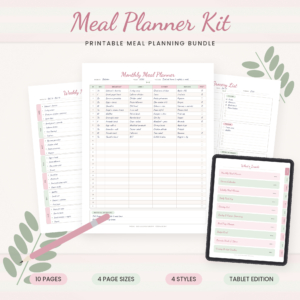
Blush & Sage Meal Planner Kit
Price: $1.49 | Best for: paper planners who like seeing the month
Blush and Sage is a ten-page printable kit in Letter, A4, A5 and Half Letter. The Monthly Meal Planner has 31 numbered days with columns for breakfast, lunch, dinner and snacks and a prep checkbox on every row, and the Dinner Calendar is a 7-day grid with boxes for theme nights and monthly stock-up items. Weekly planners, a daily food log, a grocery list in 8 sections, pantry and freezer inventory, a meal prep planner and a recipe card complete the set. Fill in the monthly page first.
A sample month, sketched
Here is how a month might look for a family of four paid on the 25th, with a birthday on the 12th and visitors on the third weekend.
| Week | What is going on | Food plan |
|---|---|---|
| Week 1 (1st to 7th) | Rent leaves, money still fine after payday | Big pantry stock-up shop. Normal rotation. Freezer day on Saturday: chili, bolognese, soup. |
| Week 2 (8th to 14th) | Birthday on the 12th, two late work nights | Freezer meals on the late nights. Birthday dinner chosen by the birthday child. Leftover cake for lunchboxes. |
| Week 3 (15th to 21st) | Visitors Friday to Sunday | One big roast for guests, a slow cooker stew, easy breakfasts. Fresh top-up shop on Thursday. |
| Week 4 (22nd to 28th) | Lean days until the 25th, then payday | Pantry meals 22nd to 24th: lentil curry, egg fried rice, pasta with frozen veg. Small fresh shop on the 25th. |
| Days 29 to 31 | End of month | Clear the freezer and fridge. Plan next month. |
The lean days are the clever part. Because the pantry was stocked on the 1st and the freezer was filled on the first Saturday, the week before payday is calm. No last-minute takeout, no anxious mid-week shop. That sense of being one step ahead is worth the 45 minutes on its own.
If your income lands every two weeks rather than monthly, the same idea applies with two money cycles in the month. Our guide to the paycheck budget for biweekly pay shows how to line spending up with pay dates.
One stock-up shop, small fresh top-ups
A monthly plan lets you shop differently. Instead of one medium shop every week, you do one big shop for long-life items and short trips for fresh food.
The monthly stock-up
Rice, pasta, oats, flour, canned tomatoes, beans, tuna, stock cubes, oil, spices, frozen vegetables, toilet paper, cleaning supplies. Buy these once, when money is freshest. A pantry list checked before you go stops you doubling up.
The weekly or twice-weekly top-up
Milk, bread, fruit, salad, fresh vegetables, meat or fish for the next few days. These trips are short and cheap because the cupboard is already full.
Many families find the monthly approach cuts impulse spending, simply because they walk the whole store less often. A short top-up shop with a short list is much easier to keep tidy.
Plan a monthly freezer day
A freezer day turns a monthly plan into weeknight relief. Pick one Saturday or Sunday and cook three or four big batches. A family of four might make:
- A double pot of chili (two dinners)
- A double batch of bolognese sauce (two dinners)
- A big pot of vegetable soup (lunches for a week)
- Two trays of baked oatmeal or muffins (breakfasts)
Label each container with the dish and date, then write each freezer meal onto the calendar on the night you will eat it. Putting them on the plan is what stops freezer meals from becoming freezer archaeology. For a full walkthrough of rotating dinners over four weeks, see our guide on how to make a monthly meal plan you will actually follow.
On a tablet, a planner where the monthly page links straight to each week makes this flow easy. Tap the month, see the freezer meals marked, tap into that week, and the shopping and prep pages are right there.
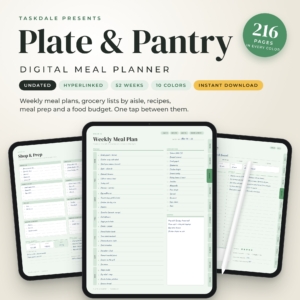
Plate & Pantry Digital Meal Planner
Price: $1.29 | Best for: tablet planners who think in months
Plate and Pantry is an undated, hyperlinked 216-page planner with 12 monthly overviews whose buttons jump to each week, and 52 weekly spreads. Each week has a meal plan page (breakfast, lunch, dinner and snack every day, plus a grocery list and notes) and a Shop and Prep page with eight aisle boxes, a quick budget and a prep day checklist. It also has 40 recipe pages and kitchen inventories, and you can print pages too. Start with this month’s overview and mark paydays and events.
Months with five weeks, and other awkward bits
Calendar months do not line up neatly with weeks. Some months touch five weekends. Some paydays fall on a Saturday. A few habits help:
- Plan in weeks, view by month. Fill weekly pages, but keep the monthly view for events and money.
- Treat the fifth week as a bonus or a squeeze. If pay is monthly, a fifth week is often the leanest. Plan pantry and freezer meals for it.
- Carry over leftovers. Unused freezer meals roll into next month’s first week.
Our post on why a 5 week meal planner beats planning by the month goes deeper into this.
A spreadsheet that plans five weeks at once handles awkward months well, because you are never short of space at the end of the calendar.
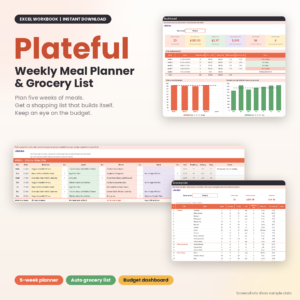
Plateful Weekly Meal Planner & Grocery List
Price: $9.99 | Best for: spreadsheet planners who look weeks ahead
Plateful is an Excel workbook with 11 connected sheets and a Word user guide. You add your recipes once, then plan up to five weeks by picking meals from dropdowns. It adds up every ingredient, subtracts what is already in your pantry, rounds up to whole packs and gives you a shopping list grouped by aisle, for one week or all five, with what each week will cost. Plan all five weeks of next month in one sitting, then shop week one.
Mistakes when planning a month ahead
- Filling every single meal for 31 days. Plan dinners in detail. Keep breakfasts and lunches on rotation.
- No flexibility. Leave one “swap night” a week for changed plans or leftover rescue.
- Buying fresh food for the whole month. Only long-life items in the stock-up. Fresh food on top-ups.
- Forgetting the freezer meals exist. Write them onto specific nights, or they hide behind the ice trays.
- Not looking back. At month end, note which meals worked and which got skipped. Next month will be easier.
- Planning a “perfect” month. Life changes. A month that runs at 80 percent of plan is a very good month.
A ten-minute month-end review
The last few days of the month are the best time to learn from the one just gone. Sit down with the planner and a cup of tea and answer four questions:
- Which dinners got eaten happily? Star them. They go into next month’s rotation.
- Which got skipped or swapped? Cross them off or move them to a quieter week.
- What is left in the freezer and pantry? Build the first week of next month around it.
- How did the food money go? Add up the receipts. Was the stock-up shop bigger than expected? Did the lean week hold?
Ten minutes, and next month’s plan almost writes itself. After three or four months, you will have a rotation of tried favorites and a clear sense of what a normal month of food costs your household. That number is gold when you sit down to plan the wider household budget.
Who monthly planning suits best
Thinking a month ahead works especially well for households paid monthly, families with busy calendars full of activities, people who live far from a big store and prefer fewer trips, and anyone who likes batch cooking. It is also a relief for anyone who finds weekly planning a chore, because the big decisions happen once a month instead of four times.
It suits people less well if your schedule changes every few days, or if you mostly eat out or cook for one on a whim. In that case, a simple weekly plan with a well-stocked pantry may be all you need. You can always try a monthly view for one month and see how it feels.
Frequently asked questions
How do I plan meals for a whole month?
Mark events and paydays first, give each weekday a theme with a few options, fill dinners for each week, plan one freezer day and one stock-up shop, and keep breakfasts and lunches on rotation.
Is monthly meal planning cheaper than weekly?
It can be. One stock-up shop for long-life items and short top-ups for fresh food often cuts impulse buys, and planning lean meals before payday avoids last-minute takeout.
Do I need to plan every meal of the month?
No. Plan dinners carefully. Breakfasts and lunches usually work fine on a simple rotation that you note once.
How do I handle fresh food on a monthly plan?
Buy fresh produce, dairy, bread and meat on weekly or twice-weekly top-up trips. Use frozen vegetables and fruit to bridge the gaps.
What is the best monthly meal planner format?
A printable monthly page suits fridge planners, a hyperlinked digital planner suits tablet users, and a multi-week spreadsheet suits anyone who wants the shopping list worked out automatically.
Your next step
On the last Sunday of this month, take 45 minutes to mark next month’s events and paydays, set your weekday themes and pick a freezer day. Then fill the dinners. For a printed monthly page with all 31 days and a dinner calendar for theme nights, use the Blush & Sage Meal Planner Kit and start with the money dates.