Every expense in your life fits one of three buckets. Fixed costs stay the same each month. Variable costs show up every month but change in size. Yearly costs arrive once or twice a year and tend to land at the worst possible moment. When you budget expenses by fixed, variable and yearly, each bucket gets the kind of attention it actually needs, and the surprises mostly stop.
This guide explains each bucket in plain terms, shows how to budget for it, and walks through a full worked household example with every number on the table. You will also find the gray-area costs that do not sort neatly, the math for turning yearly bills into a monthly figure, and a few spreadsheet and planner options that keep all three buckets in one place.
Quick picks: budget tools with all three buckets built in
| Product | Best for | Price | Link |
|---|---|---|---|
| Annual Budget Spreadsheet for Excel | Recurring bills, sinking funds and a bill calendar in one file | Original price was: $19.99.$9.99Current price is: $9.99. | View |
| Ultimate Annual Budget Spreadsheet | A 12-month view with a sinking funds tracker | $6.00 | View |
| Petalwise Budget Planner | Weekly variable spending on an iPad or tablet | $3.20 | View |
| Lantern Budget System | Cash envelopes for variable costs plus sinking funds | $12.99 | View |
The three expense types in plain words
Here is the whole idea on one table. The rest of the guide fills in the detail.
| Type | What it means | Examples | How to budget it |
|---|---|---|---|
| Fixed | Same amount, same date, every month | Rent, car loan, insurance paid monthly, phone, internet, gym | Write it once, review once a year |
| Variable | Every month, but the amount moves | Groceries, gas, electricity, eating out, toiletries | Set a target from your average, check weekly |
| Yearly | Once, twice or a few times a year | Car registration, holidays, birthdays, annual subscriptions, vet | Divide by 12 and save monthly |
Why bother sorting at all? Because each type fails in a different way. Fixed costs fail by creeping up quietly at renewal. Variable costs fail by drifting a little every week until the month runs dry. Yearly costs fail by being forgotten entirely, then arriving as a $600 bill in a month that already had no slack. One budget approach cannot fix all three problems. Three simple approaches can.
Fixed expenses: set once, check once a year
Fixed expenses are the easiest part of any budget. You know the amount, you know the date, and they rarely change. That predictability is a gift. It means you can plan these lines in five minutes and then mostly stop thinking about them.
How to list them
Go through two months of bank statements and pull out every charge that appeared both times for the same amount. Rent or mortgage, loan payments, insurance billed monthly, phone, internet, streaming, gym, any membership. Write each one with its amount and due date.
Line them up with paydays
Next to each fixed cost, write which paycheck will cover it. If you are paid twice a month and three big bills fall in the first week, the first paycheck carries most of the weight. Seeing that on paper explains a lot of tight first halves. Our guide to budgeting by paycheck shows how to split bills across pay dates so neither half of the month runs dry.
Review them once a year
Fixed costs are where money leaks without anyone noticing. A phone plan that went up $8 at renewal. A streaming service you signed up for to watch one show. Once a year, read down the list and ask two questions for each line: do we still need this, and can we get it cheaper? A single call to an internet provider can often knock $10 to $20 off the monthly bill. Over a year that is a weekend trip’s worth of gas.
Variable expenses: set a target from your real average
Variable expenses are where most budgets break. Not because people are reckless, but because the amounts move. Groceries were $640 last month and $780 the month before. Electricity doubles in August. Gas jumps when you drive to see family.
Use a three-month average
Do not set variable targets from your best month. Take the last three months, add them up and divide by three. If groceries ran $640, $780 and $710, your average is $710. Start there. You can try trimming it later, but a target you can actually hit beats an aspirational one you blow by the 20th.
Check them weekly, not monthly
A monthly check on variable spending comes too late. By the time you see groceries are $200 over, the month is gone. A quick weekly look catches drift while you can still adjust. Divide each monthly target by four or five and compare: is grocery spending around $175 a week, or already at $260 by day eight?
This is where a planner you enjoy opening helps. A weekly page on a tablet with spending boxes for each day makes the check a two-minute habit instead of a chore.
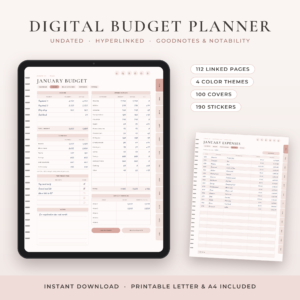
Petalwise Budget Planner
Price: $3.20 | Best for: tablet users who check spending weekly
Petalwise is an undated digital budget planner for GoodNotes, Notability, Noteshelf and Xodo, with 112 hyperlinked pages in four color themes and a printable US Letter and A4 edition. Each month follows a six-page routine: Calendar, Budget, Bills and Savings, Expenses and Review, with month tabs on every page. Fill in your fixed bills once on the Bills page, then log variable spending on the Expenses page each week.
Semi-variable costs
Some costs sit in between. Utilities on a budget billing plan behave like fixed costs even though usage changes. A car insurance bill that is fixed for six months then jumps at renewal behaves like a fixed cost with a yearly twist. Put these where they behave, not where they belong in theory.
Yearly expenses: turn them into a monthly number
This is the bucket that changes everything once you get it right. Yearly expenses are not emergencies. You know Christmas is coming. You know the car needs registering. You know your kid’s birthday is in April. What you do not have, most years, is the money sitting ready when the bill arrives.
The math
- List every cost that happens less than monthly. Look back through a full year of statements and your calendar.
- Write the yearly total for each one.
- Add them up.
- Divide by 12. That is your monthly yearly-costs amount.
- Move it into a separate savings account every month, or split it into individual funds for each cost.
These separate pots are often called sinking funds. A holiday fund, a car fund, a gifts fund. Some people keep one combined account. Others prefer a pot for each so they can see exactly what is ready. Both work.
The first year is the hardest
If your car registration is due in two months, you cannot spread it over twelve. For costs coming up soon, divide by the months left instead. A $180 bill due in three months needs $60 a month for now. After it is paid, drop to $15 a month for next year. The first year feels tight. The second year feels like a different life.
A spreadsheet with sinking funds and a bill calendar built in does this tracking for you, and shows which funds are on pace.
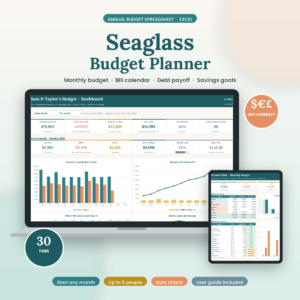
Annual Budget Spreadsheet for Excel
Price: Original price was: $19.99.$9.99Current price is: $9.99. | Best for: households juggling bills and sinking funds
The Seaglass Budget Planner is an Excel workbook with 30 tabs, including 12 monthly budget tabs, a dashboard, a bill calendar, a paycheck planner, a debt snowball and sinking funds. Recurring income and bills can be set weekly, every two weeks, monthly, quarterly or yearly, and up to 15 savings goals are tracked. Start on the Setup tab, add your fixed bills as recurring items, then add each yearly cost as a sinking fund goal.
Worked example: one household, three buckets
Lena and Sam bring home $5,200 a month between them. Here is their budget sorted by type.
| Bucket | Line | Monthly amount |
|---|---|---|
| Fixed | Rent | $1,650 |
| Fixed | Car loan | $340 |
| Fixed | Car insurance | $145 |
| Fixed | Student loan | $210 |
| Fixed | Phone, internet, streaming, gym | $235 |
| Variable | Groceries | $700 |
| Variable | Utilities | $210 |
| Variable | Gas | $220 |
| Variable | Eating out | $180 |
| Variable | Household and personal | $290 |
| Yearly | Sinking funds (see below) | $322 |
| Savings | Emergency fund | $600 |
| Buffer | Unplanned small costs | $98 |
Fixed costs total $2,580. Variable costs total $1,600. Their yearly costs add up to $3,860: car registration $180, renters insurance $240, annual subscriptions $140, holidays $900, birthdays $400, car maintenance $600, vet $300, medical and dental $500, clothing $600. Divided by 12, that is about $322 a month. Add savings and a buffer and the plan lands on exactly $5,200.
Before they sorted things this way, December and August were always awful. December had gifts. August had car registration, back-to-school clothes and the vet all at once. Now those months are just months. The money is already waiting. Sam described the first calm December as the moment budgeting finally made sense.
Gray areas: costs that do not sort neatly
A few expenses resist the three buckets. Here is where to put the common ones.
- Quarterly bills like water or some insurance: treat as yearly. Add up four payments and divide by 12.
- Annual subscriptions billed once: yearly bucket, even though they feel like a monthly service.
- Buy now, pay later plans: fixed for as long as the plan runs. Write the end date next to the line.
- Kids’ activities with term fees: yearly bucket for the fee, variable for snacks and gas getting there.
- Medical costs: yearly bucket for expected visits and prescriptions, emergency fund for the unexpected.
- Utilities on budget billing: fixed. Utilities billed by actual use: variable.
The rule of thumb: sort by how the cost behaves in your bank account, not by what it is called.
Keeping all three buckets in one place
The danger with three buckets is three systems. Fixed bills in an app reminder, variable spending in a notebook, sinking funds in a separate bank and nowhere written down. That spreads your attention too thin and something gets forgotten.
One spreadsheet or one planner, with a section for each bucket, works better. Fixed costs as a recurring list. Variable costs as monthly targets with a running total. Yearly costs as a set of funds with progress bars. If you like looking at the whole year at once, our guide to planning with an annual budget template covers how to set up the 12-month view.
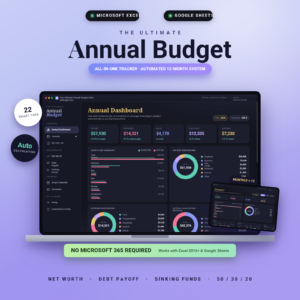
Ultimate Annual Budget Spreadsheet
Price: $6.00 | Best for: people who want the whole year on one screen
The Ultimate Annual Budget is a 22-tab workbook for Excel 2016 and later, Google Sheets and LibreOffice. It has an annual dashboard, 12 monthly dashboards with expected versus actual, a 50/30/20 dashboard, a net worth tracker, a debt payoff calculator and a sinking funds tracker, in three color themes. Fill in the gold cells on the setup tab with your fixed bills and yearly costs, then log transactions as the month goes.
If you prefer cash for variable spending, an envelope system pairs nicely with this. Groceries, gas and eating out go in envelopes, while fixed bills and sinking funds stay in the bank. The Lantern Budget System in the quick picks table is built around exactly that split.
Mistakes when sorting expenses
- Calling a yearly cost an emergency. If it happens every year, it is a plan, not a surprise.
- Setting variable targets from one good month. Use a three-month average.
- Never reviewing fixed costs. They creep. Check them every year.
- Forgetting irregular income. A yearly bonus or tax refund belongs in your plan too. Many people use it to top up sinking funds.
- Spending from the sinking fund for other things. If you borrow from the car fund for groceries, write it down and pay it back.
Frequently asked questions
What is the difference between fixed and variable expenses?
Fixed expenses are the same amount every month, like rent or a loan payment. Variable expenses happen every month but change in size, like groceries or electricity.
How do I budget for yearly expenses?
Add up every cost that happens less than monthly over a year, divide by 12, and save that amount each month in a separate account or set of sinking funds.
Is groceries a fixed or variable expense?
Variable. Even if you aim for the same amount every month, the actual spend changes. Budget it from a three-month average and check weekly.
Are utilities fixed or variable?
Usually variable, since they depend on use and season. If your provider offers budget billing with the same payment every month, treat them as fixed.
How many sinking funds should I have?
Start with three to five for your biggest yearly costs, such as holidays, car costs and birthdays. Add more once those are steady.
Your next step
Pull out last year’s bank statements and list every cost that was not monthly. Add them up and divide by 12. That one number, your monthly yearly-costs amount, is the missing line in most budgets. When you are ready to track it alongside your bills and spending, set it up as sinking funds in the Annual Budget Spreadsheet for Excel.