Most of what a good career coach does for your CV is ask the right questions, push you for numbers and refuse to let you hide behind vague phrases. None of that needs a qualification. It needs a method, a quiet weekend and a willingness to be a little tough on yourself.
This guide shows you how to build an excellent CV without a career coach. You will run your own intake session, pick a clear target, dig out achievements you have forgotten, turn them into strong bullets, get honest feedback for free and test your CV in the real job market. There is a two-day plan at the end and an honest note on when paying a coach does make sense.
It works for anyone from a school leaver to a senior manager. The questions change a little. The method does not.
Quick picks: templates with the coaching built in
| Product | Best for | Price | Link |
|---|---|---|---|
| Marlowe Resume Template | A 10-page playbook with a profile formula and bullet examples | $4.79 | View |
| Sloane Resume Template | A writing toolkit with bullet rewrites and an ATS checklist | $4.49 | View |
| Hollis Resume Template | A writing guide with 216 action verbs and a job search planner | $8.99 | View |
| Alder Resume Template with Photo | Tip-led placeholder text and a job tracker | $4.79 | View |
What a career coach actually does, and how to copy it
Strip away the branding and a CV session with a coach usually follows the same path. They interview you about your work. They ask what you want next. They pull out results you had not thought to mention. They rewrite your bullets so each one shows impact. They check the layout and length. Then they send you off to apply.
The value is in three things: structure, pressure and an outside view. The structure you can borrow from this guide. The pressure you can apply yourself, with a list of prompts and a rule that every bullet needs a number. The outside view you can get from two people you trust, if you ask them the right questions.
You will not get the warm encouragement of a good coach. You will get a CV that does the same job, and the quiet pride of knowing you built it.
Run your own intake session
Set aside 45 minutes with a notebook or a blank document. Answer these questions in full sentences, as if someone were asking you across a table. Do not edit yet.
- What are the three things you are proudest of from the last five years at work?
- What do colleagues come to you for help with?
- What problem did you fix that nobody asked you to fix?
- When did your manager last thank you, and what for?
- What would fall apart if you went on leave for a month?
- What numbers do you track or report on, even informally?
- Which part of your job do you enjoy most, and which least?
- What kind of role do you want next, and why now?
You will probably end up with two or three pages of rough notes. That is the raw material. A coach charges for this hour mostly because people do not make time for it on their own.
One tip: answer out loud first. Many people describe their work far better when talking than when writing. Record yourself on your phone, then type up the best lines.
Choose one target role before you write a word
The most common reason a CV feels weak is that it is trying to fit every job at once. An excellent CV is written for one kind of role. You can adapt it later.
Collect five real job adverts for the role you want, from different employers. Copy them into one document and highlight every skill, task and qualification mentioned. Then count. If customer onboarding appears in four of the five adverts, it needs to be on your CV, and probably near the top.
By the end of this step you should have a short list: the eight to ten things employers in your target role care about most. Every section of your CV will be measured against that list.
A warehouse supervisor aiming for an operations manager role, for example, might find that the adverts keep asking for budget control, health and safety, team leadership and continuous improvement. Those four words become the backbone of the CV.
Dig out achievements and turn them into strong bullets
This is where a coach earns their fee, and where most DIY CVs fall short. People list duties because duties are easy to remember. Achievements need digging.
Prompts that unlock results
- Did you save time? How many hours a week, or days a month?
- Did you save or make money? Even a rough figure helps.
- Did you improve a number your team tracks: errors, complaints, sales, response times, stock accuracy?
- Did you train, mentor or lead people? How many?
- Did you handle something big: a budget, a contract, a launch, a move, a system change?
- Were you chosen for something: a project, an award, a promotion, covering for your manager?
The bullet formula
Action verb, what you did, and the result. One or two lines. For example:
- Before: Responsible for staff rotas.
After: Rebuilt the rota for a team of 26 across three shifts, cutting overtime costs by 14 percent in six months. - Before: Dealt with customer complaints.
After: Resolved around 40 escalated complaints a month, with a repeat complaint rate under 5 percent.
If you truly cannot find a number, use scale or frequency: across four sites, every week for two years, for the company’s largest client. Then hold yourself to a rule: no bullet survives the first edit unless it shows a result, a scale or a choice you made.
A template with writing help makes this far less lonely. Sloane’s toolkit includes bullet rewrites and a simple formula for strong points.
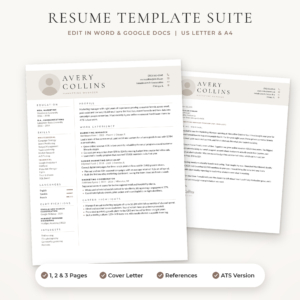
Sloane Resume Template
Price: $4.49 | Best for: people writing their own CV for the first time
Sloane includes a 1-page resume with and without a photo, a 2-page resume, a 3-page CV, an ATS version, a cover letter and a references page, in Stone, Sage and Navy and both A4 and US Letter. The 7-page Resume Writing Toolkit has profile examples, bullet rewrites, 96 action verbs, an ATS checklist and a final checklist. Work through the bullet rewrites page with your intake notes open beside it.
Build the page
Now the writing becomes a CV. Keep the structure simple and familiar, because recruiters read hundreds of CVs and like to find things where they expect them.
- Header: name, phone, email, town, LinkedIn.
- Profile: three sentences aimed at your target role.
- Key skills: six to eight, drawn from your target list.
- Experience: newest first, three to six bullets per recent role.
- Education and training.
- Extras: languages, certificates, volunteering, only if useful.
One page for early career, two for most experienced people. Use a clean template rather than designing from scratch, because layout problems eat hours you could spend on content. Our guide to free versus paid resume templates explains what you get at each level.
The three-sentence profile
Sentence one: who you are and how long you have done it. Sentence two: what you are best at, with a result. Sentence three: what you want next. Operations supervisor with seven years in food distribution. Cut picking errors by 22 percent through a new training system for 30 staff. Looking for an operations manager role with a growing regional business.
Marlowe’s playbook includes a profile formula like this, plus before-and-after bullets and a final checklist.
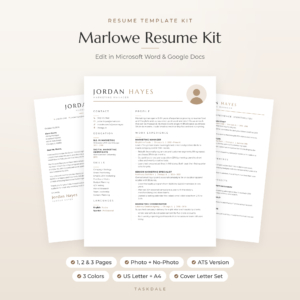
Marlowe Resume Template
Price: $4.79 | Best for: DIY writers who want a step-by-step guide
Marlowe includes 1, 2 and 3 page CVs with and without a photo, an ATS version, a cover letter, references page and thank-you letter, in Sand, Sage and Slate and both A4 and US Letter. The 10-page Resume Playbook explains how recruiters read CVs, gives a three-sentence profile formula, 120+ action verbs, ATS tips and a final checklist. Read the how recruiters read section before you decide what goes at the top of page one.
Get a second pair of eyes for free
A coach’s outside view is the hardest thing to replace, but two honest readers come close. Pick one person who works in or near your target field and one who does not. Send them the CV and a copy of a job advert, and ask three specific questions:
- After ten seconds, what job do you think I am going for?
- Which line made you most want to meet me?
- Which line did you skim or not understand?
Specific questions get useful answers. Can you look over my CV? gets you a thumbs up and a typo. These three questions show whether your message is landing, which bullet is doing the work and where the dead weight sits.
Then read the whole thing aloud yourself. You will hear clumsy sentences and repeated words that your eyes slide past.
Test it in the market and adjust
An excellent CV is one that gets replies. The only way to know is to send it and measure.
Send 10 to 15 tailored applications, then look at the results. If you are getting interviews, the CV works, and your attention should shift to interview preparation. If you are getting nothing at all, something needs to change: the target, the top third of page one, or the match between your keywords and the adverts. Change one thing at a time, then send another batch.
Keep a simple record of where you applied, which version you sent and what happened. Our job application tracker guide shows how to set one up, and our guide to a cover letter that matches your resume helps the letter pull in the same direction.
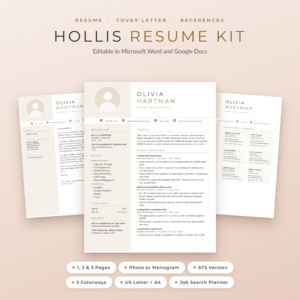
Hollis Resume Template
Price: $8.99 | Best for: testing and tracking your applications
Hollis includes photo and monogram CVs in 1, 2 and 3 pages, a 1 and 2 page ATS version, a cover letter, references page and thank-you letter, in Champagne, Rosewood and Graphite and both paper sizes. It also comes with a Job Search Planner for Excel and Google Sheets and a Resume Writing Guide with 216 action verbs. Log your first batch of 10 applications in the planner before you change anything on the CV.
A weekend plan to build it from scratch
Saturday morning (2 hours). Run your intake session and collect five job adverts. Highlight the adverts and make your target list.
Saturday afternoon (2 hours). Work through the achievement prompts for your last two or three jobs. Aim for 15 rough bullets, each with a number or scale.
Sunday morning (2 hours). Choose a template, write the three-sentence profile, pick your best bullets and build the page. Cut to one or two pages.
Sunday afternoon (1 hour). Read it aloud, fix what sounds wrong and send it to your two readers with the three questions.
Following week. Make their changes, export a PDF and send your first five applications.
Seven hours of focused work. Spread across a weekend, it is far less daunting than it sounds, and you finish on Sunday evening with something you are genuinely proud of.
When a career coach is worth paying for
Doing it yourself works for most people. A coach can still be worth the money in a few situations:
- You are making a big career change and cannot see how your experience transfers.
- You are applying for senior roles where a search firm will read your CV and the stakes are high.
- You have sent 40 or more applications with no replies and cannot see why.
- Your confidence has taken a knock, after a redundancy for example, and you want someone in your corner.
- You want interview coaching as much as CV help.
If you do hire one, everything in this guide still helps. You will arrive with your notes, your target list and your rough bullets, and your coach can spend the session on the hard parts.
Frequently asked questions
Can I write a good CV without professional help?
Yes. Most of what makes a CV strong is clear targeting, specific results and a clean layout, all of which you can do yourself with a method and honest feedback.
How long does it take to write a CV from scratch?
Around six to eight hours of focused work, spread over a weekend, is realistic for most people.
Who should review my CV for free?
One person in your target field and one outside it. Ask them specific questions about what job they think you want and which lines stand out or confuse.
How do I know if my CV is working?
Send 10 to 15 tailored applications and watch the replies. If you get interviews, it works. If not, change one thing at a time and test again.
What if I have no numbers to put on my CV?
Use scale, frequency and scope instead: how many people, how often, how many sites, which clients. Almost every job has something you can measure.
Your next step
Block two hours this Saturday, answer the eight intake questions and collect five job adverts for the role you want. When you are ready to build the page, open the Marlowe Resume Template and its playbook and work straight from your notes.