The best first mandala is a boring-looking one. Big petals, thick lines, a simple sun in the middle. It looks almost too plain in the thumbnail. Then you sit down with it, and twenty minutes later you have a finished page that looks lovely, and you want to do another. That feeling is what gets beginners hooked.
This guide is for adults who have never colored a mandala, or tried one and gave up when it took a week. We walk through which easy mandala designs to start with and why, the small set of tools a beginner actually needs, five techniques that make a page look finished, and a first-week plan. Along the way we point to a few beginner-friendly printable books on Taskdale.
Quick picks for a beginner’s first mandalas
| Product | Best for | Price | Link |
|---|---|---|---|
| Easy Mandala Coloring Book | A first mandala book with bold, open designs | $3.49 | View |
| Bold Florals Flower Coloring Book | Wreaths and blooms with the same bold lines | $3.49 | View |
| Snug Hours Bold and Easy Cozy Coloring Book | Cozy scenes, with PNGs for tablets | $5.99 | View |
Why most first mandalas go wrong
Most people pick their first mandala because it looks impressive. Hundreds of tiny cells, lace-like detail, a center like a snowflake. Then they spend an hour on one corner, their hand cramps, and the page goes in a drawer. Sound familiar?
The fix is simple. Start where the page is easy, not where it looks fancy. An easy mandala keeps the calming part, the repeating shapes and the steady rhythm round the circle, and drops the fiddly part. You still get that settled, absorbed feeling. You just get it in one evening instead of seven.
If you have never colored as an adult at all, our guide to simple coloring books for adults covers the basics of picking a first book.
Easy mandala designs to start with, in order
Not all easy mandalas are equally easy. Here is a gentle order to try them in, from the simplest shapes to slightly more involved ones.
1. Sun mandalas
A circle in the middle, rays all round. Maybe two rings of rays. These are the simplest of all and finish in 15 to 20 minutes. Perfect for your very first page.
2. Daisy and petal circles
One ring of big petals, a round center, perhaps a second ring of smaller petals behind. The petals are generous, so you can practice keeping color even without worrying about edges.
3. Star and starburst designs
Points instead of petals. The sharp corners teach you to slow down at tips, a small skill that makes everything look neater later.
4. Heart and leaf mandalas
Shapes that are not perfectly round. A ring of hearts or leaves pointing outward adds a little variety while staying simple.
5. Wave and shell designs
Curving lines that flow round the circle. They need a bit more care to follow but feel lovely and calm to color.
6. Butterfly and mixed-shape mandalas
Several shapes combined in one design. By now you have enough practice that these feel fun rather than tricky.
Working through this order in your first two weeks builds confidence step by step. Every page is a little harder than the last, and every page still gets finished. That steady run of small wins is what keeps a new hobby alive.
What’s inside a beginner mandala book
A good beginner book does more than print mandalas. It helps you choose colors, test your tools and see your progress. Look for a color test page, a planner for picking a palette, and one design per page so you can print just what you need.
The Easy Mandala Coloring Book on Taskdale was made with exactly this kind of beginner in mind. Its designs follow the shapes above, from suns and daisies to stars, hearts, leaves, waves, shells and butterflies, all with thick outlines and open spaces.
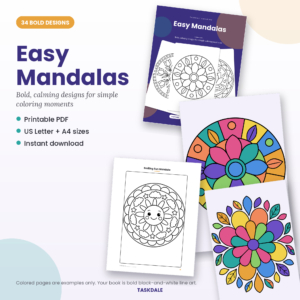
Easy Mandala Coloring Book
Price: $3.49 | Best for: complete mandala beginners
Easy Mandala has 34 bold mandala designs with thick outlines and generous spaces, including Petal Sun, Smiling Sun, Daisy Circle, Starburst, Heart Bloom, Leafy Garden and Butterfly Wings. Each 45-page PDF (US Letter and A4) adds a clickable contents page with a check box beside every design, a thumbnail gallery, a color test page, a palette planner and a “colored on” date line, plus a Word user guide, for personal use. Print Smiling Sun Mandala first and tick it off on the contents page when you finish.
That little check box is more satisfying than it sounds. Ticking off design after design, with the date you colored each one, gives you a quiet record of something you made time for.
The only tools a beginner needs
Coloring shops can make you think you need 120 pencils and three kinds of marker. You do not. Start small. Upgrade once you know what you enjoy.
Colored pencils (start here)
A set of 24 student-grade pencils is plenty for your first month. Pencils are forgiving: you can layer them, press lightly or hard, and they never bleed through paper. Keep a small pencil sharpener next to you. Sharp tips make clean edges.
Felt-tip or fineliner markers (optional)
Water-based markers give bright, flat color quickly. They are great for bold mandalas with big spaces. Use thicker paper so they do not soak through.
Gel pens (for accents)
A few metallic or white gel pens add sparkle to centers and small dots. Fun, but not essential on day one.
Paper
Plain printer paper is fine for pencils. For markers, a light card around 65 lb (176 gsm) stops bleeding. Print single-sided either way.
A total beginner kit, pencils, sharpener and a pack of card, costs about the same as a takeaway lunch. That is the whole investment.
Five beginner techniques that make pages look finished
You do not need art training to color a mandala well. These five habits make the biggest difference.
1. Plan one slice first
Mandalas repeat round a circle. Color one full slice, from center to edge, as your test. Like it? Copy it all the way round. Do not like it? You have only one slice to rethink.
2. Use light pressure, then build
Press gently for your first layer. Go over it again for richer color. Light-to-dark layering looks smooth. Pressing hard from the start leaves waxy patches that will not take a second color.
3. Color in one direction
Small strokes all going the same way, or small circles, give an even finish. Scribbling back and forth leaves visible streaks.
4. Edge first, then fill
Trace just inside the black line with a sharp pencil, then fill the middle. Your color stays inside the shape without slowing you down.
5. Limit your palette
Three to five colors per mandala. That is it. A small palette looks calm and planned. Ten colors on one page usually looks busy.
Fixing common beginner mistakes
Every beginner makes these. None of them ruin a page.
- Colored outside the line? Darken the black outline slightly with a fine black pen. It hides small slips.
- Color too pale? Add another layer. Pencils build up nicely.
- Color too dark? Leave it. Make the next ring darker too, so it looks intentional.
- Uneven, streaky patch? Go over it with small circles in the same color, pressing lightly.
- Hate the colors halfway through? Finish anyway, then print a fresh copy and try again. You learned what you do not like, which is useful.
That last one matters. A “bad” page is still practice. Many colorists keep their first pages to look back on later. The difference after a month is often surprising, and a nice little boost.
Your first week: a gentle plan
Twenty to thirty minutes a day is enough. Here is a week that builds skills without pressure.
- Day 1: A sun mandala. Use only three colors. Finish it in one sitting.
- Day 2: A daisy circle. Practice light pressure and a second layer.
- Day 3: A starburst. Slow down at the tips.
- Day 4: Rest day. Look at your three pages side by side.
- Day 5: A heart mandala. Try the edge-first technique.
- Day 6: Reprint your day 1 sun and color it in a completely different palette.
- Day 7: A wave or leaf mandala. Your choice.
Day 6 is the one people remember. Same design, new colors, and you see how much smoother your coloring already is after less than a week. That is real progress, and you can hold it in your hands.
What to do with finished mandalas
After a couple of weeks you will have a small stack of finished pages. Do not let them vanish into a drawer. A finished mandala is a handmade thing, and it can go to work around the house.
- Cards. Cut a finished mandala into a circle and glue it to the front of a folded piece of card. A birthday card nobody else could buy.
- Bookmarks. Cut a strip through the middle of a colored page. The rings make a lovely striped pattern.
- Gift tags. Punch small circles from the most colorful bits and tie them on presents with string.
- A framed set. Three mandalas in matching frames, colored in one palette, look smart on a hallway wall.
- Journal pages. Glue a mandala onto a page as a background, then write over the plain center.
That last idea is popular with people who keep scrapbook-style journals. If that sounds like you, our guide to junk journals for beginners shows how colored pages fit in. Seeing a mandala you colored on a friend’s mantelpiece, propped up as a card, is a small and lovely kind of pride.
When you are ready for a little more
After two or three weeks of bold mandalas, you might want a change. There are two easy next steps.
The first is round floral designs: wreaths, floral hearts and flower circles. They keep the circular rhythm of a mandala but add the friendliness of real flowers. The same thick lines mean nothing feels like a leap.
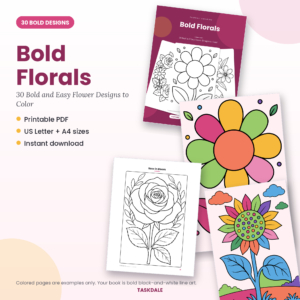
Bold Florals Flower Coloring Book
Price: $3.49 | Best for: beginners moving on from mandalas
Bold Florals has 30 easy flower designs with thick outlines and big petals, including wreaths, a floral heart, a bluebell arch, a sunflower and a spring bouquet. It comes as 41-page US Letter and A4 PDFs with a clickable contents page, design gallery, color test page and palette planner, for personal use. Pick a wreath design first, since it colors much like a mandala ring.
The second step is cozy scenes. A reading nook, a cat by the fire, a little bakery. These teach you to color objects, not just shapes, and they are a nice change on evenings when patterns feel repetitive.
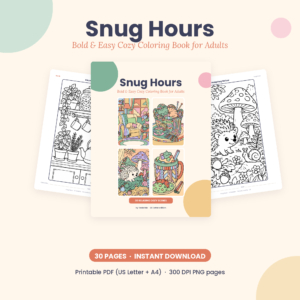
Snug Hours Bold and Easy Cozy Coloring Book
Price: $5.99 | Best for: beginners who want cozy scenes
Snug Hours has 30 bold and easy cozy pages, from a sleeping cat in a reading nook to a rainy window seat and a snowy log cabin, each designed to finish in one sitting. You get US Letter and A4 PDFs, 300 DPI PNG pages on white and transparent line art for tablet apps with layers, plus a color test page, six palette ideas, a coloring tracker and sample colorings, for personal use. Print the reading nook page for a quiet Sunday afternoon.
Want to try something completely different? Reverse coloring, where the color is already on the page and you draw the lines, is a fun experiment. Our post on reverse coloring book examples explains how to start.
Frequently asked questions
What is the easiest mandala to color for a beginner?
A sun mandala with one center circle and one or two rings of rays. It has few, large shapes and finishes in about 20 minutes.
Do I need special pencils to color mandalas?
No. A set of 24 basic colored pencils and a sharpener is plenty to start. Upgrade later once you know what you enjoy.
How long does it take to color an easy mandala?
Most bold, easy mandalas take 20 to 45 minutes. Intricate ones can take several evenings.
Should I start coloring a mandala from the center or the outside?
Many beginners find the center easiest, working outward ring by ring. It gives a clear sense of progress. There is no wrong way, though.
How many colors should I use on a mandala?
Three to five colors look calm and balanced. Use one color per ring as a simple starting scheme.
Your next step
Tonight, grab any three colored pencils from a drawer and print one simple sun mandala. Color one slice, then copy it round. When you want a whole set of beginner-friendly designs in the right order, start with the Easy Mandala Coloring Book and its Smiling Sun page.