The essential coloring stuff fits in a shoebox: a set of pages you like, 24 to 36 colored pencils, a good sharpener, decent paper, a handful of fineliners or markers, and a folder to keep finished pages flat. That is it. Everything else in the craft aisle is a nice extra you can add once you know how you like to color.
This guide is for adults picking up coloring for the first time, or coming back to it after years away, and for parents putting together a kit for a child. We will go through each supply, why it matters, what to look for, and what you can skip. There is a simple starter kit list near the end, and a kids’ version, so you can shop once and start coloring the same evening.
Quick picks: pages to start with
| Product | Best for | Price | Link |
|---|---|---|---|
| Easy Mandala Coloring Book | Adult beginners who want calm, bold patterns | $3.49 | View |
| Snug Hours Cozy Coloring Book | Cozy scenes with a color test page and palettes | $5.99 | View |
| Pretend Play Coloring Book | Kids who love dress-up and make-believe | $2.99 | View |
| Friendship Fun Coloring Book | Kids who like scenes of friends and play | $2.99 | View |
1. Pages you actually want to color
Start here, not with the pencils. The page decides which tools you need. A bold, open design works with almost anything, even crayons. A dense, detailed page needs sharp pencils or fine pens.
For a first book, choose bold or easy designs. Large shapes give you quick wins and let you learn how your pencils behave without squinting. After five or six finished pages, you will know whether you want more detail or are happy with the calm, bold style.
Printable books are handy for beginners for one reason above all: you can print the same page again. Ruin a page while testing a new marker? Print another. Want to try two color schemes on one design? Print two.
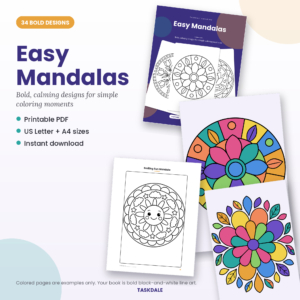
Easy Mandala Coloring Book
Price: $3.49 | Best for: adult beginners wanting easy wins
Easy Mandala has 34 bold mandalas with thick outlines and open spaces, such as a petal sun, a daisy circle, a heart bloom and a butterfly wings design. It comes as separate US Letter and A4 PDFs, with a clickable contents page and picture gallery. Print one page on ordinary paper and use it to test every pencil in your new set.
2. Colored pencils: the one tool to get right
If you buy only one coloring tool, make it colored pencils. They are clean, quiet, portable and forgiving. You can press lightly for soft color or harder for bold color, and you can layer one over another to mix new shades.
How many colors?
Twenty-four to 36 is the sweet spot for beginners. Fewer than 24 and you will miss in-between shades like a soft peach or a teal. More than 72 and the choice gets overwhelming, with many colors you will never touch.
Soft or hard core?
Soft-core pencils lay down rich color and blend easily but wear down faster. Hard-core pencils hold a sharp point for fine detail but feel scratchier. For a first set, a mid-range soft core is the most enjoyable to use.
Student or artist grade?
Student-grade sets are cheaper and fine for learning. Artist-grade pencils carry more pigment and blend better, which you will notice after a few months. A good path: start with a student set, then replace your most-used colors with artist-grade singles as they run out.
One quick test when a new set arrives: color a small square of each pencil on scrap paper and write the color number beside it. That swatch sheet saves a lot of guessing, because pencil barrels rarely match the color they put down.
3. A sharpener that does not eat pencils
Cheap sharpeners break leads, which wastes pencils and is maddening mid-page. A sharp blade is worth more than any other small upgrade.
- Handheld metal sharpener. Small, cheap, effective. Replace the blade or the sharpener once it starts chewing.
- Two-hole sharpener with a shavings box. One hole for standard pencils, one for thick ones. The box keeps your table clean.
- Electric or hand-crank desk sharpener. Fast and even, good if you color a lot. Some eat soft-core pencils quickly, so look for one with an auto-stop.
Sharpen gently, turning the pencil rather than the sharpener, and stop as soon as the point forms. Over-sharpening is where most pencil length disappears.
4. Paper that suits your tools
If you print your pages, paper is part of your supply list. Standard 20 lb copy paper is fine for pencils and crayons. It struggles with markers, which bleed through, and with heavy layering, which wears the surface.
| You color with | Print on |
|---|---|
| Colored pencils, crayons | 20 lb to 28 lb bright white |
| Water-based markers, fineliners | 28 lb to 32 lb smooth |
| Alcohol markers | 65 lb to 110 lb smooth cardstock |
| Gel pens on top of color | Any of the above, let dry before touching |
Buy one pack of 28 lb or 32 lb bright white paper to start. It handles pencils and most markers well, and it makes printed lines look noticeably darker than cheap copy paper does.
5. A small set of fineliners or markers
Markers are not essential, but they are fun and fast. They give smooth, saturated color that pencils take many layers to match.
Fineliners
Thin felt-tip pens with a fine point. Brilliant for small spaces, patterns and detailed pages. A set of 10 to 20 is plenty. They are water-based, so print on slightly heavier paper to stop bleeding.
Dual-tip water-based markers
A broad tip for filling and a fine tip for edges. Good for bold pages. Choose a set with a range of light and dark colors, not just bright primaries.
Alcohol markers
Rich, streak-free color that blends beautifully. They are also the priciest and bleed through almost any paper, so they need cardstock and a scrap sheet underneath. Wait on these until you know you love coloring.
For a fuller comparison, our guide to the best adult coloring book markers goes through the main types and the paper each one needs.
6. Small extras that earn their place
A few cheap extras make coloring easier and more fun. None is essential, but each solves a real problem.
- White gel pen. Adds sparkle and highlights at the end: a glint in an eye, a dewdrop, a star.
- Colorless blender pencil. Smooths layered pencil color and fills white flecks. One pencil lasts ages.
- Kneaded eraser. Lifts a little pencil color without damaging the paper. Regular erasers tend to smear colored pencil.
- Clipboard. Turns any chair or sofa into a coloring spot, and keeps loose printed pages flat.
- Pencil case or cup. Keeps pencils point-up so the tips stay sharp.
- Daylight lamp. Evening light makes colors look yellow. A daylight bulb shows true colors and is easier on the eyes.
What to skip at the start
Craft shops are full of tempting coloring gear. Most of it can wait.
- Giant 120-color sets. You will use about 30 of them. Start smaller and add.
- Watercolor pencils. Lovely, but they need special paper and a brush. Try them in month three.
- Solvent blending kits. An advanced technique. Learn layering first.
- Specialty paper packs. Ordinary 28 lb bright white paper covers most needs.
- Every new book that catches your eye. Finish a few pages in the first one before buying the next five. You will learn which style you actually enjoy.
Skipping these keeps your first kit small and cheap. That matters: a beginner who spends a fortune and then feels guilty about an unused tin of pencils is less likely to keep coloring.
A simple beginner kit, all in one list
- One bold or easy printable coloring book
- A pack of 28 lb or 32 lb bright white printer paper
- 24 to 36 soft-core colored pencils
- A metal handheld sharpener with a shavings box
- A small set of fineliners, 10 to 20 colors
- A white gel pen
- A colorless blender pencil
- A clipboard and a plain folder for finished pages
That kit handles bold pages, cozy scenes and moderately detailed designs. Once you have finished ten pages, you will know exactly what to add next.
A cozy book with built-in helpers is a gentle place to use that kit for the first time.
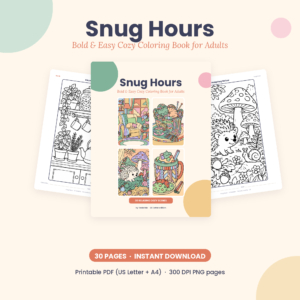
Snug Hours Cozy Coloring Book
Price: $5.99 | Best for: beginners who like warm, cozy scenes
Snug Hours has 30 bold, easy pages of everyday comfort, such as a cat in a reading nook, a bakery counter and a garden tea party. Inside the US Letter and A4 PDFs you also get a color test page, six palette ideas and a coloring tracker, plus 300 DPI PNG pages for tablets. Swatch your new pencils on the color test page before you start the first scene.
A starter kit for kids
Children need even less, and simpler versions of the same things.
- Chunky crayons or washable markers for under-fives, colored pencils with thick barrels from about five or six.
- A twin-hole sharpener that fits both thin and thick pencils.
- Plain printer paper, since kids go through pages quickly.
- A box or caddy they can carry to the table themselves. Owning the box is half the fun.
- Pages with stories in them, so coloring turns into talking and playing.
Scenes built around play hold children’s attention much longer than single objects, because there is something to imagine while they color.
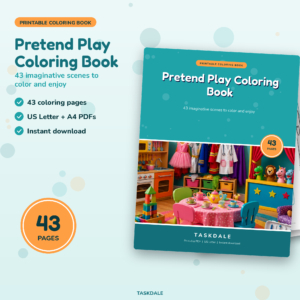
Pretend Play Coloring Book
Price: $2.99 | Best for: kids who love make-believe
Pretend Play has 43 detailed scenes built around jobs and adventures, including a toy kitchen chef, a firefighter rescue, a doctor visit, a pirate ship captain, a space explorer and an ice cream parlor. Each page holds one large picture in a rounded frame, cleaned up so lines print dark. Print the toy kitchen page and ask your child what the chef is cooking.
Setting up a spot to color
Where you color affects how often you color. A small, ready spot gets used far more than a kit that lives in a cupboard.
Pick one place: the end of the kitchen table, a tray on the sofa, a corner of a desk. Keep the pencil cup, sharpener and current page there. Good light from the side, not behind you, stops your hand casting a shadow on the page. A cushion or footrest makes a long session comfortable.
Many beginners find a small routine helps. Fifteen minutes after dinner, or twenty minutes with a cup of tea on Sunday afternoon. The routine does the deciding for you, and the page gets finished. If you want quick pages to fill those short sessions, our round-up of free coloring sheets for adults is a good place to look.
Looking after your supplies
A little care makes a modest kit last for years. Most of it takes seconds.
- Store pencils flat or point-up. A tin dropped on a hard floor can shatter the leads inside every pencil, and you will not know until each one keeps snapping as you sharpen.
- Cap markers the moment you put them down. An uncapped fineliner can dry out in an afternoon.
- Store markers flat. Dual-tip markers stored on one end push all the ink toward that tip.
- Keep paper in its wrapper. Paper left out absorbs moisture and curls, which can jam printers.
- Empty the sharpener box often. A full box jams the blade and breaks points.
Every few months, sort through the pencil cup. Move stubs too short to hold into a small jar for a child, a grandchild or a crafty day. It is satisfying to see how much you have colored.
Frequently asked questions
What do I need to start adult coloring?
A coloring book or printable pages, 24 to 36 colored pencils, a good sharpener and decent paper if you print. A few fineliners and a white gel pen are nice optional extras.
Are colored pencils or markers better for beginners?
Colored pencils. They are forgiving, let you control how light or dark the color is, and do not bleed through paper. Add markers once you know you enjoy coloring.
How many colored pencils does a beginner need?
Between 24 and 36. That gives enough in-between shades without an overwhelming choice. Replace favorites as they wear down.
What paper should I print coloring pages on?
A 28 lb or 32 lb bright white printer paper works for pencils and most markers. Use cardstock if you color with alcohol markers.
What coloring supplies are good for kids?
Chunky crayons or washable markers for young children, thick-barreled colored pencils from about five, a twin-hole sharpener, plain paper and a carry box they can call their own.
Why do my colored pencils keep breaking when I sharpen them?
Usually the leads cracked inside the barrel after a drop, or the sharpener blade is dull. Try a fresh metal sharpener and turn the pencil gently. If one pencil keeps snapping, the lead is likely broken all the way through.
Your next step
Print one page from the Easy Mandala Coloring Book, sharpen six pencils, and color for 15 minutes tonight. Use the finished page to decide what your kit needs next. You might find you already have everything.