Food prep plans for lunches and dinners work when you prep parts, not just finished meals. Cook a tray of protein, a pot of grains and two trays of vegetables, and you can build five lunches and four dinners that do not all taste the same. Prepping seven identical boxes of chicken and broccoli is how most people quit by week two.
The good news: one two-hour session on a Sunday, or split across two evenings, covers most of the week. You come home on Wednesday to a dinner that takes ten minutes to finish instead of forty-five to start. That feels great. It also stops the 1 pm sandwich run that costs twice what a home lunch does.
This guide gives you two styles of prep to choose from, a two-hour session timed minute by minute, a container plan, how long food keeps, a version for families, and the mistakes that make prepped food boring. It suits office workers, parents, students and shift workers who want the week’s food mostly sorted before Monday.
Quick picks: planners with a meal prep page
| Product | Best for | Price | Link |
|---|---|---|---|
| Fresh Week Meal Planner Printable Bundle | A prep day timeline and portion plan on paper | $2.99 | View |
| Prep & Plenty Weekly Meal Planner Spreadsheet | A grocery list that writes itself from your prep plan | $31.99 | View |
| Plate & Plan Weekly Meal Planner Printable | Cook list, prep timeline and portions table you can type into | $2.00 | View |
Two ways to prep: components or full meals
Before you cook anything, decide which style suits your week. Many people mix both.
Component prep
You cook building blocks: a protein or two, a grain, roasted vegetables, a sauce. Each day you put them together in a different way. Monday is a rice bowl. Tuesday the same chicken goes into wraps. Wednesday the roasted veg becomes a pasta sauce. This keeps food interesting and is the better choice for dinners, because you can finish them fresh in ten minutes.
Full-meal prep
You cook complete dishes and portion them into boxes: a chili, a curry, a pasta bake. Grab and go. Best for lunches, where you want zero thinking at 7 am, and for nights you know you will come home wiped out.
The mixed approach
For most households, the sweet spot is full meals for lunches and components for dinners. You get the speed of grab-and-go at midday and the variety of a freshly assembled dinner in the evening.
Plan the menu before you shop
Prep goes wrong when you start cooking without a plan. Ten minutes with a page and a pen on Saturday saves an hour of muddling on Sunday.
- Count the meals. How many lunches? How many dinners at home? A couple both working office days might need ten lunches and four home dinners.
- Pick two proteins. One for lunches, one for dinners, or both shared. Chicken thighs and a lentil and beef chili, say.
- Pick one grain and one starchy veg. Rice and sweet potatoes cover a lot of ground.
- Pick two vegetable trays. One for roasting, one for raw crunch: peppers and broccoli to roast, carrots and cucumber to slice.
- Pick one sauce. A yogurt-garlic dip, peanut sauce or a simple vinaigrette. Sauce is what stops day four tasting like day one.
- Write the shopping list from that.
Writing it all out by hand works. So does a spreadsheet that takes the week’s meals and builds the list, subtracts what is in the fridge and rounds up to the pack sizes you actually buy. That second option is handy when you are prepping for a family and the quantities get big.
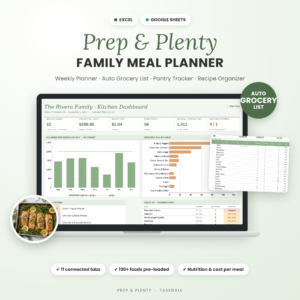
Prep and Plenty Weekly Meal Planner Spreadsheet
Price: $31.99 | Best for: families who prep in bulk
A family meal planner for Excel and Google Sheets. Pick meals for the week and it builds an aisle-sorted grocery list rounded to pack sizes, subtracts what is in your fridge, freezer and pantry, and shows calories, macros and estimated cost per day. It has a pantry inventory with use-by alerts and a use-it-up list, plus 130+ common foods pre-loaded with pack sizes. Add your prep-day recipes first, then plan the week around them.
A two-hour prep session, minute by minute
This plan makes five lunches for one person and four dinners for two. Double the trays for a family. Put a podcast on. It goes quicker than you think.
| Time | Task |
|---|---|
| 0:00 | Oven to 425°F (220°C). Rice on the stove. Kettle on for later. |
| 0:05 | Chop sweet potatoes, peppers, red onion and broccoli. Two trays, oil, salt. |
| 0:20 | Veg trays in the oven. Season 2 lb (about 1 kg) of chicken thighs on a third tray. |
| 0:25 | Start the chili: onion, garlic, ground beef, canned lentils, tomatoes, spices. |
| 0:40 | Chicken in the oven. Rice done; spread it on a plate to cool fast. |
| 0:50 | Make the sauce: Greek yogurt, garlic, lemon, salt. Slice carrots and cucumber. |
| 1:05 | Pull veg trays. Chili on low. Boil six eggs. |
| 1:15 | Pull chicken. Rest it, then slice half and leave half whole. |
| 1:25 | Pack five lunches: three chili and rice, two chicken grain bowls. |
| 1:40 | Pack dinner components into larger tubs: chicken, veg, rice, sauce. |
| 1:50 | Cool the rest of the chili, freeze two portions. Wash up. |
At 2:00 you are done. The fridge is full of labeled boxes, the oven is off, and the week ahead looks a lot calmer. If this is your very first prep, try the shorter session in meal prep for beginners before this one.
Turning prepped parts into four different dinners
Here is how the same tubs become four meals that each feel like dinner, not leftovers.
- Monday: chicken rice bowls. Warm chicken and rice, roasted veg on top, a big spoon of the yogurt sauce, sliced cucumber. Five minutes.
- Tuesday: chicken wraps. Warm tortillas, sliced chicken, raw carrot and cucumber, sauce, a handful of salad. Eight minutes.
- Wednesday: roasted veg pasta. Blend half the roasted veg with a splash of pasta water into a sauce; toss through pasta with a little cheese. Fifteen minutes.
- Thursday: chili-topped sweet potatoes. Microwave two sweet potatoes, top with a portion of chili and a spoon of yogurt. Ten minutes.
Friday is open. Leftovers, takeout, eggs on toast. Leaving one night unplanned is not a failure; it is the release valve that keeps the plan going next week.
A lunch formula you can repeat
For lunches, one simple pattern covers almost any week: grain plus protein plus one cooked veg plus one raw veg plus sauce on the side. Rice, chicken, roasted peppers, cucumber, yogurt sauce. Next week: quinoa, chickpeas, roasted squash, shredded cabbage, peanut sauce. Change one or two parts each week and the boxes never feel stale, yet the shopping and cooking pattern stays almost the same.
Containers, labels and a portion plan
Good containers make a surprising difference. Boxes that leak or stack badly turn prepping into a chore.
- Lunch boxes: five matching glass or BPA-free plastic boxes, ideally microwave-safe with clip lids. Matching sizes stack neatly.
- Dinner tubs: two or three large containers for components.
- Sauce pots: small lidded pots so dressing does not soak into everything.
- Freezer bags: flat bags for chili and soup. They freeze fast and stack like files.
- Labels: masking tape and a marker. Write the dish and the date.
A portion plan on paper helps you split food evenly so Friday’s box is not half the size of Monday’s. Write down how many portions of each dish you need, then tick them off as you pack. It sounds fussy, but it stops the classic mistake of eating three portions of chili by Tuesday and having nothing left for Thursday.
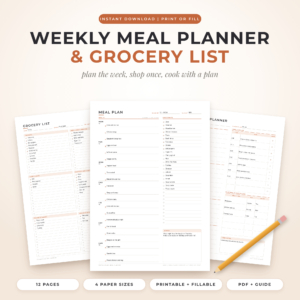
Plate and Plan Weekly Meal Planner Printable
Price: $2.00 | Best for: meal preppers who like a checklist
A 12-page planner in A4, US Letter, A5 and Half Letter, each as a printable PDF and a fillable PDF. It includes a Meal Prep Planner with a cook list, prep timeline, tick boxes and a portions table, plus weekly meal plans, a grocery list by aisle, a pantry and freezer check and a Meal Ideas Bank with a 15-minute meals list. Fill in the Meal Prep Planner on Saturday, then shop from the grocery page.
How long prepped food keeps
Most cooked food is good in the fridge for three to four days. That is why a single Sunday session usually covers Monday to Wednesday or Thursday, and anything for later goes in the freezer.
| Food | Fridge | Freezer |
|---|---|---|
| Cooked chicken, beef or pork | 3 to 4 days | 2 to 3 months |
| Chili, stews, curries, soups | 3 to 4 days | 2 to 3 months |
| Cooked rice | Up to 3 days, cooled quickly | About 1 month |
| Roasted vegetables | 3 to 4 days | Best fresh, OK in soups |
| Hard-boiled eggs (in shell) | Up to a week | Not recommended |
| Yogurt-based sauces | 3 to 4 days | Not recommended |
Cool cooked food quickly before it goes in the fridge. Spreading rice on a plate or splitting chili into shallow tubs gets it cold faster than leaving a deep pot on the stove. When in doubt, throw it out.
Reheating without rubbery chicken
Add a splash of water or sauce before microwaving, cover the box loosely and heat in two shorter bursts with a stir between. Grain bowls with cold toppings, like cucumber and dressing, are best with those toppings packed separately and added after heating.
A family version of the plan
Prepping for four or five people is the same process with bigger trays and one extra rule: build meals in parts so each person can assemble their own. A teenager who wants extra rice takes extra rice. A picky eight-year-old has plain chicken and cucumber while the adults add sauce and roasted peppers. Same prep, no separate kids’ dinner.
Families also benefit most from writing the plan where everyone can see it. When the plan says Tuesday is wraps, the kids know, and the question “what’s for dinner?” goes away. If you are cooking for a mix of fussy and adventurous eaters, our guide to family meal planning when half the table is picky has more ideas.
Printed planning pages on the fridge help here. One with the week’s meals, one with the prep timeline for Sunday, one with what is in the freezer. A bigger household can also split the prep: one adult on vegetables, one on proteins, a teenager on washing up and labeling.
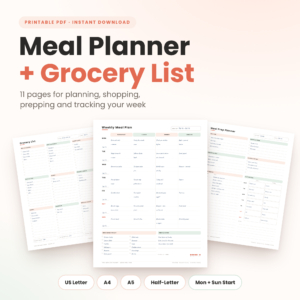
Fresh Week Meal Planner Printable Bundle
Price: $2.99 | Best for: households planning prep on paper
Eleven printable pages in US Letter, A4, A5 and Half-Letter PDFs, with Monday and Sunday start versions. The Meal Prep Planner covers what to cook, a timeline for prep day and a portion plan for lunches and dinners, alongside a weekly meal plan, grocery lists, a 72-item Master Shopping Checklist and a Pantry, Fridge and Freezer Inventory. Print the Meal Prep Planner and the weekly plan together and stick both on the fridge.
Food prep mistakes to skip
- Prepping seven days of fresh food. By Saturday it is past its best. Prep three or four days and freeze the rest.
- One flavor all week. Same chicken, same seasoning, five days running. Use two sauces or two spice mixes.
- Dressing everything in advance. Salads go soggy. Keep sauces in separate pots.
- Cooking pasta for later. It turns soft. Cook pasta fresh; it only takes ten minutes.
- No prep for dinner at all. Many people prep lunches and still scramble at 6 pm. Even chopping two onions and marinating tomorrow’s chicken counts.
- Skipping the freezer. A few frozen portions are your safety net for the week the plan collapses.
Frequently asked questions
How do I meal prep lunches and dinners for the week?
Plan the meals, then cook two proteins, one grain, two trays of vegetables and a sauce in one session. Pack lunches as complete meals and store dinner parts separately so you can assemble different meals each night.
How long does meal prep last in the fridge?
Most cooked meals keep three to four days in the fridge. Freeze anything you plan to eat on day five or later.
What foods are best for meal prep?
Chicken thighs, ground meat dishes like chili, lentils and beans, rice and other grains, roasted root vegetables, hard-boiled eggs and sturdy raw veg like carrots and cabbage all hold up well.
Is it better to prep full meals or ingredients?
Full meals are best for grab-and-go lunches. Prepping ingredients gives more variety at dinner, because you can combine them differently each night. Many people do both.
How much time does meal prep take?
About two hours for five lunches and four dinners for two people, including washing up. A first session often takes longer, and it gets faster each week.
What can I prep if there is no microwave at work?
Pack lunches that taste good cold: grain salads with a dressing on the side, pasta salad, wraps, cold chicken with hummus and crunchy veg, or soup in a good insulated flask filled with boiling-hot soup in the morning.
Your next step
Pick one two-hour slot this weekend. Before then, write down two proteins, one grain, two vegetable trays and one sauce, and shop for only those. On the day, follow the timeline above and pack lunches first. To plan the session and portions on paper, print the Plate & Plan Weekly Meal Planner Printable.