A coloring page becomes a game the moment you add a rule. “Color every space with a 3 in it red.” “Roll the dice and color that many apples.” “Color the thing that starts with the sound mmm.” Same paper, same crayons. Now a 4-year-old is counting, listening and following directions while thinking they are just playing.
This guide is for parents, preschool teachers and homeschoolers who want coloring time to pull double duty. You will find games grouped by the skill they build: numbers, shapes, letters and talking. Each one has a quick setup and a note on age. We also cover how to turn any plain page into a game with a dice or a spinner, how to tell when a game is too hard, and which printable sets on Taskdale come ready to play.
Quick picks: coloring pages built for learning games
| Product | Best for | Price | Link |
|---|---|---|---|
| Hop to Ten Color by Number for Kids | Number games from 1 to 10 | $4.49 | View |
| Crayon Campus Preschool Learning Coloring Worksheets | Shapes, matching and simple science | $4.99 | View |
| Letter Parade Alphabet Coloring Book A to Z | Letter sound games | $3.99 | View |
| Little Explorers Preschool Coloring Book | Talking and feelings games for ages 2 to 5 | $3.49 | View |
What turns a coloring page into a learning game
Every good game has three parts. A rule, a goal and a way to know you won. Coloring pages already have the goal (a finished picture). Add the other two and you have a game.
- The rule tells the child what to color and how. “Only color the circles.” “Use the color the number tells you.”
- The goal is the finished picture, or a target like “five apples colored”.
- The check lets the child see if they got it right. A finished answer picture to compare, a parent counting along, or a hidden picture that only appears if the rule was followed.
The check is the bit most people skip, and it matters most. When a child colors a color-by-number page and a ladybug appears, they did not need you to tell them they were right. The page told them. That small “I did it” feeling is what brings them back tomorrow.
Which game builds which skill
Here is a quick map of the games in this guide, so you can pick by what your child needs right now.
| Game | Main skill | Good from age |
|---|---|---|
| Color by number | Number recognition, color words | 3 |
| Roll and color | Counting objects | 3 |
| Color by answer | Adding and taking away within 10 | 5 |
| Shape detective | Naming shapes | 3 |
| Color the order | Sequencing, life cycles | 4 |
| Sound detective | First letter sounds | 4 |
| Letter rainbow | Letter recognition | 3 |
| Feelings color | Naming emotions, talking | 3 |
| Big and small | Comparing size, describing | 2 |
Number games: counting with crayons
Color by number
Each space has a number. A key at the bottom matches each number to a color. The child finds a number, checks the key, picks the crayon and colors. A picture slowly appears. It is the classic for a reason: a 3-year-old reads the numeral 4 about twenty times in one sitting without noticing it is practice.
Roll and color
Take any page with lots of small repeated things: apples on a tree, spots on a ladybug, stars in a sky. Roll a dice. Color that many. Roll again. The first person to color everything wins. For 3-year-olds, use a dice with only 1, 2 and 3 (cover the other faces with stickers).
Color by answer
This is color by number with a twist. Instead of a 5, the space says 2+3. The child works out the answer, then uses the crayon for 5. It suits kindergarten-age children who already know their numbers to 10 and are ready for simple sums.
A book that moves step by step from 1 to 5, then up to 10, then on to sums keeps the game growing with your child.
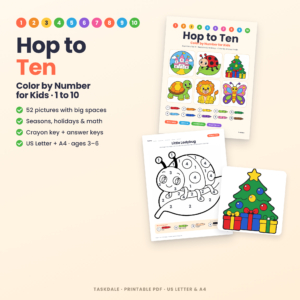
Hop to Ten Color by Number for Kids
Price: $4.49 | Best for: ages 3 to 6 learning numbers
Hop to Ten has 52 original color by number pictures using only the numbers 1 to 10, in five parts from easy to harder: numbers 1 to 5, 6 to 10, mixed numbers, seasons and holidays, and 10 color-by-answer pages with addition and take-away within 10. Every page has a crayon key with plain color names, a name line and a full-color finished picture to check against. It comes as US Letter and A4 PDFs with a one-teacher classroom licence. Start with Part 1, the ladybug page, and let your child check the finished picture on their own.
Want more ideas for number pages? Our guide to color by number pages for preschool math goes deeper on picking the right level.
Shape and science games: looking closely
Shape detective
Give your child a page with a scene: a house, a playground, a train. Call out a shape. “Find every circle and color it blue.” Then “Find every triangle and color it yellow.” The picture fills up as they hunt. Wheels, windows, roofs and doors suddenly become shapes, and your child starts spotting them on real buildings on the walk home.
Color the order
Sequencing pages show steps out of order: an egg, a chick, a hen. Or a seed, a sprout, a flower. The game: color the first step green, the second yellow, the third red, like a traffic light. Then cut them out and line them up. This builds the idea that things happen in an order, which helps later with stories, routines and simple science.
Weather match
Show a weather page in the morning. Look outside. “Color the picture that matches today.” Check again after lunch. Did it change? Children love being weather reporters.
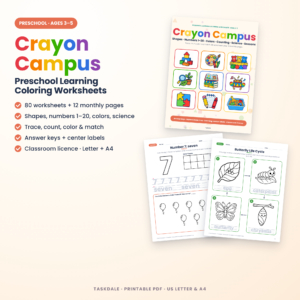
Crayon Campus Preschool Learning Coloring Worksheets
Price: $4.99 | Best for: preschool shape and science games
Crayon Campus has 80 one-skill worksheets including 12 shape pages, two color-by-shape pictures, matching pages and 12 simple science pages covering weather, plant parts, four life cycles (plant, butterfly, frog and chicken) and a sequencing page, plus 12 seasonal monthly pages. It includes answer keys, a skills checklist and a certificate, printable in US Letter or A4 with a classroom licence for one teacher. Try a color-by-shape picture first, then move on to the butterfly life cycle for color the order.
For more science-themed pages and ideas, see our guide to coloring worksheets for science.
Letter and sound games: listening while coloring
Sound detective
Lay out three letter pages, say B, M and S. Say a word slowly: “mmmoon.” Your child points to the M page and colors a part of its picture. Next word: “sssun.” They color part of the S page. Keep going until all three pictures are done. It trains the ear to hear first sounds, which is the first step toward reading.
Letter rainbow
On a page with a big hollow letter, your child traces around the inside edge in red, then orange, then yellow, building a rainbow inside the letter. Each trip round the letter is another practice of its shape. Five laps feels like art, not drill.
Letter hunt race
Use a page full of mixed letters. Set a sand timer or a one-minute song. How many of one letter can they find and color before it ends? Count them together. Next time, try to beat it.
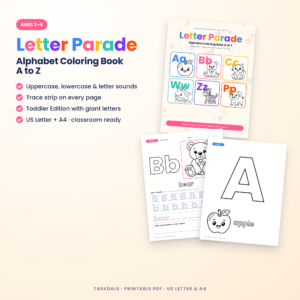
Letter Parade Alphabet Coloring Book A to Z
Price: $3.99 | Best for: pre-readers aged 3 to 6
Letter Parade gives each letter a page with a big uppercase and lowercase letter, a picture that starts with that sound, the word and three trace rows with a start dot. It adds three Letter Hunt pages (find B, M and S), four Match Big and Small pages, an alphabet chart and a Toddler Edition with one giant letter per page, in US Letter and A4 PDFs. The licence covers personal use and one teacher’s classroom. Print the B, M and S pages for a first round of sound detective.
Talking games: words, feelings and stories
Some of the most useful games are not about letters or numbers at all. They are about talking. A child who can say “the bear is bigger than the bunny” or “the balloon looks sad” is building the vocabulary that reading leans on later.
Feelings color
Use a page with faces, like balloons or animals with different expressions. Ask: “What color is happy? What color is cross?” There is no right answer. Your child picks a color for each feeling and tells you why. You might hear that grumpy is brown “because it’s muddy”. Perfect. They are naming feelings and explaining a choice.
Big and small
Find a page with animals of different sizes. “Color the biggest one first. Now the smallest.” Then flip it: “Which one would fit in your pocket?” Lots of giggling, lots of comparing words.
Tell me what happens next
Once a page is finished, ask what the character does next. The puppy just caught the ball. Then what? Write their answer at the bottom of the page. Kids are thrilled to see their own words written down, and you get a lovely keepsake.
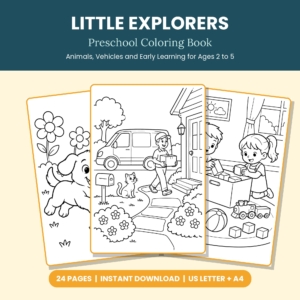
Little Explorers Preschool Coloring Book
Price: $3.49 | Best for: toddlers and preschoolers aged 2 to 5
Little Explorers has 24 pages with thick outlines in three themes: Friendly Animals, Busy Vehicles and an Early Learning section with Counting Ducks, Shape Playground, Bead Pattern, Big and Small Animals, Feelings Balloons and Animal Homes. You get US Letter and A4 PDFs plus every page as a separate PNG, licensed for personal, family and classroom use. Start with Feelings Balloons and let your child pick a color for each face.
Turn any plain page into a game
You do not need special pages for every game. A dice, a spinner or a timer turns almost any coloring page into play.
- Color dice. Stick colored dots on the six faces of a wooden block. Roll it, then color one part of the picture in that color. No choosing, just luck, which some kids find funny and freeing.
- Paper spinner. Draw a circle split into four, color each slice, and spin a paper clip on a pencil point in the middle.
- Take turns. You color one part, your child colors the next. Talk about what you are each coloring as you go.
- Mystery instruction cards. Write simple tasks on cards: “color something round”, “color the biggest thing”, “use your favorite color”. Draw one at a time.
- Freeze color. Play music. Color while it plays. Stop when it stops. Great for listening and self-control.
Signs a game is too hard, or too easy
Watch your child for the first two minutes. Their body tells you everything.
Too hard looks like scribbling over the whole page, asking “Is it done?” every 30 seconds, or sliding off the chair. Step back a level. Fewer numbers, bigger spaces, one rule instead of two.
Too easy looks like rushing through without looking at the rule, or getting bored half way. Add a twist: a timer, a second rule, or a turn-taking rule with you.
Just right looks like a quiet, focused child who calls you over to show what they have done. That is the moment you are after. A face lit up with “Look, it’s a whale!” is worth more than a perfect page.
Screen-based coloring games can be fun too, especially on car trips. Our roundup of coloring games online covers some free picks, but paper still wins for grip strength and for games where you sit side by side.
Frequently asked questions
Are coloring pages educational for preschoolers?
They can be, especially when you add a rule or a question. Color by number builds number recognition, letter pages build sound awareness, and talking about a page builds vocabulary.
What age can kids do color by number?
Most children can try simple color by number with numbers 1 to 5 from about age 3. Pages with sums suit ages 5 and up.
How long should a coloring learning game last?
Ten to fifteen minutes is plenty for ages 3 to 5. Stop while your child is still enjoying it, so they want to play again.
How do I make a coloring page into a math game?
Roll a dice and color that many objects, or write small sums in the spaces and match each answer to a color. A picture appearing is the reward.
Can coloring games help with reading?
Games that link a letter to its sound, like sound detective, build the listening skills early reading depends on. They are a gentle warm-up, not a reading program.
Your next step
Pick one game from the table above that matches what your child is working on this month, and play it once tomorrow for ten minutes. Notice which part made them smile. If numbers are the focus, the easy first part of Hop to Ten is a ready-made place to start.