The call-out charge is the line customers question most on a plumber’s invoice. Not because it is unfair, but because nobody explained what it covered. Put the call-out on its own line, say what is included, list every part you fitted, and the invoice stops being a talking point and starts being a payment.
This guide is for sole-trader plumbers, small plumbing and heating firms, and handymen who take on plumbing jobs. You will find what a plumbing invoice template with call-out and parts lines should show, how to word the call-out so it is clear, how to bill parts from the van, how to handle out-of-hours work, a fully worked burst pipe example, and the Taskdale templates that do the totals for you.
Quick picks
| Product | Best for | Price | Link |
|---|---|---|---|
| Ledgerline Invoice, Quote and Receipt Kit | Fast invoices from a saved price list of call-outs and parts | Original price was: $3.00.$1.50Current price is: $1.50. | View |
| QuoteBloom Price Quote Template | Quoting bathroom fits and boiler swaps before the work | $4.99 | View |
| PaidPath Client and Invoice Hub | Landlords, agents and repeat customers with running balances | $9.49 | View |
| Ledgerline Business Forms Kit | Printed invoice and receipt pads for the van | $2.99 | View |
What the call-out charge covers, and how to word it
A call-out fee pays for getting to the job: fuel, travel time, the van, the tools you carry and the fact that you turned up at all. Many plumbers include a set amount of labour in it, often the first 30 minutes or the first hour. Others charge it purely for attendance and bill all labour on top.
Either way works. The problem is when the invoice just says “Call-out: 75.00” and the customer has no idea whether that included the 40 minutes you spent under their sink. So spell it out on the line itself:
- “Call-out, weekday daytime, includes first hour on site”
- “Call-out, attendance only, labour charged separately”
- “Emergency call-out, Saturday 7:40pm, includes first hour”
Short. Plain. And it answers the question before the customer picks up the phone.
When you attend but cannot fix it
Sometimes you arrive, find the problem needs a part you do not carry, and have to come back. Say so on the invoice. “Call-out and diagnosis, fault traced to failed diverter valve, part ordered.” The customer then sees why they are paying for a visit that did not end in a working boiler, and the second visit makes sense.
Setting the call-out figure
Work out what an average trip really costs you. Say your round trip is 40 minutes, fuel and van running costs come to about 8.00 a trip, and you want the first half hour on site covered. Add your hourly rate for that time to the running costs and you have a floor. Anything under it means every small job loses money before you pick up a spanner. Review the figure each January, when fuel and insurance renewals tend to land.
Billing parts from the van
Most plumbing jobs use parts you already carry: compression fittings, isolation valves, washers, a length of copper or plastic pipe, PTFE tape. Then there are parts you order for the job, such as a specific cistern mechanism or a thermostatic mixer.
Van stock
List each part you fitted with a quantity and a price. “15mm compression elbow, 2, at 4.20.” Small sundries like tape, jointing compound and wire wool can go on one line: “Sundries and consumables, 4.00.” Keep that line the same on every job so it looks like policy, not a guess.
Ordered parts
Give these their own lines with the make and model where it helps: “Thermostatic bar mixer, chrome, 1.” If you collected it from the merchant, you can add a short collection charge or build it into the price. Keep the merchant receipt with the job.
Markup on parts
Charging a margin on parts is normal in the trade. It covers your time buying them, the van space and the parts that sit unused for months. Build it into the unit price so the customer sees one clean figure per item, and apply the same approach every time.
The fastest way to keep part prices consistent is a saved price list. Enter your standard call-outs, labour rates and the 30 parts you fit most, and each invoice becomes a few picks from a list instead of a hunt through old paperwork.
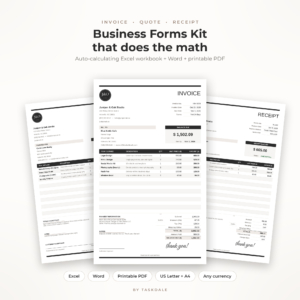
Ledgerline Invoice Kit
Price: Original price was: $3.00.$1.50Current price is: $1.50. | Best for: Plumbers billing from a set price list
An Excel workbook where a price list of up to 150 items, including call-outs, labour rates and parts, fills each invoice line when you pick it. Clients fill in from a list of 100, and the discount, tax and balance due calculate on their own. An invoice log flags late payers in red and a statement sheet shows what each customer owes. Word templates and printable PDFs in US Letter and A4 come too. Load your call-out rates and top 30 parts into the Items sheet first.
Labour after the call-out
Once the time included in the call-out runs out, bill further labour in clear blocks. Quarter or half hours both work. Pick one and stick to it.
“Additional labour, 0.5 hours at 70.00” is better than “Extra time, 35.00.” The first tells the customer how long you were there and at what rate. The second makes them wonder.
If you bring an apprentice or a mate to lift a cylinder, put their time on a separate line at their own rate. Customers accept a second pair of hands when they can see it was there.
Worked example: a burst pipe on a Saturday evening
A customer rings at 7:15pm on a Saturday. Water is pouring from a split pipe under the kitchen sink. You arrive at 7:40, isolate the supply, cut out the damaged section, fit new pipe and fittings, add an isolation valve so it is easier next time, and test. You leave at 9:10. In this example the plumber is VAT registered at 20 percent and the emergency call-out includes the first hour.
| Line | Qty | Rate | Amount |
|---|---|---|---|
| Emergency call-out, Saturday evening, includes first hour | 1 | 95.00 | 95.00 |
| Additional labour, out of hours | 0.5 hours | 70.00 | 35.00 |
| 15mm copper pipe | 1 m | 9.50 | 9.50 |
| 15mm compression elbow | 2 | 4.20 | 8.40 |
| 15mm isolation valve | 1 | 7.80 | 7.80 |
| Sundries and consumables | 1 | 4.00 | 4.00 |
Parts and sundries come to 29.70. With the call-out and extra labour, the subtotal is 159.70. VAT at 20 percent adds 31.94, so the total is 191.64.
Under the table, add a short note: “Split in 15mm cold feed under kitchen sink, section replaced, isolation valve fitted, tested and dry at 9:05pm.” The customer has a record for their insurer if they need one, and you have a record if they call again. That note takes 30 seconds and saves a lot of back and forth later.
Out-of-hours and emergency rates
Evenings, weekends and bank holidays usually cost more. That is fair, and most customers expect it, as long as they hear the rate before you set off. Tell them on the phone, then show it on the invoice so the two match.
A simple rate card keeps you consistent:
- Weekday daytime: standard call-out, standard hourly rate
- Weekday evening: higher call-out, higher hourly rate
- Weekend and bank holidays: highest call-out and hourly rate
Put each rate on your price list as its own item, named clearly. Then the invoice line itself says “Weekend call-out” and you never have to explain the figure from memory. Being able to point at a printed rate card when a customer queries a bill is a quiet relief.
Landlords, letting agents and repeat customers
A lot of steady plumbing work comes from landlords and letting agents. They pay well and send regular jobs, but they often have their own rules: a purchase order number on every invoice, the tenant’s address shown separately from the billing address, and monthly statements.
Set up your invoices so they show:
- The agent or landlord as the billing client
- The property address as the job address
- The tenant’s name if the agent asks for it
- The agent’s works order or PO number
With five landlords and 20 properties, it gets hard to see who owes what. A tracker that lists balances by client and sorts overdue invoices to the top saves you from chasing the wrong agent. If you have never set one up, our guide to building an invoice tracker spreadsheet is a good starting point.
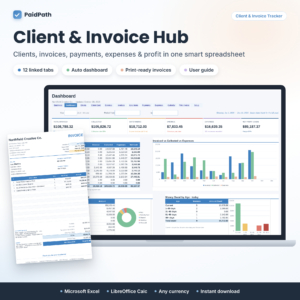
PaidPath Client and Invoice Hub
Price: $9.49 | Best for: Plumbers with landlord and agent work
An Excel workbook linking clients, services, invoices, payments and expenses. Each client card shows billed, paid, balance and overdue amounts and prints as a one-page account statement, which suits agents who pay monthly. Statuses update on their own, and the dashboard lists overdue invoices first, with money owed grouped by age. Start by adding your agents and landlords as clients with their payment terms.
Quoting bigger jobs before you invoice
Bathroom installs, boiler replacements and full re-pipes are a different kind of job. Customers want a price before you start, and the invoice should match that price line for line, with any agreed changes added clearly.
A good quote for a bigger plumbing job lists the main parts with makes and models, the labour by stage, any waste removal and the deposit you need. When the customer accepts, you invoice from the same lines. If you find a corroded valve or a hidden leak along the way, add it as a separate, approved line rather than adjusting the original figures. We cover how to set out labour and materials on longer jobs in our contractor invoice template guide.
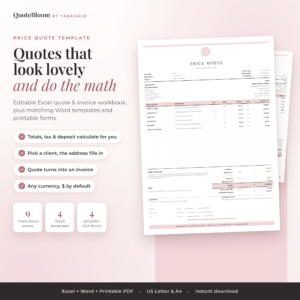
QuoteBloom Price Quote Template
Price: $4.99 | Best for: Plumbers quoting installs and upgrades
An Excel workbook where the quote and invoice share the same lines, so an accepted quote becomes an invoice without retyping. It stores 200 clients and 200 catalog items with units and tax settings, takes off a deposit and shows the remaining balance. A quote log tracks each quote as draft, sent, accepted, declined or expired, with follow-up dates. Add your standard install packages to the Catalog sheet before your next survey visit.
A Friday paperwork routine for a one-van firm
Most plumbers would rather be under a sink than at a desk. That is exactly why a short, fixed routine works. Block out 30 minutes on Friday afternoon and do the same five things every week:
- Check every job from the week has an invoice. Match them against your diary or job sheets.
- Log payments that arrived and mark those invoices paid.
- Send a polite reminder for anything more than seven days late.
- Restock the van list: note which parts you used so you can reorder on Monday.
- File merchant receipts with the jobs they belong to.
Half an hour a week keeps the books current and stops the dreaded month-end pile. And there is something satisfying about starting Monday knowing exactly who owes you and what is on the van.
Mistakes that slow down plumbing payments
- An unexplained call-out. Say what it includes on the line itself.
- “Parts” as one figure. List what you fitted. Customers trust what they can count.
- Out-of-hours rates that were never mentioned. Tell them on the phone and show the rate on the invoice.
- No job address. Agents and landlords need to know which property you visited.
- No work notes. One sentence on what you found and fixed protects you if the problem comes back.
- Invoicing a week later. Hand it over or email it the same day, while the customer is still grateful the water stopped.
If you are still deciding between writing invoices on paper in the van or sending them from a laptop, our comparison of Word, Excel and PDF invoice templates covers the pros and cons of each.
Frequently asked questions
What should a plumber’s call-out charge include?
Usually travel, attendance and often the first 30 minutes or hour of labour. Whatever you include, write it on the invoice line so the customer knows what they paid for.
Should a plumbing invoice list every part?
List each main part with a quantity and price. Small sundries like tape and jointing compound can go on one consumables line.
How do I charge for a visit where I could not fix the problem?
Bill the call-out and any diagnosis time, and note what you found and what part is on order. The return visit then goes on its own invoice or on the final one.
Can I charge more for emergency plumbing on weekends?
Yes, most plumbers do. Tell the customer the rate before you set off and show the out-of-hours call-out and labour rate clearly on the invoice.
How do I invoice a letting agent for a tenant’s repair?
Bill the agent or landlord as the client, show the property address as the job address, and include their works order or PO number if they use one.
Should I take payment before leaving the job?
For one-off domestic call-outs, many plumbers take payment on the day by card or transfer and hand over a receipt. Regular agent and landlord work usually runs on agreed terms instead.
Your next step
Write out your rate card tonight: daytime, evening and weekend call-outs, your hourly rates, and the 30 parts you fit most often. Load it into a template that turns those into invoice lines with a click, such as the Ledgerline Invoice, Quote and Receipt Kit, and your next call-out invoice will be done before you have packed the van.