Labour and materials are two different conversations with a client. Labour is your time and skill. Materials are the tiles, timber, cable and adhesive you bought on their behalf. Mash them into one figure and the client starts wondering what they really paid for. Split them and the invoice explains itself.
This guide is for builders, tilers, electricians, joiners, decorators, landscapers and handymen who send invoices for jobs that use both. You will see what a contractor invoice template for labour and materials should contain, how to price each half, a worked example from a real-sized bathroom job, how to handle deposits and extra work, and which Taskdale templates take the arithmetic off your hands.
Quick picks
| Product | Best for | Price | Link |
|---|---|---|---|
| Ledgerline Business Forms Kit | Trades who need a job estimate, invoice and purchase order | $2.99 | View |
| QuoteBloom Price Quote Template | Quoting first, then turning the quote into an invoice | $4.99 | View |
| PaidPath Client and Invoice Hub | Tracking balances, part payments and job costs | $9.49 | View |
| Ledgerline Invoice, Quote and Receipt Kit | A simple invoice with a client list and price list | Original price was: $3.00.$1.50Current price is: $1.50. | View |
Why labour and materials belong on separate lines
A homeowner who sees “Bathroom: 1,536.00” has no idea whether that is fair. A homeowner who sees 571.00 in materials and 880.00 in labour, with the tile count and the hours listed, can check it against what they saw happening in their house. Most will simply pay.
Splitting the two helps you as well. You can see, job by job, whether you made your money on your time or lost it on materials. A run of jobs where materials keep creeping over the estimate tells you to change how you quote. That is hard to spot when everything sits in one lump.
It also matters for deposits and tax. Many contractors ask for the materials money up front, so the split shows exactly what the deposit covered. And in some places, materials and labour are treated differently for tax, so separate lines make the tax figure easy to follow.
What a contractor invoice template should include
Top of the page
- Your business name, address, phone, email and any trade or tax registration number
- Client name and billing address
- The job address, if it is different from the billing address
- Invoice number, invoice date and due date
- A job reference or the quote number it came from
Labour section
- Task description: “strip existing wall tiles,” “first fix wiring, kitchen”
- Hours or days, and the rate
- Or a fixed price per task, if that is how you quoted
Materials section
- Item, quantity and unit (m², lengths, bags, boxes)
- Unit price and line total
- A note if materials were supplied by the client
Other charges and totals
- Equipment hire, skip hire or waste disposal on their own lines
- Subtotal, tax, deposit received and balance due
- Payment terms and bank details
If your current invoice is a Word table you tidy up by hand each time, a matching set of forms saves a lot of fiddling. One design for the estimate, the invoice and the purchase order you send to your own supplier keeps your paperwork looking like it came from one business.
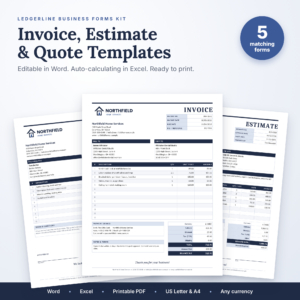
Ledgerline Business Forms Kit
Price: $2.99 | Best for: Contractors, handymen and home service trades
Five matching forms: quote, job estimate with labour and materials split, invoice, sales receipt and purchase order. Each comes as a Word template in US Letter and A4, plus blank printable PDFs, and the Excel Invoice Maker fills client details and item prices from saved lists, then works out tax, total and balance due. Invoices mark themselves paid or overdue, and a tracker holds 300 of them. Start by adding your day rate and your five most-used materials to the Items tab.
How to price the labour half
There are three common ways to bill labour. All of them work. The trick is choosing one per job and making it obvious on the invoice.
Hourly
Good for repairs, call-outs and work where you cannot predict the time, like tracing a fault. Show the hours to the nearest quarter and the rate: “3.25 hours at 45.00.”
Day rate
Common for tilers, plasterers and decorators. “4 days at 260.00” is easy for a client to picture, because they watched you arrive four mornings in a row. Be clear about what a day means, for example eight hours on site.
Fixed price per task
Best when you know the job well. “Hang and finish internal door: 120.00.” The client likes the certainty, and if you are quick, you keep the benefit. List each task on its own line so the client can see the breakdown.
Whatever you choose, list labourers or apprentices separately if you charge for them at a different rate. “Labourer, 2 days at 150.00” is fair and transparent.
How to price the materials half
Materials raise one awkward question: do you add a margin? Plenty of contractors do, to cover the trip to the merchant, the van space, the time spent ordering and the risk of breakage. Others charge at cost and build that time into their labour rate. Both are honest if you are consistent.
Two clean ways to show a margin:
- Built into the unit price. You buy adhesive at 16.00 a bag and charge 18.50. The client sees one price per bag.
- As a handling line. Materials at cost, then “materials handling, 15 percent” as a separate line. On 571.00 of materials, that is 85.65.
Keep your merchant receipts with the job file either way. If a client asks to see what tiles cost, you can show them in a minute. When a client supplies their own materials, write “client-supplied tiles” on the invoice so nobody later claims you charged for them.
Leftovers deserve a line in your terms too. Half a box of tiles and a spare bag of grout: do they stay with the client or go back to the merchant for credit? Decide before the job and the end of the job is calmer.
Worked example: retiling a family bathroom
A tiler quotes for stripping and retiling a bathroom with 14 square metres of wall tiles. Here is the invoice, with materials charged at the tiler’s set unit prices and labour at 40.00 an hour.
| Line | Section | Qty | Rate | Line total |
|---|---|---|---|---|
| Wall tiles, 300 x 600, white satin | Materials | 14 m² | 32.00 | 448.00 |
| Tile adhesive, 20 kg bag | Materials | 4 | 18.50 | 74.00 |
| Grout, grey, 5 kg | Materials | 2 | 11.00 | 22.00 |
| Aluminium trim, 2.5 m length | Materials | 6 | 4.50 | 27.00 |
| Strip old tiles and prepare walls | Labour | 6 hours | 40.00 | 240.00 |
| Tile, grout and fit trims | Labour | 16 hours | 40.00 | 640.00 |
| Waste removal and disposal | Other | 1 | 85.00 | 85.00 |
Materials total 571.00. Labour totals 880.00. With waste removal, the subtotal is 1,536.00. If the tiler is VAT registered at 20 percent, tax adds 307.20, making 1,843.20. The client paid a 300.00 deposit when they accepted the quote, so the balance due is 1,543.20.
Every line can be checked. The client can count the trims. They know how long the job took because they made the tea. There is nothing to argue about, and the tiler gets paid the same week. That is a good feeling after a long job on your knees.
Deposits, stage payments and the quote they come from
On bigger jobs you should not fund the materials yourself. A deposit on acceptance, often matched to the materials cost, keeps your cash safe. On jobs that run longer than two weeks, stage payments make sense: one at the start, one at a halfway point you both agree, and the balance on completion.
The cleanest setup starts with a quote that already lists labour and materials separately. When the client says yes, the invoice inherits the same lines, and the deposit comes off the balance automatically. If your quotes are still written in emails, our guide on how to write a price quote covers the format and wording step by step.
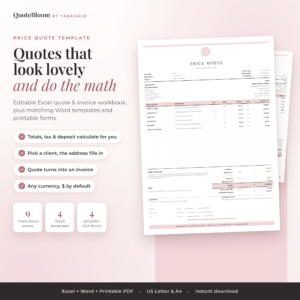
QuoteBloom Price Quote Template
Price: $4.99 | Best for: Trades who quote every job first
An Excel workbook where the quote and invoice share the same lines: pick a client and catalog items, and discounts, tax, a deposit and the remaining balance calculate on their own. The catalog holds 200 items with units, so you can store both labour rates and materials. Word templates in US Letter and A4, printable hand-fill forms and a quote log with follow-up dates are included. Load your materials and labour rates into the Catalog sheet, then send your next quote from it.
Extra work and changes halfway through
Every contractor knows this moment. You pull the old tiles off and the plasterboard behind them is soaked. Or the client asks for a niche in the shower wall while you are there. That is a variation, and it needs its own paper trail.
- Stop and explain the extra work and its price before you do it.
- Get a yes in writing. A text message with a date is fine for small items.
- Add the variation to the invoice as its own labelled lines: “Variation 1: replace damp plasterboard, 2 sheets plus 3 hours.”
- Keep the original quote lines unchanged so the client can see what was agreed and what was added.
Clients rarely mind paying for extra work they agreed to. They mind finding it on the invoice for the first time.
Keeping track of who still owes you
Sending the invoice is half the job. On a busy month, with eight jobs on the go and three part-paid, it is easy to lose track of a balance. A tracker that shows every invoice, its payments and its status stops money slipping through.
It helps to see job costs too. If you can enter materials and hours against a price and see the margin, you learn which jobs are worth chasing and which ones barely pay. Our article Who Still Owes You? shows how to set up a simple tracker for exactly this.
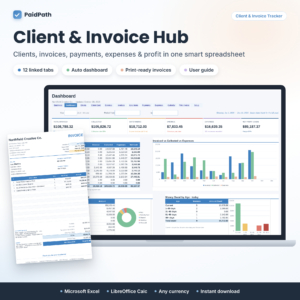
PaidPath Client and Invoice Hub
Price: $9.49 | Best for: Contractors juggling several open jobs
An Excel workbook that links clients, services, invoices, quotes, payments and expenses. Status updates on its own for paid, part paid, unpaid and overdue, and part, split and instalment payments are all handled. A cost calculator works out materials, labour hours and other costs to suggest a price for your target margin, and the dashboard lists overdue invoices first. Begin by entering your open jobs and any deposits already received.
Paper, Word or spreadsheet on site?
Where you write the invoice shapes which format suits you. A joiner who finishes a job at 4pm and wants the invoice in the client’s hands before leaving might prefer a printed form filled in by hand, with a copy kept in the van. A builder who does the paperwork on Sunday evening at the kitchen table will get more from a spreadsheet that remembers clients and prices and adds up every line.
Word sits in between. It is easy to type into and looks tidy, but it will not catch a sum you got wrong at the end of a long day. That one mistyped total can cost more than the template ever did. Many trades use a spreadsheet for the real invoice and keep a pad of printed forms for small cash jobs. For a side-by-side look at each option, see our comparison of invoice templates in Word, Excel and PDF.
Mistakes contractors make on invoices
- One lump sum. It invites haggling. Split labour, materials and other costs.
- No job address. When a client has a rental property and a home, they need to know which job this was.
- Variations hidden inside the original lines. Label them separately.
- Forgetting the deposit. Show it as paid so the balance is right and the client feels treated fairly.
- Vague quantities. “Tiles” is not a line. “14 m² wall tiles” is.
- Late invoicing. Send it the day you finish. A week later, the client has moved on.
Frequently asked questions
Should a contractor invoice show labour and materials separately?
Yes. Separate sections let the client check quantities and hours, show what a deposit covered, and help you see which half of the job made money.
Can I add a markup to materials on an invoice?
Many contractors do, either built into the unit price or as a separate handling line. Be consistent, and keep your merchant receipts in case a client asks.
How do I invoice a day rate?
List the number of days and the rate per day on a labour line, with a short description of the work. Note what counts as a day if clients might ask.
What if the client supplied the materials?
Leave them off the materials section and add a note such as “client-supplied tiles and grout.” Bill only your labour and any consumables you provided.
How much deposit should a contractor ask for?
Many trades ask for enough to cover materials before work starts, and stage payments on longer jobs. Agree the amount in the quote so it is not a surprise.
Do I put skip hire under materials or labour?
Neither. Give skip hire, scaffold and tool hire their own lines under other charges, so the client can see them clearly.
Your next step
Open your last finished job and rewrite its invoice with labour, materials and other costs in separate sections. Compare it to what you sent. If the new version is clearer, make it your standard. The Ledgerline Business Forms Kit gives you the estimate, invoice and purchase order in one matching set, so the next job starts on the right paper.