If you have never counted a calorie in your life, the first week feels like learning a new language. Labels make no sense, portions look tiny, and every app wants your email address. Take a breath. You need three things to start: a rough daily number, a short list of meals you already like, and a way to add them up.
This beginner guide walks you through all three. You will find out how to pick a starting number, how to read a food label in ten seconds, why a cheap kitchen scale is worth two weeks of your time, and what a simple first week looks like with the totals already done. At the end there are a few planners from Taskdale that do the sums so you can focus on eating.
No food is banned here. Pizza is allowed. It just gets counted.
Quick picks: beginner-friendly calorie planners
| Product | Best for | Price | Link |
|---|---|---|---|
| Pantry Bloom Meal Planner Spreadsheet | First-timers who want the sheet to explain itself | $18.99 | View |
| Larkspoon Meal Planner Spreadsheet | Counting calories while cooking for a household | $12.99 | View |
| Thymewise Digital Meal Planner | Planning by hand on a tablet or printed pages | $1.75 | View |
| Mealory Meal Planner Spreadsheet for Excel | Excel users who like a dashboard | $21.99 | View |
Calories in plain English
A calorie is a unit of energy, the same way a liter is a unit of liquid. Food gives you energy. Your body spends it on breathing, walking, thinking, digesting and everything else. If you take in less than you spend over a few weeks, your body draws on its stores and your weight tends to go down. Take in more and it tends to go up. Match them and it tends to hold steady.
That is really all calorie counting is: keeping a rough tally so you can steer. It does not tell you whether food is healthy. A 300-calorie bowl of lentil soup and a 300-calorie chocolate bar count the same on the tally, but the soup will keep you full until dinner and the chocolate bar will be a memory by 3:15. That is why most beginners end up choosing more filling foods on their own, without anyone telling them to. They just notice what holds them over.
Step 1: pick a starting number
Your starting number is a best guess at how much to eat each day. You can get one in two ways.
Use a calculator
Free online calculators ask for height, weight, age, sex and activity level, then estimate your maintenance calories. For weight loss, many people start around 300 to 500 below that. For holding steady, they eat around maintenance.
Use a week of honest notes
Write down everything you eat for seven normal days without changing anything. Add it up. If your weight stayed the same that week, your average is roughly your maintenance. This takes longer but teaches you more than any calculator, because you see your real habits in black and white. A simple food journal template makes those seven days easier to record.
Either way, write the number down and treat it as a draft. You will adjust it after a few weeks. Nobody gets it exactly right on day one, and nobody needs to.
Step 2: learn to read a label in ten seconds
Food labels look busy, but beginners only need three lines at first.
- Serving size. This is the amount every other number refers to. A bag of crisps might say “serving: 30 g” while the bag holds 150 g. That is five servings, not one.
- Calories per serving. Multiply by how many servings you actually eat.
- Servings per container. A quick sense check for sharing bags and big tubs.
Try it on a jar of peanut butter. Serving: 2 tablespoons (32 g). Calories: about 190. Now spread it the way you normally do and weigh it. Many people find their “normal” spread is 50 g, which is closer to 300. That one discovery is worth the whole exercise. It is not about guilt. It is about knowing.
Step 3: weigh things for two weeks, then relax
A digital kitchen scale costs about the same as two takeaway coffees and it is the best beginner tool there is. Use it for two weeks. Weigh cereal, pasta, rice, cheese, oil and nut butters, because these are the foods where eyeballing goes most wrong.
After two weeks, something clever happens. Your eyes learn. You will know what 40 g of oats looks like in your bowl and what 30 g of cheddar looks like on the board. Then you can put the scale in the cupboard and bring it out once a month to check you have not drifted.
You do not need to weigh fruit, vegetables (except potatoes) or foods that come in fixed units like eggs and yogurt pots. Keep it simple.
A beginner week with the totals done for you
Here is a sample week built around 1,700 calories a day. It uses everyday supermarket food, repeats on purpose, and leaves room for a takeaway on Friday. Numbers are rounded estimates, so treat them as a guide.
| Day | Breakfast | Lunch | Dinner | Snacks | About |
|---|---|---|---|---|---|
| Mon | 40 g oats, milk, banana (350) | Turkey and salad sandwich, apple (450) | Chicken stir-fry with 1 cup rice (600) | Yogurt pot, tea with milk (200) | 1,600 |
| Tue | Two eggs on toast (330) | Leftover stir-fry (600) | Jacket potato, beans, 30 g cheese (520) | Apple, 15 g peanut butter (190) | 1,640 |
| Wed | 40 g oats, milk, banana (350) | Tuna pasta salad (480) | Turkey chili with rice (620) | Popcorn, 25 g (120) | 1,570 |
| Thu | Two eggs on toast (330) | Leftover chili (520) | Salmon, potatoes, peas (580) | Yogurt pot, berries (180) | 1,610 |
| Fri | Yogurt, granola, berries (300) | Soup and a roll (350) | Takeaway pizza, 3 slices (900) | Tea with milk (40) | 1,590 |
| Sat | Pancakes with fruit (450) | Chicken wrap, salad (450) | Homemade burger, oven chips (750) | Square of chocolate (60) | 1,710 |
| Sun | Scrambled eggs, mushrooms, toast (380) | Light lunch, fruit (300) | Roast chicken dinner (750) | Crumble, small portion (250) | 1,680 |
Notice what is here. Pizza. Pancakes. Crumble. Notice what is missing too: no weird powders, no meals you would need to look up. A beginner plan should look like your normal life, only slightly better organized. If it looks like someone else’s life, you will not keep it.
Also notice the repeats. Breakfast alternates between two options. Lunch on Tuesday and Thursday is last night’s dinner. Fewer decisions means fewer chances to give up.
Where to write it all down
You can count calories on the back of an envelope, but you will not keep it up for long. The beginners who stick with it usually have one place where meals, totals and the shopping list live together. That way, planning on Sunday automatically sorts out Wednesday’s dinner and the grocery run.
A spreadsheet is the easiest option if you are comfortable typing into cells. You type a meal, it fills in the calories, and the day adds itself up. If you have never planned meals before at all, our guide on how to meal plan for the week is a gentle place to start before adding numbers.
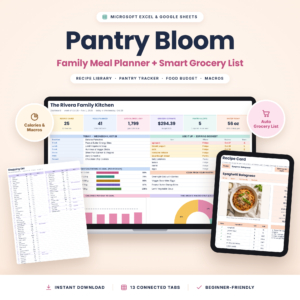
Pantry Bloom Meal Planner Spreadsheet
Price: $18.99 | Best for: total beginners who like clear instructions
Pantry Bloom is built for beginners: white cells are for typing, tinted cells calculate, and every one of its 13 tabs has short instructions, plus an 18-page user guide. It works in Excel and Google Sheets and shows daily calories, protein, carbs, fat and fiber per person against your goals, then builds a grocery list checked against your pantry. Open the Start Here tab, follow the 10-minute quick start, and add the recipes from your first planned week.
If you cook for a partner or children, a planner that tracks calories per person helps, because only your plate needs to match your number. The Larkspoon spreadsheet does exactly that, and its nutrition columns are optional, so you can switch them on for yourself and ignore them for everyone else.
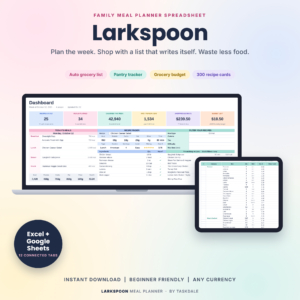
Larkspoon Meal Planner Spreadsheet
Price: $12.99 | Best for: beginners cooking for a whole household
Larkspoon runs in Excel and Google Sheets with twelve connected tabs. Plan seven days of meals, and it adds up calories, protein, carbs, fat and fiber per meal, per day and per person, prices each dish and writes an aisle-sorted grocery list. It also has a weight tracker tab and prints a one-page menu for the fridge. Start with your household size on the settings tab, then add the meals from your first beginner week.
If you would rather use a pen
Some beginners find screens make counting feel clinical. Writing meals by hand, then adding them up with a calculator, slows you down in a useful way. You notice more. You remember more.
The trick on paper is to keep a single “calorie cheat sheet” page with your 20 most-eaten foods and their numbers. Then every weekly page is quick to fill in, because you are copying, not looking things up.
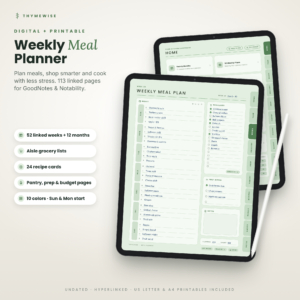
Thymewise Digital Meal Planner
Price: $1.75 | Best for: hand planners using a tablet or paper
Thymewise is an undated, hyperlinked meal planner for GoodNotes, Notability and other PDF apps, with 113 pages: 52 weekly meal plans, monthly meal calendars, aisle-sorted grocery lists, pantry inventories, 24 recipe cards, a grocery budget tracker and a healthy habits tracker. Printable US Letter and A4 versions are included too. It does not add up calories itself, so use one recipe card as your cheat sheet and write a daily total in the notes space of each week.
Your first month, week by week
Week 1: just notice
Follow the sample week or your own version. Weigh the tricky foods. Do not worry about hitting the number yet. Your only job is to get used to writing things down.
Week 2: aim for the number
Plan the week ahead with daily totals. Swap one or two foods that surprised you in week 1. The 300-calorie latte becomes a 100-calorie one. The extra 20 g of cheese gets shaved off.
Week 3: put the scale away (mostly)
Trust your eyes for the foods you know. Keep weighing oil and nut butter. Plan, shop, cook, repeat.
Week 4: check and adjust
Compare your average weight in week 4 to week 1. Moving the way you hoped? Keep going. Not moving at all? Lower the daily number by about 100 to 150 and try two more weeks. Losing much faster than expected and feeling drained? Add 100 to 150 back.
By the end of the month, most people can estimate a meal within about 10 to 15 percent just by looking at it. That is a real skill, and it is yours for good.
Beginner mistakes worth avoiding
- Going too low. A very low number feels exciting for four days and miserable by day ten. A modest gap is easier to keep.
- Skipping the weekends. Five careful days and two uncounted ones can cancel each other out. Count Saturday too, even roughly.
- Forgetting drinks. Juice, sweet coffees and alcohol add up fast. They get a line on the plan like any food.
- Weighing yourself daily and panicking. Daily weight jumps around with water and salt. Look at the weekly average instead.
- Quitting after one bad day. One big day is one big day. Write it down and carry on tomorrow.
Frequently asked questions
How many calories should a beginner eat to lose weight?
There is no single figure. Many beginners start about 300 to 500 below their estimated maintenance, then adjust after a few weeks based on how their weight and energy respond.
Do I need an app to count calories?
No. Food labels, a kitchen scale and a spreadsheet or notebook are enough. An app is one option among several.
Is it okay to eat the same thing every day?
Yes, especially at breakfast and lunch. Repeats make counting much easier for beginners. Vary dinners and snacks for interest.
How do I count calories in homemade food?
Add up the calories in every ingredient, then divide by the number of portions. Write the result on the recipe so you only do it once.
When will counting calories start to feel easy?
Most people find it gets much quicker by the third week, once their regular meals are written down and they have learned their usual portions.
Your next step
Today, find out your starting number with a calculator or start your seven days of honest notes. Then copy two breakfasts, two lunches and four dinners from the sample week into your own plan. If you would like a spreadsheet that explains each step as you go, open the Pantry Bloom meal planner and start on its quick-start tab.