Sleep, water and movement are the three habits that quietly run the rest of your day. Sleep badly and the afternoon drags. Forget to drink and the 3pm headache arrives on time. Sit for nine hours straight and your back lets you know. A wellness planner that tracks just these three gives you a clear, honest picture without turning your life into a spreadsheet of numbers.
This guide is for busy people who want to feel a bit better and would like to see why some days go well and others do not. You will learn what to log for each habit, how to set up a page that takes under a minute a day, a Sunday review that spots patterns, and four Taskdale planners on paper, in Excel or on a tablet.
No fancy gadgets needed. A pen, a page and a little curiosity will do.
Quick picks
| Product | Best for | Price | Link |
|---|---|---|---|
| Bloom & Breathe Printable Self-Care Journal | Paper sleep and water trackers in a binder | $3.59 | View |
| Bloom Habit Tracker Spreadsheet | Streaks, sleep hours and mood in Excel or Sheets | $1.17 | View |
| Petal & Pause Digital Self-Care Planner | Daily water and sleep on an iPad | $4.75 | View |
| Glow & Grow Digital Fitness Planner | Movement and workouts alongside wellness logs | Original price was: $4.75.$1.19Current price is: $1.19. | View |
Why track these three together
Each habit pulls on the others. A late night means less energy for a walk. A long walk often means better sleep. A day with barely any water can leave you sluggish enough to skip movement altogether. Tracked on their own, these links stay hidden. Tracked side by side on one page, they jump out.
Picture Jo, a call centre team leader, who logs all three for a month. By week three she notices something she never expected: every night she slept under six hours followed a day with no walk at all. The walk was not the cure for everything, but the pattern was hers, written in her own hand. That made it far easier to act on than any article telling her to move more.
Keeping it to three also makes it stick. A tracker with fifteen habits is exciting on day one and abandoned by day nine. Three small boxes take thirty seconds. Thirty seconds survives a bad week.
What to log for sleep
Keep sleep tracking simple. You want enough detail to spot a pattern, not a lab report.
- Bedtime and wake time. Write the rough times, such as 11:15pm and 6:40am. The hours work themselves out.
- Hours slept. Your best guess is fine.
- How rested you feel. A score from 1 to 5, written within ten minutes of getting up, before coffee changes your mind.
- One note, if anything stood out. “Late screen.” “Kids up at 3.” “Big dinner.”
That fourth line is where the gold hides. After a month, you might see that every 2-out-of-5 morning came after a night of scrolling past midnight. Or after a heavy meal at 9pm. You cannot guess these things. You have to see them.
A printable tracker works well for sleep, because you can keep it on the bedside table with a pen clipped to it.
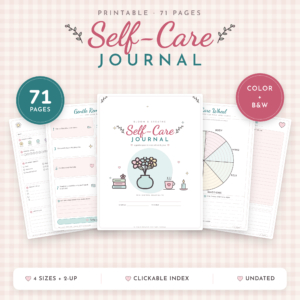
Bloom and Breathe Self-Care Journal
Price: $3.59 | Best for: people who like trackers on paper
This 71-page printable journal includes a sleep tracker, a water and nourishment tracker, a monthly habit tracker, a full-year mood tracker and daily and weekly check-ins, with a clickable index. It comes in a soft color edition and an ink-friendly black and white edition, in US Letter, A4, A5 and Half Letter. Print the sleep and water trackers first and keep them by the bed.
What to log for water
Water is the easiest of the three to track and the easiest to forget. Most people do best counting glasses or bottles rather than milliliters. Draw eight small circles, or however many match the target you have chosen, and fill one each time you finish a glass.
Pick a target that suits your body, your work and the weather. A gardener in July will drink more than an office worker in January, and that is fine. The point of the tracker is consistency against your own number, not hitting someone else’s.
Two small tricks make water tracking easier:
- Use the same glass or bottle. If your bottle holds 500ml, four fills is two liters. No maths needed during the day.
- Tie it to moments you already have. One glass when you wake, one with each meal, one when you get home. That is five before you even think about it.
After two weeks, look at which part of the day the circles go empty. For many people it is the afternoon slump between 2 and 5. Knowing that, you can put a bottle on your desk at lunch and solve it.
What to log for movement
Movement is the habit most people overcomplicate. You do not need workout names, sets and reps unless you enjoy that. For a wellness planner, three questions cover it:
- Did I move on purpose today? Yes or no.
- What was it? Walk, stretch, swim, dance in the kitchen, carried shopping up four flights.
- Roughly how long? 10, 20, 45 minutes.
If you count steps on your phone, write the number instead. A daily figure like 6,200 is easy to compare across weeks. Just do not let a step count make a gentle 20-minute stretch feel like it does not count. It counts.
If movement is your main focus, and you want space to log workouts as well as water and sleep, a fitness planner gives you more room.
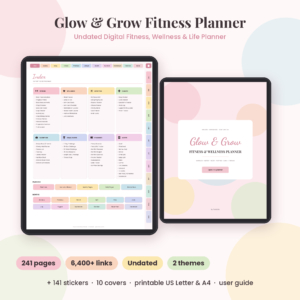
Glow and Grow Digital Fitness Planner
Price: Original price was: $4.75.$1.19Current price is: $1.19. | Best for: people who want workouts and wellness together
Glow & Grow is an undated hyperlinked PDF with 241 linked pages in blush pink and sage green, plus printable US Letter and A4 editions. Each month has a 31-day health and habit grid, and each daily page has a schedule, a 10-row workout table, cardio, meals, water, mood and gratitude, with separate sleep and water tracker pages. Open it in GoodNotes or Notability and set up this month’s habit grid with your three habits first.
For more ideas on what to write after a workout, these fitness journal ideas cover what to track and what to skip.
Set up a one-minute daily page
Here is a layout you can draw in a notebook or find in most wellness planners. One row per day:
| Day | Bed / wake | Hours | Rested (1 to 5) | Water | Movement | Note |
|---|---|---|---|---|---|---|
| Mon | 11:30 / 6:45 | 7.25 | 3 | 6 of 8 | Walk, 25 min | Late email |
| Tue | 10:45 / 6:45 | 8 | 4 | 8 of 8 | Stretch, 10 min | |
| Wed | 12:20 / 6:45 | 6.4 | 2 | 4 of 8 | None | Phone in bed |
Fill the sleep columns in the morning and the rest before bed. That is two tiny moments a day. Even this short sample tells a story: Wednesday’s late night came with less water and no movement. One day proves nothing. Four weeks of Wednesdays like that is worth a look.
If you would rather have the scores, streaks and charts worked out for you, a spreadsheet does the adding up.
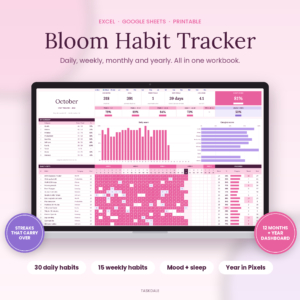
Bloom Habit Tracker Spreadsheet
Price: $1.17 | Best for: people who love seeing streaks and charts
Bloom is a 15-tab workbook for Excel and Google Sheets with 12 month tabs, a Year dashboard, mood and sleep logging, and printable tracker pages in US Letter and A4. You list habits once, tick done or missed each day, and it shows month scores, current and best streaks, perfect days and a Year in Pixels view. Add water, movement and a bedtime habit on the Setup tab, then log sleep hours on the month tab each morning.
If spreadsheets are new to you, this walkthrough on how to set up a habit tracker spreadsheet that lasts covers the basics.
A ten-minute Sunday review
Logging is only half of it. The other half is looking back, and that is where a wellness planner earns its place. Once a week, read your seven rows and answer four questions:
- Which day felt best, and what did its row look like?
- Which day felt worst, and what was different?
- Is there a habit that dropped off on the same weekday each week? Many people find Fridays or Mondays slip.
- What is one small change for next week? Just one. “Phone charges in the kitchen.” “Bottle on the desk at lunch.”
Write the answer to the last question at the top of next week’s page. Then forget about it until next Sunday. You are not trying to fix your life in a weekend. You are collecting small wins, and by the end of a month there is a quiet pride in seeing four of them stacked up.
Keeping the habits alive on hard weeks
Every planner looks great in a calm week. The real test is the week the car breaks down, a child gets a cold and work piles up. That is when sleep, water and movement slip first, and also when they help most.
Have a smaller version of each habit ready for those weeks. If your usual walk is 30 minutes, the hard-week version is 10 minutes around the block at lunch. If your usual bedtime is 10:45, the hard-week version is phone down by 11:15. Water stays the same, because filling a bottle takes ten seconds even on the worst day.
Mark hard weeks on the page with a small star. Later, when you review a month, you will see that you kept something going even when life was messy. That feels good. It also tells you the habit is real now, not just a nice idea for easy weeks.
One more help: keep the tracker where the habit happens. Sleep log by the bed. Water chart on the fridge. Movement row on the same page as your daily plan. A tracker you have to go and find is a tracker you will skip.
Paper, spreadsheet or tablet?
All three work. The best choice is the one you will open every day.
Paper
Best if you like to wind down without a screen. A printed tracker by the bed and a water chart on the fridge are hard to ignore. The downside is that you do the counting yourself.
Spreadsheet
Best if you like numbers and charts. The totals, streaks and averages fill in for you. The downside is that you need your phone or laptop, and opening a phone at bedtime can undo the sleep you are trying to protect.
Tablet planner
Best if you already plan your days on an iPad. Water, sleep and mood sit right on the daily page next to your to-do list, so tracking happens while you plan.
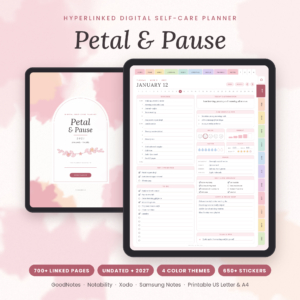
Petal and Pause Digital Self-Care Planner
Price: $4.75 | Best for: iPad planners who track as they plan
Petal & Pause is a hyperlinked PDF for GoodNotes with an undated planner and a dated 2027 edition, four soft color themes, printable US Letter and A4 pages and a 653-piece sticker pack. Every daily page pairs your schedule and to-do list with water, sleep and meal tracking, mood faces and an energy meter, and each month adds a habit tracker and a mood and wellness tracker. Start with the undated edition and fill one daily page tonight.
Mistakes that make people quit
Tracking too much
Sleep, water and movement, plus mood if you like. Stop there for the first month. You can add more once the habit of tracking itself is solid.
Treating a blank day as a failure
Everyone misses days. Leave the row empty and carry on tomorrow. A tracker with gaps still shows patterns. A tracker you abandon because of guilt shows nothing.
Chasing perfect numbers
Eight out of eight glasses every day is not the goal. Noticing that you drink less on busy workdays is. Use the numbers to learn, not to judge.
Never reviewing
Thirty days of rows that nobody reads are just ink. Book the Sunday review into your calendar like any other appointment.
For gentler ideas on keeping a self-care habit going, see these self-care journal ideas, prompts and trackers.
Frequently asked questions
What should a wellness planner include?
At minimum, a daily log for sleep, water and movement, a short note space, and a weekly review page. Mood, meals and gratitude are popular extras once the basics are a habit.
How do I track my water intake on paper?
Draw a row of circles for each day, one per glass or bottle, and fill one in each time you finish a drink. Use the same glass every time so the count is consistent.
Can I track sleep without a smartwatch?
Yes. Write down roughly when you went to bed and when you woke, then score how rested you feel from 1 to 5. Over a few weeks, that simple log shows clear patterns.
Is a habit tracker spreadsheet better than a printable?
Neither is better for everyone. A spreadsheet counts streaks and draws charts for you. A printable is screen-free and easy to keep by the bed. Pick the one you will open every day.
How long before I see patterns in my tracker?
Most people start to notice something after two to four weeks. A single week is too short, because one late night or one busy day can skew it.
Your next step
Tonight, draw seven rows with columns for bedtime, wake time, water and movement, or print a ready-made tracker, and fill in today’s row before bed. Tomorrow morning, add your sleep. If you would like the trackers ready to print, start with the sleep and water pages in the Bloom & Breathe Printable Self-Care Journal.