Detailed color by number is a different hobby from the easy kind. One page can hold 180 spaces and fourteen colors. A lion’s mane might use four golds. You do not finish it in an evening, and you do not want to. If you are the sort of person who zooms in on a painting to see the brushstrokes, this is the version for you.
This guide is for adults who love fine, intricate art and want free color by number printables that match. You will learn where detailed free pages come from, how to judge whether a page is truly advanced, the tools and techniques that make small spaces a pleasure, and how to turn any intricate coloring page into your own numbered project.
Quick picks for detail lovers
| Product | Best for | Price | Link |
|---|---|---|---|
| Hue and Harmony Color by Number for Adults | Ten Advanced designs with 11 to 14 colors each | $4.99 | View |
| Secret Gardens Coloring Book | Intricate garden scenes to number yourself | $3.49 | View |
| Moonlit Wildlife Coloring Book | Night animals with layered textures and hidden objects | $3.49 | View |
What makes a color by number page truly detailed
Plenty of pages call themselves “advanced” when they are really medium. A page made for detail lovers usually has most of these features.
- Eleven or more colors. Enough to suggest light and shadow, not just flat shapes.
- Several shades of one hue. Three greens on a single leaf, four blues in one wave. That is where the depth comes from.
- Small spaces that follow form. The spaces trace the curve of a petal or the fall of fur, so the finished picture looks painted, not tiled.
- Over 100 spaces. A real advanced page is a two- or three-session project.
- Crisp, thin lines. Heavy outlines swallow small spaces. Detailed pages use fine linework.
If a page has twelve colors but only 40 big spaces, it is a medium page with a long key. Nice, but not what you are after.
Where to find free detailed color by number pages
Detailed free pages are rarer than easy ones, because they take much longer to design. Here is where they tend to show up.
Designer samples
Artists who sell advanced books often give away one sample page. Because they want to impress, the sample is often one of their best. Look on the designer’s own site or shop page for a “free sample” or “try a page” link.
Mosaic and mystery pages
Mosaic color by number pages split a picture into hundreds of tiny squares or shards. They are very detailed by design. Many printable sites carry a few. Be aware that some are low-resolution and print with blurry numbers, so zoom in before you print.
Apps
Color by number apps have huge libraries of detailed art. They are free to start, often with ads, and many lock the best designs behind a subscription. They are fun on a train, but you lose the feel of a pencil on paper.
Your own numbering
The most reliable free source of detailed color by number is a detailed coloring page that you number yourself. There is a method for that below. For more places to look, our roundup of color by number sites, apps and printables compares the main options.
The zoom test for advanced pages
Before printing any detailed page, run a quick check on screen.
- Zoom to 200 percent on the smallest area. Can you read every number clearly? If numbers touch lines or overlap, they will be worse on paper.
- Count the colors in the key. Note any you do not own. Plan swaps now, not halfway through.
- Look at one complex area. A face, an eye, a petal center. Do the spaces follow the shape naturally?
- Check for a preview. On a detailed page, the preview matters even more, because it shows how the shades blend.
A page that passes all four will reward you with hours of absorbing work. A page that fails the first will frustrate you within ten minutes.
A guided set when you want the palette done for you
Sometimes the joy of detailed color by number is not having to plan. Fourteen colors are already chosen to sit well together, the spaces follow the form, and you can sink into the work. Free pages rarely give you a run of those.
A set with a dedicated advanced section is worth a look if you want several weeks of that experience in a row, from one designer with one consistent style.

Hue and Harmony Color by Number for Adults
Price: $4.99 | Best for: adults who love small detailed areas
The Advanced section has ten designs with eleven to fourteen colors and small areas: a golden lion, a jewel mandala, a coral reef, a hilltop village, a peony bouquet, a festival elephant, a Japanese garden, a wildflower meadow, a moonlit owl and hibiscus with a hummingbird. Each page has a named color key and a Finished Gallery preview, plus a Swatch Chart. It prints in US Letter and A4. Start with the peony bouquet.
Tools that make small spaces a pleasure
Detailed pages need a slightly different kit. Nothing expensive, just the right things.
- A good sharpener. You will sharpen every ten minutes. A blunt pencil on a rice-sized space leaves white specks.
- Harder-lead pencils for detail. They hold a point longer. Keep softer leads for larger areas and blending.
- Fine-tip markers or fineliners. For the tiniest spaces, a 0.3 mm or 0.5 mm tip is cleaner than any pencil.
- A white gel pen. For highlights on eyes, water and petals once the page is done.
- A daylight lamp. True color matters when you have four golds side by side.
- A desk magnifier. Not essential, but many detail lovers swear by one for long sessions.
Print on smooth, heavier paper too. Rough copy paper fights fine pencil work. A 28 or 32 lb sheet, or light cardstock, makes the pencil glide.
Techniques for a painted look
Following the key is step one. These techniques turn a neat page into one that looks painted.
Light to dark, always
Color every light number first across the whole page, then the mid-tones, then the darks. Dark pigment drags, and putting it down last keeps your pale spaces clean.
Soft edges inside a hue
Where two shades of the same color meet, such as a light and dark green on a leaf, go back over the join with the lighter pencil using gentle pressure. The line between them softens, and the leaf starts to look round.
Burnish at the end
For a glossy finish, press firmly with a white or colorless blender pencil over finished areas. The tooth of the paper fills in and the color goes smooth. Do this last, because burnished areas will not take more color.
Add a highlight
A tiny dot of white gel on an owl’s eye, a fleck on wet stone, a glint on a beetle’s back. Two or three highlights bring a page to life.
Number your own detailed page
Intricate coloring pages without numbers are easy to find. Turning one into your own color by number is a satisfying project in itself, and it gives you a completely free advanced page.
- Pick a detailed page with a clear subject. A garden gate, an owl in an oak, a fountain.
- Choose 10 to 14 colors. Work in families: three greens, three browns, two blues, two warm accents, a gray and a cream.
- Decide on a light source. Say, top left. Spaces facing the light get the light shade; spaces away from it get the dark one.
- Number lightly in pencil. Go section by section so you do not lose track.
- Write a key in the margin. Name each color, for example 4 = Moss, 5 = Pine, 6 = Forest.
- Photocopy before coloring. Keep a clean numbered master.
Numbering a page with 150 spaces takes about an hour. Coloring it takes four or five. The pride when the shadows line up the way you planned is hard to beat.
Garden scenes are especially good for this, because foliage naturally breaks into many small spaces with clear light and dark sides.
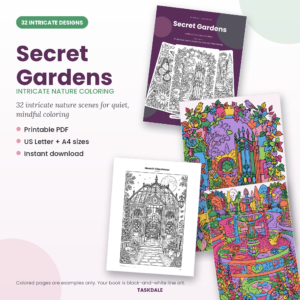
Secret Gardens Coloring Book
Price: $3.49 | Best for: colorists who like to plan their own palette
Thirty-two intricate garden scenes with fine linework and layered flowers, stone and foliage, including a hidden garden gate, a moonlit glasshouse, a fountain of birds, a wisteria archway and a hedge maze seen from above. Tiny treasures hide among the leaves. Each design is on its own page in US Letter and A4 PDFs. Pick the wisteria archway and number it with three purples and three greens.
When you do not own a color in the key
With fourteen colors per page, you will hit a gap sooner or later. The key asks for Teal and your tin jumps from Turquoise to Pine. Here is how to handle it without spoiling the page.
- Layer two pencils. A light pass of blue under a light pass of green makes a convincing teal. Test it on scrap first.
- Keep the order of values. If the key has light, mid and dark greens, your swaps must stay light, mid and dark. Value matters more than hue on detailed pages.
- Swap the whole family. If you change one green, check the two greens beside it still sit well together.
- Write it down. Note the swap next to the key so you use the same mix on every space with that number.
Done this way, nobody looking at the finished page will ever know a color was missing. You might even like your version better.
Pacing a long project
A detailed page is a marathon, not a sprint. A little structure keeps it enjoyable.
- Work in sections. Divide the page into four quarters with a light pencil mark. Finish one quarter per session.
- Stop before your hand tires. Precision drops after about 45 minutes. Shaky lines on the last petal are not worth it.
- Cover finished areas. Lay a sheet of paper over done sections to protect them from your hand.
- Keep a log. Write the date and hours on the back. A page that took nine hours over two weeks deserves a little record.
Many detail lovers have two pages on the go: one big project and one medium page for nights when focus is low.
Night scenes and moody palettes
Once you are comfortable, try detailed pages with a dark palette. Night scenes are a real test of skill, because you have to tell five dark blues apart and keep the moonlight glowing.
The trick is contrast. Keep the light areas very light, almost untouched paper, and press harder in the darkest areas. A silver or gold accent where the moon hits fur or feathers makes the whole page shine. It is a lovely moment when an owl seems to step out of the dark.
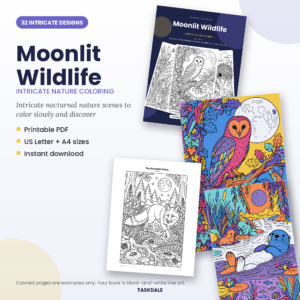
Moonlit Wildlife Coloring Book
Price: $3.49 | Best for: detail lovers who want a challenge
Thirty-two intricate night scenes with layered textures: a barn owl in a moonlit oak, a fox beneath ferns, a wolf on a ridge, an otter family, a luna moth among moonflowers and a deer at a woodland pool. Small objects are hidden in leaves, feathers and stones, and each page opens with a short line that sets a calm mood. US Letter and A4 PDFs. Try the barn owl with deep blues, silver and gold.
Showing off finished pages
A finished advanced page deserves better than a drawer. Square designs look lovely in an 8 by 8 inch frame, and a simple white mat makes the colors pop. Rectangular pages fit standard letter-size frames.
Some colorists scan finished pages and print them as cards for birthdays. Others keep a binder in sheet protectors, one page per sleeve, with the hours logged on the back. Flip through it on a slow evening and you will see your technique grow page by page. For ideas on other detailed themes, our guide to detailed cat coloring pages for adults is worth a look.
Common mistakes on detailed pages
- Printing at “fit to page”. It shrinks the smallest spaces even further. Print at 100 percent.
- Starting with the darks. Dark pigment spreads into neighbors. Work light to dark.
- Pressing hard too early. Wax builds up, and you cannot layer or soften edges later.
- Swapping colors mid-page. If you run out of a shade, the change will show. Check your supplies before you begin.
- Rushing the last section. The final quarter is where tired hands slip. Leave it for a fresh day.
Frequently asked questions
Where can I find free detailed color by number pages for adults?
Designer sample pages, mosaic and mystery pages on printable sites, and apps are the main free sources. You can also number a detailed coloring page yourself.
How many colors does an advanced color by number page use?
Usually eleven to fourteen, sometimes more. Several shades of the same color are what give detailed pages their depth.
What pencils work best for tiny color by number spaces?
Harder-lead colored pencils hold a sharp point longer. For the smallest spaces, fine-tip markers or fineliners are cleaner.
How long does a detailed color by number page take?
Anywhere from four to ten hours, often spread over several sessions.
Can I turn a regular coloring page into color by number?
Yes. Choose a palette of 10 to 14 colors, decide where the light comes from, number each space lightly in pencil and write a key in the margin.
What paper is best for detailed coloring?
Smooth, heavier paper such as 28 to 32 lb or light cardstock. It takes layers of pencil without pilling.
Your next step
Choose one detailed page this week, run the zoom test, sharpen every pencil you will need and color the lightest numbers across the whole page in your first session. When you want a run of advanced designs with the palettes already planned, open the Advanced section of Hue and Harmony Color by Number for Adults and start with the peony bouquet.