A free recipe costing template is the fastest way to find out what one menu item really costs to make. This guide shows you how to cost a dish from the supplier’s pack price down to a single serving, including the trim loss most quick calculations miss, and gives you a free one-item menu cost calculator for Excel and Google Sheets.
Free Recipe Costing Template: One-Item Menu Cost Calculator (Excel & Google Sheets)
Cost one menu item from supplier pack prices: usable yield, density, packaging, ingredient cost %, remaining per sale and price at your target %. Pre-filled example included.
Want everything unlocked?
The free file is a sample. The full version has every page, tab and feature, plus the user guide.
See the full versionThe download is free. You enter your email address to get the file, and free downloads are limited to 3 per day.
What a recipe costing template should calculate
Recipe costing answers one question: how much do the ingredients and packaging in one serving cost at today’s prices? To answer it properly, a template needs to handle four things:
- Pack price to unit cost. You buy a 4 kg case or a gallon jug, but you use 120 g or 280 ml. The template has to convert between the two.
- Usable yield. Trimming, peeling, bones and drained liquid mean you never use 100% of what you buy.
- Packaging. Cups, lids, boxes and liners are part of the cost of a takeaway item.
- Servings. If a recipe makes 12 portions, the cost per serving is the recipe cost divided by 12.
Step 1: Turn the pack price into a cost per usable unit
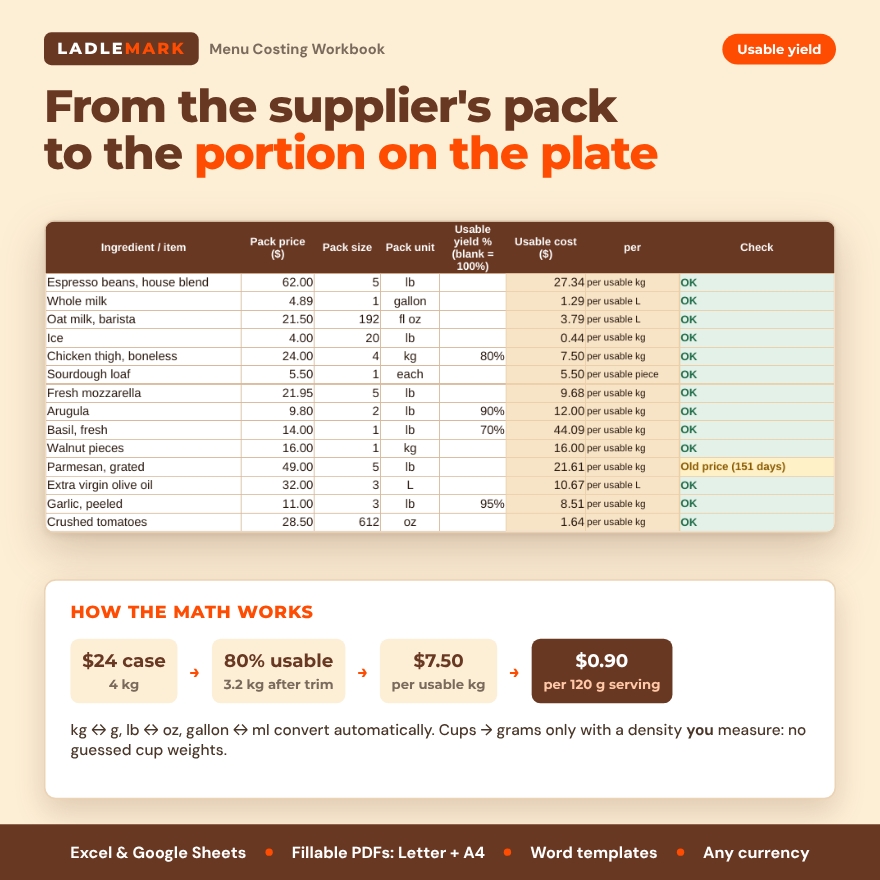
Start with the latest invoice, not memory. For each ingredient, write down the pack price, the pack size and the unit. Then apply the usable yield: the share left after prep.
Example: a case of boneless chicken thigh costs $24.00 and holds 4 kg. After trimming, 80% is usable.
- Usable quantity = 4 kg x 80% = 3.2 kg
- Cost per usable kg = $24.00 / 3.2 kg = $7.50
- A 120 g serving = 0.12 kg x $7.50 = $0.90
Without the yield step, the same serving looks like it costs $0.72. That 25% gap is exactly the kind of error that makes a menu look healthier than it is. The free template does this calculation for every line, and the full Ladlemark Menu Costing Workbook does it for up to 200 ingredients with price dates and sources.
Step 2: Keep units in the same family
Grams convert to kilograms, ounces and pounds. Milliliters convert to liters, teaspoons, tablespoons, cups, fluid ounces and gallons. The trap is mixing the two: a cup is a volume, and what it weighs depends on the ingredient. A cup of all-purpose flour is roughly 120-125 g, while a cup of honey is around 340 g.
If a recipe uses cups but you buy by weight, measure a density once: weigh one level cup in grams and divide by 236.6 (the milliliters in a US cup). Flour at 125 g per cup gives 0.53 g per ml. Enter that number and the template converts correctly. If you skip it, a good template should flag the line instead of guessing.
Step 3: Add packaging and divide by servings
Add every piece of packaging a takeaway serving uses: cup, lid, sleeve, box, bag, napkin, cutlery. A case of 1,000 cups at $89.00 is $0.089 per cup; that sounds small until you multiply it by a few hundred coffees a week.
Then divide the recipe total by the number of servings it makes. A muffin batter that costs $9.87 and yields 24 muffins costs about $0.41 per muffin before the liner and bag.
Step 4: Read the results the right way
Once you have the cost per serving, three numbers matter:
- Ingredient cost % = ingredient cost per serving / menu price. Many cafés aim for roughly 25-35%, but your own target depends on your concept and other costs.
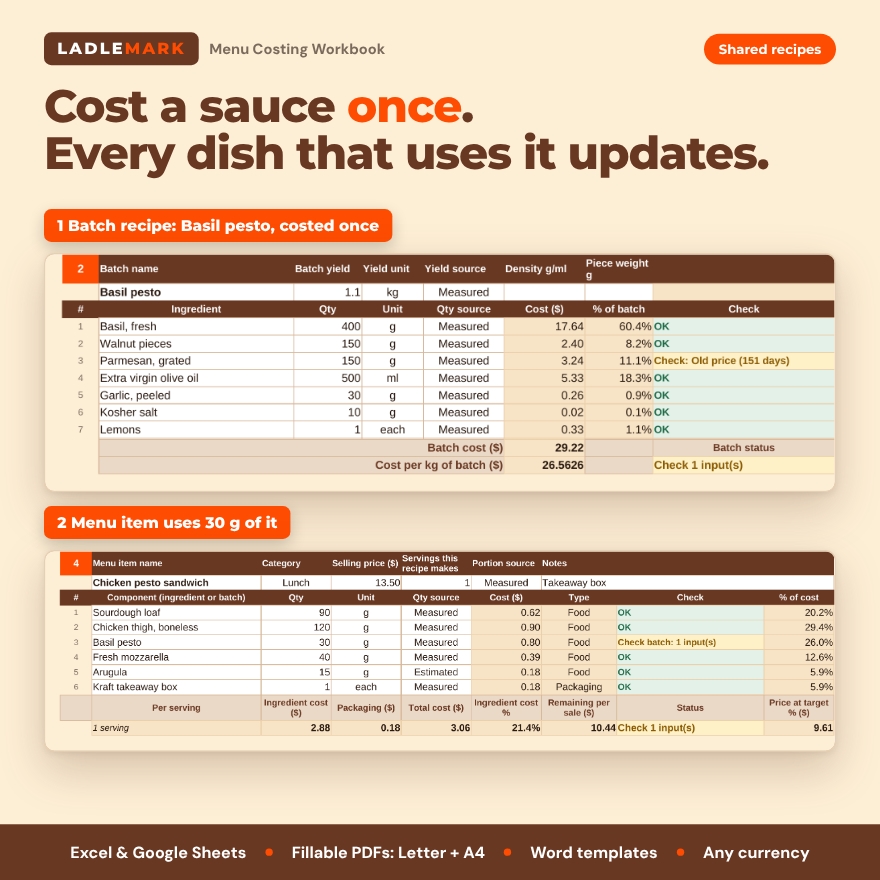
- Price at target % = ingredient cost / target %. If a sandwich costs $2.88 in ingredients and your target is 30%, the price that hits the target is $9.61.
- Amount remaining per sale = menu price – ingredient cost – packaging cost. This is not net profit: labor, rent, utilities, card fees and taxes still come out of it.
Step 5: Replace estimates with measurements
The biggest errors in recipe costing are not math errors. They are portions that drifted, batch yields nobody measured, and prices from an invoice six months ago. A simple routine fixes most of them:
- Weigh three real portions as served and use the average.
- Measure a batch yield after cooking, before portioning.
- Re-check your most expensive ingredient on the latest invoice.
- Mark anything you guessed as an estimate, so you know what to measure next.
The full Ladlemark kit includes printable kitchen measurement sheets for exactly this: a prep-yield log, a portion-weight record and a batch-output sheet, in US Letter and A4.
When a one-item template is not enough
A single-item calculator is perfect for checking one dish. It gets painful when a sauce or dough appears in several items, because a single price change means editing every copy. That is where a full workbook helps: you cost the sauce once as a batch recipe, and every menu item that uses it updates when an ingredient price changes.
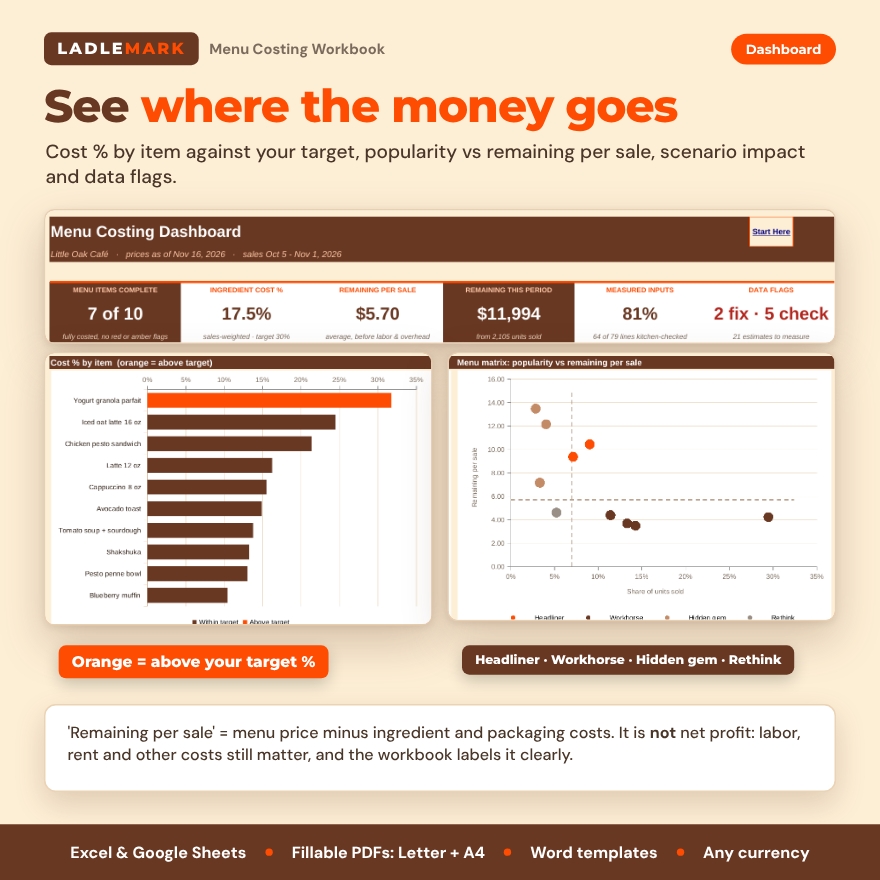
The Ladlemark Menu Costing Workbook also adds a sales mix (which items are popular, and which leave the most per sale), three side-by-side what-if scenarios, and a Data Check tab that flags missing prices, incompatible units, zero batch yields and old invoice dates instead of quietly treating them as zero.
Get the full Ladlemark Menu Costing Kit
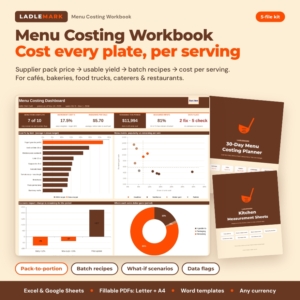
- Workbook for 200 ingredients, 20 batch recipes and 40 menu items, with a dashboard
- Usable yield, density and piece weights, with measured vs estimated tracking
- Sales mix matrix and 3 what-if scenarios that never overwrite your recipes
- Data-quality flags for missing prices, unit mismatches, zero yields and old invoices
- 30-day planner, kitchen measurement sheets, owner review template and a worked café example
$24.99, instant download, Excel and Google Sheets.
A 30-day plan to cost your menu
Costing a whole menu in one weekend rarely works. Spreading it over 30 short sessions does:
- Days 1-5: pick ten items, gather supplier prices, enter pack sizes, collect recipes and list missing measurements.
- Days 6-15: cost one menu item per day, including packaging and serving yield, and mark estimates.
- Days 16-20: weigh an actual portion, measure a batch yield, verify the most expensive ingredient, update a shared recipe and review every flag.
- Days 21-25: enter units sold, compare popular and low-volume items, run a supplier-price scenario and a portion or packaging scenario, and pick one change to test.
- Days 26-30: document the test, collect observations, compare them with your assumptions, complete an owner report and set a recurring price-update date.
The finish line: ten costed menu items, a record of which numbers were measured versus estimated, and one decision you can explain with figures. The day-by-day planner is part of the full kit.
Common recipe costing mistakes
- Using the price you remember instead of the latest invoice.
- Costing raw purchase weight instead of usable weight.
- Assuming every cup weighs the same.
- Forgetting cups, lids and boxes on takeaway items.
- Treating a missing price as zero, which makes an item look cheaper than it is.
- Calling the amount left after ingredients “profit”.
Download the free recipe costing template
The free Ladlemark Lite calculator costs one menu item with up to 12 ingredients and 3 packaging lines, applies usable yield and density, flags missing prices and mismatched units, and shows ingredient cost %, remaining per sale and the price at your target %. It comes pre-filled with the chicken example above, so you can see it work before you type your own numbers.
Ready to cost the whole menu? Get the Ladlemark Menu Costing Workbook and finish with numbers you trust.