Splitting rent is easy because it never changes. Utilities are where shared homes fall apart. The electric bill doubles in January, someone works from home all day, one person showers for 25 minutes, and suddenly a 140 bill turns into a group chat argument.
This guide shows you exactly how to split utilities with roommates in a way everyone can live with. You will get four split methods with worked numbers, a simple monthly settle-up routine, house rules that stop arguments before they start, and a free fillable bill split sheet you can download right now.
Free download: bill split sheet for roommates
Enter your email below and the free Splitwren sampler lands in your inbox. It is a fillable PDF in US Letter size with four working pages: an equal split sheet, an electric usage and cost log, a full monthly settle-up page, and a payment log. Type into it on your computer or print it and stick it on the fridge.
Free Bill Split Sheet for Roommates & Couples (Fillable PDF)
A 7-page Splitwren sampler: equal split sheet, electric usage and cost log, a full monthly settle-up page and a payment log. Fillable PDF, US Letter.
Want everything unlocked?
The free file is a sample. The full version has every page, tab and feature, plus the user guide.
See the full versionWhy splitting utilities causes more fights than rent
Rent is fixed and agreed before anyone moves in. Utilities are not. Three things make them messy:
- They change every month. A summer electric bill of 85 can become 180 in winter. If nobody planned for that, the person whose name is on the account feels it first.
- Usage is not equal. One roommate works from home with two monitors and a space heater. Another is barely there. Equal splits start to feel unfair fast.
- One person usually fronts the money. The bill comes out of one bank account, and that person spends the month chasing everyone else. Resentment builds quietly.
The fix is not a perfect formula. It is an agreed formula, written down, plus a regular day when everyone squares up. Let’s start with the formulas.
4 fair ways to split utilities with roommates
There is no single right answer. Pick the method that matches how your household actually lives, and you can use different methods for different bills.
1. Split everything equally
The simplest option and the one most roommates start with. Add up the bill and divide by the number of people.
Each pays = bill total ÷ number of people sharing
Example: internet costs 65.00 and three people share it. Each pays 21.67. That is 65.01 in total, so someone gets a one cent rounding win. Decide who in advance. A good rule: the person who pays the provider covers or keeps the odd cent.
Best for: internet, streaming services, trash pickup, and homes where everyone is around about the same amount.
2. Split rent and utilities by room size
When one bedroom is bigger or has its own bathroom, many households tie a slightly bigger share of costs to that room. A clean way to do it for rent is a two-part split:
- Agree a shared part, often 30% to 50% of the total, that everyone pays equally for the kitchen, living room and hallways.
- Split the rest by bedroom square footage.
- Add or subtract agreed extras, like a private bathroom or a parking space. Extras must add up to zero.
Example with rent of 2,400 and a 40% shared part: 960 split three ways is 320 each. The private part is 1,440, split across rooms of 180, 150 and 120 square feet (450 in total), giving 576, 480 and 384. The room with a private bathroom adds 50, and the other two each take 25 off. Final rent: 946, 775 and 679, which adds up to exactly 2,400.
For utilities, you can use the same percentages as rent, or keep utilities equal and only adjust rent. Most households find the second option easier to explain.
3. Split by income (popular with couples)
Couples, and sometimes friends with very different paychecks, split bills in line with what each person earns. It keeps the bills from eating up a much bigger slice of one person’s pay.
Your share = bill × your income ÷ total household income
Example: Sam takes home 4,000 a month and Ria takes home 2,500. Total household income is 6,500. On an electric bill of 110.50, Sam pays 110.50 × 4,000 ÷ 6,500 = 68.00 and Ria pays 42.50. Together that is 110.50.
Tip: work out each amount from the incomes rather than from rounded percentages like 61.5%. Rounded percentages are where the missing cents come from.
4. Split by usage or fixed contributions
Sometimes a flat agreement is fairer than math. A few common setups:
- The work-from-home top-up. The person home all day adds a set amount, say 15 a month, to the electric share before the rest is split equally.
- Guest nights. A partner who stays more than four nights a month adds a guest share to that month’s utilities.
- Family contributions. An adult child living at home pays a fixed amount each month toward household bills.
- Bill owners. Each person pays certain bills in full (one pays electric, one pays internet), and you even up the difference once a month.
Which split method should your household use?
| Method | Works best when | Watch out for |
|---|---|---|
| Equal | Everyone uses about the same amount | Feels unfair if one person is home all day |
| By room size | Bedrooms differ in size or one has a private bath | Agree the shared part % before you start |
| By income | Couples or families with different paychecks | Use exact amounts, not rounded percents |
| Fixed or by usage | Guests, work from home, adult kids paying board | Write the amounts down and review every 6 months |
EDITOR’S PICK FOR SHARED HOMES
Splitwren Shared Household Bills Tracker
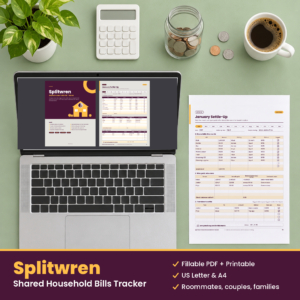
The free sampler covers equal splits. The full Splitwren tracker covers every method in this guide: equal, by percentage, rent by room and fixed contributions, each with a worked example. It adds water, gas and internet logs, 12 monthly settle-up pages with tabs, a House Rules for Bills agreement with signature lines, shared purchase and payment logs, and a move-out checklist with a deposit tracker.
- 36 pages, fillable PDF plus ink-saver printables
- US Letter and A4, undated, any currency
- For roommates, couples and families
How to settle up each month (without chasing anyone)
A split method tells you what is fair. A settle-up tells you who actually owes money this month. Pick one day each month, ideally a few days after most bills are paid, and run these four steps.
Step 1: List every shared bill and who paid it
Write each bill, the amount, and the person whose account it came out of. Include shared purchases like cleaning supplies and toilet paper.
Step 2: Work out each person’s fair share
Use the split method you agreed for each bill. Add up the shares for each person.
Step 3: Find each balance
Balance = what you actually paid minus your fair share. A plus number means you are owed money. A minus number means you owe. All the balances together always add up to zero. If they don’t, a number was copied wrong somewhere.
Step 4: Send the fewest transfers
The person who owes the most pays the person owed the most. Repeat until everyone is at zero. With three people this almost always takes two transfers or fewer.
A real example
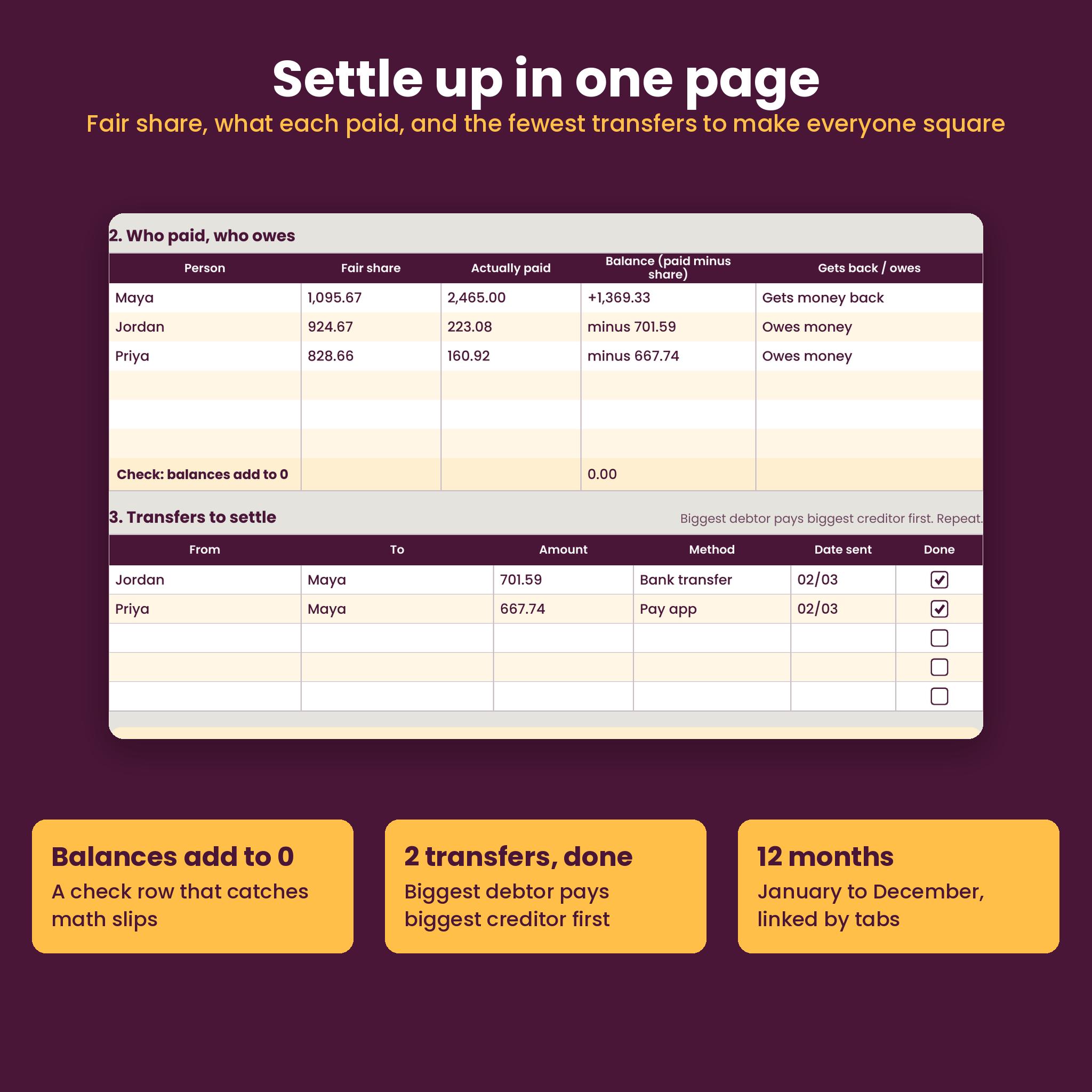
Maya, Jordan and Priya share a 3-bedroom apartment. In January their shared bills came to 2,849.00, including 2,400 rent (split by room), and electric, gas, internet, water, trash, streaming and cleaning supplies (split equally three ways).
| Person | Fair share | Actually paid | Balance |
|---|---|---|---|
| Maya | 1,095.67 | 2,465.00 | +1,369.33 |
| Jordan | 924.67 | 223.08 | minus 701.59 |
| Priya | 828.66 | 160.92 | minus 667.74 |
| Total | 2,849.00 | 2,849.00 | 0.00 |
Two transfers settle the month: Jordan sends Maya 701.59 and Priya sends Maya 667.74. Maya paid the rent, so she gets most of it back. Nobody has to remember who covered what in week two.
Track usage so the split stays fair
Equal splits only feel fair when everyone trusts the bill. Logging usage each month makes the numbers visible. For electric, write the kWh and the bill amount, then work out the cost per kWh (bill ÷ kWh). If the cost per kWh jumps, your rate changed. If the kWh jumps, your usage changed.
Three months of logs usually tell you what you need to know:
- A winter spike in gas or electric is normal. Compare with the same month last year, not last month.
- A water bill up 20% or more with no extra guests often means a leak. Turn off every tap and watch the meter for 15 minutes.
- Internet promo prices often end after 12 months. Write the promo end date down so the price jump doesn’t surprise anyone.
If seasonal swings cause stress, ask your utility about budget billing. It spreads the year’s cost into equal monthly payments, so each person’s share stays the same all year.
Whose name goes on the utility accounts?
Someone has to hold each account, and that person carries the risk if others don’t pay. A few ways to make it fair:
- Spread the accounts. One person holds electric, another holds internet, another holds water.
- Put autopay bills with the most organized person, who also keeps the tracker.
- Record every account in one place: provider, whose name it is in, due day, autopay, and the last 4 digits of the account number. Never write passwords down in a shared tracker.
- Agree what happens at move-out: the account holder either transfers the account or closes it, and final bills are split by days lived in the home.
House rules for bills worth writing down
Most money arguments between roommates are not about math. They are about expectations nobody said out loud. Agree on these before the first bill arrives:
- The day each month shares are due, and how people pay each other.
- What happens if someone pays late. A common rule: the late person covers any late fee in full.
- Thermostat settings for winter and summer.
- When a regular guest starts paying a share of utilities.
- Who buys shared supplies, and how they get split.
- A spending limit for shared purchases before everyone has to agree.
- The odd cents rule for bills that don’t divide evenly.
- Notice period, final bills and deposit refunds when someone moves out.
- What you do when you disagree: check the payment log together first.
Write the answers down and have everyone sign. The full Splitwren tracker has a House Rules for Bills page with all nine prompts and signature lines, so you can point to it instead of arguing from memory.
Free sampler vs the full Splitwren tracker
| Feature | Free sampler | Full Splitwren |
|---|---|---|
| Equal split sheet | ✓ | ✓ |
| Split by percentage, rent by room, fixed contributions | ✗ | ✓ |
| Monthly settle-up pages | 1 | 12, with month tabs |
| Utility logs | Electric | Electric, water, gas, internet + annual summary |
| Household profile and bill directory | ✗ | ✓ |
| House rules for bills with signatures | ✗ | ✓ |
| Payment log and shared purchases log | 1 page | 5 pages |
| Move-in, move-out and deposit tracker | ✗ | ✓ |
| Paper sizes | US Letter | US Letter + A4 + ink-saver printables |
| User guide | ✗ | ✓ |
See the full Splitwren tracker on Taskdale
More tools for shared homes
If you’d rather work in a spreadsheet, or you’re setting up a whole new home, these Taskdale products pair well with a roommate bill split routine:
| Product | Format | Good for |
|---|---|---|
| Evenstead Roommate Bill Splitter | Excel & Google Sheets | Roommates who want automatic who-owes-whom math |
| Pairbloom Couples Budget Spreadsheet | Excel & Google Sheets | Couples splitting bills by income |
| Oursly Yours, Mine & Ours Budget | Excel & Google Sheets | Couples with joint and personal accounts |
| Tillbrook Printable Budget Binder | Fillable PDF | Your own monthly budget alongside shared bills |
| Quadnest Dorm Checklist & Move-In Planner | Fillable PDF | Students moving into shared housing |
| Homewright Home Management Binder | Printable & fillable PDF | Running the rest of the household |
Prefer a spreadsheet for the free version too? Our guide to the free roommate bill split spreadsheet covers the Excel and Google Sheets route.
Frequently asked questions
What is the fairest way to split utilities with roommates?
For most homes, an equal split is fairest for utilities, with rent adjusted for room size. Switch to a usage top-up only when one person clearly uses much more, such as working from home every day.
Should utilities be split by room size?
You can, but most households keep utilities equal and adjust only rent. Bigger rooms don’t always use more power, while the person in the smallest room might run a space heater all winter.
How do couples split utilities fairly?
Many couples split by income: each pays the bill multiplied by their income and divided by total household income. Others pay into a joint account in the same proportion and pay every bill from there.
Who should have the utilities in their name?
Ideally, spread the accounts across roommates so no one person carries all the risk. Whoever holds an account should collect the shares at each monthly settle-up.
How often should roommates settle up?
Once a month works for most homes. Pick a fixed day a few days after most bills are paid, and do it every month even when the amounts are small.
What if a roommate won’t pay their share?
Start with the written record: the payment log and the house rules everyone signed. Most disputes end when the numbers are on paper. If it keeps happening, talk to your landlord about how the lease handles shared costs.
Get your free bill split sheet
A fair split, written down, plus one settle-up day a month is all it takes to keep utilities from turning into an argument. Start with the free sampler today: it’s in the download box at the top of this page. When you want every split method, 12 months of settle-ups and the house rules page, get the full Splitwren tracker on Taskdale.