You have outgrown the big-petal books. The bold daisies and chunky mandalas that felt so calming a year ago now take twenty minutes and leave you wanting more. What you need now are intricate adult coloring book pages for advanced colorists: scenes with depth, texture and enough tiny spaces to keep a sharpened pencil busy for a week.
This guide is for that colorist. We will look at what makes a page properly detailed rather than just busy, the tools that make small spaces manageable, the shading methods that turn flat pages into scenes, and four printable books from Taskdale that reward patience.
Expect practical detail. You already know how to stay inside the lines.
Quick picks: detailed printable books worth the effort
| Product | Best for | Price | Link |
|---|---|---|---|
| Pond Life Coloring Book | Reeds, ripples and wetland wildlife | $3.49 | View |
| Secret Gardens Coloring Book | Layered garden scenes with hidden treasures | $3.49 | View |
| Botanical Animals Coloring Book | Fur, feathers and petals woven together | $3.49 | View |
| Forest Cabins Coloring Book | Cozy woodland scenes with hidden objects | $3.49 | View |
What makes a page intricate, not just busy
Plenty of pages are crowded. Fewer are well made. An intricate page has detail that serves the picture, and you can feel the difference about ten minutes in.
Detail with a purpose
On a good page, small shapes describe something real: the scales on a koi, the veins of a lily pad, the grain on a cabin door. On a poor page, the artist has filled empty space with random swirls. Swirls are fine in a mandala. In a scene, they flatten everything.
Clear layers
Look for a foreground, a middle and a background. A heron in the reeds with willow branches behind and water below gives you three distances to play with. That is where your shading has room to work.
Steady line weight
Thin, even lines leave more space for color. Heavy black outlines on a detailed page swallow tiny cells and make shading look muddy. Zoom in before you print. If the lines are thicker than the spaces between them, move on.
Something to find
Many advanced colorists love hidden objects: a key in the ivy, a snail on a stone. They give your eye a reason to slow down, and spotting one halfway through a session is a small, real pleasure.
The tools that make tiny spaces easier
Intricate pages punish blunt tools. You do not need an expensive kit, but a few choices make a big difference.
- Colored pencils with a firm core. Oil-based pencils hold a sharp point longer, which helps in tight corners. Wax-based pencils blend more softly and are great for smooth skies. Many advanced colorists keep a few of each.
- A good sharpener. A long-point sharpener gives a finer tip than a basic one. Sharpen often. A sharp point is half of neat work.
- Fine-tip markers or gel pens. Tips around 0.4 to 0.5 mm reach the smallest cells. Test them on a spare print first to check for bleeding.
- A white gel pen. Perfect for highlights on water, eyes and dewdrops, added at the very end.
- A colorless blender. A blender pencil or blending stump smooths layers without adding pigment.
- Good light. A daylight lamp aimed across the page shows every gap. Some colorists add a clip-on magnifier for the finest areas.
For marker-specific advice and the paper that holds up to them, see our guide to the best markers for adult coloring books.
Shading methods that turn flat pages into scenes
The leap from good to striking is almost always about value, meaning how light or dark each area is. Color choice matters less than people think.
Build in light layers
Start with almost no pressure. Lay three to five thin layers instead of one heavy one. Each layer fills the paper’s tooth a little more, and the colors stay luminous instead of waxy. Save heavy pressure, called burnishing, for the final pass on the areas you want to shine.
Decide where the light comes from
Pick one light source before you begin, say the top left. Every leaf, stone and feather gets its darkest shade on the bottom right. This single decision makes a page look three-dimensional more than anything else you can do.
Warm forward, cool back
Warm colors such as orange and yellow-green seem to come toward you. Cool blues and blue-greens seem to sink back. Color the reeds at the front in warm greens and the far bank in cooler, paler ones, and the pond suddenly has depth.
Use the squint test
Every twenty minutes, step back and squint. If everything blurs into one mid-tone, you need darker darks. Most pages that feel flat have no area darker than a mid-green.
Wetland scenes for layered greens
Water is one of the best subjects for practicing all of this. Reflections, ripples and reeds force you to think about light, and a pond scene gives you dozens of greens to separate: lily pads, algae, rushes, frog skin and willow leaves all at once.
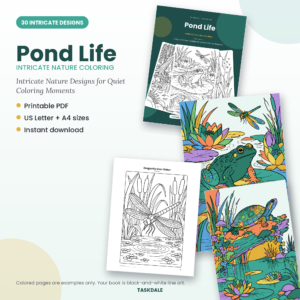
Pond Life Coloring Book
Price: $3.49 | Best for: colorists who love water and wildlife
Pond Life has 30 intricate nature scenes, from Lily Pad Frog and Heron in Reeds to a willow reflection and a rainy pond. Each design sits on its own page in both US Letter and A4 PDFs, with a clickable contents page and picture gallery. Try Dragonfly Over Water first and practice keeping the wings almost white.
A tip for water: color the reflection after the object above it, using the same colors but one step darker and a little bluer. Then pull a white gel pen across in short horizontal strokes. That is a ripple.
Planning a page across several evenings
Intricate pages rarely get finished in one sitting, and they should not. Here is how one colorist might plan a single detailed cabin scene across four evenings of about an hour each.
| Session | Focus | Why it comes now |
|---|---|---|
| Evening 1 | Choose a palette of 12 colors, swatch them on scrap paper, color the sky and distant trees lightly | The background sets the mood and light for everything else |
| Evening 2 | The cabin walls, roof and windows, with the light source marked in pencil | The main subject needs the most care while you are fresh |
| Evening 3 | Foreground plants, path and animals in warmer greens | Warm colors at the front push the cabin back into the scene |
| Evening 4 | Darkest shadows, burnishing, white highlights, hidden objects | Final contrast pulls the whole page together |
Write the palette on the back of the page. When you return on evening three, you will not have to guess which green you used for the moss. That small habit saves a lot of second-guessing.
Keep finished pages in a clear sleeve with the date written on the back. Six months from now, put an early page next to a recent one. The jump in your shading is usually obvious, and seeing it is a proud moment that no tutorial can give you.
Woodland cabins for long winter sessions
Cabin scenes are a natural fit for the four-evening plan above. They mix hard surfaces like logs, shingles and window glass with soft ones like moss, snow and pine needles, so every session brings a new problem to solve. A cabin window glowing at dusk is also one of the most satisfying things to shade well: warm yellow inside, cool blue outside, and a soft halo where the two meet.

Forest Cabins Coloring Book
Price: $3.49 | Best for: cabin lovers who like hidden objects
Forest Cabins has 30 intricate woodland scenes, including Pine Trail Cabin, Lakeside Retreat, Winter Woodland Lodge, a Treehouse Cabin and a Cabin Window Close-Up. Animals, plants and hidden objects are woven through each one. It comes as US Letter and A4 PDFs, one design per page. Start with Twilight Cabin to practice that warm window glow.
For logs, color the whole wall in a mid brown, then add a darker line under each log where the shadow falls. Finish with a lighter tan along the top edge of each one. Three passes, and the wall looks solid enough to lean on.
Garden scenes with real depth
Walled gardens are a gift to the advanced colorist. Stone, brick, glass, water, petals and leaves all sit on one page, and each surface needs a different touch. A glasshouse alone teaches you more about reflection than a month of flower close-ups.
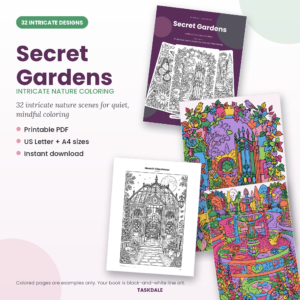
Secret Gardens Coloring Book
Price: $3.49 | Best for: detail lovers who enjoy garden scenes
Secret Gardens has 32 intricate scenes, including The Hidden Garden Gate, Moonlit Glasshouse, a hedge maze seen from above and a Rose Window Mandala. Small treasures are tucked among the leaves. It comes as US Letter and A4 PDFs, one design per page. Start with Foxglove Path and give the stones a cool gray base before the flowers go in.
For stone walls, avoid coloring every brick the same. Pick three close shades, say a sand, a warm gray and a pale rust, and rotate them. The wall will look weathered and real instead of printed.
Fur, feathers and petals: texture practice
Texture is where advanced colorists really show their skill. Fur needs short directional strokes. Feathers need a clean edge and a soft middle. Petals need a gentle shift from the base to the tip. Pages that put animals and plants side by side let you practice all three on one sheet.
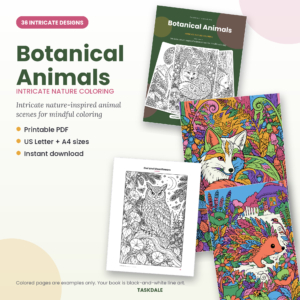
Botanical Animals Coloring Book
Price: $3.49 | Best for: colorists who enjoy texture work
Botanical Animals blends creatures and plants across 36 detailed scenes, such as Fern Fox, Owl and Moonflowers, Hummingbird Hibiscus and Peacock Garden Gate, plus a Foxglove Fox Mandala. You get US Letter and A4 PDFs. Pencils, fine markers and gel pens all suit the linework. Begin with the Hedgehog Garden for a friendly lesson in spiky texture.
For fur, follow the direction the hair would grow, using flicking strokes that start with pressure and lift off. Layer a dark brown under a lighter tan and leave tiny gaps. Those gaps read as light on the fur.
Printing detailed pages so the lines hold up
A detailed page printed badly is a frustrating page. Thin lines are the first thing a cheap print setting loses.
- Use your printer’s best quality setting. Draft mode breaks fine lines into dots.
- Print at actual size. Shrinking a page to fit loses the smallest cells.
- Choose smooth, heavier paper. A smooth 65 to 80 lb cardstock takes many pencil layers without pilling. Rough paper eats fine detail.
- Consider printing larger. If your eyes find a page too tight, a local print shop can enlarge a US Letter page to 11 by 17 inches. The detail stays, the spaces grow.
- Keep a test sheet. Print one extra copy of each page you plan to color and use it to try palettes.
If you like the idea of quality detail on a smaller budget, our list of cheap adult coloring books that are actually good includes more printable options.
Habits that hold advanced colorists back
Skilled colorists still fall into a few traps. Spotting them is usually enough to fix them.
- Too much pressure too early. Once the paper’s tooth is full, nothing else will stick. Stay light until the last layer.
- A different color for every cell. On a detailed page, this turns into noise. Group areas into color families instead.
- No true darks. Fear of ruining a page keeps many colorists in the safe middle. Add one deep shadow and watch the page wake up.
- Overworking one corner. If you have colored the same leaf for twenty minutes, move on and come back later with fresh eyes.
- Skipping breaks. Fine work tires the eyes and hand. Stretch your fingers and look across the room every half hour.
Frequently asked questions
What is the most detailed type of coloring page?
Layered scenes with hidden objects and fine textures, like gardens, ponds and woodland cabins, tend to be the most detailed. Complex mandalas are close behind, though they repeat the same patterns more.
How long does an intricate coloring page take?
Anything from three to ten hours, depending on the page and how much you layer. Spreading a page over several evenings is normal and usually gives a better result.
What colored pencils are best for intricate pages?
Pencils that hold a sharp point, which often means oil-based or harder wax-based cores. A long-point sharpener matters as much as the brand.
Can I print detailed coloring pages on regular printer paper?
You can, but thin paper wears out after a few pencil layers and markers bleed through. Smooth cardstock gives cleaner results on detailed work.
How do I stop my coloring from looking flat?
Pick one light source, add real shadows on the opposite side, and put warmer colors in front and cooler ones behind. Then check with the squint test.
Which intricate book should I start with?
If you enjoy wildlife, start with Pond Life. If you prefer architecture and flowers, Secret Gardens has the most variety in surfaces. For more gentle detailed picks, see two intricate adult coloring books for a calm evening.
Your next step
Choose one detailed page, swatch twelve colors on scrap paper, write them on the back, and color only the background tonight. Tomorrow, mark your light source and start on the main subject. If you want a page built for exactly that slow approach, download the Secret Gardens Coloring Book and begin with the hidden gate.