Streaky hair. Ink bleeding through to the next page. Pencil that goes waxy and refuses to take another layer. Most problems with manga coloring are not skill problems at all. They are supply problems. The right pen on the wrong paper will let you down every time, and a modest kit that works together beats an expensive one that fights itself.
This guide covers manga coloring book supplies that give clean results: markers, colored pencils, paper and the small extras that make a big difference. It is for teens and adults who color manga and anime-style pages and want smoother fills, sharper edges and fewer ruined sheets. There is no single “best” brand list here. Instead, you will learn what each type of supply does well, what it struggles with, and how to test what you already own. Three printable Taskdale books are featured for practice.
Quick picks to test your supplies on
| Product | Best for | Price | Link |
|---|---|---|---|
| Ink and Glint Manga Coloring Book | Manga pages with test circles and brand-free palettes | $4.99 | View |
| Lumen and Lead Stained Glass Coloring Book | Marker swatching and vellum suncatchers | $4.49 | View |
| Indoor Activities Coloring Book Adventure | Pages for younger siblings who share your supplies | $2.99 | View |
Start small: a kit that grows with you
The biggest supply mistake is buying a giant set on day one. A 72-marker box sounds exciting, but you will reach for 15 of them, and the rest sit unused. Worse, a huge set can make choosing colors harder, not easier.
Starter kit
- A set of 24 to 36 colored pencils with a decent range of skin tones and browns.
- Two or three fineliners, such as 0.1, 0.3 and 0.5 mm, with pigment ink.
- A white gel pen.
- A pack of smooth, slightly heavier printer paper.
Growing kit
- A small set of 12 to 24 alcohol markers chosen around skin, hair and a few outfit colors.
- A colorless blender marker.
- A pad of marker paper or a box of smooth cardstock.
Serious kit
- Refillable alcohol markers bought one by one as you find gaps.
- Soft, artist-grade colored pencils for detail over markers.
- A few paper types for different jobs, including vellum for special pieces.
Build up slowly. Every time you wish you had a color you do not own, write it down. When the list hits five, that is your next shopping trip.
Alcohol markers: smooth, bold, a little wild
Alcohol markers are the classic tool for anime-style coloring. The ink dries quickly and blends while wet, so you get smooth, flat fills with no streaks when you work fast. They are ideal for crisp cel shading: lay a base, let it dry, add a darker shadow shape on top.
What they do well
- Even, saturated color on large areas such as hair and clothing.
- Smooth gradients when you layer light into dark while the ink is wet.
- Clean edges for cel shading.
What to watch for
- Bleed. Alcohol ink soaks through most paper. Always put a scrap sheet underneath.
- Feathering. On soft, absorbent paper, ink spreads past the lines. Smooth, coated paper helps.
- Darkening. Each layer gets darker. Start lighter than you think.
- Smell. Work somewhere with fresh air, and keep caps on when not in use.
A tip for choosing colors: buy markers in families of three or four related shades, such as light, medium and dark of one skin tone. A family lets you shade properly. A random rainbow of single colors does not.
Water-based markers and brush pens
Water-based markers are gentler. They do not smell, bleed far less, and many are washable. The trade-off is blending. Water-based ink tends to streak if you go back over it, and too many layers can pill or tear thinner paper.
They shine in two places. First, for younger artists or shared family supplies, where mess and smell matter. Second, as brush pens for line work, where a flexible tip gives beautiful tapered strokes on hair and outlines. Many manga fans ink with a water-based brush pen and color with alcohol markers on top, though you should always test that the ink is fully dry and does not smear.
For a deeper look at marker types and the paper they need, see our guide to the best markers for adult coloring books.
Colored pencils: control and soft blending
Colored pencils are the most forgiving tool for manga coloring. You can build color slowly, fix mistakes with light layers, and get soft gradients on skin and eyes that markers struggle to match.
Wax-based or oil-based?
Wax-based pencils are usually softer and creamier. They lay down rich color fast and blend well, but heavy layers can create a shiny “wax bloom” film. A light wipe with a soft cloth clears it.
Oil-based pencils tend to be firmer and hold a sharper point, which is excellent for fine details like eyelashes and catchlight edges. They layer cleanly without bloom.
Many artists keep both: soft pencils for broad areas, firmer ones for detail.
Pencil techniques for clean manga results
- Light pressure first. Build three or four thin layers rather than one heavy one.
- Follow the form. Stroke in the direction hair falls or fabric drapes.
- Burnish last. When you are done, a firm final layer with a light color or a colorless blender pencil smooths the paper texture and gives a polished finish. After burnishing, the paper will not take much more color, so save it for the end.
Paper: the supply everyone forgets
If you color printable pages, you choose the paper. That is a big advantage over a bound book, as long as you choose well.
Paper weights in plain terms
- Standard printer paper (about 20 lb or 75 to 80 gsm): fine for colored pencils and testing. Markers will bleed through.
- Heavier printer paper (about 24 to 32 lb or 90 to 120 gsm): a great everyday choice. Smoother, brighter, and handles light marker work better.
- Smooth cardstock (about 65 to 80 lb cover): excellent for pencils and layered markers. Check your printer can feed it.
- Marker paper: thin but coated, so alcohol ink stays on top and blends smoothly. Often comes in pads, so you may need to trace or use a light box.
- Vellum or translucent paper: for special effects like suncatchers.
Smooth or textured?
For manga, smooth almost always wins. Clean lines and flat fills need a smooth surface. Textured or “toothy” paper grabs pencil pigment well but makes marker fills patchy and fine lines rough.
Printer settings
Print at actual size, not “fit to page”, and use your printer’s best quality setting for line art. Laser-printed lines usually resist alcohol markers well. Some inkjet inks can smear under alcohol, so test a corner first. Our guide to printing a coloring book PDF has more on settings.
Pages that let you test colors right beside the art save a lot of guessing about how a marker looks on your chosen paper.
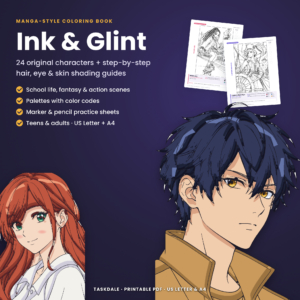
Ink and Glint Manga Coloring Book
Price: $4.99 | Best for: manga fans testing new supplies
Twenty-four original manga-style characters, each page with dashed test circles beside the art so you can check a color on the same paper before using it. The 42 palettes list light, base, shadow and deep roles with hex codes, so you can match them to whatever marker or pencil brand you own. Shading guides, practice sheets and US Letter and A4 PDFs are included. Print one page on two paper types and compare.
White pens, fineliners and small extras
A few small tools punch far above their weight.
- White gel pen: adds catchlights in eyes, shine on hair and sparkle on metal. It also rescues highlights you colored over by mistake. Let marker ink dry first, or the gel can sink in.
- Colorless blender: for alcohol markers, it softens edges and pushes ink around. For pencils, a blender pencil smooths layers.
- Pigment fineliners: for touching up lines after coloring, or adding detail like eyelashes.
- Scrap paper under every page: the cheapest supply of all, and it saves your table and your next page.
- A desk lamp with daylight bulb: warm light makes blues and purples hard to judge.
Swatch everything before you color
Every marker and pencil looks different on the paper than on the cap or barrel. A swatch chart solves this and takes one evening.
- Print or draw a grid of boxes on the paper you color on most.
- Fill one box per marker or pencil, and write its name or number beside it.
- For markers, color half of each box once and half twice, to show how layering darkens.
- Keep the chart in a sleeve next to your desk.
Next time you plan a palette, you pick colors from the chart, not the box. It is a small habit that removes a lot of disappointment.
Large, closed shapes make perfect swatch and blending practice, and they look lovely when you are done.
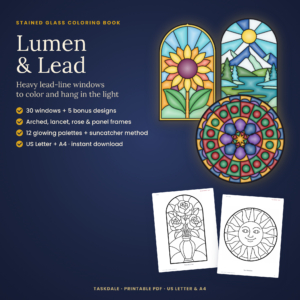
Lumen and Lead Stained Glass Coloring Book
Price: $4.49 | Best for: marker owners learning their colors
Thirty-five window designs with heavy, uniform lead lines and big panes, with 12 named palettes that show which colors glow together. The Suncatcher Method explains printing on vellum, coloring with alcohol markers and hanging the result in a window. It prints on US Letter and A4. Use one window as a living swatch chart: one marker per pane, labeled on the back.
Combinations that give clean results
Supplies work best in pairs. Here are a few that reliably look good.
- Alcohol markers on marker paper or smooth cardstock: smooth fills, crisp cel shading, less feathering.
- Markers first, pencils on top: lay base and shadow with markers, then add fine details, soft blush and eye gradients with sharp pencils.
- Pencils on heavier printer paper: a cheap, clean everyday setup that suits soft shading.
- White gel pen last: always the final step, after everything is dry.
One combination to avoid: heavy alcohol markers on thin, standard printer paper. It bleeds, feathers and curls. If that is all you have, switch to pencils for that page.
Looking after your supplies
Cap markers firmly. A marker left open for an hour can dry out. Listen for the click.
Store double-ended markers flat. Lying horizontal keeps ink evenly spread to both tips.
Sharpen pencils gently. A good handheld sharpener and a light touch stop leads from snapping inside the wood.
Keep paper flat and dry. Humid, curled paper prints badly and takes ink unevenly.
Well-kept supplies last for years. That makes even a modest kit feel like a good investment.
When a younger sibling wants to borrow your markers
It will happen. A little brother or sister sees you coloring and wants your best markers. Alcohol markers and small kids are not a great match: the ink stains, the smell is strong, and fine tips get crushed fast.
The peaceful fix is giving them their own kit and their own pages. A box of washable markers or chunky pencils, and a book with friendly scenes sized for younger hands. They get to color beside you, and your markers survive.
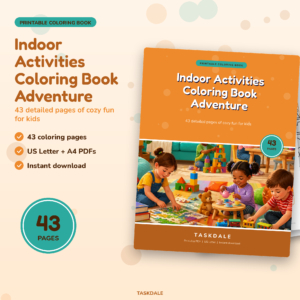
Indoor Activities Coloring Book Adventure
Price: $2.99 | Best for: younger kids coloring beside you
Forty-three busy, friendly scenes of things kids do at home: a blanket fort, baking cookies, a reading nook, board game night, a puppet show and an indoor picnic. Large shapes suit little ones, and patterned rugs and shelves keep older kids busy. Print a page, hand over a set of washable markers, and keep your alcohol markers for your own manga page.
Frequently asked questions
What markers are best for manga coloring?
Alcohol markers are the most popular choice for smooth fills and cel shading. Water-based markers and brush pens are gentler and suit inking and younger artists.
What paper should I print manga coloring pages on?
Smooth, heavier paper of around 24 to 32 lb (90 to 120 gsm) works for most uses. For heavy alcohol marker work, try smooth cardstock or marker paper, and always put scrap paper underneath.
Can I use colored pencils over alcohol markers?
Yes. Let the marker dry, then add details and soft gradients with sharp pencils. It is a common and effective combination.
Why do my alcohol markers look streaky?
Usually because the ink dried between strokes. Work in small sections, keep the area wet, and use overlapping circles or quick, even strokes.
Do I need expensive supplies to color manga well?
No. A modest set of pencils, a few fineliners, a white gel pen and decent paper can give clean results. Add markers gradually as you learn which colors you use.
Your next step
This weekend, make a swatch chart of every marker and pencil you own on the paper you print on. Then color one page using only colors from the chart. For manga pages with built-in test circles and brand-free palettes, try the Ink and Glint Manga Coloring Book.