Type “meal plans near me” into a search bar and you get a mixed bag: local meal prep kitchens that deliver ready-made boxes, meal kit services, gyms offering nutrition plans, dietitians, and the odd grocery store with a weekly dinner deal. Every one of them solves part of the same problem. Somebody else decides what you eat, and in some cases cooks it too.
The other route is quieter. You plan at home with a printable or digital planner, shop once and cook your own food. This guide compares the two honestly. You will see what each kind of local service is good at, where a home plan wins, a simple way to compare costs with your own numbers, and how many people end up mixing both. Then three Taskdale planners if home planning is the way you go.
Quick picks: plans you use at home
| Product | Best for | Price | Link |
|---|---|---|---|
| Plate & Plan Weekly Meal Planner Printable | A full paper system with fillable PDFs | $1.69 | View |
| Fresh Week Meal Planner and Grocery System | Landscape pages with a family dinner plan and a dinner rotation | Original price was: $4.99.$1.99Current price is: $1.99. | View |
| Spoonful Digital Meal Planner | Planning on a tablet with linked grocery lists | $4.99 | View |
| Hearth & Ladle Digital Recipe Book & Meal Planner | Tablet cooks with a big recipe collection | $9.99 | View |
What “meal plans near me” usually means
The phrase covers several quite different services. Knowing which one you actually want saves a lot of browsing.
Local meal prep kitchens
Small businesses cook a weekly menu and you collect or receive boxed meals, ready to heat. You choose from their menu, often with portion sizes or calorie ranges listed. Popular with gym-goers and busy workers who want zero cooking.
Meal kit services
You get a box of pre-measured ingredients and recipe cards. You still cook, but the planning and most of the shopping is done. Usually ordered online and delivered.
Dietitians and nutrition coaches
A professional builds a plan around your goals and health. You usually get a written plan and follow-up sessions. This is the one to choose if you have a medical reason to change how you eat.
Gym or trainer plans
Some gyms and personal trainers include meal plans with their programs. Quality and detail vary a lot from place to place.
Store-based options
Some supermarkets offer ready meals, weekly dinner bundles or recipe cards near the entrance. Handy, but not really a plan.
Where local services shine
There are good reasons people pay for these. Be honest with yourself about whether one of these is your reason.
- Zero cooking time. A nurse working three 12-hour shifts may simply not have the hours. Ready meals solve that.
- Portion control built in. Someone else has weighed it. For people who find portions hard, that removes a daily decision.
- Professional input. A dietitian can tailor a plan to a health condition in a way no template can.
- Learning new dishes. Meal kits teach techniques and flavors you might not try alone.
- A short-term crunch. New baby, house move, exam season. A few weeks of help can be worth every penny.
None of that is a small thing. If one of those fits, a local service may be exactly right, at least for a while.
When home planning is the wrong fit
A printable plan will not help much if nobody in the house can cook at all and nobody wants to learn, if you live somewhere without a proper kitchen, or if a health condition means you need a professional to set your meals. A student in a dorm with only a microwave, for example, may get more from a mix of ready meals and simple no-cook lunches than from a weekly cooking plan. Be honest about your kitchen and your week before you choose. The best plan is the one that matches the life you actually have.
Where printable plans you use at home win
Home planning has a different set of strengths, and for many households they add up to more.
- Cost per serving. Cooking from basic ingredients is usually cheaper per plate than paying someone to cook or pack them for you.
- Your food, your tastes. You cook what your family already likes, including the picky eater’s three safe meals.
- No subscription. A printable is bought once and reused week after week. No skip-a-week reminders, no account to manage, no menu changes you did not ask for.
- Less packaging. Ready meals and kits often arrive in a lot of plastic and cardboard.
- Flexible portions. Cook once for six, eat twice. Freeze the rest.
- A skill that lasts. Planning, shopping and batch cooking are habits you keep for life.
The trade-off is time. A home plan asks for 20 minutes of planning and some cooking each week. That’s the whole deal. For most families, it is worth it. For more ideas on cutting the bill once you plan at home, our guide on how to lower your grocery bill without coupons is a good companion.
A paper planner that covers the whole loop (plan, list, pantry, prep, budget) makes home planning feel like a system rather than a chore.
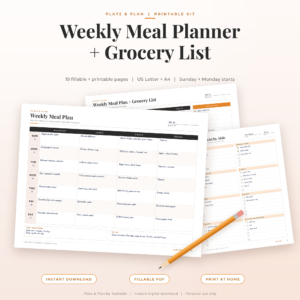
Plate & Plan Weekly Meal Planner Printable
Price: $1.69 | Best for: families planning and shopping on paper
Plate and Plan has 19 pages in four PDF files: US Letter and A4, each fillable and print-only, with Sunday and Monday start options. You get weekly plans with breakfast, lunch, dinner and snacks, a weekly plan with 21 grocery tick-off lines beside the meals, a meal prep planner with a storage plan, a monthly calendar, a four-week dinner rotation, pantry and freezer inventories, a grocery list with budget and a weekly food spending tracker. Begin with the four-week rotation so your favorite dinners repeat on their own.
Compare the cost with your own numbers
Prices for local services differ hugely by town and provider, so the only fair comparison uses your numbers. Here is a five-minute exercise.
- Write down the per-meal price of the local option you are considering, as shown on its menu or website.
- Pick three dinners you already cook, such as chili, a chicken traybake and pasta bake.
- Add up the ingredients for each from your last grocery receipt.
- Divide by the number of portions each one makes.
- Compare per plate, then multiply by the number of dinners a week you would replace.
Here is how the home side might look as a worked example. A pot of chili costs $14 in ingredients and makes six portions, so about $2.35 a plate. A chicken traybake costs $12 for four portions, $3 a plate. Pasta bake costs $9 for five portions, $1.80 a plate. Write your local service’s per-meal price next to those and the difference over a month becomes very clear, one way or the other.
Then add the time. If the service saves you four hours a week and those hours are worth more to you than the gap, that is a fair choice too. This exercise is about seeing the numbers, not winning an argument.
The hybrid approach most people end up with
It does not have to be one or the other. Plenty of households plan most meals at home and buy help for the gaps.
- Ready meals on shift days, home cooking the rest of the week.
- A meal kit once a week to try something new, with your own plan around it.
- A dietitian’s plan as the guide, with a printable planner to turn it into weekly shopping lists.
- Gym meal guidelines written into your own planner so you cook them yourself.
The trick is to put everything on one plan, including the bought meals. Write “ready meal” in Monday’s box. Then the grocery list does not include food for a dinner you are not cooking, and nothing goes to waste.
A landscape planner with a family dinner page (who cooks, how long it takes, a done box) suits households that mix cooking nights and bought nights.

Fresh Week Meal Planner and Grocery System
Price: Original price was: $4.99.$1.99Current price is: $1.99. | Best for: busy homes mixing cooked and bought meals
Fresh Week gives you 18 landscape pages in six PDF files: US Letter, A4 and A5, each as a print version and a fill-in version you can type into. There are six weekly layouts, including a Family Dinner Plan with who cooks, how long it takes and a done box, plus a Meal Prep Sunday page, an undated monthly plan, a four-week dinner rotation and a meal idea bank. Fill in the Family Dinner Plan first and mark any bought meals so they stay off your list.
Planning at home on a tablet
If paper feels old-fashioned, a digital planner gives you the same home-planning benefits on an iPad or Android tablet. You write with a stylus, tap from the week’s meals to that week’s grocery list, and carry the list into the store on the same device. Choosing an app first helps; our comparison of GoodNotes vs Notability for digital planning explains the differences.
A digital planner is also a good halfway house if you are moving off a meal service. You can copy the dishes you liked from their menu into your own recipe pages and cook them yourself.
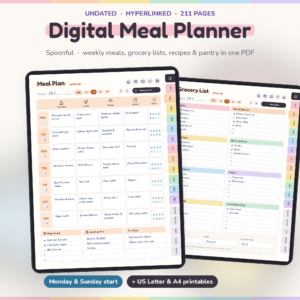
Spoonful Digital Meal Planner
Price: $4.99 | Best for: tablet users replacing a meal service
Spoonful is an undated hyperlinked PDF planner. Each week has a meal plan page for breakfast, lunch, dinner and snacks, with a water tracker, a prep-ahead checklist and a use-it-up-first list, linked to its own grocery list in eight store sections. Around it sit a recipe book, a favorites list, 60 dinner ideas, kitchen inventories and a yearly grocery budget. Monday and Sunday start editions and printable US Letter and A4 pages are included. Copy your three favorite bought meals into the recipe book first.
Your first week of planning at home
If you have never planned meals yourself, the first week feels like the biggest hurdle. It is smaller than it looks. Here is a gentle way in, spread over a weekend.
Friday evening: choose three dinners
Pick three meals you already know how to cook or have eaten from a service and liked. Spaghetti bolognese, a stir-fry and a traybake are a solid trio. Write them on Monday, Wednesday and Friday. Leave the other nights as they are for now, whether that is a bought meal, leftovers or eggs on toast.
Saturday morning: write the list and shop
Go through each recipe and write what you need, checking the cupboard as you go. Group the list by store section. Shop once. If you want ideas for what to keep on hand, our roundup of printable meal planner kits shows the pantry and list pages that help most.
Sunday: cook one thing ahead
Make the sauce for Monday’s bolognese, or chop the vegetables for the stir-fry. Twenty minutes is enough. It makes Monday feel easy, and an easy Monday sets the tone.
The following weekend: review
Which meals worked? Which were a pain? Keep the winners, add one more home dinner, and repeat. By week four, most people are cooking five nights without thinking about it, and the small pride of a full fridge you planned yourself is hard to beat.
Mistakes when switching from a service to home planning
- Going from zero cooking to seven nights at once. Start with three home-cooked dinners a week and build up.
- Forgetting lunches. Services often covered lunch. Plan leftovers or simple packed lunches so you do not end up buying them.
- Buying every spice in the shop. Copy two or three favorite dishes first and buy only what they need.
- Not tracking the savings. Write down what you spent on the service and what you spend now. Seeing the gap is motivating.
- Cancelling with no plan in place. Have your first home week planned before the last delivery arrives.
Frequently asked questions
Are local meal prep services worth it?
They can be when cooking time is very short, such as long shifts or a new baby, or when you want portions handled for you. For many households, planning and cooking at home costs less per plate over a month.
What is the difference between a meal kit and a meal prep service?
A meal kit sends ingredients and recipes for you to cook. A meal prep service sends cooked meals that you only reheat.
Can a printable meal planner replace a dietitian?
No. A dietitian gives professional advice for your health. A printable planner helps you organize that advice into weekly meals and a shopping list.
How do I find meal plans near me?
Search for local meal prep kitchens, check gyms and community centers, ask your doctor about a dietitian referral, or look at supermarket meal bundles. Compare per-meal prices with your own home-cooked costs before signing up.
Is a printable or digital home planner better?
Printable suits families who like a plan on the fridge. Digital suits people who already use a tablet every day. Both can be reused every week at no extra cost.
Your next step
Do the five-minute cost check with three dinners you already cook and the per-meal price of the local option you are considering. If home planning comes out ahead, plan just three home dinners for next week to start. The Plate & Plan Weekly Meal Planner Printable gives you the plan, list and budget pages to do it on paper or on screen.