A good money worksheet does one thing well: it turns a vague worry into a number on paper. How much do I earn? Where did it go? What do I want next? Once those answers are written down, the next move gets obvious. That is true for a 15-year-old with a babysitting income and for a 45-year-old with a mortgage.
This guide covers money management worksheets for teens and adults side by side, because the core skills are the same and many families learn them together. You will find the six worksheets every teen should fill in before a first real paycheck, a worked example with actual numbers, a set of pages for adults who are starting over, a monthly family routine, and tips for getting a reluctant teenager to sit down with a pen.
Quick picks: printable money workbooks
| Product | Best for | Price | Link |
|---|---|---|---|
| The Calm Money Method | Adults who want mindset pages plus a budget and debt tracker | $11.99 | View |
| Rooted & Rich Money Mindset Workbook | Older teens and adults learning budgeting from scratch | $17.99 | View |
| Money Mindset Workbook | Parents and couples talking about money habits | $6.49 | View |
| Financial Anxiety Workbook | Adults who avoid bills and statements | $17.99 | View |
What a money worksheet should do for you
Plenty of free worksheets online are really just blank tables. They ask you to list income and expenses, and then they stop. That has some value. But a worksheet earns its place when it also asks a question you would not have asked yourself.
“List your expenses” is a table. “Which three expenses would you cut first if your hours dropped by a quarter?” is a worksheet. The second one makes you think, and thinking is where the learning happens.
So when you pick worksheets for yourself or your kids, look for three things:
- A prompt, not just a grid. Each page should ask you to decide something.
- Real numbers. Your own pay, your own phone bill. Made-up classroom numbers fade fast.
- A next action. The best pages end with one thing to do this week.
Six worksheets every teen should fill in before a first paycheck
Teens do not need a full budget binder. They need a handful of pages that build the habits early. Here are six you can sketch on plain paper in ten minutes each.
1. Where my money comes from
List every source: allowance, gifts, a weekend job, selling old games. Write the amount and how often it arrives. Many teens are surprised by the total. A 14-year-old who gets $15 a week plus birthday money might see $1,000 a year for the first time.
2. Needs, wants and in-between
Make three columns and sort 20 recent purchases into them. Bus pass, phone case, lunch with friends, a hoodie. The arguments about which column a hoodie belongs in are half the lesson.
3. My first spending plan
Split one month of income into three jars on paper: spend, save, give. A common starting split is 50, 40 and 10 percent, but let the teen choose. Ownership matters more than the perfect ratio.
4. A savings goal with a date
Pick one thing worth saving for. Write the cost, divide by weeks, and draw a progress bar to color in. A $240 pair of headphones at $20 a week is 12 weeks. Seeing that number makes the wait feel finite.
5. Reading a pay stub
Print a sample stub or use their first real one. Circle gross pay, taxes and net pay. The first time a teen sees that 22 hours at $12 does not land as $264 in their account, the lesson sticks for life.
6. What it costs to live on your own
Have them look up a local one-bedroom rent, a phone plan, groceries for one and a bus pass. Add it up. Then work out the hourly wage needed to cover it. This one often ends in silence, then questions. Good questions.
Worked example: Jordan’s first job budget
Jordan is 16 and works at a grocery store, about 15 hours a week at $13 an hour. Gross pay is $195 a week. After taxes, roughly $180 lands every Friday, or about $780 a month.
With a parent, Jordan fills in a simple plan:
- Gas and car insurance share: $160
- Phone: $45
- Food out with friends: $120
- Clothes and personal: $80
- Savings for a laptop: $250
- Long-term savings: $100
- Giving or gifts: $25
That adds up to exactly $780. In month two, food out ran $165. Rather than lecture, the parent asked Jordan where the extra $45 should come from. Jordan chose the clothes line. Small choice, big lesson: money moved on purpose is still a plan working.
Five months later the laptop was paid for in cash. Jordan still mentions it. That is the kind of pride a worksheet can start.
Notice what the parent did not do. No paying the difference, no taking over the pen. The worksheet stayed Jordan’s, and so did the decision. That is the part most teens remember years later, when the paycheck is bigger and the stakes are higher.
Worksheets for adults who are starting over
Adults rarely need to learn what a budget is. What they need is a reason the last three budgets did not last. Maybe it is stress spending after long shifts. Maybe it is the guilt that comes with buying anything for yourself. Maybe statements go unopened for weeks.
The useful adult worksheets work on two levels. First the inside: where your money habits came from and what triggers them. Then the outside: a monthly budget, a debt list, savings goals. Skip the inside part and the outside part tends to fall apart by week two.
A workbook that puts both in one place saves you from stitching together scattered printables.
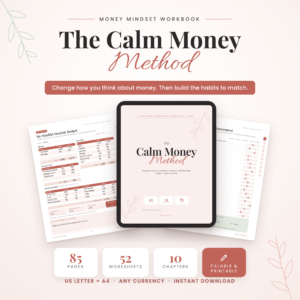
The Calm Money Method
Price: $11.99 | Best for: adults restarting after dropped budgets
The Calm Money Method has 85 fillable and printable pages in US Letter and A4, and every money field works with any currency. Chapters one to three look at money habits and spending triggers; chapters four to eight cover goals, budgeting, saving, debt and a plain intro to investing, then weekly money dates and a 30-day challenge help it stick. Start with the first chapter’s reflection pages before you touch the budget section.
Three pages to do first as an adult
- Money timeline. Write down five money memories from childhood. Notice any rules you still follow without thinking.
- Spending trigger log. For two weeks, note the mood behind any purchase over $20. Patterns show up quickly.
- One-page debt list. Balance, rate, minimum and due date for every debt. Seeing it all in one place is uncomfortable for about a day, then it feels like control.
Using worksheets together: parents and teens at one table
Teens learn more from watching what you do with money than from anything you tell them. So the best setup is often the same session for both of you. You work on your page. They work on theirs. Twenty minutes, Sunday afternoon, snacks on the table.
It also helps you notice the messages you pass on. If you sigh every time a bill arrives, your teen learns that money equals stress. If you never talk about pay, they learn that money is secret. Neither is a great lesson, and most parents do not realize they are teaching it.
Confidence matters here too. A teen who already feels bad about themselves will avoid anything that might show a mistake. If that sounds familiar, the exercises in our guide to self-esteem worksheets for teens pair well with early money pages.
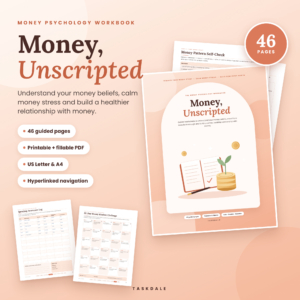
Money Mindset Workbook
Price: $6.49 | Best for: parents and couples examining money habits
Money, Unscripted is a 46-page money psychology workbook in fillable and printable PDF, US Letter and A4. It covers money scripts, the scarcity loop, emotional spending and couples money talks, and opens with a check-in that scores ten statements out of 100 so you can measure change at the end. Parents can work through the money scripts pages first, then share what they find with an older teen.
Fillable or printed: which works better?
Both have a place. Fillable PDFs suit adults who live on a laptop and want to edit numbers month after month without reprinting. Type in this month’s budget, save a copy, start fresh next month.
Printed pages tend to work better for teens and for reflection exercises. Writing by hand slows you down, and slow is good when the question is “why do I spend more on Fridays?” Paper also stays visible. A savings goal taped inside a bedroom door gets looked at far more than a file in a downloads folder.
Printing tips that save ink and paper
- Print one copy of each reflection page and two or three copies of pages you will repeat, like monthly budgets.
- Use an ink-saver version if one is included, especially for 80-plus page workbooks.
- Keep pages in a slim binder with dividers for budget, savings and reflection. A home management binder can hold a family’s money section in the same place as bills and schedules.
- Print at 100 percent scale so fillable boxes line up properly with your handwriting.

Rooted & Rich Money Mindset Workbook
Price: $17.99 | Best for: older teens and beginner adults
Rooted & Rich is an 83-page fillable and printable workbook in US Letter and A4, plus an Ink-Saver edition with lighter color blocks for home printers. It holds nine short lessons, 34 guided worksheets and nine bonus tools, and each lesson takes about ten minutes to read. An older teen and a parent can each print a copy and do one lesson per week together.
A monthly worksheet routine for the whole family
Worksheets work best on a rhythm. Here is one that fits into a single weekend afternoon each month, and it suits a household with one teen or three.
- First weekend of the month: plan. Each person fills in a fresh spending plan for the month ahead. Teens do their jars, adults do the household budget.
- Every Sunday: a five-minute check. Everyone looks at their own page and notes one thing that went well and one that did not.
- Last weekend: review. Compare plan to actual. Color in savings progress bars. Pick one change for next month.
Keep the tone light. A family in which the parent admits “I went $40 over on takeout too” gets far more honest answers from a teenager than one where the adult plays the expert. Shared mistakes build trust. Trust is what keeps a 17-year-old coming back to the table when the stakes get real, like a first credit card or a car loan.
After three or four months, most families can retire the weekly check for anyone who has it handled and keep just the monthly plan and review.
Mistakes that make money worksheets fall flat
- Doing every page in one sitting. A 50-page workbook in an afternoon teaches nothing. One page, one action, one week.
- Grading a teen’s choices. If they plan $100 on snacks, let it play out. The empty jar in week three teaches better than you can.
- Using fake numbers. Practice examples are fine for a first look. After that, real pay and real bills only.
- Never revisiting old pages. Look back at month one in month four. The progress is the reward.
- Keeping it private in a shared household. Teens with no idea what groceries cost will have a rough first year away from home.
Frequently asked questions
At what age should a teen start using money worksheets?
Around 12 to 13 for simple pages like needs versus wants and a savings goal. Budgets and pay stubs make more sense once there is real income, often around 15 or 16 with a part-time job.
Are adult money workbooks suitable for teenagers?
Older teens, around 16 and up, can use beginner-friendly adult workbooks with a parent nearby. Skip pages about mortgages or retirement and focus on budgeting, saving and spending habits.
What should be on a basic money management worksheet?
Income sources and dates, fixed costs, flexible spending, a savings line, and a short prompt asking what you will change next month. Anything beyond that is optional.
Where can I find free money management worksheets?
Banks, credit unions and school financial literacy programs often share simple printable pages, and you can sketch the six teen worksheets above on plain paper. Free pages are fine for a first try. A paid workbook makes sense once you want lessons, prompts and trackers that build on each other in order.
Can I use a fillable PDF worksheet on my phone?
Many fillable PDFs open in phone PDF apps, but the boxes are small. A tablet or laptop is much more comfortable for typing, and printing works for everyone.
How do I get my teenager interested in budgeting?
Tie it to something they want. A car, a trip, a new phone. Once the worksheet answers “how soon can I get it?”, most teens lean in.
Your next step
This weekend, sit down with a teen or on your own and fill in just one page: where the money comes from, with amounts and dates. Fifteen minutes, one sheet of paper. If you want the next pages ready to go, with lessons, a budget and savings trackers in one book, start with The Calm Money Method.