There is a lot to love about a personalised designer planner. Your name on a beautiful cover. Thick paper. A parcel on the doormat that feels like a present to yourself. For many people that is exactly right, and if it is right for you, enjoy it.
But some people want a different deal. They want to start this week, not when the post arrives. They want A5 for the handbag and A4 for the desk. They want to swap the weekly layout in March without buying a whole new book. A Papier planner alternative you can print and customise gives you that: pretty pages, your own cover and colours, printed at home on paper you choose.
This guide covers what to look for in a printable that feels as special as a gift planner, how to make your own personalised cover, four Taskdale planners with a designer feel, and the honest trade-offs of printing your own.
Quick picks
| Product | Best for | Price | Link |
|---|---|---|---|
| Washi Doodle Weekly Planner | A sweet, decorated week in four sizes | $5.00 | View |
| Petalpath Undated Daily Planner | Soft colours and a full daily page | $2.39 | View |
| Clearweek Weekly Planner Printable | Changing labels, fonts and colours in Word | $5.00 | View |
| Mix & Match Planner Library | Building a whole planner from 95 page types | $5.49 | View |
What personalised gift planners do well
It is worth being fair about why designer planners are so popular. You choose a cover from a big range, add your name or a short phrase, pick a layout, and receive a finished, bound book. There is no printing, no punching and no fiddling. The result looks lovely on a desk and makes a thoughtful present.
The trade-offs are the usual ones for any made-to-order item. You wait for it to be printed and posted. The layout is set once the book is bound. The start date is fixed, and if you fall behind, the blank weeks stay in the book. And if you change your mind about the layout halfway through the year, you start again with a new planner.
None of that is a flaw exactly. It is just a different way of planning. A printable planner trades the finished-book feeling for flexibility, speed and control.
What makes a printable feel special
A plain grid printed on copier paper will not scratch the same itch as a designer planner. To feel special, a printable needs a few things.
- A considered colour palette. Two or three soft colours that work together, not a rainbow of clashing shades.
- Little design touches. A doodle, a washi strip, a pretty date circle. Enough to make you smile, not so much it gets in the way of writing.
- Matching pages. Weekly, monthly, habits and notes all in the same style, so the binder looks like one planner.
- Several sizes. At least A4 and A5, ideally Letter and Half Letter as well.
- A punch-safe margin so nothing important gets lost to the holes.
- An ink saver version for everyday pages, saving the colour version for covers and favourites.
Pair that with good paper and a nice binder, and the result can feel every bit as personal as a bought book. Arguably more, because you chose every page.
A pretty week with a bit of personality
If you want your planner to feel cheerful, start with a weekly layout that has some character. Soft colours, playful details and enough structure to hold a real week: work, meals, money, a habit or two.
This sort of planner suits people who enjoy the ritual of a Sunday planning session with a cup of tea and a few nice pens.
Washi Doodle Weekly Planner
Price: $5.00 | Best for: Sunday planners who love a cute week
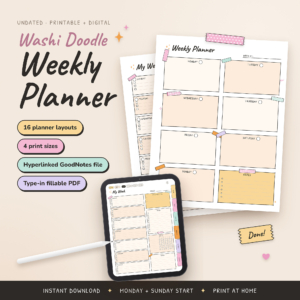
An undated weekly planner with soft peach boxes and doodled washi tape, in 16 layouts: classic, lined and checklist weeks, a My Week page, an hourly schedule, a weekly to-do list, a meal planner, habits and wellness, a week in review and a weekly budget. It prints in US Letter, A4, A5 and Half Letter with a punch-safe margin, in colour and Ink Saver versions, Monday or Sunday start, and also comes as fillable PDFs and a 255-page GoodNotes planner with 37 stickers. Print the colour My Week page for this week and the Ink Saver version for the weeks after.
The mix of colour and Ink Saver pages is a smart habit for any printable planner. Print the pages you look at most, like the cover and the month opener, in full colour. Print the everyday weekly pages in the lighter version. Your ink lasts much longer, and the planner still feels pretty.
Soft colours and a full daily page
Some designer planners are known for their daily layouts, a full page per day with a schedule and space for notes. If that is what you love, look for a printable with a calm daily page and matching weekly and monthly spreads.
Petalpath Undated Daily Planner
Price: $2.39 | Best for: people who plan day by day
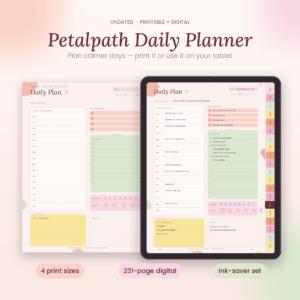
An undated printable and digital planner in soft blush, coral, sage and butter tones. Its core Daily Plan page has a 6 AM to 9 PM hourly schedule, four top priorities, a to-do checklist, water and mood trackers, a For Tomorrow box and dot-grid notes, and 13 more layouts cover weeks, months, habits, goals, meals, budgets and notes. It prints in four sizes and includes a hyperlinked digital version. Print a week of daily pages and one monthly calendar to see how the colours look on your printer.
If you are drawn to soft, pretty pages, our guide to cute daily planner picks compares a few more styles side by side.
Making your own personalised cover
The cover is where a designer planner earns most of its charm, and it is the easiest part to recreate at home. Here are three ways, from simplest to most polished.
Option 1: a printed cover page
Many printable sets include a cover page with space for your name. Print it on card, around 200 to 250 gsm, and slip it into the clear front pocket of a binder. Change it each term or season.
Option 2: design your own in a free tool
Open a free design app or even a word processor, set the page to A5 or A4, add a background colour or pattern, then type your name and the year in a font you love. Print on card and trim. Ten minutes, and nobody else has one like it.
Option 3: a laminated front
For a cover that survives a year in a handbag, print your design on card and run it through a home laminator, or use a self-seal laminating pouch from a stationery shop. Punch it to match your binder or disc system. It feels sturdy and looks smart.
A small touch that makes a big difference: add a quote or a word for the year under your name. “Steady.” “Brave.” “Less, but better.” You see it every time you open the planner.
When you want to change the words, not just the colours
Personalised planners let you add your name. A fully editable template goes further: you can change the headings, the labels and the colours on every page. That is useful if you want your planner to speak your language. A wedding planner might rename “Main focus” to “Venue tasks”. A small business owner might add “Orders to post” as a fixed line.
Clearweek Weekly Planner Printable
Price: $5.00 | Best for: anyone who wants their own wording
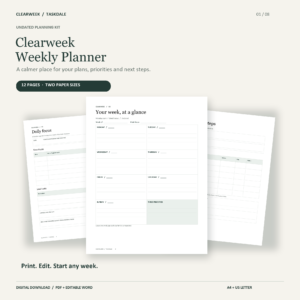
An undated weekly planner with appointments, tasks and three priorities on one page, in A4 and US Letter, Monday or Sunday start, with lined and open writing versions. It includes editable Word files so you can change text, labels, fonts and table colours, plus six supporting worksheets: week setup, task inbox, daily focus, project next steps, a routine tracker and a weekly review. Open the Word file, set the table colour to match your cover, and print one week to test.
Matching the table colour to your cover is a lovely detail. It ties the whole planner together, the way a designer range carries one colour through every page.
Building a whole planner, page by page
One of the joys of printing your own is that you choose every section. Want a reading log and a meal planner but no fitness pages? Done. Want a budget section in the back and a gratitude page each week? Done. You end up with a planner nobody else has, because nobody else lives your life.
Mix and Match Planner Library
Price: $5.49 | Best for: binder lovers designing their own planner
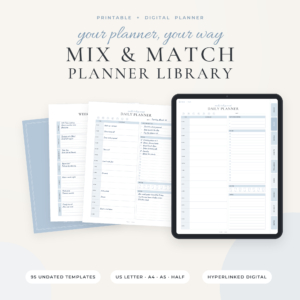
A printable library of 95 undated planner templates across plan, goals, habits, wellness, home, money, mindset and notes, in A4, A5, US Letter and Half Letter, with matching page numbers in every size. It also includes three cover designs, eight section dividers, a linked index and a hyperlinked digital version. Choose one weekly layout, one monthly calendar and two extras that suit your life, and print those first.
If you want ideas for combining sets into one binder, our printable planner bundle guide shows how three sets can sit together in a single planner.
Paper, binders and finishing touches
The physical feel is where homemade planners can fall short, so it is worth a little care here.
- Paper: step up from 80 gsm copier paper to 100 or 120 gsm for everyday pages. It feels nicer, takes ink better and stops show-through.
- Cover card: 200 to 250 gsm for covers and dividers.
- Binder: an A5 six-ring planner for carrying, or a disc system if you like to move pages around.
- Tabs: printed dividers or sticky tabs in your planner colours.
- Pens: fine-liners that do not bleed. Test on a spare page first.
- Print settings: always print at 100% or Actual Size, and use the printer’s best quality setting for colour pages.
Assembling the planner is half the fun. Put on some music, lay out the pages, punch, sort and clip. When you snap the rings shut on a planner you designed yourself, there is a real little glow of pride.
A fresh look every season
Here is something a bound book cannot do. With a printable planner, you can give it a new look four times a year without buying anything new.
Each season, design a new cover in colours that suit the months ahead. Deep green and gold for autumn. Frosty blue for winter. Soft pink and sage for spring. Warm yellow for summer. Print it on card, swap it into the front pocket, and the whole planner feels new again. It takes about fifteen minutes and costs a sheet of card.
You can carry the theme inside too. Change the colour of your sticky tabs, switch to a different weekly layout for the busy run-up to Christmas, or add a holiday planning page in early summer. A teacher might add a term planner each September and remove it in July. A gardener might slip in a sowing calendar every March.
This small seasonal ritual does something useful. It gives you a natural moment to look back at the last three months, clear out pages you no longer need, and set the planner up for what is coming. Many people find that the planner they refresh each season is the one they are still using in December.
The honest trade-offs
Printing your own is not for everyone. You need a printer, or a nearby print shop, and a bit of patience. Colour ink costs money, though using Ink Saver pages keeps that down. And a homemade binder will never feel quite like a sewn, hardback book.
On the other side, you can start today. You can change any page at any time. A coffee spill means reprinting one sheet, not living with a stain for a year. And you choose the size, the layout and the look down to the last detail.
If you mainly want a beautiful gift, a bound personalised planner is hard to beat. If you mainly want a planner that fits how you work and grows with you, printing your own is often the better match.
Frequently asked questions
Is there a printable alternative to a personalised designer planner?
Yes. Undated printable planners in A4, A5 and Letter give you pretty, matching pages you print at home, and you can make your own personalised cover with your name on card.
How do I make a personalised planner cover?
Design a page in a free design tool or word processor with your name and a background colour, print it on 200 to 250 gsm card, and laminate it if you want it to last. Punch it to fit your binder.
What paper should I print a planner on?
Around 100 to 120 gsm for the inside pages and 200 to 250 gsm card for the cover and dividers. Heavier paper feels nicer and stops ink showing through.
Can I print planner pages in A5?
Yes, if the set includes an A5 file. Washi Doodle, Petalpath and the Mix and Match Planner Library all include A5.
Can I change the colours of a printable planner?
Only in editable files such as Word templates. Clearweek lets you change table colours, fonts and labels. PDF planners keep their colours, but many offer a colour and an Ink Saver version.
Your next step
Pick your size first, A5 to carry or A4 for the desk. Then print one colour week from the Washi Doodle Weekly Planner on 100 gsm paper, design a simple cover with your name, and clip them together. Plan this coming week in it and see how it feels.