A personal meal plan template you fill in beats any ready-made diet plan for one simple reason: every meal on it is something you chose. Your tastes, your hours, your budget, your fridge. A plan made by a stranger tells you to eat salmon on Tuesday. Yours knows you hate salmon and work until 8 on Tuesdays.
The catch is the blank page. Open a fresh template and the boxes can feel like a test. So this guide walks you through it box by box. You will see what a good personal template needs, how to fill one in during a single 25-minute sitting, a filled-in sample week for one person, and the small tweaks that help when you are cooking for yourself.
It suits anyone who wants to plan their own food: people living alone, students, someone working on a health or money goal, or the one adult in a family who eats differently from everyone else.
Quick picks: templates you can make your own
| Product | Best for | Price | Link |
|---|---|---|---|
| Plate & Plan Weekly Meal Planner Printable | Typing or writing your plan on a fillable PDF | $1.69 | View |
| Larkspoon Meal Planner Spreadsheet | Personal nutrition goals and costs worked out for you | $12.99 | View |
| Thymewise Digital Meal Planner | Handwriting your plan on a tablet | $1.75 | View |
What makes a meal plan personal
Generic plans fail because they ignore the details that decide whether you eat the meal. Before you fill in a single box, jot down five things about yourself on a scrap of paper.
- Your schedule. Which nights are late? Which mornings are rushed? Do you get a real lunch break?
- Your goal. Spend less, eat more vegetables, more protein, fewer takeaways, lose a little weight. Pick one, two at most.
- Your no-list. Foods you dislike, cannot eat, or will not cook. Write them down so they never reach the plan.
- Your kitchen. A full oven, or a microwave and one hob? A big freezer, or a drawer?
- Your budget. A weekly food number, even a rough one.
Those five lines are your brief. Every meal on the template should pass all five. A 45-minute roast fails the “late Wednesday” test. A big pot of chili fails the “tiny freezer” test if you cannot store the leftovers. This is the step that turns a template into your template.
The sections a good template needs
A meal plan page can be as simple as a seven-by-three grid. But a few extra boxes make it far more useful, especially for one person.
The weekly grid
Seven days down, breakfast, lunch, dinner and a snack across. Leave room to write two or three words per box. “Chili + rice” is enough.
A grocery list beside it
The list should sit next to the plan, not in a separate notebook. You fill the list as you fill the plan, which saves a whole step.
A prep or notes box
Reminders like “defrost chicken Tuesday night” or “cook double rice Sunday.” These small notes are what make a plan actually run.
A pantry check
A short list of what you already have. It stops you buying a fourth jar of paprika.
A goal or tracker line
Somewhere to write your one goal for the week and tick it off. Water, vegetables, home-cooked dinners, money left over. Small ticks are oddly motivating.
If you like writing by hand but want to keep a clean master, a fillable PDF is a good middle ground. You can type into it on a laptop, save a new copy each week, or print and use a pen.
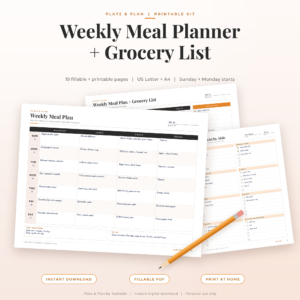
Plate and Plan Weekly Meal Planner Printable
Price: $1.69 | Best for: people who want to type or write
Nineteen pages in four PDF files: US Letter and A4, each as a fillable version and a print-only version, with a clickable contents page and a Word user guide. The weekly planner sits alongside grocery list, meal prep, pantry inventory and budget pages, in Sunday-start and Monday-start versions. Save a blank fillable copy as your master, then make a new copy for this week.
How to fill in your template in 25 minutes
Set a timer. A time limit stops you from agonizing over Thursday’s lunch.
Minutes 0 to 5: block out the week
Cross out any meal you will not eat at home. The work lunch on Wednesday, Saturday dinner at a friend’s. Write “out” in those boxes. Then mark your two busiest evenings with a star.
Minutes 5 to 12: fill the dinners
Start with dinner because it decides everything else. Starred nights get something that takes 15 minutes or comes from the freezer. Other nights can take a little longer. Plan two dinners that make leftovers, so they become lunches.
Minutes 12 to 17: lunches and breakfasts
Lunches come from dinners where you can. Breakfasts can be the same most days. Two breakfast options for the whole week is plenty.
Minutes 17 to 22: the list
Go down each day and write what you need to buy. Check the pantry box first. Group the list by store section if your template has them.
Minutes 22 to 25: notes and goal
Write any defrost or prep reminders. Write your goal for the week. Done. Stick it where you will see it: fridge door, the inside of a cupboard, your phone lock screen.
A filled-in sample week for one person
Here is what a finished personal template might look like. Meet Leah: lives alone, works in a hospital office, gets home late on Tuesdays and Thursdays, has a small freezer, and wants to cut takeout to once a week. Budget: about $70 a week.
| Day | Breakfast | Lunch | Dinner |
|---|---|---|---|
| Monday | Oats and banana | Leftover Sunday chicken wrap | Turkey chili (makes 4 portions) |
| Tuesday (late) | Oats and banana | Chili and rice | Chili baked potato (microwave) |
| Wednesday | Yogurt and granola | Out (work lunch) | Cod, green beans and new potatoes |
| Thursday (late) | Yogurt and granola | Leftover potatoes and cod salad | Freezer chili portion |
| Friday | Eggs on toast | Tuna sandwich | Takeout night |
| Saturday | Pancakes | Cheese toastie and soup | Veggie stir fry with egg noodles |
| Sunday | Eggs on toast | Stir fry leftovers | Roast chicken thighs and veg (extra for Monday) |
Notes box: “Chili Monday, freeze 1 portion. Buy 2 potatoes only. Takeout budget $15.” Goal box: “Cook 5 dinners at home.”
Look at how personal it is. Late nights have zero-effort dinners. One portion of chili goes into the small freezer, not four. The takeout is planned, so it does not feel like failing. That last one matters: a plan that allows Friday takeout is a plan Leah will still be using in March.
Cooking for one without waste
Most recipes serve four. Most packs are sized for families. Living alone, that mismatch is where the waste and the boredom come from. A few habits help.
- Cook once, eat twice. Make two portions of everything. Dinner tonight, lunch tomorrow.
- Freeze in single portions. Small tubs or flat freezer bags. A drawer of six different single meals is a gift to your future self.
- Share ingredients across meals. One bunch of spring onions goes into the stir fry, the omelet and the noodle soup.
- Buy loose produce. Two carrots, not a 1 kg bag, if they will just rot.
- Keep a short “use it up” list in the notes box: “half a pepper, cream cheese, 3 tortillas.”
Want to see whether your plan is actually hitting your goal? A spreadsheet template can do the sums for you. Type your recipes in once with the ingredients, and it works out calories, protein and cost per meal. That makes a personal goal much easier to stick to, because the numbers show up as you plan.
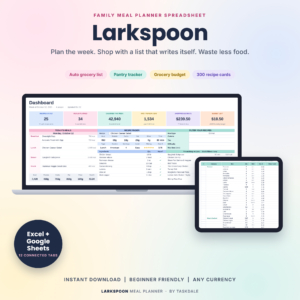
Larkspoon Meal Planner Spreadsheet
Price: $12.99 | Best for: personal goals with numbers attached
An Excel and Google Sheets planner with twelve connected tabs and no subscription. Plan any 7 days with three slots each for breakfast, lunch, dinner and snacks, and it shows calories, protein, carbs, fat and fiber per meal, per day and per person, plus cost per serving against your budget. It writes an aisle-sorted grocery list and subtracts your pantry. Set household size to one before you add recipes.
Your first month with the template
The first filled-in week is the hardest. After that, each week borrows from the last. Here is what a typical first month looks like when it goes well.
Week 1: get something on paper
Do not chase perfect. Fill in dinners and the list, and let breakfasts be rough. If you cook four of the seven planned dinners, count it as a win. It is four more than “I’ll see what I feel like.”
Week 2: add the leftovers
Look at last week’s page. Which dinners made good lunches? Plan those again on purpose, and write “lunch” in the next day’s box before you even think about what else to eat.
Week 3: start a favorites list
On the back of the page or in a notes tab, list every meal you enjoyed and would happily eat again. By now there should be eight or ten. This list makes filling in the template much faster, because you pick rather than invent.
Week 4: check the goal
Count up. How many home-cooked dinners? How much did you spend compared with your weekly number? Pick one small change for month two, like adding a vegetable to every lunch or moving takeout from twice a week to once. Small, steady changes stick far better than a big overhaul.
Paper, spreadsheet or tablet?
The right format is the one you will open again next week. Here is a quick way to choose.
| If you… | Try |
|---|---|
| Like pens, sticky notes and a plan on the fridge | A printable or fillable PDF |
| Want totals for cost or nutrition without doing maths | A spreadsheet |
| Carry an iPad or Android tablet everywhere | A digital planner for note apps |
| Want food tracking more than planning | A food journal page |
On that last row: if your main goal is to understand how you eat now, start with a week of logging before you plan. Our guide to what a food journal template should include shows a simple layout. For spreadsheet lovers, building an Excel meal planner that writes your grocery list goes deeper on that setup.
A tablet in your bag
If your planning happens in snatched minutes on a bus or in a waiting room, a hyperlinked digital planner suits you. You write in it with a stylus, tap from the plan to the grocery list, and it is there in the store.
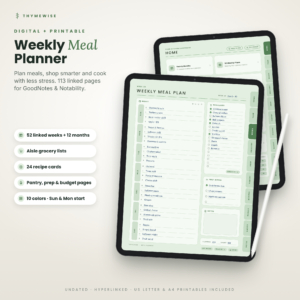
Thymewise Digital Meal Planner
Price: $1.75 | Best for: planning by hand on a tablet
An undated, hyperlinked 113-page planner for GoodNotes, Notability and similar PDF apps, with printable US Letter and A4 versions included. It has 52 weekly meal plans with grocery lists, a meal prep planner, pantry and fridge inventories, 24 recipe cards, a grocery budget tracker and a healthy habits tracker. Write your five-line brief on the first notes page, then plan week one.
Mistakes when filling in your own plan
- Filling every box. Leave one dinner blank for whatever comes up. It is a buffer, not a gap.
- Planning the person you wish you were. If you never eat breakfast, do not plan smoothies every day. Plan a banana for the bus.
- Copying a plan from social media. It was made for someone else’s schedule and someone else’s budget.
- Not looking back. At the end of the week, circle the meals you loved. They go straight onto next week’s template.
- Starting with seven new recipes. One new recipe a week is plenty. The rest should be meals you already cook well.
Frequently asked questions
How do I make my own meal plan template?
Draw a seven-day grid with breakfast, lunch, dinner and snack rows, then add a grocery list, a notes box and a pantry check beside it. Or start from a ready-made printable or spreadsheet and fill it in with your own meals.
What should I write on a personal meal plan?
Short meal names in each box, which nights you are out, any prep reminders, the grocery list for the week and one goal. Keep it brief so filling it in takes minutes.
Is a fillable PDF meal planner better than a printable one?
A fillable PDF lets you type on screen and keep a clean master copy, then print if you want. A print-only version is fine if you always write by hand. Many planners include both.
How do I meal plan when I live alone?
Cook two portions of each dinner and eat the second as lunch, freeze single servings, share ingredients across several meals and buy loose produce in small amounts.
How often should I update my meal plan?
Once a week works for most people. Keep old pages, and after a month you will have four plans you can reuse with small changes.
Can I share my personal meal plan with my partner?
Yes. Print a copy for the fridge, or keep the plan in a shared spreadsheet so you can both add meals. If you eat differently, give each person a column for the meals that differ and share the rest.
Your next step
Grab a scrap of paper now and write your five-line brief: schedule, goal, no-list, kitchen, budget. Then set a 25-minute timer and fill in next week. If you want a fillable page ready to go, open the Plate & Plan Weekly Meal Planner Printable.