A coloring page of Grandpa asleep in his deck chair beats any dragon or castle. Kids color it with a grin, grandparents keep it for years, and the whole thing costs you an evening and some printer ink. Unique coloring books that turn family photos into personalized art are one of the few gifts that nobody else can buy.
This guide is for parents, grandparents and anyone planning a gift that feels made by hand. You will learn which photos convert well, how to turn a photo into clean line art with free tools, and how to build a full book around those pages so it does not feel thin.
We will also look at three printable sets on Taskdale that do the heavy lifting on the name pages and filler scenes, so your photo pages become the star instead of the whole job.
Quick picks for a personalized photo coloring book
| Product | Best for | Price | Link |
|---|---|---|---|
| Marquee Me Personalized Name Coloring Pages | Name pages plus a photo to coloring page guide | $4.99 | View |
| Turret & Tiara Princess and Castle Coloring Book | A named cover for a castle-loving child | $4.49 | View |
| Friendship Fun Coloring Book | Warm scenes to fill out a family book | $2.99 | View |
What a photo coloring book actually is
A photo coloring book is a set of pages where real pictures from your life have been traced into black outlines. Mum at the beach. The dog on the sofa. The twins in matching raincoats. Everything else, the color and the shading, is left for whoever holds the crayons.
There are three ways to get one, and each has a trade-off.
Hire an illustrator
An artist on a craft marketplace draws each photo by hand. The results can be lovely, with clean lines and a little charm added. You also wait, often a week or more, and you pay per page. For a ten-page book that adds up fast.
Use an app or online converter
Upload a photo, press a button, get an outline. It is quick. The catch is that many of these tools need an account, add a watermark or a subscription, and the output can look like a photocopy left in the rain: speckled backgrounds, broken faces, too much detail in the hair. Some photos convert well. Plenty do not.
Do it yourself with free software
This is the route most families end up on. Free editors such as GIMP, Photopea and Inkscape can trace a photo into a crisp outline, and you control how much detail stays in. It takes maybe 15 to 20 minutes for your first page and five minutes once you have the knack. The rest of this guide focuses here, because it gives the best pages for the least money.
Choosing family photos that become clean line art
The photo matters more than the software. A good source picture turns into a good page with almost no fuss. A poor one fights you the whole way.
Look for strong, even light
Outdoor shots on a bright, slightly cloudy day work best. Harsh midday sun throws deep shadows across faces, and those shadows turn into black blobs on the page. Indoor photos under a single lamp tend to go muddy.
Pick a plain background
A child against a blue sky converts cleanly. The same child in front of a crowded bookshelf ends up buried in a thousand little rectangles. If the background is busy, plan to erase it later and draw a simple line for the ground instead.
Keep faces big
Faces need to fill a decent chunk of the frame. A family of six standing in front of a waterfall looks lovely as a photo, but each face ends up the size of a lentil, and a crayon cannot color a lentil. Two or three people, shot from the waist up, is the sweet spot.
Pets are the easy win
A dog or cat lying on a plain rug might be the single best photo for a first attempt. Clear shape, simple pose, no fussy clothing. Grandparents love a pet page with the pet’s name across the top, and kids color pets with real care.
If you want to see how bold, open line art compares with fine detail, our roundup of the best coloring books for adults shows both styles side by side and is handy when you are deciding how much detail to keep.
How to turn a photo into a coloring page, step by step
Here is the method that works on a laptop with free tools. The same steps apply in Photopea, which runs in a browser, so a Chromebook is fine too.
- Crop tight. Cut the photo down to the people or pet that matter. Remove anything at the edges you do not want on the page.
- Turn it black and white. Desaturate the image so you are only dealing with light and dark.
- Boost the contrast. Push it until the main shapes stand out clearly. Faces should have a clear edge against the background.
- Find the edges. Use an edge detect or sketch filter, then invert so the lines are dark on white.
- Clean up. Paint out stray speckles with a white brush. Erase busy patterns on clothing. This is where a page goes from messy to lovely.
- Thicken the lines. Thin lines vanish under crayon. Thicken them a touch for kids, less for adults who like fine work.
- Test print one copy. Look at it from arm’s length. If the face reads as a face, you are done.
Expect the first one to take longer. By the third page you will move quickly, and there is a real small thrill when your own kitchen table appears as clean line art for the first time.
If you would like a guided walkthrough and a ready place to drop your finished outline, the Marquee Me set includes both.
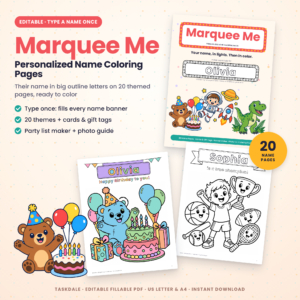
Marquee Me Personalized Name Coloring Pages
Price: $4.99 | Best for: Families making a named photo book
A fillable PDF in US Letter and A4 with 20 themed name coloring pages: type a name once and it appears in hollow outline letters you can color. It also comes with an offline Name Banner Maker that makes a page for your own photo line art, plus a 7-page bonus guide on turning a family or pet photo into a coloring page with free tools. Start with the photo guide, then add the name banner above your first converted picture.
Building a whole book around your photo pages
Ten photo pages in a row can feel a bit samey. A good personalized book has rhythm: a cover with the child’s name, a few photo pages, a themed page for a break, then back to family. Think of it like a playlist.
Here is a simple 16-page layout that works for a child aged 4 to 8:
- Page 1: name cover
- Pages 2 to 4: the child with parents, siblings and the pet
- Page 5: a themed page they love, such as castles or dinosaurs
- Pages 6 to 9: grandparents, cousins, a favorite day out
- Page 10: a draw-your-own page with the prompt “Draw your family here”
- Pages 11 to 15: holidays, birthdays, the first day of school
- Page 16: a back page with the date and a short note from you
For a castle or princess fan, a book that already has a fillable name cover saves you designing one from scratch.
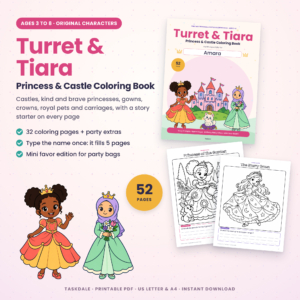
Turret and Tiara Princess and Castle Coloring Book
Price: $4.49 | Best for: Castle fans aged 3 to 8
32 original princess and castle pages for ages 3 to 8, each with a story starter question and writing lines. One name box fills the cover, the This Book Belongs To page, a birthday page, favor toppers and a certificate. Print the named cover and a few castle pages, then slot your family photo pages in between so the book feels like a fairy tale starring your own family.
One more trick: write a short caption under each photo page before you print. “Nana’s garden, June” or “The day Max lost his first tooth”. Children love reading what the picture is, and years later those captions are what make the book precious.
Gift ideas that use family photo pages
A photo coloring book suits more occasions than you might expect. A few that land well:
A grandparent visit book
Before a visit, make six pages of the grandchildren and two of the grandparents’ own home or garden. The child colors them on the drive or flight, then hands over the finished book on arrival. It turns a three-hour car trip into a present.
A new sibling book
Older siblings can feel a bit sidelined when a baby arrives. A book called “Me and My New Baby” with photos of the bump, the hospital visit and the first cuddle gives them something to own. It helps, and it keeps small hands busy while you feed the baby.
A pet memory book
When a family dog or cat dies, coloring pages of the pet in favorite spots give a child a gentle way to talk about it. Keep it short, maybe five pages, and add the pet’s name at the top of each.
A family reunion table book
Print one page per household at a reunion, with each family’s photo outline and surname at the top. Kids color their own family, then go hunting for cousins. Pair the photo pages with scenes of people doing things together so there is plenty to color.
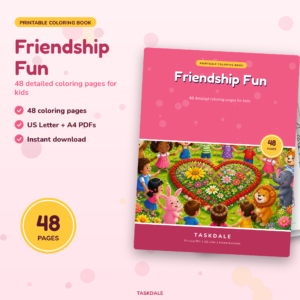
Friendship Fun Coloring Book
Price: $2.99 | Best for: Kids who like warm everyday scenes
A printable book of 48 scenes showing friends doing things together, from picnics under a tree to building a block tower, each with a short kind line at the top. Big shapes give younger children quick wins while patterned details keep older kids busy. Use a few pages as breathers between your family photo pages, or print a stack for a reunion or party table.
Printing and binding tips
Print a single test page first, always. Check that the faces read clearly and that the lines are dark enough. If they look gray, raise the contrast and print again.
- Paper: standard 80 gsm copy paper is fine for crayons. For markers, go up to 120 gsm or cardstock so the ink does not bleed through.
- Single-sided: print on one side only. Markers will ruin whatever is on the back.
- Binding: a long-reach stapler handles up to about 20 sheets. For a keepsake, a local print shop can add a coil binding in a few minutes.
- Cover: print the cover on cardstock so the book survives a backpack.
- Spares: save the files in one folder. When a page gets torn or a cousin wants the same one, just print again.
Mistakes that ruin a photo coloring page
Most failed pages come down to the same handful of problems.
- Keeping too much detail. Every strand of hair becomes a line. Simplify. A few strokes suggest hair far better than three hundred.
- Dark clothing left solid. A black jumper turns into a solid black shape with nothing to color. Erase it to an outline.
- Tiny faces. If the face is smaller than a coin on the printed page, crop in closer or pick another photo.
- Forgetting the age of the colorer. A 3-year-old needs thick lines and big spaces. A teenager or adult might enjoy finer detail and shading.
- Using a photo someone dislikes. Check with older kids and adults before you put their face in a book. A 12-year-old may not want their braces immortalized.
For calm evenings where an adult wants to color too, our piece on coloring books for relaxation and stress relief has ideas for making it a shared habit rather than a one-off craft.
Who this project suits, and who it does not
Photo coloring books are a great fit for families who like a craft project, grandparents with a stack of photos on their phone, and teachers making a class book at the end of the year. A Year 1 teacher with 25 children could photograph each child holding a sign and end up with a class book that every family wants a copy of.
They are less suited to someone who needs a gift tomorrow morning and has never opened a photo editor. In that case, print a ready-made named set tonight and save the photo pages for a later edition. Kids also like screen-free variety, and our guide to printable coloring books for kids lists sets that work straight from the printer.
Frequently asked questions
Can I turn any photo into a coloring page?
Most photos can be converted, but not all look good. Clear light, a plain background and large faces give the cleanest outlines. Group shots from far away rarely work.
Do I need Photoshop to make a photo coloring page?
No. Free tools such as GIMP, Photopea and Inkscape can do the job, and Photopea runs in a web browser without installing anything.
How many pages should a personalized coloring book have?
For a young child, 10 to 16 pages is plenty. More than 20 and the book gets heavy to staple and rarely gets finished.
What paper is best for printing coloring pages at home?
Standard copy paper works for crayons and colored pencils. Use heavier paper or cardstock if the pages will meet markers.
Is it okay to use photos of other people’s children?
Ask their parents first. Even for a private book, it is kind and sensible to check before a child’s face goes onto pages that get handed around.
Your next step
Tonight, scroll through your phone and pick three photos: one of the pet, one close-up of your child and one of the grandparents. Convert the pet photo first, since it is the easiest, and print it. Then add a named cover and a few name pages from Marquee Me Personalized Name Coloring Pages and you have the start of a book nobody else on earth owns.