The best ways to save money each month without feeling broke have one thing in common. They take money from the places you won’t miss it and leave the small joys alone. Cancel the gym you never visit. Keep the Friday pizza. That trade is the whole game.
If you have tried to save before by cutting everything at once, you know how it ends. Two lean weeks, one big blowout, and a feeling that saving just isn’t for people like you. It is. It just has to be built differently. This guide walks through the changes that save the most for the least pain, a simple month-by-week plan, and three Taskdale workbooks and planners that help with the habits behind the numbers.
Quick picks: tools that make saving feel lighter
| Product | Best for | Price | Link |
|---|---|---|---|
| The Calm Money Method | Mindset work plus a budget and savings tracker | $11.99 | View |
| The Money Exhale Financial Anxiety Workbook | Stress spending and money worry | $17.99 | View |
| Greyfinch Budget Binder | Paper planners who like savings challenges | $12.99 | View |
| Money, Unscripted Money Mindset Workbook | Understanding where your money habits came from | $6.49 | View |
Why cutting everything makes you spend more
Strict saving plans fail for the same reason crash diets do. You can white-knuckle it for a while, but every no builds pressure. Then a stressful Thursday arrives, and $90 of takeout and online shopping disappears in an evening. The savings from the past fortnight are gone, and so is your confidence.
The fix is to stop treating every dollar as equal. Some spending makes your week better. A coffee with a friend. A paperback for the train. Some spending does nothing at all. An unused subscription. Paying $40 more than you need to for phone service. Cut the second kind hard and protect the first. You will save more, and you will stick with it longer, because nothing you love has been taken away.
Try this quick test on last month’s bank statement. Go through each line and mark it with a smile, a shrug or a frown. Smiles stay. Frowns go. Shrugs are where most of your savings will come from.
Cut fixed costs once and save every single month
A one-off phone call can save more than a month of skipped lattes. Fixed bills repeat, so every cut repeats too. Spend one evening on these and the savings show up every month without any effort from you again.
- Phone plan: most people pay for more data than they use. Check last quarter’s usage. Dropping from a $65 plan to a $35 one saves $30 a month.
- Car and home insurance: get two new quotes before renewal. A saving of $25 a month is common when you haven’t shopped around in a few years.
- Subscriptions: list every streaming service, app and box. Keep the two you use most. Rotating one service at a time instead of holding four can free up $25 or more.
- Internet: call and ask about current offers for existing customers. Ten minutes on hold can be worth $15 a month.
- Bank fees: if you pay a monthly account fee, look at accounts that waive it.
Add those up and you could be looking at $95 a month, or $1,140 a year, without changing a single thing about how you live. That is the least painful saving there is. You did the work once. Your future self keeps getting paid for it.
Move the money the same day
Here is the catch. If you cut $95 of bills and don’t move that $95 anywhere, it gets absorbed into everyday spending within weeks. The moment a cut goes through, raise your automatic savings transfer by the same amount. The money never had time to feel like yours to spend.
Keep a guilt-free spending line
This one sounds backwards. To save more, budget money you are allowed to waste. Give yourself a fixed amount each month, say $120, that you can spend on anything at all without explaining it to anyone, including yourself. Takeout, a plant, a concert ticket, a nice candle.
The fun line does two things. It removes the guilt that leads to secret splurges. And it puts a fence around treats. Once the $120 is gone, it is gone until next month, and you know it. Couples often give each partner their own line, which ends a surprising number of arguments about who bought what.
Pick the number honestly. If you usually spend $300 a month on little treats, a $50 line will snap in a week. Start at $200 and lower it by $20 every couple of months as the habit settles. Small steps beat a big cut you abandon.
If the guilt runs deeper than a fun line can fix, it helps to look at where your money habits came from. The Calm Money Method does exactly that, then turns it into a working plan.
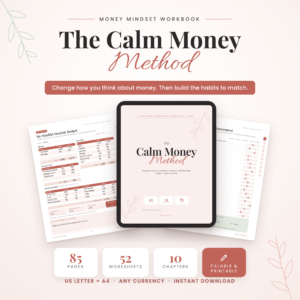
The Calm Money Method
Price: $11.99 | Best for: people who want mindset and a plan
The Calm Money Method is an 85-page money mindset workbook and financial planner you can type into as a fillable PDF or print in US Letter or A4. The first chapters look at where your habits came from and what sets off your spending. Later chapters give you a monthly budget, goals with a real reason behind them, and debt and savings trackers. Begin with the habit chapters, then fill in the savings tracker with one goal.
Make saving automatic and small
Willpower is a terrible savings plan. Automation is a great one. Set up a transfer that leaves your checking account on payday, before you have looked at your balance. Start smaller than you think you should. $25 a paycheck is fine. $50 is great.
Why small? Because a transfer you never have to cancel beats a big one you stop in month two. Every three months, nudge it up by $10. Most people barely notice a $10 change, and after a year your transfer has doubled without a single hard month.
Save the raises and the windfalls
When you get a raise, send half of the extra to savings before your new paycheck lands. You still feel richer, and your savings grow faster. Do the same with tax refunds, birthday cash and work bonuses. A $600 refund split half to savings and half to something fun feels like a treat and a win at the same time.
Name the account
An account called Savings is easy to raid. An account called Lisbon 2027 or Car Repairs is not. Most banks let you rename accounts in the app. It is a tiny change that makes you stop and think before dipping in.
Spend less on food without eating sadder meals
Food is often the biggest flexible cost in a household, and the one with the most waste. A family that throws away a bag of salad, half a loaf and some yogurt each week is binning around $15, or $60 a month. Our list of ways to reduce food waste at home has plenty of quick fixes.
A few habits save the most without making dinner feel like a punishment:
- Plan five dinners, not seven. Leave two nights for leftovers or a use-it-up meal. Less food bought, less food binned.
- Shop with a list and a full stomach. Hungry shopping adds snacks you didn’t plan.
- Keep one treat meal. If Friday is pizza night, keep it. Just make it at home twice a month with a $6 base and toppings you already have.
- Batch the lunches. Cooking one pot of soup on Sunday covers four work lunches. At $11 a bought lunch, that is around $40 a week saved.
For more ideas on the shopping side, see our guide on lowering your grocery bill without coupons.
Spot the spending that is really about feelings
A lot of monthly overspending isn’t about wanting things. It is about feeling tired, bored, lonely or anxious, and buying something because it helps for ten minutes. The 11pm shopping cart. The impulse order after a hard call with your mother. Nobody is immune.
Two simple tools help. First, a pause list. When you want something that isn’t food or a bill, write it on a list instead of buying it. Wait 48 hours. Half the items will look silly by Sunday. Second, a short note when you do buy on impulse: what time it was and how you felt. After a month, patterns jump out. Maybe it is always Tuesday nights. Maybe it is always after scrolling.
None of this is about shame. It is about noticing. Once you see the pattern, you can plan around it, like going for a walk on Tuesday nights or deleting the shopping app from your phone for a month.
If money brings up real stress for you, The Money Exhale is written for exactly that feeling.
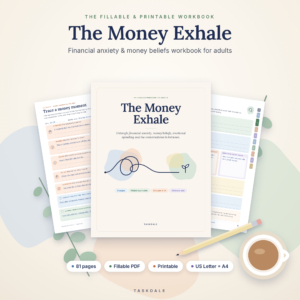
The Money Exhale Financial Anxiety Workbook
Price: $17.99 | Best for: anxious or avoidant savers
The Money Exhale is an 81-page financial anxiety workbook and money beliefs journal. You can type into the fillable PDF or print any page and write by hand, in US Letter or A4. Gentle prompts and worked examples help you separate facts from fears, slow down emotional spending, open the mail you have been avoiding and get ready for money talks. Start with the emotional spending pages and keep the pause list beside you.
Try a small savings challenge for momentum
Challenges work because they turn saving into a game with a finish line. You color in a box, tick off a week, watch a chart fill up. It sounds childish. It works anyway, and the small hit of pride each time you fill a square is real.
Keep the first one short. A 30-day no-spend challenge on one category, like takeout or clothes, is easier than a full no-spend month. A 52-week challenge that starts at $1 and climbs by $1 a week saves $1,378 over a year, but the December weeks get heavy. Many people run it in reverse, starting at $52 when motivation is high. Our comparison of savings challenge printables lays out the options side by side.
If you like a pen in your hand and a binder on the shelf, a planner with challenge pages built in makes this simple.
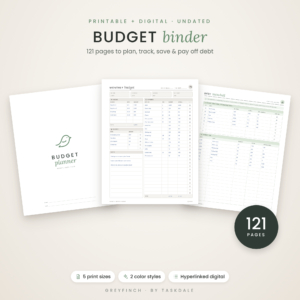
Greyfinch Budget Binder
Price: $12.99 | Best for: paper planners who love a binder
Greyfinch is an undated budget binder with 121 pages across nine tabbed sections, in printable and hyperlinked digital versions. It covers paycheck budgets, bill and spending trackers, debt payoff and savings challenges, plus a spending pause list and a 10-minute weekly check-in. It prints in five sizes, including Letter, A4, A5 and Happy Planner. Do the 15-minute Start Here setup, then pick one savings challenge page to begin.
Your first month, week by week
Trying everything at once is how saving plans collapse. Spread it out over four weeks so each change has time to settle.
- Week 1: mark last month’s statement with smiles, shrugs and frowns. Cancel two frowns.
- Week 2: call the phone company and get one insurance quote. Move whatever you save into savings the same day.
- Week 3: set up an automatic payday transfer, even $25, and rename your savings account after a goal.
- Week 4: set your guilt-free spending line and start a pause list. Plan five dinners for the week ahead.
At the end of the month, check your savings balance. Even if it only grew by $150, that is $150 more than last month, and you did it without a single miserable week. That deserves a small celebration from your fun line.
Mistakes that make saving feel like punishment
Comparing with other people. A friend saving $1,000 a month may earn twice what you do. Your only fair comparison is you, last month.
No buffer. If every spare dollar goes to savings, the first flat tire sends you to the credit card. Keep $200 to $500 in checking as a cushion.
Cutting the cheap joys first. A $4 coffee you love is a poor target. A $45 subscription you forgot about is a great one.
Never spending the savings. Savings are for things. When you hit the trip goal, take the trip and enjoy every bit of it. Feeling the payoff is what makes the next goal easier.
Frequently asked questions
How can I save money every month on a normal salary?
Cut fixed bills like phone, insurance and subscriptions first, then set up a small automatic transfer on payday. Those two steps alone often free $100 or more a month without changing your daily life.
How much should I save each month?
Start with an amount you won’t need to cancel, even $25 a paycheck, and raise it by $10 every few months. Many people work toward 10% to 20% of take-home pay over time.
Is it okay to spend money on fun while saving?
Yes. A fixed fun budget makes saving easier, because it removes guilt and stops the big rebound splurges that wipe out weeks of effort.
What is the easiest savings challenge for beginners?
A 30-day no-spend challenge on one category, like takeout, is a gentle start. Once that feels easy, try a longer challenge such as the 52-week plan.
Why do I keep spending what I planned to save?
Usually because the money sits in checking and looks available. Move savings out automatically on payday, and keep a pause list for impulse buys so you have time to change your mind.
Your next step
Grab last month’s statement and a pen tonight. Mark every line with a smile, a shrug or a frown, then cancel the two frowns that cost the most. If you want a guided place to work through the habits behind your spending, start with The Calm Money Method.