Every January somebody tapes a 52-week chart to the fridge. By March it has a coffee ring on it and three empty boxes. Sound familiar? The idea was fine. The setup was not. A good savings challenge printable fits how you actually get paid, how much you can spare, and how easily you can see your progress. Get those three right and the chart gets filled in. Get them wrong and it joins the junk drawer.
Here is how the big three challenges compare, which one suits which person, and five printable budget planners from Taskdale that already include savings challenge pages.
Quick picks
| Product | Best for | Price | Link |
|---|---|---|---|
| Rosewood Budget Planner | Lowest price, auto totals in a fillable PDF | $0.99 | View |
| Petal & Penny Budget Binder | A simple binder with bills and debt next to your challenge | $1.49 | View |
| Sorbet Budget Binder | A bundle with challenges, debt payoff and bill trackers | $1.79 | View |
| Brightway Budget Planner | Undated monthly budgeting you can start any month | $2.50 | View |
| Hazelwood Budget Planner | Undated monthly budget with challenges built in | $3.75 | View |
Why Most Savings Challenge Printables Get Abandoned
Let me be blunt. The chart is rarely the problem. The problem is that the challenge lives on its own, away from the rest of your money. You print a 52-week grid, you do weeks one through eight with a smile, and then a car repair eats the cash you meant to set aside. Now you are behind, you feel bad, and the chart goes in the drawer.
Three things usually kill a challenge. First, the amounts rise faster than your income. Second, there is no room for a missed week. Third, nobody told you where the money physically goes. Fix those and a savings challenge printable becomes a habit instead of a guilt trip.
That last point matters most. Pick a spot for the cash before you start. A separate savings account works. So does a jar, if you are the jar type. The chart only tracks it. It does not hold it.
The 52-Week Savings Challenge Printable, Explained
The classic version is simple. Save $1 in week one, $2 in week two, and keep adding a dollar until you put away $52 in week 52. Add it all up and you have $1,378. That is real money from small steps.
Here is the catch. The heavy weeks come at the end, when the holidays are circling and your budget is already stretched. Plenty of people quit around week 38, when the ask jumps past $38 a week.
So flip it. Start at $52 and work down. You front-load the hard part while you are motivated, and the last weeks feel like a victory lap. Same $1,378, far better odds of finishing. Or scale it. If $1,378 is too much, save 50 cents more per week step instead of a dollar, and cut the total to about half.
Who the 52-week plan suits
It suits people paid weekly or who like a steady rhythm. It is also easy to start in any month, since week one is just whichever week you begin. If you are paid once a month, the weekly beat can feel awkward, and one of the other options below may fit better.
The 100 Envelope Challenge: Fun, Fast and Messy
This one is more physical. You number 100 envelopes from 1 to 100. Whenever you can, you pick one at random and put that many dollars inside. When all 100 are full, you have $5,050.
The appeal is the randomness. Pulling number 87 hurts. Pulling number 4 feels like winning. Because you choose when to draw, you can match it to your pay days instead of a rigid calendar.
The downside is just as real. $5,050 is a big total, and people often stall once the small envelopes are gone and only the scary ones remain. Many folks do a half version instead, with 50 envelopes and a total of $1,275. If you try the full thing, give yourself a long window. Six months to a year is more honest than a few weeks.
Printable versus real envelopes
You do not need actual envelopes. A printed grid of 100 numbered boxes works, and you shade a box when you save that amount. Cash in envelopes feels good, but it also sits around the house. A printed tracker plus a savings account is safer.
The No-Spend Challenge: Saving Without Adding Money
This is the odd one out. A no-spend challenge does not ask you to put a set amount aside. Instead, you pick a stretch, say a weekend, a week or a whole month, and you skip anything that is not on your essential list. Rent, bills, groceries and fuel stay. Takeout, impulse buys and extra subscriptions go.
Honestly, this is the best starting point for anyone who feels broke. You are not hunting for spare cash that does not exist. You are simply not spending the cash you have.
The trick is writing down your rules before day one. Decide what counts as essential, what happens if a friend invites you out, and where the money you do not spend will go. If it just stays in your checking account, it tends to drift away by the end of the month. Move it.
Which Challenge Fits Your Pay Schedule
When you search for a savings challenge printable, you will find hundreds of pretty grids. Ignore the colors for a minute. Ask one plain question instead: can I afford the biggest number on this page without borrowing from next week? If the answer is no, shrink the amounts before you print. A smaller savings challenge printable you finish beats a grand one you abandon.
Match the challenge to your paycheck, not to a trend on social media. Here is a quick way to think about it.
| Challenge | Total saved | Works best if you are | Watch out for |
|---|---|---|---|
| 52-week | $1,378 | Paid weekly or want a steady habit | Big amounts in late weeks |
| 100 envelope | $5,050 | Okay with a long timeline and some chaos | Stalling on the large envelopes |
| No-spend | Whatever you skip | Short on spare cash right now | Vague rules and no plan for the money |
If you are paid every two weeks, try halving the weekly amounts and saving on pay day only. Paid monthly? Run the no-spend version for a week each month, then move what you did not spend into savings the same day.
Savings Challenge Printable Picks From Taskdale
You can print a free grid from anywhere. But a grid on its own is the thing that gets lost. These planners put savings challenges beside a monthly budget, a bill tracker and a debt payoff page, so the whole picture sits in one binder. Here are five.
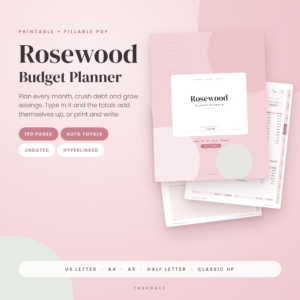
Rosewood Budget Planner
Price: $0.99 | Best for: a very low-cost start
A printable and fillable PDF budget binder with auto totals. It includes a monthly budget, bill tracker, debt payoff and savings challenges, in Letter, A4 and A5 sizes. At under a dollar, it is an easy first try.
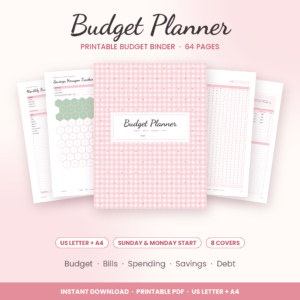
Petal & Penny Budget Binder
Price: $1.49 | Best for: a straightforward printable binder
A printable budget planner with a bill tracker, savings challenges and a debt payoff tracker. It comes as a US Letter and A4 PDF. Good if you want the basics together without extras.
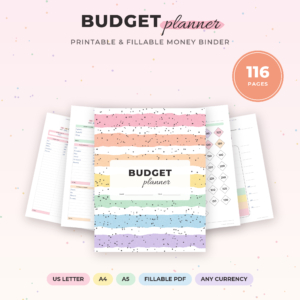
Sorbet Budget Binder
Price: $1.79 | Best for: challenges plus debt and bills in one bundle
A printable budget planner bundle with savings challenges, debt payoff and bill trackers. It is a fillable PDF in US Letter, A4 and A5. A solid pick if you carry a little debt while you save.
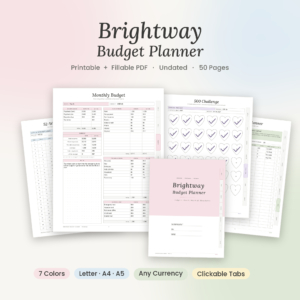
Brightway Budget Planner
Price: $2.50 | Best for: starting in any month
A printable and fillable PDF that is undated, so you can begin whenever you like. It covers a monthly budget, bill tracker, savings challenges and a debt payoff planner, in Letter, A4 and A5.
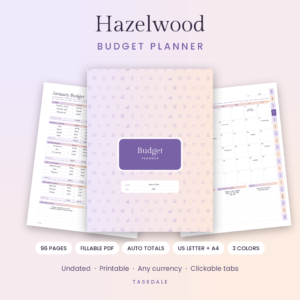
Hazelwood Budget Planner
Price: $3.75 | Best for: an undated monthly budget with challenges
A printable and fillable PDF with an undated monthly budget, bill tracker, debt payoff and savings challenges. Pick it if you want one planner that handles the month and the challenge together.
Compare the Five Savings Challenge Printable Planners
| Product | Format | Price | Best for | Link |
|---|---|---|---|---|
| Rosewood Budget Planner | Printable and fillable PDF, auto totals, Letter, A4, A5 | $0.99 | Cheapest way to try | View |
| Petal & Penny Budget Binder | PDF, US Letter and A4 | $1.49 | Simple binder basics | View |
| Sorbet Budget Binder | Fillable PDF, US Letter, A4, A5 | $1.79 | Saving while paying down debt | View |
| Brightway Budget Planner | Undated printable and fillable PDF, Letter, A4, A5 | $2.50 | Starting any month | View |
| Hazelwood Budget Planner | Undated printable and fillable PDF | $3.75 | Month plus challenge in one | View |
How to Make a Savings Challenge Stick for a Whole Year
A few habits do more than any chart design. None of them are fancy.
Pay yourself first. Move the challenge amount into savings the day your pay lands, before anything else gets a chance at it. Waiting until the end of the week means the money is gone.
Build in a skip. Allow yourself two free weeks across the year, no questions asked. A challenge with a pressure valve survives a flat tyre or a sick kid. A strict one does not.
Keep the chart where you see it. Not buried in a binder you open once a month. Clip it inside a cupboard door, pin it near the kettle, or keep the binder on your desk.
And pair it with your real budget. A challenge on top of a budget that already runs short just creates stress. Look at your bills first, find the spare amount honestly, and then pick the challenge that matches it. That is why a planner with a bill tracker and a monthly budget page beside the challenge pages makes sense.
One more thing. Celebrate the milestones. When you pass the halfway mark, do something small and free. It sounds silly, but it keeps you coming back.
Frequently Asked Questions
How much do you save in a 52-week savings challenge?
If you save $1 in week one, $2 in week two and so on up to $52, you end up with $1,378. You can shrink it by using 50 cent steps, or flip the order and start with $52 so the hardest weeks come first while you are still motivated.
How much is the 100 envelope challenge?
Numbering envelopes from 1 to 100 and filling each with that many dollars adds up to $5,050. Because the total is large, many people give themselves six months to a year, or do a half version with 50 envelopes for $1,275.
Can I do a savings challenge if I am paid monthly?
Yes. Weekly charts can feel awkward, so try a no-spend week once a month and move what you did not spend into savings on the same day. Or use the envelope style and draw a number on pay day.
Is a no-spend challenge really a savings challenge?
It can be, as long as the money you skip spending actually goes somewhere. Write your essentials list first, then transfer the saved amount to a separate account at the end of the period. Otherwise it quietly disappears into everyday spending.
What should I do if I miss a week?
Skip it and keep going. Do not try to cram in two weeks of savings at once. A missed week is data, not failure. Build a couple of free skip weeks into your plan from the start so a hiccup does not end the whole thing.
Your Next Step
So, the short version: pick the challenge that matches how you are paid, give the money a home, and keep the chart next to your real budget. If you want a low-risk way to try it, start with the Rosewood Budget Planner for $0.99. Print the savings challenge page tonight, fill in the first box, and you are already ahead of the January fridge chart.