Some budgets die of detail. Thirty-two categories, a spreadsheet tab for every month, and a nagging feeling that you are always behind on logging. The 50 30 20 split goes the other way. Three numbers. Needs, wants, and savings. If those three are roughly where they should be, your money is in decent shape, and you can get on with your life.
This piece is for people who have tried detailed budgeting and burned out, and for anyone who wants a plan they can hold in their head. Rather than re-explaining the basics, we will look at why the split is so easy to stick with, a ten-minute monthly check, how couples can share it without arguments, how to fund trips and big wants from the 30, how to use the 20 in a sensible order, and the point at which you might outgrow it.
Quick picks: simple tools for a three-bucket budget
| Product | Best for | Price | Link |
|---|---|---|---|
| Sagebloom 50/30/20 Budget Planner | Seeing your real split against the target | $14.99 | View |
| NestShare Couples Budget Spreadsheet | Two incomes, shared bills, a fair split | $19.00 | View |
| Lilac Compass Travel Planner | Planning a trip from your wants money | $5.79 | View |
Why three buckets beat thirty categories
Every category in a budget is a small decision. Is the birthday cake Groceries or Gifts? Is the bus fare to the concert Transport or Fun? Multiply that by forty purchases a week and budgeting starts to feel like a part-time job. Most people quit somewhere around week six, not because they are lazy, but because they are tired.
With 50 30 20, the question shrinks to one: did I have to buy this, or did I want to? Most purchases answer themselves in a second. Rent, need. Concert ticket, want. Extra $200 to the credit card, savings. The choices that remain are few enough to make calmly.
There is also less to fall behind on. Miss a week of logging in a 30-category budget and catching up is a chore. Miss a week in a three-bucket budget and you can rebuild it from your bank app in ten minutes. That forgiving quality is the real reason it lasts.
What simple looks like on a real month
Here is a month for Jordan, who takes home $3,400. The targets are $1,700 for needs, $1,020 for wants and $680 for savings and debt.
| Bucket | Target | Actual | What happened |
|---|---|---|---|
| Needs | $1,700 | $1,760 | Higher electric bill in a cold snap |
| Wants | $1,020 | $940 | Skipped one weekend away, cooked more |
| Savings and debt | $680 | $700 | Put the $20 left over on the car loan |
That is the whole review. Needs were $60 high for a clear reason. Wants came in under. Savings were on target. Jordan did not need to know that coffee was $46 and books were $31. The three totals were enough to say the month went fine, and it took four minutes to see that. Honestly, that feeling of “yes, this is fine” is underrated.
The ten-minute monthly check
Simplicity only works if you still look. Once a month, on the same day, sit down with your bank app and answer three questions.
- How much went to needs? Add rent, bills, groceries, transport, insurance and debt minimums. Compare with half your take-home.
- How much went to wants? Everything optional. Compare with 30%.
- How much went to the future? Savings transfers plus extra debt payments. Compare with 20%.
Write the three numbers in a notebook or a single spreadsheet row. Over a year, those twelve rows tell you more than most detailed budgets do, because you will actually have filled them in. If one bucket is off two months running, that is the moment to dig deeper, and only into that bucket.
If you would rather not add up the buckets by hand, a spreadsheet that tags each purchase and does the percentages saves the ten minutes entirely.
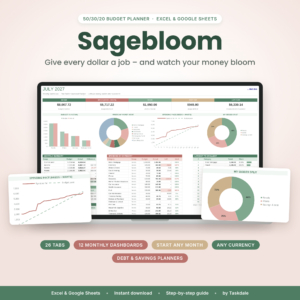
Sagebloom 50/30/20 Budget Planner
Price: $14.99 | Best for: three-bucket budgeters who want the sums done
Sagebloom is a 50/30/20 budget spreadsheet for Excel and Google Sheets with 26 tabs fed from one transactions list. Its 50/30/20 dashboard shows your real needs, wants and savings split next to the target, with plain-English tips when a bucket drifts, and the ratio can be changed to 60/20/20 or 70/20/10 in Settings. It also includes monthly dashboards, a bill calendar, debt payoff and sinking funds. Set your income and ratio, then log one week of spending.
A year of three-line reviews
The quiet power of this method shows up after twelve months. Picture a page with one row per month and three columns. By December, patterns jump out that no single month could show you.
Maybe wants run hot every summer, from barbecues, weddings and a week at the lake. Maybe needs spike in January and February when heating bills land. Maybe savings were strong from March to June and then faded once the car needed work. None of that is a problem. It is a map.
With that map, next year’s plan almost writes itself. Put a little extra into savings in spring to cover the summer dip. Set aside $40 a month from the wants bucket for wedding season. Expect the heating bill and stop being surprised by it. Twelve rows of three numbers, maybe thirty-six figures in all, and you understand your money better than most people with elaborate apps.
Sharing the split as a couple
Couples often find 50 30 20 easier than a detailed joint budget, because it leaves room for personal spending without a line-by-line review. The trick is deciding which wants are shared and which belong to each of you.
One approach that works well:
- Shared needs. Rent, utilities, groceries, insurance. Split 50/50 if you earn similar amounts, or by income if you do not. If one partner earns 60% of the household pay, they cover 60% of shared needs.
- Shared wants. Date nights, holidays, a streaming service you both watch. Fund these from a joint pot.
- Personal wants. Each of you gets an amount to spend with no questions asked. Golf, makeup, video games, whatever.
- Shared savings. An emergency fund and joint goals, plus any personal savings each of you wants.
The “no questions asked” part matters most. Plenty of money arguments are really about one person feeling watched. A personal wants amount ends that. Our guide on how to budget as a couple compares splitting 50/50 with splitting by income in more detail.
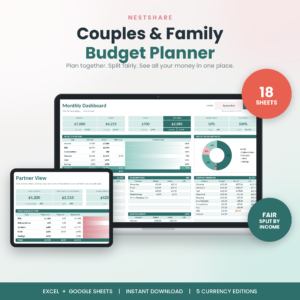
NestShare Couples Budget Spreadsheet
Price: $19.00 | Best for: couples with shared bills
NestShare is a couples budget spreadsheet for Excel and Google Sheets. You can share costs 50/50, by income or by your own percentage, override the split on any single bill, and see a Settle Up line showing who owes whom. Bills set up once fill all twelve months, and it adds monthly and yearly dashboards, a bill calendar, savings goals, debt payoff and net worth. Agree your split method first, then enter both incomes and your shared bills.
Funding trips and big wants from the 30
The 30% is not only for coffee and takeaways. It is also where holidays, concert tickets and a new bike come from. The mistake is treating it as money to spend this month. Big wants work better as a small monthly slice of the 30, saved up in advance.
Say your wants bucket is $1,020 a month and you want a $1,800 trip next summer, nine months away. Set aside $200 of each month’s wants into a trip pot. That leaves $820 for everyday fun, and the trip is paid for before you leave. No credit card bill waiting at home, which is the best souvenir of all.
The planning side of a trip has its own numbers: flights, places to stay, food, activities, and who paid what if you go with friends. A dedicated travel planner keeps all of that in one place, so the trip pot and the trip budget agree. For a step-by-step on estimating the cost first, see our guide to working out what a trip will really cost.
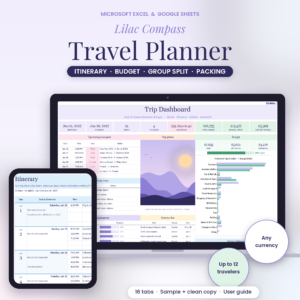
Lilac Compass Travel Planner
Price: $5.79 | Best for: saving for and planning a trip
Lilac Compass is a travel planner spreadsheet for Excel and Google Sheets with a trip dashboard, a 60-day itinerary, booking trackers for transport, stays, rentals and activities, a travel budget, packing lists and a group expense split. Type each booking once and it converts foreign prices, counts the nights, fills in the itinerary and keeps a running total against your budget. Enter your trip dates and budget first, then add bookings as you make them.
Using the 20 in a sensible order
Twenty percent can feel like a lot of money with no clear destination. Without an order, it tends to sit in checking and slowly leak into wants. A common order many people follow:
- A starter buffer. Around $1,000, so a surprise bill does not land on a credit card.
- Any workplace retirement match. If your employer adds money when you contribute, that is usually worth taking.
- High-interest debt. Credit cards and store cards, above the minimum.
- A fuller emergency fund. Often three to six months of needs.
- Longer goals. Retirement, a home deposit, a child’s education.
This is general, not advice for your exact situation, and the right order can differ. The point is to have one. When the 20 has a clear next destination each month, it actually gets there.
When the numbers do not fit
For plenty of households, needs alone run past half of take-home pay. High rent, childcare, a long commute. That does not mean the split has failed. It means the percentages bend to fit the life you have, at least for now.
The simplest adjustment is to keep the shape and change the sizes. A 60/25/15 split is still three buckets with three targets. So is 65/20/15. What matters is that savings never drops to zero and that you know your real numbers. When rent falls, a raise arrives or a loan is paid off, move a few points back towards 20 and watch the savings line grow. Many people find that one change, like a roommate or a cheaper insurance quote, buys back five points in a single month.
Teaching the split to a teenager
Because it is so short, 50 30 20 is one of the easiest money ideas to pass on. A sixteen-year-old with a weekend job earning $480 a month can run it on day one. Half, $240, goes towards their own phone bill, bus pass and lunches. Thirty percent, $144, is theirs to enjoy. Twenty percent, $96, goes into a savings account for a car or college.
The lesson lands best when they choose the savings goal themselves. Watching $96 a month grow to over $1,100 in a year is a far stronger lesson than any talk about compound interest. And the habit of moving the 20 first, before the fun money, is one that tends to stay for life.
Signs you have outgrown the simple split
The 50 30 20 split is a great starting point and, for many people, a forever plan. But a few situations call for more detail:
- You are paying off a lot of debt fast. A detailed plan finds more money to throw at it.
- One bucket is always over and you cannot see why. Tracking that bucket in detail for a month usually reveals it.
- Income swings a lot. Freelancers and commission earners often need a month-by-month plan for lean months.
- You are saving for something big and close. A house deposit in eighteen months may need every category tightened.
Outgrowing it is not failure. Plenty of people use detailed budgeting for a year to reach a goal, then return to three buckets once the pressure is off.
Small habits that keep it effortless
- Move savings on payday. Before anything else gets spent.
- Use one card for wants. Its monthly total is your wants bucket, near enough.
- Round generously. If needs are $1,742, call it $1,750. Precision is not the point.
- Review on the same date. The 1st, or the day after payday. Habit beats motivation.
- Celebrate a good month. Three buckets on target is worth a small treat. From the wants bucket, naturally.
Frequently asked questions
What does 50 30 20 mean in budgeting?
It means splitting take-home pay into roughly 50% for needs, 30% for wants, and 20% for savings and extra debt payments.
Is 50 30 20 realistic on a low income?
Often needs take more than half. Many people adjust to 60/20/20 or 70/20/10 and keep the same three-bucket idea, raising savings when income grows.
How do couples use the 50 30 20 rule?
Share needs by income or 50/50, fund joint wants from a shared pot, give each person a personal wants amount, and agree on shared savings goals.
Where do holidays go in a 50 30 20 budget?
Holidays are wants. Save a slice of the 30% each month into a trip pot so the trip is paid for before you go.
Can I use 50 30 20 with irregular income?
Yes, but base the split on your lowest normal month. In bigger months, send most of the extra to the 20 bucket so lean months are covered.
How often should I check my 50 30 20 split?
Once a month is enough. Add up each bucket, compare with the targets, and only dig into detail if one bucket is off two months in a row.
Your next step
Work out your three targets from this month’s take-home pay and write them on a sticky note on the fridge. At the end of the month, fill in the actual numbers beside them. If you want those numbers worked out for you, set up the Sagebloom 50/30/20 Budget Planner and tag your first week of spending.