You have an idea, a bit of savings, and a nagging voice saying you need a plan. Then you open a blank page and stare at it. Nothing is harder than the first line of a business plan. The good news: a plan is not a school essay or a bank puzzle. It is a set of answers to a few plain questions. This guide shows how to write a business plan in clear steps, section by section, with a realistic idea of what each part should say, and two Taskdale tools that give you a head start on the writing and the numbers.
Quick picks
| Product | Best for | Price | Link |
|---|---|---|---|
| Clarity Business Plan Kit | A written plan in Word or Google Docs with an Excel forecast | $5.25 | View |
| Business Launch Planner | Startup costs, pricing and cash flow worked out early | $14.99 | View |
Why You Should Learn How to Write a Business Plan
Plenty of small owners skip the plan. They figure they will learn as they go. Some do fine. Many hit the same wall: they run out of cash before they find their footing, or they build something nobody wants to pay for.
Writing a plan forces you to answer the awkward questions while mistakes are still cheap. Who exactly will buy this? What will they pay? How much does it cost me to deliver? How many sales do I need each month to stay afloat? It is far better to find out on paper than in your bank balance.
A plan also helps other people. If you want a loan, a partner or an investor, they will ask for one. Even if you fund everything yourself, a plan keeps you honest, and it is something to look at when a bad week makes you doubt yourself.
Here is the part nobody tells you. The plan does not need to be long. For a small business, ten to twenty pages is often plenty, and a short version fits on two. What matters is that the thinking is real.
How to Write a Business Plan: The Sections You Need
However you approach how to write a business plan, most plans follow the same shape. You can reorder things, but these parts cover what readers expect. We’ll go through them one at a time.
1. The executive summary
This is a one-page overview of the whole plan. It says what you sell, who you sell to, why you will win, and what you need to get going. Write it last, even though it comes first. It is much easier to summarize something you have already worked out.
2. The business description
Explain what the business does in plain words. What problem does it solve? Where will it operate? What is your legal setup, such as sole trader or company? Keep it simple. A stranger should understand your business after reading two paragraphs.
3. The market and your customers
Describe who buys from you. Be specific. “Everyone with a car” is not a customer. “Homeowners within 15 miles who want their driveway cleaned before summer parties” is. Add what you know about the size of the group, what they pay for similar things, and how they find providers today. Use facts you can check, not guesses dressed up as numbers.
4. Competitors
List a few other businesses that serve the same customers, including indirect ones. Note what they do well and where they fall short. You do not need to bash anyone. You need to show where you fit.
5. Products or services and pricing
Spell out what you sell and what you charge. Explain how you chose your prices. A price that comes from your costs and your goals is far stronger than one that was copied from someone else.
6. Marketing and sales
How will customers hear about you, and how will you turn interest into sales? Name your real plans: a website, local flyers, referrals, social posts, markets. Add how much time or money each will take. Skip the list of every channel on earth. Pick two or three you can actually do.
7. Operations
Describe how the work gets done. Where, with what equipment, by whom, and with which suppliers. Note any licenses or insurance you need. This section shows that you have thought about the daily grind, not only the big idea.
8. The team
Who runs the business? Share relevant experience, even if it is small. If it is only you, say what skills you bring and where you might need help from an accountant, a mentor or a part-time hire.
9. The financial plan
Here come the numbers. You need startup costs, a forecast of sales and expenses, and a view of cash flow. We will give this part its own section, because it is where most plans go soft.
The Financial Part Without the Panic
Many people freeze at the numbers. They shouldn’t. The ideas are simple, even if the spreadsheet looks busy.
Start with startup costs. List everything you need to buy or pay for before the first customer. Equipment, supplies, licenses, a website, initial marketing, insurance. Add a cushion for the things you forgot.
Next, estimate sales. Be modest. Think about how many customers you can reach in a month and what each one will pay. Use your own research, not a rosy guess. If you are unsure, make three versions: a cautious one, a middle one and a good one.
Then list monthly expenses. Rent, insurance, subscriptions, materials, fuel, and your own pay if the business can afford it. Subtract expenses from sales to see what is left.
Finally, look at cash flow, which is the timing of money in and out. A business can be profitable on paper and still run short of cash, because bills arrive before customers pay. Month-by-month cash flow shows you where the squeeze will come, and gives you time to plan for it.
This is general information, not financial advice. For big decisions, speak with a qualified adviser in your area.
A Simple Way to Draft Your Plan in a Weekend
If how to write a business plan feels like a mountain, try this schedule. It works because every step is small.
On Friday evening, write the business description and the customer section. Just talk it out on the page. Don’t edit.
On Saturday morning, do competitors, pricing and marketing. Look up three or four rivals and jot down what you see. Then work out your prices.
On Saturday afternoon, tackle operations and the team. These are the easy parts because you already know them. Write them down so you can read them later.
On Sunday, build the numbers. Startup costs first, then sales, then expenses, then cash flow. Take your time here. When you finish, read the entire plan once from top to bottom and fix anything that sounds vague.
On Monday, write the executive summary and walk away. Come back in a few days with fresh eyes.
That is a draft. It will not be perfect, and that is fine. A rough plan you finish beats a perfect plan you never start.
Template or Blank Page?
You can work out how to write a business plan from a blank page. Some people enjoy that. But a template gives you headings, prompts and a sensible order, so you spend your energy on ideas and not on formatting. An Excel forecast handles the math so you are not building formulas at midnight.
Which tool fits depends on where you are stuck. If the writing is the hard part, you want a structured document. If the numbers scare you, you want a calculator that walks through costs, pricing and cash flow. Here are two Taskdale options. I’m describing only what each listing says, so read the product page before you buy.
If the writing is the hard part
Clarity gives you the headings and prompts in a Word or Google Docs file, so you fill in answers instead of facing a blank page. An Excel forecast comes with it for when you reach the numbers.
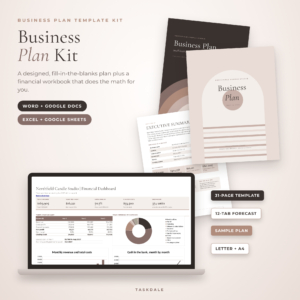
Clarity Business Plan Kit
Price: $5.25 | Best for: people who want a written plan with a financial forecast
Clarity is a business plan template for Word and Google Docs, paired with an Excel financial forecast. It suits anyone who wants headings to fill in and a spreadsheet for the numbers, whether the plan is for a lender, a partner or just for yourself.
If the numbers are the hard part
The Launch Planner starts with what you need to buy, what to charge and when cash will run tight. Its fillable PDF checklist keeps the setup tasks in order while the calculator does the sums.
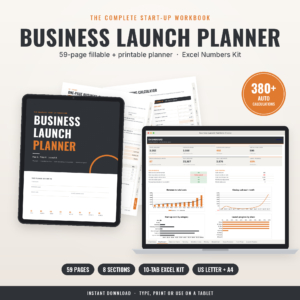
Business Launch Planner
Price: $14.99 | Best for: working through startup costs, pricing and cash flow before launch
This is a fillable startup planner in PDF, plus an Excel calculator for startup costs, pricing and cash flow, in US Letter and A4. It is a good match for anyone who learns by filling in pages and who wants a clear picture of the money before spending any.
Comparing the Two Tools
| Product | Format | Price | Best for | Link |
|---|---|---|---|---|
| Clarity Business Plan Kit | Word, Google Docs, Excel forecast | $5.25 | Writing the full plan with a forecast | View |
| Business Launch Planner | Fillable PDF, Excel calculator, US Letter and A4 | $14.99 | Startup costs, pricing and cash flow | View |
The honest difference: Clarity is built around the written plan, while the Launch Planner is built around the numbers and the startup checklist. Some owners use both. They draft the story in Clarity and test the money in the Launch Planner. If you can only pick one, choose the tool for the part that scares you more.
Common Mistakes When You Write a Business Plan
I see the same slips again and again. Part of knowing how to write a business plan is knowing what to avoid, and a quick list saves you a rewrite.
Making it too long. A plan padded with filler hides the useful parts. Say it clearly and stop.
Guessing at numbers. Invented sales figures look impressive until someone asks where they came from. Base your forecast on something real: your capacity, local prices, early orders.
Ignoring costs you don’t enjoy. Insurance, taxes, repairs and software subscriptions are boring, and they are real. Include them.
Forgetting your own pay. If the plan only works when you earn nothing, it doesn’t work. Put a wage in the budget, even a modest one.
Treating it as finished. A plan is a living document. Review it every few months, compare it with what actually happened, and update it. The gap between plan and reality teaches you more than the plan itself.
Frequently Asked Questions
How long should a business plan be?
For most small businesses, ten to twenty pages is plenty, and a lean one or two page version can work for a simple idea. Banks or investors may ask for more. Focus on clear answers rather than page count, and cut anything that does not help a reader decide.
What are the main parts of a business plan?
The usual sections are an executive summary, business description, market and customers, competitors, products and pricing, marketing and sales, operations, the team, and a financial plan. Order can vary. Together they show what you do, who buys, and how the money works.
Do I need a business plan to start a small business?
Not by law in most cases, though rules vary by place and by what you are doing. Still, a plan helps you test the idea and spot money problems early. Lenders and investors usually ask for one. This is general information, not legal or financial advice.
Can I write a business plan myself?
Yes, and learning how to write a business plan is easier than it sounds. Most small owners do. A template gives you structure, and a spreadsheet handles the math. You can ask an accountant or mentor to review the numbers once the draft is done, which is often cheaper than hiring someone to write the whole thing.
How often should I update my business plan?
Review it every three to six months, or sooner if something big changes, like a new product, a price rise or a lost customer. Compare your forecast with real results and adjust. A plan that stays current is far more useful than one that sits in a drawer.
Your Next Step
So, here is the plan for your plan: block out one weekend, write each section in plain words, and build the numbers last. If you want structure for the writing, start with the Clarity Business Plan Kit. If the money side worries you most, look at the Business Launch Planner. That is how to write a business plan without the panic. Either way, open a file today and write the first sentence. That is the hardest line, and you are already past it.