The trip was perfect. The sunset, the cabin, the terrible karaoke. Then comes the group chat, three days later: “So… who owes what?” Nobody wants to be the person asking. Nobody remembers who paid for the groceries. And a good week slowly turns into a small, sour argument over twenty dollars. You can avoid all of it. If you decide how to split trip expenses before you leave, and write every cost down as it happens, the money part of the trip takes care of itself. Here is a simple way to do it, plus three Taskdale planners with a splitter built in.
Quick picks: trip planners with an expense splitter
| Product | Best for | Price | Link |
|---|---|---|---|
| Lilac Compass Travel Planner | Group trips on a tighter budget | $5.79 | View |
| Atlas Bloom Travel Planner | Splitter plus bookings tracker | $5.99 | View |
| Postcard Travel Planner | Full trip file with splitter | $9.99 | View |
Why splitting costs goes wrong on group trips
Most friendships survive a bad hotel. Far fewer survive a vague conversation about money. The trouble is rarely greed. It is memory.
One person books the rental car on their card. Another buys groceries on day one. A third pays for dinner because the others were in the restroom. Two days later, nobody can say who paid for what, and everyone feels slightly uneasy about it.
There is also the problem of fairness. Not every trip cost is shared equally. One friend does not drink, another skipped the boat tour, a couple took the bigger room. If you do not talk about it up front, resentment gets a seat at the table.
And the awkwardness is real. Chasing a friend for forty dollars feels petty, even when they owe it. A neutral sheet that does the math takes the personal edge off. It is not you asking. It is the spreadsheet.
Agree on the rules before you leave
This is the part most groups skip, and it is the part that matters most. Spend ten minutes before the trip on a short chat. Cover these points.
What is shared and what is personal
Lodging, groceries, fuel and rental cars are usually shared. Souvenirs, personal snacks and one-off treats are usually personal. Say it out loud, so nobody is guessing.
Equal or fair?
Equal splits are easy. Fair splits can be different. If one couple takes a room with a private bathroom, they might pay a bit more. If someone joins for only three of the seven nights, they pay for three. Decide the rule now.
Who pays upfront
Someone has to put the first bill on a card. Spread this around. Let one person cover lodging, another cover the rental car, another handle groceries. It stops one friend from carrying the whole float.
When you settle up
Pick a date. Within a week of coming home works well. Money chased for months turns into a grudge.
How you pay each other
Bank transfer, a payment app, cash on the last night. Choose one and stick with it, so settling takes two minutes.
How to split trip expenses step by step
The method is the same for four friends or fourteen. Here is the basic version.
First, write down every shared expense with three things: what it was, how much, and who paid. That is it. Do this the same day. Receipts get lost, and memory fades by dinner.
Second, add up the total of all shared costs.
Third, divide the total by the number of people sharing. That is each person’s fair share.
Fourth, compare what each person actually paid with their share. If you paid more than your share, you are owed money. If you paid less, you owe money.
Fifth, settle up with the fewest payments possible. Usually, the people who owe pay the people who are owed, and that is that.
A worked example: four friends and a cabin
Let’s use real numbers. Four friends rent a cabin for a long weekend. These figures are made up for illustration.
Anna books the cabin and pays 900. Ben buys groceries for 240. Chloe pays for fuel at 120. Dan pays for nothing yet, since he is bringing the speaker and the snacks he already owned.
The total is 900 plus 240 plus 120, which is 1,260. Divided by four, each person’s share is 315.
Anna paid 900, so she is owed 585. Ben paid 240, which is 75 short of his share, so he owes 75. Chloe paid 120, so she owes 195. Dan paid nothing, so he owes the full 315.
Check the sums: 75 plus 195 plus 315 equals 585. The money that is owed matches the money that is due. Ben, Chloe and Dan each send a payment to Anna and the trip is square. Three transfers, no arguments.
A good splitter does exactly this math for you. You type in the expenses and who paid, and it shows who owes whom.
When someone skips an activity
Now say the group does a kayak tour for 200 and Dan sits it out. Then only three people split that cost, about 67 each. In your sheet, mark the tour as shared by Anna, Ben and Chloe only. This keeps things fair, and it keeps Dan from feeling he paid for something he did not do.
Our picks: Taskdale planners with an expense splitter
If you do not want to build a splitter from scratch, these three planners include one. I describe each using only what its product title says.
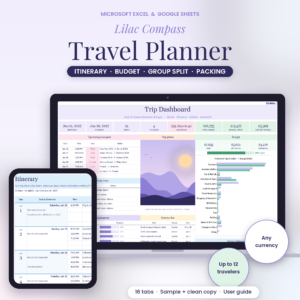
Lilac Compass Travel Planner
Price: $5.79 | Best for: group trips where cost sharing matters
Lilac Compass is a travel planner spreadsheet for Excel and Google Sheets. It includes an itinerary, travel budget, packing list and group expense split. It is the lowest priced of the three and covers the essentials.
Comparison: expense splitter planners
| Product | Format | Price | Best for | Link |
|---|---|---|---|---|
| Lilac Compass | Excel and Google Sheets | $5.79 | Budget, itinerary, group split | View |
| Atlas Bloom | Excel and Google Sheets | $5.99 | Bookings plus group splitter | View |
| Postcard | Excel and Google Sheets | $9.99 | All-in-one trip file | View |
Habits that keep group money drama-free
Pick one keeper of the sheet. Not a boss, just the person who updates it. If six people edit one file, you will get six versions of the truth. One keeper, who everyone sends receipts to, keeps things clean.
Log costs the same day. A quick photo of the receipt and a line in the sheet takes thirty seconds. Waiting until the end of the trip is how errors sneak in.
Round sensibly. Nobody wants to send 13.37. Round to the nearest dollar, or use whole numbers, and let the small differences even out over time.
Use one currency in your sheet. If you spend abroad, convert each cost using the rate on the day, or agree a single rate for the whole trip. Either works, but changing the method halfway causes confusion.
Share the sheet with everyone. Transparency is the whole point. Anyone should be able to open it and see the same numbers. A shared Google Sheets file is handy here, since it updates for everyone at once.
Finally, settle quickly. Send the final numbers within a few days of getting home, and pay within a week. The longer money hangs, the heavier it feels.
A planner that keeps bookings and the splitter in the same file makes the keeper’s job much easier, because confirmation numbers and costs sit side by side.
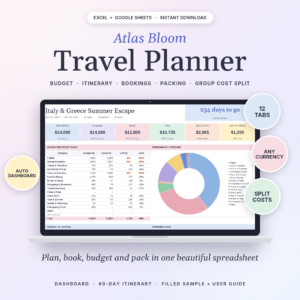
Atlas Bloom Travel Planner
Price: $5.99 | Best for: groups who also want bookings tracked
Atlas Bloom is a travel planner spreadsheet for Excel and Google Sheets with a trip budget, itinerary, bookings, packing list and group expense splitter. Keeping bookings beside the splitter makes it easier to see who paid for what.
Tips for different kinds of groups
Couples and close friends can keep it loose. A shared sheet and a quick settle-up at the end is usually plenty. You know each other, and a small rounding difference will not matter.
Bigger groups need more structure. With eight people, the way you split trip expenses has to be written down, or the first dinner bill will start a debate. Name a keeper, share the sheet and agree the rules by message before the flights.
Family trips add another layer. Grandparents may want to treat everyone, siblings may have very different budgets, and kids do not pay at all. Talk about it early and kindly. Some families split trip expenses by household, not by head, which is often the simplest route.
Work trips and team retreats are different again. There may be a company card or an expense policy to follow. Keep the receipts and use your sheet only for the costs the company does not cover.
Whatever the group, the principle is the same. Be clear before the trip, write things down during it, and settle fast after it. That is the entire secret.
For bigger family trips, where the itinerary, packing and money all need a home, an all-in-one trip file keeps everyone on the same page.
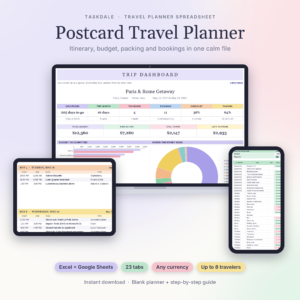
Postcard Travel Planner
Price: $9.99 | Best for: one file for planning and sharing costs
Postcard is a travel planner spreadsheet for Excel and Google Sheets with an itinerary, travel budget, packing list and expense splitter. It is the priciest of the three, and it keeps the whole trip in a single file.
Build a simple splitter sheet in five columns
If you’d rather make your own, five columns are enough for most trips:
| Date | What | Amount | Paid by | Shared by |
|---|---|---|---|---|
| Fri | Cabin, 3 nights | 900 | Anna | All |
| Fri | Groceries | 240 | Ben | All |
| Sat | Kayak tour | 200 | Chloe | Anna, Ben, Chloe |
Below the log, add one row per person. Use SUMIF on the “Paid by” column to total what each person paid, then work out each share from the “Shared by” column. Paid minus share gives the balance: positive means they’re owed, negative means they owe. It takes about 20 minutes to set up the first time. After that, copy the file for every trip.
Keep the “Shared by” column honest. It’s the one that stops the friend who skipped the kayak tour from quietly paying for it.
Common mistakes when you split trip expenses
The first is splitting everything equally without asking. A fair split is a conversation, not a default. People are usually happy to pay more or less when the reason is clear.
The second is forgetting small shared costs. Tips, parking, tolls, a bag of ice. They feel too small to log, and they add up. Put them in anyway.
Third, mixing personal and shared costs. If you buy yourself a souvenir on the group card, note it as personal. Keep the shared column clean.
Fourth, relying on someone’s memory. “I think you owe me about fifty” is how friendships fray. Use the sheet.
And fifth, letting one person carry the whole float for too long. If a friend paid 900 for the cabin, send them their share early. You do not have to wait for the end of the trip.
For more planning help, see our guide to the best travel planners, or our tips on when to start planning a trip. Sharing costs on a party instead? See how co-hosts split a baby shower budget.
Split trip expenses FAQ
What is the easiest way to split trip expenses?
Log every shared cost with the amount and who paid, add the total, divide by the number of people, and compare each person’s payments with their share. The people who paid less send money to the people who paid more. A spreadsheet splitter does the math for you.
Should trip costs always be split equally?
Not always. Equal splits are simple, but fair splits sometimes differ. If someone joins for fewer nights or skips a paid activity, adjust their share. Agree on the rules before the trip, so nobody feels surprised.
Which Taskdale planners include an expense splitter?
Postcard has an expense splitter, Atlas Bloom has a group expense splitter, and Lilac Compass has a group expense split. All three are Excel and Google Sheets travel planners, according to their product titles.
Can everyone edit the spreadsheet at once?
If you upload the file to Google Sheets and share it, several people can open it together. For most groups it is easier to have one keeper enter costs, and everyone else view. That avoids accidental changes.
When should we settle up after a trip?
Within about a week of getting home works well for most groups. Fresh memory helps, and nobody sits on a debt. Send the final numbers in the group chat and agree on the payment method early.
What if one person can’t afford to pay their share straight away?
Agree a simple plan in private, not in the group chat. Splitting the amount over two or three paydays is common among friends. Write the plan in the sheet so the keeper knows the balance is settled, and nobody else needs the details.
Your next step
Before your next group trip, send one message to the chat: “Let’s agree how we split costs.” Then open a shared sheet. If you want the layout ready to go, the Lilac Compass Travel Planner includes a group expense split. Ten minutes now saves an awkward conversation later.