Strong CVs are rarely written in one sitting. They come from small habits repeated every week: noting a win the day it happens, keeping one master file, tailoring for ten minutes instead of rewriting for two hours. People who do this apply faster, and their CVs read sharper because the details are fresh.
This guide sets out nine CV writing habits worth keeping, whether you are hunting now or just want to be ready when the right advert appears. You will also get a worked example of one month, a weekly routine that fits around a job, a few habits to drop, and three Taskdale kits that make the routine easier to stick to.
Quick picks: kits that support good CV habits
| Product | Best for | Price | Link |
|---|---|---|---|
| Hollis Resume Template | Writing guide with 216 action verbs | $8.99 | View |
| Alder Resume Template with Photo | A full matching set plus tracker | $4.79 | View |
| Job Application Tracker Spreadsheet for Excel | Follow-up dates and weekly goals | $5.99 | View |
Habit 1: Keep a wins log, starting today
The hardest part of writing a CV is remembering what you did. Ask most people what they achieved in March last year and they draw a blank. That’s why the first habit has nothing to do with the CV itself. It is a plain note on your phone called “Wins”.
Every time something goes well at work, add one line. Date, what happened, any number attached. “14 June: closed the month-end two days early.” “3 Sept: trained two new starters on the till system.” “20 Oct: customer emailed my manager to say thanks.” Thirty seconds each.
After six months you will have forty or fifty lines to pick from. Writing bullet points stops being a memory test and becomes a choosing exercise. That is a far nicer job on a Sunday evening.
Habit 2: Keep one master CV and never send it
Your master CV is the long version. Every role, every bullet you have ever written, every course, every award. It might run to five pages. Nobody sees it except you.
When a job comes up, you copy the master, delete what does not fit, reorder the rest and save the copy under a new name. You never start from a blank page again, and you never lose a good bullet because you cut it from a past version.
A simple naming habit helps: “Master-CV.docx” for the long file, then “Sam-Patel-CV-Logistics-Oct.pdf” for each tailored copy. When a recruiter rings in three weeks, you can open the exact version they read.
Habit 3: Write bullets as action, result, number
Most weak CVs describe duties. “Responsible for customer complaints.” “Handled stock.” Strong CVs describe what changed because you were there. The difference is one habit: every bullet starts with a verb and ends with a result.
- Weak: Responsible for the staff rota.
- Better: Rebuilt the staff rota for a team of 18, cutting last-minute shift gaps from about six a week to one.
Not every result has a number. That’s fine. “Wrote the onboarding checklist the whole branch now uses” is still a result. But when a number exists, use it. Hours saved, people trained, calls handled per day, complaints closed. Numbers stick in a reader’s head.
If you struggle to find verbs, a list helps. Rotating between “led”, “built”, “cut”, “trained”, “fixed” and “won” keeps your page from sounding like the same sentence nine times. A good writing guide does this work for you.
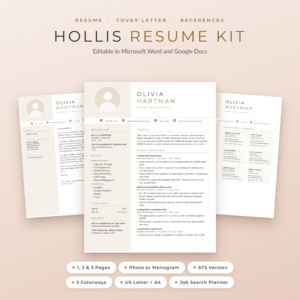
Hollis Resume Template
Price: $8.99 | Best for: people who want writing help
Hollis comes with a Resume Writing Guide in Word and PDF holding 216 action verbs, alongside resumes with photo or monogram in 1, 2 and 3 page versions, ATS resumes, a cover letter, a references page and a thank-you letter. There are 84 editable Word files in three colourways and two paper sizes, plus a Job Search Planner for Excel and Google Sheets. Read the guide’s verb list first, then rewrite your three weakest bullets with it open beside you.
Habit 4: Tailor in ten minutes, not two hours
Tailoring sounds like a big job. It does not have to be. With a master CV in place, it is a short checklist you run every time.
- Read the advert twice. Highlight the five things they mention most.
- Rewrite your profile. Make sure two of those five things appear in it, in your own words.
- Reorder bullets. In each recent role, move the most relevant bullet to the top.
- Cut one thing. Remove a bullet or section that has nothing to do with this job.
- Match the job title. If they say “Customer Service Advisor” and you were a “Client Care Agent”, add the plain term in brackets if it is honest.
Set a timer. Ten minutes is plenty once the habit settles. A teaching assistant applying to six schools in one week can tailor all six on a single evening and still get to bed on time.
Habit 5: Read it out loud before you send it
Spellcheck catches typos. It does not catch “manger” for “manager”, a missing word, or a sentence that runs on for four lines. Reading aloud does.
It feels odd the first few times. Do it anyway. You will hear clumsy phrasing at once, and you will notice when three bullets in a row start with “Managed”. Then read it once more on your phone, because that is where plenty of hiring managers first see it.
If you can, ask one friend to read it cold for five minutes and tell you the first thing they remember. If they cannot name anything, your strongest point is buried.
Habit 6: Keep your whole application in one matching style
A CV in one font and a cover letter in another looks like two different people wrote them. It is a small thing. Small things add up when a recruiter is choosing between 12 close candidates.
Use the same header, fonts and colour on your CV, cover letter and references page. If you have never written a cover letter to go with your CV, our guide to writing a cover letter that matches your resume walks through the structure. The easy route is a kit where all the pages already match, so you only type.
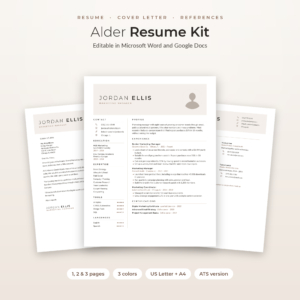
Alder Resume Template with Photo
Price: $4.79 | Best for: a calm matching application set
Alder gives you a resume with photo in 1, 2 and 3 page versions, a no-photo resume, a one-column ATS resume, plus a cover letter, references page and thank-you letter with the same header. That is 48 Word files in three colours and US Letter or A4, with a Job Application Tracker for Excel and a six-page Job Search Toolkit. Fill in the 1-page resume first, then copy your header details across to the cover letter so both match from day one.
Habit 7: Update your CV every quarter, even when you are happy
Most people only touch their CV when they are desperate. Then they sit down on a bad day after a bad week and try to remember three years of work. It shows.
Put a 30-minute reminder in your calendar on the first Saturday of January, April, July and October. Open the master CV. Copy the best lines from your wins log into it. Update dates, job title, new training. Close it.
When a recruiter messages out of the blue, or a dream job shows up with a Friday deadline, you are ready in an hour instead of a weekend. That calm feels very good.
Habit 8: Log every application the same day
After twenty applications, memory fails. Who replied? Which version did you send to the council job? Was the interview Tuesday or Thursday? Writing it down the day you apply takes two minutes and saves embarrassing moments later.
Log the company, role, date, CV version, where you saw it and when to follow up. Our guide to the job application tracker sets out a simple layout. Over a few weeks the log also tells you something useful: which job sites lead to replies and which are a waste of your evenings.
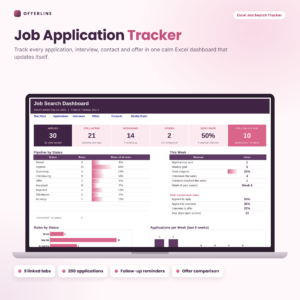
Job Application Tracker Spreadsheet for Excel
Price: $5.99 | Best for: active job seekers with many applications
Offerline is an Excel workbook with nine linked tabs, including Applications, a Dashboard, a weekly goal, follow-up reminders that move from Soon to Due now, an interview countdown, a source report showing which job sites get replies, and an offer comparison. Dropdowns keep entries tidy and formula cells are locked. Set your follow-up gap to seven days, then log today’s applications before you close the laptop.
Habit 9: Ask for feedback after rejections
Not every employer replies. Some do. A short, polite email after a rejection, asking if there is one thing you could improve, sometimes brings back gold: “Your CV did not show enough experience with budgets.” That is one line you can fix tonight.
Keep any feedback in a note beside your wins log. After three or four replies, patterns appear. If two employers say your experience looks thin, the problem may be how you describe it rather than what you have done.
Rejection stings. Nobody enjoys it. But a single honest sentence from an employer can be worth more than a week of guessing, so the two-line email is worth sending even on a flat day.
What these habits look like over one month
Habits are easier to believe in when you see them working together, so here is a worked example. Priya is a warehouse team leader who wants to move into a logistics coordinator role. She works full time and has a toddler, so her evenings are short.
In week one she spends 40 minutes building a master CV from an old file and her phone notes. She finds eleven wins she had forgotten, including a picking route she redesigned that cut walking time on the night shift. That line goes straight to the top of her latest role.
In week two she applies to three coordinator jobs, tailoring each in about fifteen minutes. She logs every one the same evening. In week three she sends two follow-up emails on the dates her tracker flags, and one of them gets a phone screen.
In week four a rejection arrives with a short note: the employer wanted to see more about systems. Priya adds a line about the stock software she uses daily, which she had left off because it felt too ordinary. Her next application gets an interview. Nothing dramatic happened. She just kept the small habits going, four weeks in a row.
Habits to drop
Some habits feel productive but quietly hurt your chances.
- Sending one CV to everything. Fifty identical applications usually do worse than ten tailored ones.
- Rewriting from scratch every time. It burns hours and loses your best lines. Work from the master.
- Fiddling with fonts at midnight. Design changes feel like progress. The words matter more.
- Listing every duty. If the reader would assume you did it, cut it.
- Waiting for the perfect CV. A good CV sent today beats a perfect one sent next month.
A weekly CV routine that fits around a job
Here is a rhythm that works for someone with a full-time job and limited evenings. Adjust the days to suit you.
| Day | Task | Time |
|---|---|---|
| Monday | Save three adverts worth applying to | 15 minutes |
| Tuesday | Tailor and send one application | 20 minutes |
| Wednesday | Add any wins from the week to your log | 5 minutes |
| Thursday | Tailor and send the second application | 20 minutes |
| Friday | Send follow-ups that are due | 10 minutes |
| Weekend | Third application, then a short review of what worked | 30 minutes |
That is under two hours a week for three solid applications. Do it for a month and you have twelve tailored applications out, a log of what works and a CV that keeps getting sharper.
Frequently asked questions
How often should I update my CV?
Once a quarter is a good rhythm, plus any time you change role, finish a course or win something worth mentioning. Short, regular updates beat one painful rewrite.
What is a master CV?
A master CV is a long private file holding every role, bullet, course and award you have. You copy it and trim it for each application, so you never start from a blank page.
How long should it take to tailor a CV?
With a master CV ready, about ten to twenty minutes. You change the profile, reorder bullets and remove what does not fit the advert.
Should I use the same CV for every job?
Keep the same design and core facts, but tailor the profile and the order of bullets for each role. Small changes make the CV read as if it was written for that employer.
What is the best way to write CV bullet points?
Start with an action verb, say what you did, then show the result, with a number when you have one. For example: trained six new starters, cutting their time to work alone from four weeks to two.
Your next step
Open the notes app on your phone right now and start a page called “Wins”. Add three lines from this month. Then set a reminder for the first Saturday of next quarter. If you want a guide with verbs and a matching template set to build on, start with the Hollis Resume Template.