A long career break does not have to be the first thing an employer notices on your CV. With the right layout and one honest line about the gap, the reader sees your skills and recent effort first. You can build that CV for free tonight, and this guide shows you how.
It is written for parents going back after years at home, carers whose caring role has ended, people returning after illness, and anyone who stepped away for travel, study or redundancy and is now ready to work again. You will learn how to explain the gap in a single line, which CV layout keeps it in proportion, what to put in the space where recent jobs would go, and where free tools end and a ready template starts to help.
Quick picks: templates for a return-to-work CV
| Product | Best for | Price | Link |
|---|---|---|---|
| Marlowe Resume Template | Projects and volunteer sections built in | $4.79 | View |
| Sloane Resume Template | Room to show transferable skills | $4.49 | View |
| Hollis Resume Template | Writing guide with 216 action verbs | $8.99 | View |
| Alder Resume Template with Photo | A full set plus a job tracker | $4.79 | View |
First, the mindset: a gap is a fact, not a flaw
Career breaks are common. People raise children, look after parents, recover from illness, move countries, retrain or simply rest after burnout. Hiring managers have usually seen plenty of CVs with gaps, and many have taken breaks themselves.
What makes a reader hesitate is not the gap. It is an unexplained gap, or a CV that looks frozen in the year you left. A line that says what happened, followed by evidence that you are ready now, settles most worries before they form.
So the aim of this CV is simple. Name the gap briefly, show what you did with your time where it is relevant, and prove your skills are current. That is all.
How to create a new CV for free
You do not need to spend anything to build a solid return-to-work CV. Here are the free routes that work well.
- Google Docs. Free with a Google account. Open the template gallery from the Docs home page, choose a resume layout, and download a PDF when you are done. Your file saves automatically, which helps if you write in short bursts around school runs.
- Word for the web. Free with a Microsoft account, with a small set of CV templates and PDF export.
- A blank document. Clear headings, one font, bold job titles. A plain CV with strong content beats a fancy one with weak content.
- Return-to-work programmes and job centres. Many councils, colleges and charities run free CV workshops for returners. Some employers also run paid “returnship” placements for people coming back after a break, so it is worth searching for those in your sector.
Our step-by-step guide to making a resume in Google Docs covers the free route in detail. The rest of this article focuses on what to write, which is where returners usually get stuck.
Choose a layout that keeps the gap in proportion
The layout you pick changes how loudly the gap speaks.
Reverse chronological
Newest job first, working backwards. This is the most common format and the one recruiters like best. With a break, the career break line sits at the top of your experience, so it is the first thing a reader sees in that section. That is fine if your previous roles are strong and relevant.
Hybrid or skills-first
A short profile, then a “Key skills” section with three to five skill groups and evidence under each, then a shorter employment history. This puts your abilities in front of the dates. It suits returners whose last role was a while ago or who are changing direction.
For most people after a long break, the hybrid layout is the better choice. It still lists every job with dates, so nothing looks hidden, but it leads with what you can do.
A template with a two-column design makes the hybrid layout easy. Skills sit in a side column where the eye lands early, and experience fills the main column.
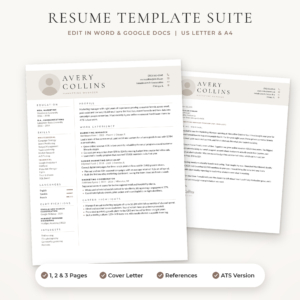
Sloane Resume Template
Price: $4.49 | Best for: returners showing transferable skills
Sloane uses a slim left column for education, skills and languages and a wider right column for experience, built from simple tables and Word styles so sections grow as you type. You get a 1-page resume, 2-page resume, 3-page CV, an ATS-friendly resume, a cover letter and a references page in three colours and both US Letter and A4, plus a Resume Writing Toolkit with 96 action verbs. Fill in the skills column first, then decide how much of your older history you need.
How to word the career break on your CV
Put the break in your employment history as if it were a role, with dates. One line of explanation is enough. You do not owe anyone medical details or a family story.
| Reason | Example wording |
|---|---|
| Raising children | Career break, 2018 to 2025: full-time parent to three children, now returning to work. |
| Caring for a relative | Career break, 2020 to 2025: full-time carer for a family member. |
| Health | Career break, 2022 to 2024: health-related leave, now fully ready to return. |
| Relocation | Career break, 2023 to 2025: relocated from Durban to Manchester and settled family. |
| Study or retraining | Career break, 2021 to 2024: completed a part-time diploma in bookkeeping. |
| Travel | Career break, 2023 to 2024: planned travel across South America. |
Then, if relevant, add two or three bullets under the break showing skills you used. A parent who ran the school fair might write: “Organised the school summer fair for 400 families, managing 25 volunteers and a budget of about £3,000.” That is real project management, and it belongs on the page.
Keep the tone matter-of-fact. No apology, no long story. Confidence on paper reads as confidence in person.
What to put where recent jobs would go
The fear with a long break is an empty page. In reality, most returners have more to show than they think. Look through the last few years for these.
- Volunteering. School governor, food bank shifts, sports club treasurer, charity shop rota.
- Short courses. Free online courses in Excel, digital marketing, safeguarding, first aid. List the provider and the year.
- Freelance or informal work. Bookkeeping for a friend’s business, tutoring, a small online shop.
- Caring skills. Managing appointments, medication schedules, benefits paperwork, liaising with professionals.
- Household projects. Planning a house move, running a renovation budget. Only include these if they map clearly to the job.
Group them under a heading such as “Volunteering and projects” or “Recent training”. A kit that already has a projects and volunteer work section saves you inventing one.
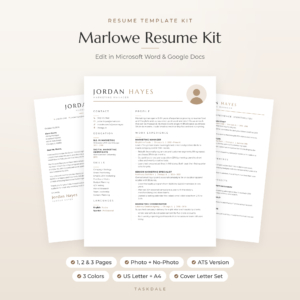
Marlowe Resume Template
Price: $4.79 | Best for: returners with projects and volunteering
Marlowe’s 2-page resume adds tools, certifications, awards, key achievements and selected projects, and the 3-page version adds volunteer work, memberships and professional development. Each comes with and without a photo, alongside an ATS resume, cover letter, references page and thank-you letter: 60 Word files in Sand, Sage and Slate, US Letter and A4. The 10-page Resume Playbook includes a profile formula and before-and-after bullets. Start with the 2-page file and fill the projects section with what you did during your break.
Show your skills are current
An employer’s quiet worry about a returner is whether their skills are up to date. Answer that on the page before they ask.
- Take one short, recent course. Even a free four-hour course in the software your field uses now gives you a 2025 or 2026 date to list.
- Name current tools. If your old job used a system that has since been replaced, list the new one you have learned.
- Join a professional body or group. Membership shows you are back in the conversation.
- Renew lapsed registrations. Nurses, teachers and accountants often need to do this anyway. Put the renewal date on your CV.
Picture a former payroll officer coming back after six years at home. Her CV lists her old job, then a 2025 online course in the payroll software most local employers use, then her volunteering as treasurer of a playgroup. The reader sees someone who is ready, not someone who is rusty.
Write a profile that faces forward
Your profile is the three or four sentences at the top. For a returner, it should point forward, not back. Mention your experience, one or two strengths and the role you want now. You can mention the break, briefly, or leave it for the experience section.
Here is an example: “Experienced office manager with eight years in logistics firms, returning to work after a planned career break raising my family. Strong in scheduling, supplier relations and keeping small teams organised. Recently completed refresher training in Excel and Microsoft 365. Seeking a part-time office manager or team administrator role.”
Notice the order. Experience, honest context, strengths, proof of current skills, goal. It reads as calm and ready. If you are unsure how long the whole CV should be with an older career behind you, our guide to how long a resume should be helps you decide between one page and two.
If writing about yourself feels awkward after years away, a list of action verbs is a real help. It gets you past the blank feeling and into specific lines.
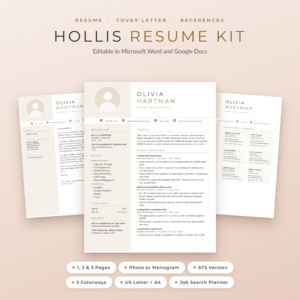
Hollis Resume Template
Price: $8.99 | Best for: returners who want writing help
Hollis includes a Resume Writing Guide in Word and PDF with 216 action verbs, along with resumes in photo and monogram versions in 1, 2 and 3 pages, ATS resumes, cover letters, a references page and a thank-you letter. There are 84 Word files in Champagne, Rosewood and Graphite and two paper sizes, a Job Search Planner for Excel and Google Sheets and a 13-page user guide. Read the verb list, pick five that describe your break, then write your volunteering bullets.
Mistakes returners often make
- Hiding the gap by dropping dates. Readers notice missing dates and assume the worst. Show dates and explain the break.
- Over-explaining. A paragraph about why you left reads as defensive. One line is enough.
- Apologising. Phrases like “despite my long absence” undercut you. State facts.
- Listing old software only. If you last used a system in 2017, check whether it is still around and add what has replaced it.
- Applying for the exact old role without checking. Roles change. Read three current ads for your old job title and adjust your skills section to match.
Your cover letter does the explaining
The CV gives the gap one line. The cover letter is where you can add two or three sentences of warmth and context, if you want to. It is the natural place to say why now, and why this employer.
Keep the structure simple. Open with the role you are applying for and one strong reason you fit it. In the middle paragraph, mention your break briefly and move straight to what you have done to prepare: a course, a volunteer role, a conversation with someone in the field. Close with your availability, especially if you are looking for school hours or part-time work.
For example, a returning teaching assistant might write: “After five years at home with my children, I am ready to return to the classroom. This year I renewed my safeguarding training and have volunteered two mornings a week with Year 1 reading groups at my local primary school.” Two sentences. No apology. A reader finishes that paragraph thinking about the reading groups, not the five years.
Use the same header and font as your CV so the two pages look like one application. It is a small detail that quietly says you are organised.
Practising the gap question for interviews
Your CV gets you the interview. The gap question usually comes up there. Prepare a short answer of three sentences: what you did, what you gained or kept up, and why you are ready now.
For example: “I took six years out to raise my two children. During that time I kept my bookkeeping skills going by doing the accounts for our local playgroup, and last spring I completed a refresher course in cloud accounting. Now both children are at school and I’m ready to commit to a role like this one.” Say it out loud a few times until it feels natural. That small rehearsal turns a moment people dread into a moment that shows you are organised.
Frequently asked questions
How do I explain a 10-year career break on my CV?
List it as a career break with dates and one line of explanation, such as full-time parent or carer. Then show recent training or volunteering, and lead with a skills section so your abilities come first.
Should I use a skills-based CV after a long gap?
A hybrid CV usually works best. It leads with skills but still lists every job with dates, so the reader never feels something is hidden.
Can I make a CV for free after a career break?
Yes. Google Docs and Word for the web both offer free templates and PDF export. Many job centres and return-to-work programmes also offer free CV help.
Do I have to say why I took a career break?
A short reason helps, but you do not need to share private details. “Health-related leave” or “family commitments” is enough.
What counts as experience during a career break?
Volunteering, short courses, freelance work, caring responsibilities and community roles all count if they show skills the job needs.
Your next step
Tonight, write down three things you did during your break that took planning, patience or organisation. Those three lines are the start of your new CV. When you want a layout with room for projects and volunteering, start with the Marlowe Resume Template.