Accountancy recruiters read CVs with a checklist in their head. Qualified or studying? Which body? Which systems? Practice or industry? How big were the books? If your CV answers those questions in the first ten seconds, you are through to the next pile. If the answers are buried in paragraph four, you are relying on a patient reader.
This guide is for accountants at every stage: AAT students, trainees studying for ACCA, CIMA or ACA, newly qualified accountants, management accountants, and finance managers heading for controller roles. It shows where to put qualifications and exam progress, how to write a software section that actually helps, how to turn month-end work into results, and which template features make all of that easy to lay out.
By the end you will have a clear structure to follow and examples you can adapt line by line.
Quick picks: templates with room for systems and qualifications
| Product | Best for | Price | Link |
|---|---|---|---|
| Marlowe Resume Kit | Page two with tools and certifications sections | $4.79 | View |
| Alder Resume Kit | Trainees and part-qualified applicants | $4.79 | View |
| Hollis Resume Kit | A clean sidebar plus a portal version | $8.99 | View |
What accountancy recruiters look for first
Finance hiring is detail-driven, so the first scan is about facts. Make these five easy to find:
- Qualification status. Qualified, part-qualified with exams passed, or studying.
- Professional body. ACCA, CIMA, ICAEW, ICAS, AAT, CPA or another, depending on your country.
- Systems. The accounting software and ERP you have used, plus your Excel level.
- Setting. Practice, industry, public sector or not-for-profit.
- Scope. How many entities, the size of the business, how many people you managed.
A good accountant CV gets at least three of those into the top third of page one. The rest of the page then proves them.
Putting qualifications where they are seen
Your qualification belongs in two places: next to your name or in your title line, and in a full qualifications section further down.
In the header
If you are qualified, add the letters after your name or in the title line: “Priya Nair, ACCA” or “Management Accountant, CIMA qualified”. It is the fastest possible signal.
If you are part-qualified
Be precise. “Part-qualified” alone leaves the reader guessing. Say how far along you are and when you expect to finish.
| Situation | How to write it |
|---|---|
| Fully qualified | ACCA, member since 2021 |
| Studying, well advanced | CIMA, 10 of 12 exams passed, Strategic level due Nov 2026 |
| Early in studies | ACA trainee, Certificate level complete |
| Technician route | AAT Level 4, completed 2024 |
| Studying but paused | ACCA, Applied Skills complete, studies resuming 2026 |
Exemptions can go in brackets if they matter: “(exempt from 4 papers through degree)”. And if your employer is funding your studies, that is worth a line in your cover letter rather than the CV.
The full section
Lower down, list each qualification with the body, the level and the year. Add your degree here too, with the subject and university. Prizes for exam performance belong here as well. They are not common, so they stand out.
A profile that sounds like an accountant wrote it
Your profile should read the way good finance people talk: clear, specific and a little understated. Three sentences is enough. Who you are, what you have done with a number attached, and what you want next.
Here are three examples at different stages, written to be adapted rather than copied.
Trainee: ACCA student with 7 of 13 exams passed and two years in a busy high-street practice. I prepare year-end accounts and VAT returns for around 40 small business clients using Xero and Sage. Looking for a trainee role in industry with study support.
Management accountant: CIMA qualified management accountant with five years in manufacturing. I produce monthly management packs for a group of four sites and rebuilt the budget model so that site managers could update their own forecasts. Looking for a senior management accountant role.
Finance manager: ACA qualified finance manager leading a team of six across accounts payable, receivable and payroll. I brought the month-end close forward by three days and led the move from Sage 200 to NetSuite. Seeking a financial controller role.
Notice what is missing: “highly motivated”, “strong attention to detail”, “team player”. Every accountant claims those. The numbers in the examples prove them instead, which is far more convincing to a finance reader.
A software section that says something
“Proficient in accounting software” tells the reader nothing. Name the systems, group them, and give a sense of depth. Something like this works well:
- Accounting: Xero (daily, 4 years), Sage 50, QuickBooks Online
- ERP: SAP S/4HANA (FI module, month-end and AP), Oracle NetSuite (basic)
- Excel: pivot tables, XLOOKUP, SUMIFS, Power Query, building month-end templates
- Reporting: Power BI dashboards, management packs for board meetings
- Other: Dext, expense systems, payroll software
Be honest about depth. If you have only seen NetSuite in a two-week handover, “basic” is right. A reader who hires you for SAP and finds you have used it twice will remember. Interviewers in finance often ask you to describe exactly what you did in a system, so expect the question.
Where does this section go? On a two-page CV, a dedicated block on page one or near the top of page two. In a two-column layout, the sidebar is perfect: it keeps the systems visible without taking space from experience.
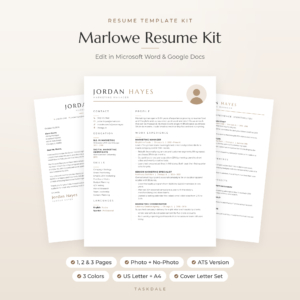
Marlowe Resume Kit
Price: $4.79 | Best for: qualified accountants with long tool lists
Marlowe’s 2 page resume adds a second page with sections for tools, certifications, awards, key achievements and selected projects, which suits a finance CV well. The kit also includes 1 and 3 page versions with and without a photo, an ATS resume, a cover letter, references and a thank-you letter, in Sand, Sage and Slate and both US Letter and A4. The 10-page Resume Playbook has before-and-after bullet examples. Start by filling the tools section with your systems grouped as shown above.
Experience bullets with numbers that accountants trust
Accountants work with numbers all day, and readers expect the CV to show some. The trick is to describe scope and improvement, not just tasks.
Here are some before and after examples:
- Before: Responsible for month-end close.
After: Ran month-end close for 3 UK entities and cut the timetable from working day 8 to working day 5. - Before: Prepared management accounts.
After: Produced monthly management accounts and variance commentary for a business with around £45m turnover, presented to the finance director. - Before: Handled supplier payments.
After: Managed a weekly payment run for 400 suppliers and cleared a backlog of 120 overdue invoices in six weeks. - Before: Helped with audit.
After: Prepared the audit file and lead schedules for the year-end audit, which closed with no adjustments. - Before: Did reconciliations.
After: Reconciled 14 bank accounts monthly and set up a tracker that caught a duplicated direct debit within a week.
Use rounded figures if exact ones are sensitive. “Around £45m turnover” or “a seven-figure budget” is fine. And never share confidential client names from practice work without permission. “A portfolio of 35 owner-managed businesses” says enough.
Section order by career stage
Trainee or AAT student
- Header with title line, such as “Trainee Accountant, ACCA student”
- Short profile
- Qualifications and exam progress
- Experience, including placements and part-time roles
- Software and skills
- Education
Newly qualified or management accountant
- Header with qualification letters
- Profile
- Experience
- Software and systems
- Qualifications and education
Finance manager or controller
- Header with qualification letters
- Profile
- Key achievements, three bullets
- Experience
- Systems
- Qualifications and education
For senior finance roles, there is more on what directors expect in our executive resume template guide.
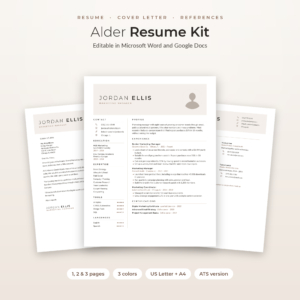
Alder Resume Kit
Price: $4.79 | Best for: trainees and part-qualified accountants
Alder’s 1 page resume suits trainees, and its 2 page version adds key projects, awards and training, which is a natural home for exam progress. You also get a 3 page resume, a no-photo version, an ATS resume, a cover letter, references page and thank-you letter, in Mocha, Sage and Slate and both paper sizes. A Job Application Tracker for Excel is included, which accountants tend to appreciate. Write your qualifications line using the table above before you fill anything else.
How long an accountant CV should be
One page for trainees, AAT students and graduates. Two pages for qualified accountants with a few roles behind them. Three pages is rarely needed outside senior or interim careers with many short contracts.
If you are an interim or contract accountant with eight assignments in six years, group them under one heading such as “Interim assignments, 2020 to present” and give each one two lines: client type, length, what you delivered. That keeps the CV to two pages and still shows the range.
Here is how the top of page one might look for a trainee once everything is in place. Name and “Trainee Accountant, ACCA student (7 of 13 exams)” in the header. A three-line profile. Then a qualifications block with ACCA progress, AAT Level 3 and a business degree. Then experience. A recruiter can see status, body and stage before reading a single bullet, and that is a quietly satisfying thing to get right.
Template features that suit finance CVs
A finance CV does not need to be flashy. It needs to be orderly, which is what readers in the profession value anyway.
- A sidebar or block for systems and qualifications, so they are always visible.
- Right-aligned dates that line up, because readers check timelines carefully.
- A conservative colour, such as navy, slate or dark green.
- An ATS version for the online portals large firms and recruiters use.
- Room on page two for certifications, systems and professional memberships.
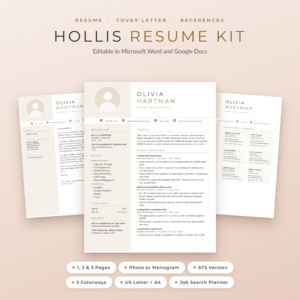
Hollis Resume Kit
Price: $8.99 | Best for: accountants applying through firms and portals
Hollis has a clean sidebar that grows with your content, so a long systems list never pushes things out of place. It comes with resumes in 1, 2 and 3 pages with a photo or monogram, an ATS resume in 1 and 2 pages, cover letters, references and a thank-you letter, in Champagne, Rosewood and Graphite and both paper sizes. The Graphite colourway suits finance well. Put your qualification letters into the monogram header first, then list your systems in the sidebar.
Getting past screening software
Big Four firms, large corporates and many recruiters use screening software. A few habits help your CV come through it intact.
- Mirror the advert’s wording. If it says “accounts payable”, use that phrase, not only “AP”.
- Spell out acronyms once. “International Financial Reporting Standards (IFRS)” the first time, then IFRS after that.
- Name systems exactly. “SAP” and “Microsoft Dynamics 365” rather than “ERP systems”.
- Keep the portal version single-column with standard headings and no text boxes.
Our ATS resume template guide covers the layout side of this in more detail.
Tweaks for practice, industry and public sector
Practice
Show the portfolio: number and type of clients, the work you did (accounts preparation, tax returns, audit), and any review or supervision of juniors. Deadlines matter here, so mention busy-season output if it is strong.
Industry
Show business impact: faster closes, better forecasts, cost savings found, systems you helped set up or move to. Readers want to see that you understand the business, not just the ledger.
Public sector and not-for-profit
Show budget management, grant and fund accounting, compliance and reporting to boards or trustees. Mention any specific frameworks you have worked under.
Mistakes that stand out to finance readers
- Typos in numbers. A wrong figure on an accountant’s CV is noticed more than a typo in a word.
- Vague study status. “Studying ACCA” with no exams listed raises more questions than it answers.
- Unexplained gaps. If you took study leave, say so in one line.
- Software lists with no context. Twelve systems in a row, no depth, no years.
- Inconsistent dates. Mixing “03/2022” and “March 2022” on the same page.
Frequently asked questions
How do I show part-qualified status on an accountant CV?
Name the body, the number of exams passed and your expected finish date, such as “CIMA, 10 of 12 exams passed, final level due Nov 2026”. Put it near the top and in your qualifications section.
Where should software go on an accountant CV?
In a dedicated systems section, grouped by type: accounting, ERP, Excel and reporting. In a two-column layout, the sidebar keeps it visible without taking space from experience.
Should I put ACCA or CIMA after my name on my CV?
Yes, if you are a qualified member. It is the quickest way for a recruiter to see your status. Students should state their progress in the title line or profile instead.
How long should an accountant CV be?
One page for trainees and graduates, two pages for most qualified accountants. Senior and interim accountants may need two full pages but rarely more.
What Excel skills should an accountant list?
Name specific functions and tools you use: pivot tables, XLOOKUP, SUMIFS, Power Query, and any templates or models you built. Specific beats “advanced Excel”.
Can I mention client names from practice work?
Only if you have permission and the work is public. Otherwise describe the portfolio, such as “35 owner-managed businesses in retail and construction”.
Your next step
Write your qualification line using the table above, then list your systems in four groups with an honest depth for each. Those two blocks are what accountancy recruiters look for first. When they are ready, drop them into the tools and certifications sections of the Marlowe Resume Kit.