Kakeibo budgeting asks you to do something most money apps work hard to remove: write every purchase down by hand. That small bit of effort is the whole point. When you have to pick up a pen and record $6.40 for a muffin you did not really want, you start to notice. And noticing, over a few months, changes how you spend.
This guide is for anyone who has bounced off spreadsheets and apps and wants a slower, calmer way to handle money. You will learn where kakeibo comes from, the four questions at its heart, the four spending categories, how a month runs from start to finish, a worked example with real numbers, how it compares with other budget methods, and how to adapt it for couples, irregular income and even children.
Quick picks: kakeibo journals and money workbooks
| Product | Best for | Price | Link |
|---|---|---|---|
| Quiet Coin Kakeibo Money Journal | A ready-made kakeibo year, print or tablet | $5.99 | View |
| The Calm Money Method | Pairing kakeibo with habit and mindset work | $11.99 | View |
| The Money Exhale Financial Anxiety Workbook | People who avoid looking at money | $17.99 | View |
| Penny Pathfinders Kids Money Workbook | Teaching children ages 7 to 12 | $10.49 | View |
What kakeibo is, and where it came from
Kakeibo (said kah-keh-boh) means household account book. The method dates back to 1904, when Hani Motoko, a Japanese journalist, published a simple ledger to help households manage money. The idea has lasted well over a century, which tells you something. It does not depend on technology. It depends on attention.
At its simplest, a kakeibo is a notebook. At the start of the month, you write down your income, your fixed costs and how much you want to save. During the month, you record every purchase in one of four categories. At the end of the month, you add it up and reflect on what happened. That is all.
No bank links. No pie charts that refresh themselves. Just you, a pen and a page that slowly fills up with the true story of your month.
The four questions at the heart of kakeibo
Every kakeibo month is built around four questions. The first two open the month. The last two close it.
- How much money do you have? Your take-home income for the month, minus fixed costs like rent, utilities, insurance and loan payments. What is left is the money you actually get to decide about.
- How much would you like to save? Pick a figure before you spend anything. Saving first, rather than saving what is left, is one of the method’s quiet strengths.
- How much are you spending? Your total spending across the four categories, added up at the end of the month.
- How can you improve? One honest reflection. Not ten resolutions. One change for next month.
That fourth question is where kakeibo feels different from most budgets. It is not a test you pass or fail. It is a conversation with yourself, once a month, about what you want your money to do.
The four spending categories
Instead of 20 categories, kakeibo uses four broad ones. Fewer choices means less time deciding where something goes, and the categories nudge you to think about why you bought it.
Survival (needs)
Groceries, fuel, bus fares, medicine, toiletries, school supplies. Things you need to get through daily life. Fixed bills like rent are usually taken out at the start, so this covers the variable needs.
Optional (wants)
Eating out, takeaway coffee, clothes you like but do not need, streaming extras, impulse buys. Nothing wrong with these. The category just makes them visible.
Culture
Books, museum tickets, concerts, classes, hobby supplies, a magazine. Spending that feeds your mind or your interests. This category often surprises people, either because it is tiny and they want more of it, or because the bookshop habit is bigger than they thought.
Extra (unexpected)
Car repairs, a broken phone screen, a last-minute gift, a doctor’s visit. The things life throws at you. Watching this one over several months shows whether “unexpected” is really as rare as it feels.
How a kakeibo month works
At the start of the month (20 minutes)
Write your income. Subtract fixed costs. Write your savings goal. Divide what remains between the four categories as a rough spending budget. Many people also set a weekly limit, since four or five smaller targets are easier to keep than one big monthly one.
Each day (2 minutes)
Write down what you bought, the amount and the category. Some people do it at the till. Many do it in the evening, with receipts from their pocket. Either works, as long as nothing waits more than a day or two.
Each week (10 minutes)
Total each category for the week. Compare with your weekly limit. Jot a line about what you noticed. “Three coffees out on stressful days” is a useful note.
At the end of the month (20 minutes)
Add up all four categories. Compare total spending with what you had available. Check whether you hit your savings goal. Then answer the fourth question in a sentence or two, and carry that one change into next month.
A worked kakeibo month
Lena is a nurse who takes home $3,900 a month. Here is her November in kakeibo form.
| Line | Amount |
|---|---|
| Take-home income | $3,900 |
| Fixed costs (rent, utilities, phone, insurance, car loan) | $2,240 |
| Available to decide about | $1,660 |
| Savings goal | $400 |
| Spending budget | $1,260 |
| Survival spent | $610 |
| Optional spent | $385 |
| Culture spent | $95 |
| Extra spent | $140 |
| Total spent | $1,230 |
| Saved (goal plus $30 left over) | $430 |
On paper, a good month. She came in $30 under and saved more than planned. But the weekly notes told a richer story. Most of the $385 in Optional went on takeout after night shifts, when she was too tired to cook. Her reflection for question four was short: “Batch cook two meals before each run of night shifts.”
In December, Optional dropped to $260. She did not feel deprived at all. She just had food waiting at home. That is kakeibo at its best: a small, specific change that came from noticing, not from forcing.
Why writing by hand makes a difference
It is tempting to think writing by hand is old-fashioned. But the slowness does real work. When a purchase goes on a card, it barely registers. When you write it down, you see it, name it and put it in a category. That moment of attention is often enough to make you pause before the next one.
Handwriting also makes patterns easier to spot. Five lines that say “lunch out” in a single week stand out on a page in a way they never do in a bank app. And there is a quiet satisfaction in turning the pages at the end of the month and seeing what you have kept track of. Plenty of people find that writing it down is calming rather than stressful, because the money finally feels like something they can see and hold.
You can keep a kakeibo in any notebook. A dedicated journal saves you drawing the same tables every month and keeps a whole year in one place.
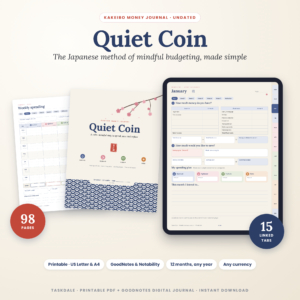
Quiet Coin Kakeibo Money Journal
Price: $5.99 | Best for: anyone starting kakeibo for a full year
An undated kakeibo journal with 98 pages in printable US Letter and A4, plus a hyperlinked digital version for GoodNotes and Notability with side tabs for every month. Each month opens with the first two questions and a plan page, then five weekly spending pages with columns for Survival, Optional, Culture and Extra, and closes with a reflection page. A yearly savings tracker, a year overview and a two-page year-end review round it off. Fill in the start-of-month plan first, then use this week’s page for every purchase.
Kakeibo compared with other budget methods
| Method | How it works | Best for |
|---|---|---|
| Kakeibo | Save first, record every purchase by hand in four categories, reflect monthly | People who want awareness and calm over detailed tracking |
| Zero-based budget | Give every dollar a job before the month starts | People who like a detailed plan |
| 50/30/20 | Split take-home pay into needs, wants and savings | People who want a quick rule of thumb |
| Envelope or cash stuffing | Fill category envelopes, spend only what is inside | People who overspend on cards |
These are not rivals. Kakeibo mixes well with others. Some people plan with a zero-based budget and use kakeibo pages as their spending log. Others use cash envelopes for groceries and write each purchase in the journal. If you have never budgeted at all, our guide on how to make a budget when you have never made one is a gentle place to begin before adding the journal.
When the hard part is feelings, not numbers
Kakeibo’s fourth question can bring things up. Why do I spend more after a hard day? Why do I feel guilty buying books? Why have I not opened the card statement? For some people, those questions are the most useful part of the whole method. For others, they are uncomfortable enough to make them stop.
If that sounds familiar, it can help to pair your kakeibo with a workbook that works on the habits and beliefs underneath the spending. Our article on money mindset workbook exercises explains the kind of prompts that help.
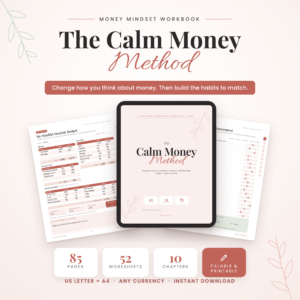
The Calm Money Method
Price: $11.99 | Best for: people who want mindset work beside the journal
An 85-page money mindset workbook and financial planner in fillable and printable PDF, US Letter and A4. The early chapters look at where your money habits came from and what sets off spending. Later chapters cover goals, a monthly budget, savings and debt trackers, then weekly money dates, monthly check-ins and a 30-day challenge. Work through chapter one alongside your first kakeibo month, using your weekly notes as material for the reflection pages.
If even opening your bank app makes your chest tight, The Money Exhale from the table above starts one step earlier, with avoidance and money worries, before any budgeting at all.
Adapting kakeibo to real life
For couples
Keep one shared journal for household spending, with initials beside each line. Do the end-of-month reflection together over dinner. Some couples also keep their own small personal kakeibo for fun money, so nobody has to explain a new paperback.
For irregular income
Base the start-of-month plan on your lowest likely income. If more arrives, add it on a separate line and decide its job at the weekly check. That keeps the savings goal realistic in slow months.
For tablet users
A digital kakeibo in a note app keeps the handwriting benefit while living on a device you already carry. Write with a stylus. The pause still happens.
For a short-term goal
Try a 30-day kakeibo before a big purchase or after a holiday overspend. One month is enough to reset habits, and a savings challenge can run alongside it. Our comparison of savings challenge printables shows a few that fit well.
Kakeibo for kids
The four categories make a natural first money lesson. A child with $10 of pocket money can sort spending into needs (school snack), wants (a toy), culture (a comic) and extra (replacing a lost water bottle). Writing it in a small notebook builds the same habit adults are trying to learn, years earlier.
Keep it light. Praise the noticing, not the saving. Ask what they enjoyed buying most, and whether they would buy it again. Those conversations stick far longer than any rule.

Penny Pathfinders Kids Money Workbook
Price: $10.49 | Best for: parents and teachers of children 7 to 12
A printable financial literacy unit for ages 7 to 12, laid out as six themed trails on a trail map. Short 10 to 20 minute activities cover money basics, earning, saving, spending, needs vs wants, sharing and planning, each ending with a Talk It Over question. Children color a badge after each trail and finish with a quiz and a certificate, and an answer key is included. Start with the first trail and the needs vs wants activities, then let your child try a simple four-column spending page.
Common kakeibo mistakes
- Skipping the savings goal. Without question two, kakeibo becomes a diary of spending rather than a plan.
- Letting entries pile up. A week of missing receipts is hard to rebuild. Write it the same day or the next.
- Overthinking categories. Is a cookbook Culture or Survival? Pick one and move on. Consistency matters more than precision.
- Writing ten resolutions. Question four wants one change. One you will actually do.
- Quitting after a bad month. The bad months teach the most. Write what happened and keep going.
Frequently asked questions
What are the four kakeibo questions?
How much money do you have? How much would you like to save? How much are you spending? How can you improve? The first two open the month and the last two close it.
What are the four kakeibo categories?
Survival for needs, Optional for wants, Culture for books, classes and hobbies, and Extra for unexpected costs.
Can I do kakeibo on a tablet?
Yes. A hyperlinked digital journal in a note-taking app works well, as long as you write entries with a stylus to keep the mindful pause.
Does kakeibo work if I pay for everything by card?
Yes. Write card purchases in the journal the same way you would cash. Many people check their banking app each evening and copy the day’s spending in.
How long does kakeibo take each day?
Two to five minutes a day, plus about ten minutes a week and twenty at the start and end of the month.
Your next step
Tonight, write the four questions at the top of a page and answer the first two. Then record every purchase for the next seven days in four columns. After one week you will already see something new. When you are ready for a full year, start the Quiet Coin Kakeibo Money Journal on the first of next month.