Being a sole trader is the simplest way to run a business on your own. You and the business are the same legal person, the profit is yours, and so is the tax bill. Get three things in place early, which are how you pay tax, how you keep records and how you invoice, and the rest of the year gets much calmer.
These sole trader basics are written for someone in their first year or two: the new mobile hairdresser, the graphic designer who just went freelance, the weekend baker whose orders turned into a real income. You will find a plain run-through of tax, a record-keeping routine that takes fifteen minutes a week, invoicing habits that get you paid, and a few templates that carry the adding up for you.
Quick picks: tools for running a tidy sole trader business
| Product | Best for | Price | Link |
|---|---|---|---|
| BalanceBloom Small Business Bookkeeping Spreadsheet | Profit and loss at a glance | $24.99 | View |
| TallyBloom Tax-Ready Bookkeeping Spreadsheet | US sole proprietors filing Schedule C | Original price was: $19.00.$13.00Current price is: $13.00. | View |
| Gleamwise Cleaning Business Management App | Solo cleaners and small crews | $77.96 | View |
| Proof & Profit Home Bakery Business Planner | Home bakers taking orders | $47.00 | View |
What being a sole trader really means
A sole trader is a person who works for themselves and has not set up a company. There is no separate business entity. If you earn £32,000 from clients and spend £6,000 on costs, you have £26,000 of profit, and that profit is taxed as your personal income.
That simplicity is the big draw. No company accounts, no directors’ duties, no separate business tax return. You can start trading tomorrow under your own name. The flip side is that you are personally responsible for any business debts, which is one reason some people move to a limited company later as they grow.
In the US the same set-up is called a sole proprietorship. The idea is identical: one owner, no separate entity, profit reported on your own tax return. The details of registering and paying differ by country, so the next section takes the UK first and the US after.
Tax basics for sole traders
In the UK
Once you earn more than £1,000 from self-employment in a tax year, you need to register with HMRC for Self Assessment. The tax year runs from 6 April to 5 April. The deadline to register is 5 October after the end of the tax year in which you started, so someone who started in June 2026 has until 5 October 2027.
You then file a return each year and pay Income Tax and National Insurance on your profit. The online return and any tax owed are due by 31 January after the tax year ends. Once your bill passes a certain level, HMRC also asks for payments on account, which are two advance payments towards next year’s bill, made in January and July. That second payment surprises a lot of people in their second year. Plan for it.
Making Tax Digital for Income Tax is also arriving in stages. From April 2026 it applies to sole traders with qualifying income above £50,000, with lower thresholds planned for later years. Those in it keep digital records and send quarterly updates through compatible software. A spreadsheet can still be part of that, usually with bridging software that sends the figures to HMRC.
In the US
A sole proprietor reports business profit on Schedule C with their personal return, and usually pays self-employment tax on top of income tax. Because no employer is holding tax back, most sole proprietors pay estimated tax four times a year. Our guide to quarterly estimated taxes explains the dates and the maths.
Wherever you are: set money aside
The single habit that saves the most stress is moving a slice of every payment into a separate savings account the day it lands. Many sole traders pick a fixed share, often somewhere between a quarter and a third, and adjust it once they see their first real bill. When a client pays £800, £200 or more goes straight to the tax pot. When January comes, the money is already there. The feeling of paying a tax bill without panic is hard to overstate.
Records: what to keep and for how long
Good records do two jobs. They let you fill in your tax return accurately, and they let you prove your figures if anyone asks. For a sole trader, that means keeping:
- All sales and income, including cash jobs and payments through apps.
- All business expenses, with the receipt or invoice for each one.
- Bank statements for any account you use for the business.
- Copies of every invoice you send.
- Mileage or vehicle costs, if you drive for work.
- Money you take out for yourself, so you can tell drawings from expenses.
In the UK, keep records for at least five years after the 31 January deadline for the tax year they cover. Other tax authorities set their own periods, so check yours once and note it somewhere you will see it.
A separate bank account for the business is not a legal must for a sole trader, but it makes record-keeping far easier. When your personal shopping and your business fuel sit in the same account, sorting them in January is a miserable afternoon. With two accounts, the business statement is already half your bookkeeping.
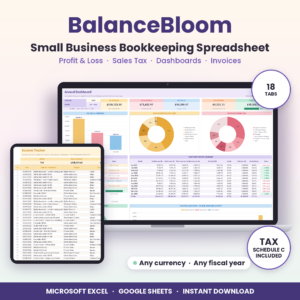
BalanceBloom Small Business Bookkeeping Spreadsheet
Price: $24.99 | Best for: sole traders who want a clear profit figure
A bookkeeping workbook for Excel and Google Sheets with 2,000 rows each for income and expenses, dropdown categories you can rename, and paid or unpaid status for invoices and bills. Six dashboards update on their own, alongside a printable profit and loss statement and a tax centre. It flags rows missing a date, amount or category and counts missing receipts. Rename the categories to match your trade on day one.
A 15-minute weekly records routine
Bookkeeping goes wrong when it is saved up for a big session. Little and often wins. Pick one slot, say Friday at 4pm or Sunday after dinner, and run through the same short list:
- Log income. Every payment that came in this week, with the date, client and invoice number.
- Log expenses. Snap a photo of each receipt, then type the date, amount and category.
- Check unpaid invoices. Who is late? Send a short reminder now, not next month.
- Move the tax slice. Transfer your set percentage of this week’s income to the tax savings account.
- Glance at the total. Profit so far this year. One number. It keeps you honest about how the business is going.
Fifteen minutes, every week. That is roughly thirteen hours a year, which is far less than the two or three frantic weekends most people lose to a shoebox of receipts. If you want more detail on which costs count, our article on business expenses you can track and claim goes through the common ones.
Invoicing basics that get you paid
An invoice is a request for money, and the clearer it is, the faster it gets paid. Every invoice you send as a sole trader should show a unique invoice number, your name and address, the client’s name and address, what you did and when, the amount for each line and the total due. Add VAT details only if you are VAT registered.
Then add the two things that change how fast you get paid: clear payment terms and your bank details. “Payment due within 14 days by bank transfer, reference INV-2026-018” leaves nothing for the client to work out.
Here is how that looks in practice. A freelance designer finishes a logo project for a local café on 9 March. That afternoon she sends invoice 2026-018: logo design, three rounds of changes, £450, plus final files in three formats, £60, total £510, due 23 March. On 22 March the money arrives with “2026-018” as the reference. She ticks it off in her log in under a minute and moves £130 to her tax pot. No hunting through emails, no guessing which job the payment was for. That small, neat loop is the whole point of a good invoicing habit.
Three habits matter more than any template:
- Invoice on the day. The job ends, the invoice goes. A delay of a week in sending is a delay of a week in being paid.
- Number them in order. 2026-001, 2026-002 and so on. Never reuse or skip a number.
- Chase on day one. A friendly “just checking this reached you” the morning after the due date clears most late payments.
Trade-specific tools: when a general spreadsheet is not enough
A general bookkeeping sheet suits most sole traders. Some trades, though, have so many moving parts that a tool built for that trade saves hours a week. Cleaners juggle recurring visits, key codes and room checklists. Home bakers juggle orders, deposits, recipe costs and allergen labels. Typing all that into a plain sheet gets old quickly.
A solo cleaner with 22 regular clients, for example, books the same houses every week or fortnight. Rebooking them by hand, writing invoices one by one, and then working out monthly profit is three separate jobs. A dedicated app joins them up.
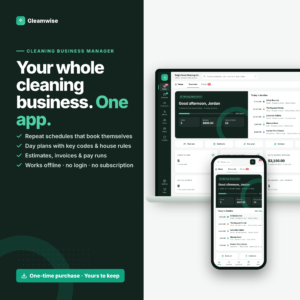
Gleamwise Cleaning Business Management App
Price: $77.96 | Best for: solo cleaners and small cleaning crews
An offline app delivered as a single HTML file that opens in your browser, with no subscription or login. It books recurring visits up to 104 weeks ahead, prices jobs with a square-foot quote calculator, keeps entry details private on your own device, and tracks invoices, revenue, expenses and profit. Room-by-room checklists and before and after photos back up every clean. Start by adding your regular clients and their visit pattern.
Home bakers get the same kind of help from the Proof & Profit Home Bakery Business Planner, an offline app with an order board, recipe cost calculator, stock tracking and invoices that print with QR payment links.
For US sole proprietors: records that match Schedule C
If you file in the US, your expenses end up on specific Schedule C lines: advertising, car and truck expenses, supplies, office expense and so on. Sorting a year of costs onto those lines in March is slow. Sorting each one as you log it takes no extra time at all.
The same goes for mileage. A dog walker covering 40 business miles a week clocks up around 2,000 miles a year, and every one of those miles needs a dated log entry to count. A spreadsheet that records trips and applies the right rate turns that into a real deduction rather than a guess.
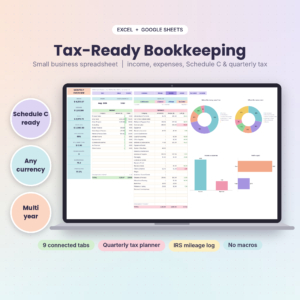
TallyBloom Tax-Ready Bookkeeping Spreadsheet
Price: Original price was: $19.00.$13.00Current price is: $13.00. | Best for: US sole proprietors filing Schedule C
An income and expense tracker for Excel 2010 or newer and Google Sheets that sorts expenses into 26 categories already mapped to Schedule C lines. It includes a quarterly estimated tax planner, a mileage log that picks the right IRS rate by date, and pending status so unpaid invoices are not counted as income. The tax centre and mileage rates are US-specific, while the tracking sheets work in any currency. Begin on Setup with your tax year.
Mistakes new sole traders make in year one
- Spending the tax money. The cash in your account is not all yours. Move the tax slice first.
- Missing the registration deadline. In the UK, 5 October after your first tax year comes round quickly.
- Forgetting payments on account. Year two can bring a bill that covers last year plus half of next year’s estimate.
- Throwing away small receipts. A £6 parking ticket here and a £12 phone top-up there add up over twelve months.
- Mixing business and personal money. It makes every record harder to read.
- Not chasing unpaid work. Being polite and being firm are not opposites.
Frequently asked questions
Do I need to register as a sole trader before I start working?
In the UK you can start trading straight away, but once self-employed income passes £1,000 in a tax year you must register for Self Assessment by 5 October after that tax year ends. Registering early does no harm.
What records does a sole trader have to keep?
Income, expenses with receipts, bank statements, copies of invoices and any mileage or vehicle costs. Keep them in a form you can find again, whether that is a spreadsheet with a folder of receipt photos or bookkeeping software.
Can a sole trader use a spreadsheet for bookkeeping?
Yes, and many do. A spreadsheet works well for most small businesses. Under Making Tax Digital in the UK, people in scope pair their spreadsheet with bridging software to send updates to HMRC.
How much should a sole trader save for tax?
It depends on your profit and your country’s rates. Many sole traders start by saving a quarter to a third of each payment, then adjust once their first real bill shows what they actually owe.
Does a sole trader need a separate bank account?
It is not required, but it makes records much simpler. One account for the business means your bank statement doubles as a clean list of business income and costs.
Your next step
Block out fifteen minutes this Friday, open a bookkeeping sheet, and log every payment and receipt from the past month. Then set up a tax savings account and move your first slice across. If you want a workbook that builds the profit and loss for you as you go, start with BalanceBloom.