A mid year diary for July to June planning makes sense the moment your year does not start in January. Teachers and students live by the school year. Australian households and small businesses work to a financial year that ends on 30 June. Plenty of people simply find that July, not January, is when they want a fresh page. For all of them, a January diary splits the year in the wrong place.
This guide covers who a July to June diary suits, how to set one up in your first week, how to plan it in four quarters, and what to do if you are already a few months in. You will also find three Taskdale planners that run on a mid-year calendar, on a tablet or on paper.
It is a small change of calendar. It can make the whole year feel like it finally fits.
Quick picks
| Product | Best for | Price | Link |
|---|---|---|---|
| Quiet Year Planner 2026-2027 | A calm July to June diary on a tablet | $5.00 | View |
| Unscatter ADHD Digital Planner 2026-2027 | 18 months, July 2026 to December 2027 | Original price was: $8.99.$6.99Current price is: $6.99. | View |
| Well-Kept Life Planner Printable Bundle | Undated paper pages you can start any month | Original price was: $12.99.$6.99Current price is: $6.99. | View |
| MonthMosaic Monthly Calendar Planner | A monthly calendar in Excel or Google Sheets | $8.40 | View |
Who a July to June diary suits
A mid-year diary is not a gimmick. It matches the real rhythm of some very ordinary lives.
Students and teachers
In much of the world the school or university year starts in late summer. A teacher with a January diary has to buy a second one halfway through the school year, or juggle two books in December. With a July to June diary, the whole school year sits in one place, from the first INSET day to the last report.
July financial years
In Australia the financial year runs from 1 July to 30 June, and many organisations elsewhere close their books in June too. If your tax paperwork, budgets and business targets all reset in July, your diary should as well. Your year-end tasks then sit on the last pages, not scattered across two diaries.
People who want a mid-year reset
Some people find January the worst possible time for fresh starts. Dark mornings, post-holiday bills, everyone else’s resolutions. July is lighter, often quieter at work, and comes with half a year of lessons. A mid-year diary gives that reset a home.
Set it up in your first week
Do not try to fill the whole diary on day one. Spend about an hour in the first week on four things, and leave the rest blank until you need it.
- Key dates for the year. Term dates, school holidays, birthdays, tax deadlines, renewals, any trip already booked. These go on the year-at-a-glance page.
- Three to five goals. One line each. “Finish my diploma by May.” “Save for a holiday in April.” “Run a 10K before June.”
- The first month. Fill in July’s monthly calendar with fixed appointments.
- The first week. Plan the first week in detail, and only the first week.
That is enough to start. Over-planning in week one is the fastest way to abandon a diary by week six.
If you plan on an iPad, a dated mid-year planner with links between pages saves hours of drawing calendars.
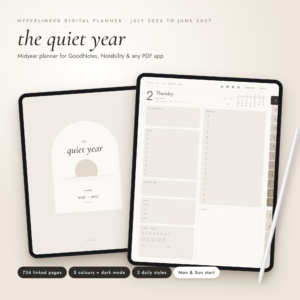
Quiet Year Planner 2026-2027
Price: $5.00 | Best for: tablet planners on a July year
The Quiet Year Planner is a 734-page hyperlinked digital planner that runs from July 2026 to the end of June 2027, for GoodNotes and Notability on an iPad, Android or Windows tablet. It has a home dashboard, a midyear reset page, year goals by life area, four quarterly plan and review pages, monthly, weekly and daily pages, and month tabs on every page. Open the midyear reset page first and add your key dates.
New to tablet planning? This guide on how to use a digital planner in GoodNotes walks through importing the file and your first page.
Plan the year in four quarters
Twelve months is a long time to keep a goal in your head. Splitting the July to June year into four quarters of about thirteen weeks each makes it manageable. Each quarter gets its own short plan and its own review.
| Quarter | Months | Typical focus |
|---|---|---|
| Q1 | July to September | Settling in, new routines, start of term |
| Q2 | October to December | Busy stretch, holidays, year-end gifts and travel |
| Q3 | January to March | Steady work, catching up, any January resolutions you want |
| Q4 | April to June | Exams, deadlines, year-end paperwork, planning next year |
For each quarter, write three goals and two or three milestones you can tick. Say you want to save towards a holiday in April. Q1 milestone: open a separate savings pot. Q2: reach a third of the target before the festive spending starts. Q3: book the trip. Q4: enjoy it, and note what you would do differently.
At the end of each quarter, give yourself twenty minutes. What worked? What did not? Which goal needs to change? This is where a mid-year diary quietly beats a calendar app, because the review page is right there in the book.
Your monthly and weekly rhythm
Once the year and quarter pages are set, the diary runs on two small habits.
Monthly: the last weekend of the month
Fill next month’s calendar with fixed dates. Check the quarter goals and pick one or two tasks for the month. Note any bills or renewals due. Ten to fifteen minutes is plenty.
Weekly: Sunday evening
Look at the month, then plan the week. Appointments first, then a short task list, then one thing you are looking forward to. That last line sounds small. On a hard week, it is the line you read twice.
A student might see the rhythm like this. On the last Sunday of September, she copies October’s assessment dates from her course handbook. Each Sunday night she plans study sessions around shifts at her part-time job. By December she has not missed a deadline, and she can see it on the page. That is a proud feeling.
If you are a student who prefers spreadsheets for assignments, this guide to a student planner spreadsheet covers deadlines and grade tracking alongside your diary.
A worked example: a teacher’s July to June diary
Take Sam, who teaches Year 5 and runs the school garden club. In the first week of July, before the summer break, he opens his new diary and spends an hour on it.
On the year page he writes term start and end dates, three parents’ evenings, the Christmas play, two INSET days, report deadlines in December and June, and his own family birthdays. That is about 25 dates, and it takes fifteen minutes with the school calendar open beside him.
His goals are short. Get reports done a week early both times. Grow enough in the garden for a harvest lunch in June. Leave school by 5pm three days a week. Each goal goes into a quarter: report drafts in Q2 and Q4, seed orders in Q3, the 5pm rule from week one.
Then he plans only the first week of September in detail, and closes the diary for the holidays. When he opens it again in late August, the year is already sketched out. No scrambling for dates on the first morning back. Just a calm list for Monday, and a quiet sense of being ahead.
Starting part-way through the year
Perhaps it is November and you have only just decided that July to June suits you. That is fine. You have a few choices, and none of them waste much.
- Use the current dated diary from today. A July 2026 to June 2027 diary started in November still has eight months of pages ahead. Skip the past months or use them for notes.
- Choose an 18-month diary. Some run from July to the December of the following year, which gives you more runway if you start late.
- Go undated. Undated pages start whenever you do. You write the month names yourself, so July to June is just a choice.
Whatever you pick, do a mini setup: key dates for the rest of the year, two goals, and this week’s plan. Then start. The empty pages behind you are not a failure. They are just paper.
An 18-month dated planner is a good middle ground for late starters.
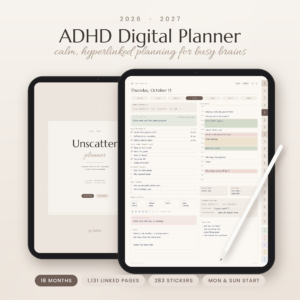
Unscatter ADHD Digital Planner 2026-2027
Price: Original price was: $8.99.$6.99Current price is: $6.99. | Best for: busy minds who start late
Unscatter is an 18-month hyperlinked planner for GoodNotes and iPad covering July 2026 to December 2027, so a start in November still leaves more than a year of pages. Each daily page opens with one must-happen task, three must-do slots with time estimates, quick wins, time blocks from 6am to 10pm and an evening check-out. Begin with this week’s daily pages and keep the must-do list to three.
Paper or digital for a mid-year diary?
A paper diary is lovely to hold and easy to scribble in during a meeting or lesson. Teachers often prefer it, because a tablet on the desk can feel like a distraction in front of thirty pupils. The downside is weight, and no way to search.
A digital diary is light, searchable and never runs out of pages. You can move a task from one week to the next without crossing out. The downside is that it relies on your tablet being charged and nearby.
A printable, undated set sits between the two. You print a month at a time, slot it into a binder, and start in any month you like. It also means you are never stuck with a dated diary that has the wrong year printed on it.
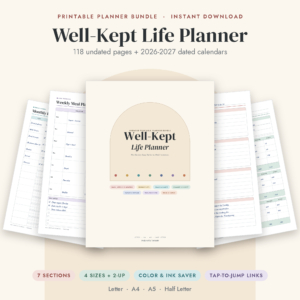
Well-Kept Life Planner Printable Bundle
Price: Original price was: $12.99.$6.99Current price is: $6.99. | Best for: paper planners who start any month
The Well-Kept Life Planner bundle has 118 undated printable pages covering monthly calendars, four weekly layouts, budgets, habit trackers, meal plans and household pages, plus 32 dated calendar pages from October 2026 to December 2027 in Monday and Sunday start. It comes in Letter, A4, A5 and Half Letter. Print a year at a glance and the current month first, then add weekly pages a month at a time.
If you would rather keep the calendar on a laptop, a monthly spreadsheet such as MonthMosaic sets itself up for a chosen year, so a July to June plan means working across two years of tabs. It suits anyone who wants a colourful monthly view with progress bars alongside a paper or tablet diary.
Mistakes to avoid
Running two diaries at once
Keeping a January diary for home and a July diary for school sounds tidy. In practice, appointments end up in the wrong book. Pick one diary for everything and use colours or tabs to tell areas apart.
Filling in the whole year on day one
Planning March in July is guesswork. Add key dates for the year, then plan only a month ahead in detail.
Skipping the quarterly reviews
The quarterly pages are the reason a mid-year diary works. Without them, goals drift. Put the four review dates in the diary as appointments: late September, late December, late March and late June.
Forgetting the year-end handover
In June, copy anything still open into next year’s diary, along with birthdays and renewals. Twenty minutes in June saves a lot of hunting in August.
Frequently asked questions
What is a mid year diary?
It is a diary or planner that starts in July and runs to the following June, instead of January to December. It suits school years, July financial years and anyone who wants a mid-year fresh start.
Is an academic diary the same as a mid year diary?
Often, yes. Many academic diaries start in July or August and run through to the following summer. Check the first and last month before buying, as some start in September.
Can I start a July to June diary in the middle of the year?
Yes. Start on today’s page and use any earlier pages for notes. An 18-month or undated diary gives you more room if you are starting late.
Is a digital mid year planner better than a paper one?
Neither suits everyone. Digital planners are light, searchable and hyperlinked. Paper diaries are quicker for scribbling and easier to use in a classroom or meeting. Choose the one you will actually open each day.
How do I plan goals across a July to June year?
Split the year into four quarters, give each one three goals and a few milestones, and review at the end of each quarter. It keeps a long year in manageable pieces.
When should I buy next year’s July to June diary?
Around May is a good time. It gives you June to copy over birthdays, renewals and open tasks before the new year begins on 1 July.
For more on planning this way, see this guide to a midyear planner for 2026-2027.
Your next step
This week, write your key dates for the rest of the year on one page, then pick three goals and split them across the remaining quarters. Plan just the next seven days in detail. If you plan on a tablet, set it all up in the Quiet Year Planner 2026-2027, starting with its midyear reset page.