It is 6 pm. Someone opens the fridge, stares into it, and asks the question. “What’s for dinner?” Nobody knows. The chicken is still frozen. Somebody suggests pasta again. Somebody else suggests ordering in. Twenty minutes later you are still standing there.
A weekly meal plan ends that scene for good, because the answer is already written down before anyone asks. This guide shows you how to set one up so it sticks: theme nights that make choosing quick, a bank of 20 dinners your household actually likes, four complete weeks you can copy straight onto your fridge, and a simple routine for the nights when the plan falls over anyway.
It works for families, couples, house shares and people cooking for one. The only thing you need is about 20 minutes on the weekend.
Quick picks: planners that answer the dinner question
| Product | Best for | Price | Link |
|---|---|---|---|
| Spoonful Digital Meal Planner | Tablet planners who want 60 dinner ideas ready | $4.99 | View |
| TableTally Weekly Meal Planner for Google Sheets | 160 meal ideas and a grocery list that fills itself | Original price was: $3.99.$2.49Current price is: $2.49. | View |
| Plateful Weekly Meal Planner & Grocery List | Planning up to five weeks at once | $9.99 | View |
| Hearth & Ladle Digital Recipe Book & Meal Planner | Gathering every family recipe in one tablet book | $9.99 | View |
Why 6 pm is the worst time to decide
At 6 pm, three things collide. You are tired. Everyone is hungry. And whatever you decide has to be possible with what is in the house right now. That is a hard puzzle to solve with a low battery. So people pick whatever is quickest to agree on, which is usually the same three meals or a delivery app.
On a Saturday morning, the same decision is easy. You are rested, nobody is hungry yet, and if a recipe needs a lime you can simply add it to the list. Moving the decision from Tuesday at 6 pm to Saturday at 10 am is the entire trick. Everything else in this guide just makes that one move easier to keep doing.
There is a small emotional win in it too. When someone asks “what’s for dinner?” and you can point at the fridge and say “it’s Tuesday, tacos,” the whole evening feels lighter.
Give each night a theme
A blank week with seven empty boxes is intimidating. A week with seven themes is not. Themes narrow the choice from “anything in the world” to “which pasta?”
Here is a set that suits a lot of households:
- Monday: one-tray night. Sheet-pan dinners. Minimal washing up after a long first day.
- Tuesday: taco or wrap night. Everyone builds their own.
- Wednesday: pasta or noodle night. Quick and loved by almost everyone.
- Thursday: soup, stew or curry night. Often made in a big pot with leftovers for Friday lunch.
- Friday: homemade fakeaway. Burgers, pizza, fried rice.
- Saturday: something new or a slower recipe. When there is time to try things.
- Sunday: roast or family favorite. Plus leftovers for Monday’s lunchboxes.
Change the themes to suit your house. If your family hates soup, Thursday can be stir-fry night. The point is that the question “what’s for dinner?” becomes “it’s pasta night, which pasta?” That is a far smaller question.
Build a dinner bank of 20 meals
A dinner bank is a written list of meals your household eats without complaining. Not aspirational meals. Real ones. Twenty is a good number because it covers about four weeks of weeknight dinners with only gentle repetition.
How to build it in one evening:
- Scroll back through your phone photos, receipts or memory for the last month. What did people actually eat and enjoy?
- Ask everyone in the house for two favorites. Children included. You will get “pizza” and “pancakes,” and that is fine.
- Sort the meals under your themes. Four or five for pasta night, three or four for taco night, and so on.
- Mark which ones take under 30 minutes. Those go on the busiest nights.
Getting children to help choose has another benefit: they are much less likely to complain about a dinner they put on the list. Our guide to a meal planner for kids has more ideas for letting them help plan.
If you are starting with an empty mind, a planner with ready-made meal ideas gets you past the blank page much faster.
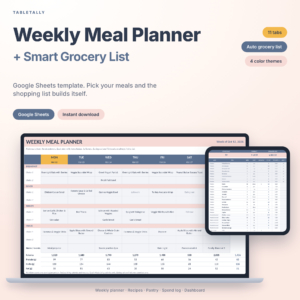
TableTally Google Sheets Meal Planner
Price: Original price was: $3.99.$2.49Current price is: $2.49. | Best for: households starting with an empty idea list
TableTally is a weekly meal planner for Google Sheets (an .xlsx file) with eleven tabs: a seven-day planner, recipe book, pantry tracker, spend log and dashboard. It comes with 160 meal ideas already in the file, 40 each for breakfast, lunch, dinner and snacks, and every slot has two choices so sides and backups have a home. Pick meals from dropdowns and the grocery list fills itself, sorted by aisle. Go through the 40 dinner ideas first and keep the ones your household would eat.
Four weekly meal plans to copy
Here are four full weeks built on the themes above. Use them as they are, or swap in meals from your own dinner bank. Each week has at least one leftovers night so you are never cooking from scratch seven nights in a row.
Week 1
| Mon | Tue | Wed | Thu | Fri | Sat | Sun |
|---|---|---|---|---|---|---|
| Sheet-pan sausages, peppers, potatoes | Beef tacos, slaw | Spaghetti bolognese | Chicken and vegetable soup, bread | Homemade burgers, wedges | Thai green curry | Roast chicken, vegetables |
Week 2
| Mon | Tue | Wed | Thu | Fri | Sat | Sun |
|---|---|---|---|---|---|---|
| Leftover roast chicken wraps | Bean and cheese quesadillas | Pesto pasta with peas | Beef stew, mash | Pizza on wraps | Fish pie | Slow-cooked pork, rice |
Week 3
| Mon | Tue | Wed | Thu | Fri | Sat | Sun |
|---|---|---|---|---|---|---|
| Sheet-pan salmon, green beans, potatoes | Chicken fajitas | Tuna pasta bake | Lentil and sweet potato curry | Egg fried rice with prawns | Homemade lasagne | Roast beef, Yorkshire puddings |
Week 4
| Mon | Tue | Wed | Thu | Fri | Sat | Sun |
|---|---|---|---|---|---|---|
| Leftover lasagne, salad | Turkey burrito bowls | Creamy mushroom pasta | Minestrone, cheese toasties | Chicken nuggets, homemade chips | Paella | Family favorite chosen by a child |
After week 4, loop back to week 1 and change two meals. Over a few months, your rotation gets better and better because the dinners nobody liked quietly drop off the list.
Want to plan the whole four weeks in one go and shop for them in batches? A spreadsheet that holds several weeks at once makes that easy.
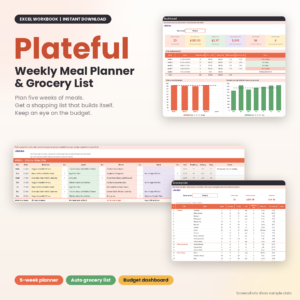
Plateful Weekly Meal Planner
Price: $9.99 | Best for: planners who set up a month at once
Plateful is an Excel workbook with 11 connected sheets that plans up to five weeks, seven days and four meal slots a day, with slot names you can rename. Pick recipes from dropdowns and it builds a grocery list for one week or all five, subtracts your pantry stock and rounds up to the packs you buy, with an estimated cost against your budget. It has room for 100 recipes and arrives empty. Enter your 20-meal dinner bank first, then lay out the four weeks above.
For a side-by-side look at other sheets that write the list, see six weekly meal planner spreadsheet picks.
The 20-minute weekend routine
The plan only works if you make it every week. Keep the routine short enough that you will not skip it.
- Check the week’s calendar (3 minutes). Football practice on Tuesday? Late shift Thursday? Mark the busy nights.
- Fill in dinners by theme (7 minutes). Put the fastest meals on the busy nights and something slower on the weekend.
- Check the fridge, freezer and cupboards (5 minutes). Anything that needs using up? Plan it in early in the week.
- Write or print the shopping list (5 minutes). Group it by aisle so the shop is quick.
Then put the plan where everyone can see it. The fridge door is the classic spot. A shared tablet planner works too, as long as the household knows to look there before asking.
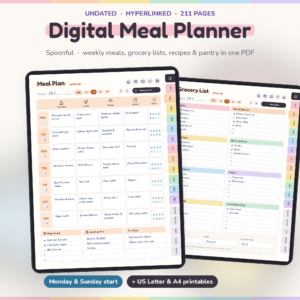
Spoonful Digital Meal Planner
Price: $4.99 | Best for: families who plan on a shared tablet
Spoonful is an undated, hyperlinked PDF meal planner with 211 pages for GoodNotes, Notability, Xodo and similar apps. Every week has a meal plan page with breakfast, lunch, dinner, snacks, a prep-ahead checklist and a use-it-up list, linked to its own eight-section grocery list. It adds a recipe book, a favorites list, 60 dinner ideas and kitchen inventories, with Monday and Sunday start editions and printable US Letter and A4 pages. Write your themes at the top of the first week and fill in dinners from the 60 ideas.
Do breakfasts and lunches need planning too?
The 6 pm question gets all the attention, but the 7:45 am scramble for lunchboxes is its quieter cousin. You do not need to plan breakfasts and lunches in the same detail as dinners. A lighter touch is enough.
For breakfast, agree on three or four options that live permanently on the shopping list: cereal, toast, yogurt and fruit, eggs at the weekend. Nobody needs a daily menu. They just need to know those things are always in.
For lunch, link it to dinner. Cook a slightly bigger dinner on two nights a week and the extra goes straight into boxes for the next day. Thursday’s soup becomes Friday’s flask. Sunday’s roast chicken becomes Monday’s wraps. Add one lunch theme for the remaining days, such as sandwiches with a piece of fruit and a yogurt, and the morning scramble mostly disappears.
Write those two leftover lunches on the weekly plan beside the matching dinners, with a little arrow. It reminds whoever is cooking to make enough, and it saves a separate shop for lunch ingredients.
When the plan falls apart on a Wednesday
It will. A child is ill, the shop forgot the mince, or you simply cannot face cooking. A good plan has a backup built in, so even a broken night does not bring the question back.
Swap, don’t scrap
If Wednesday’s pasta bake feels like too much, swap it with Friday’s quicker meal. The ingredients are already in the house. Nothing is wasted, and Friday still has a dinner.
Keep three emergency dinners
Write three ten-minute meals on the back of the plan, made entirely from cupboard and freezer food. Beans on toast with cheese and a salad. Frozen fish fillets with microwave rice and peas. An omelet with whatever vegetables are left. Keep those ingredients stocked at all times.
Plan the takeaway
If you nearly always order in on one night, put it on the plan. A planned takeaway is not a failure. It is honest, and it stops the other nights sliding too.
Keeping a simple record of what is in the cupboards makes the emergency dinners reliable. Our guide to setting up a pantry inventory list shows how to do it in an afternoon.
Keep the recipes where the plan can find them
The last piece is the recipes themselves. If Thursday says “Grandma’s beef stew” but the recipe lives in a text message from 2019, Thursday gets messy. Gather your dinner bank recipes in one place and the plan becomes easy to follow, even for the person in the house who does not usually cook.
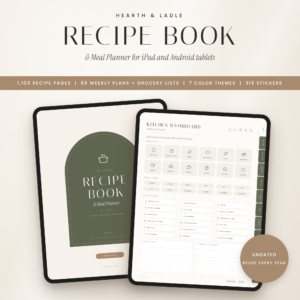
Hearth and Ladle Recipe Book
Price: $9.99 | Best for: families gathering scattered recipes
Hearth & Ladle is a digital recipe book and meal planner for iPad and Android tablets, with 1,100 hyperlinked recipe pages in 12 sections ready for your own recipes, an index that links to each page, and 60 weekly meal plans that each link to a grocery list. It works in GoodNotes, Notability, Noteshelf, Xodo and other PDF apps, and includes printable kitchen pages in US Letter and A4. Copy your 20 dinner bank recipes into it first so every planned dinner is one tap away.
Small habits that keep the question away
- Take something out of the freezer the night before. Put a reminder on the plan: “Wed: defrost chicken.”
- Write tomorrow’s dinner on a sticky note at breakfast. It sounds silly. It works.
- Let one person “own” a night. A teenager in charge of Friday pizza night learns to cook and gives you a break.
- Review on Sunday. Which dinner was a hit? Which got left on plates? Update the bank.
Frequently asked questions
How do I stop deciding what to eat every night?
Make the decision once a week instead. Pick dinners on the weekend, write them on a plan, and put the plan where everyone can see it.
What are good theme nights for dinner?
Popular ones are one-tray Monday, taco Tuesday, pasta Wednesday, soup or curry Thursday, fakeaway Friday and a roast or family favorite on Sunday.
How many meals should be in a dinner rotation?
Around 20 is a good start. That gives about four weeks of weeknight dinners before anything repeats too often.
What if my family doesn’t like the meal plan?
Let each person add two favorites to the dinner bank and choose one night a week. People complain much less about meals they picked.
Is a printed or digital weekly meal plan better?
Printed plans on the fridge are easiest for the whole house to see. Digital and spreadsheet plans are better for automatic grocery lists and planning several weeks ahead.
What day of the week is best for meal planning?
Whichever day comes just before your main shop. For many households that is Saturday or Sunday morning, when nobody is rushed or hungry.
Your next step
This weekend, choose a theme for each night and ask everyone in the house for two favorite dinners. That gives you the start of your dinner bank. Then fill in next week using the themes and put the plan on the fridge before Monday. If you want 160 meal ideas and a grocery list that fills itself, set up the TableTally weekly meal planner.