A grocery list on the back of a receipt works fine until it doesn’t. Then you’re standing in the cereal aisle trying to read your own handwriting, and the one thing you came for (onions, always onions) isn’t on it.
A printable grocery list template fixes the boring problems: no room, no order, no idea what it’ll cost. But the layout matters more than people think. A list that suits a quick top-up shop is useless for a big monthly stock-up, and a family of five needs something different from a student in a shared flat.
Below are the five layouts worth knowing, what each one is good for, and a simple routine that makes any of them stick.
Five printable grocery list template layouts, and who they suit
1. The simple list
Lines and checkboxes. Nothing else. It’s the right choice for quick midweek shops and for people who hate filling in boxes. Two columns gives you wide lines for “chicken thighs, bone-in, 2 packs”. Three columns squeezes in more short items like “milk”, “eggs”, “foil”.
Good for: top-up shops, small households.
2. The category list
The page is split into sections: produce, meat, dairy, bakery, frozen, pantry and so on. You write each item in its section as you think of it, and when you shop, you walk the store once. No doubling back to produce for the lemon you missed.
Good for: weekly family shops, anyone who shops at the same store most weeks.
3. The list with prices
Columns for quantity and price, plus boxes for an estimated total, your budget and what’s left. You fill in rough prices before you go, so you know if the trip will blow the budget while you can still do something about it.
Good for: tight budgets, end-of-month shops.
4. The staples checklist
This one’s different. Instead of writing, you tick. Fifty-odd everyday items are already printed: rice, flour, olive oil, toilet paper, dish soap. You walk the kitchen with a pen, tick what’s running low, and half your list is done in three minutes.
Good for: people who keep forgetting the things they “always have”.
5. The meal plan and list on one page
The week’s meals on one side, the list on the other. You plan Tuesday’s tacos and write tortillas, salsa and cheese right beside it. The list can’t drift away from the plan because they’re on the same sheet.
Good for: meal planners, families who shop once a week.
Why most people need more than one layout
Here’s the thing nobody tells you. One template rarely covers a whole month of shopping. The big Saturday shop wants a category list. The Wednesday milk run wants a simple list. And the staples checklist is what stops both from missing the dishwasher tablets.
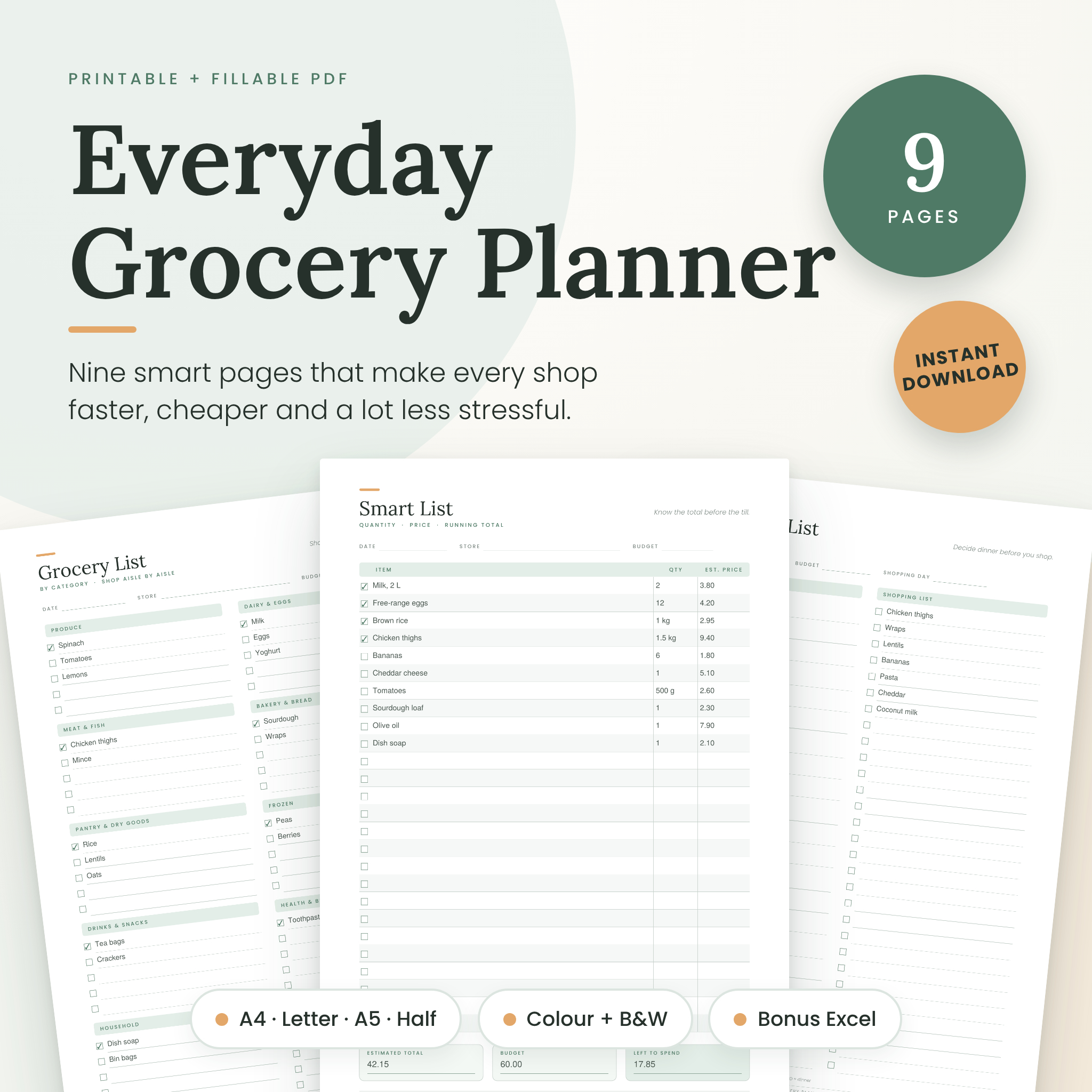
That’s why a bundle is often a better buy than a single page. The Everyday Grocery Planner includes all five of the layouts above in one download: simple lists in two and three columns, a Smart List with quantity and price columns and budget boxes, a Category List with ten sections, and a Meal Plan + Shopping List page. It adds a Kitchen Staples Checklist with 53 basics, a Household Staples Checklist with 40 cleaning, bathroom, family and pet items, a Price Comparison Sheet and a Monthly Budget Tracker.
Every page comes in A4, US Letter, A5 and Half Letter, in a soft green colour version and an ink-saver black and white version. There are fillable PDFs if you’d rather type, and a bonus Excel budget tracker with a dashboard and room for 300 entries.
A five-minute routine that makes any list work
- Keep a blank list on the fridge all week. Whoever finishes the ketchup writes it down. This alone fixes most forgotten items.
- Do a staples sweep the night before. Walk past the cupboard, fridge and bathroom with the checklist. Three minutes.
- Add the meal plan ingredients. Go dinner by dinner and write what you don’t already have.
- Estimate the total. Even rough numbers help. If the list looks like $180 and your budget is $150, cut now, not at the till.
- Take it with you and tick as you go. Then put the used list in a drawer. A month of old lists shows you exactly what you buy every week.
Paper or fillable PDF?
Paper wins for the fridge list, since anyone can grab a pen. Fillable PDFs win when you plan on a laptop and want a neat printout, or when you want to keep a typed “master list” and save a fresh copy each week.
If you like having both options and want the list tied to a meal plan, the Fresh Week Meal Planner and Grocery System is worth a look. Every page comes as a print version and a fill-in version, in US Letter, A4 and A5. Its Master Grocery List has ten categories with tick boxes and quantity boxes, and the Smart Shopping List has columns for estimated price and actual price plus a trip totals box. There’s a Plan + Shop page that puts the week and the list side by side, and a Pantry Check page with a “use soon” strip. Your typing shows in blue in the fill-in files, so you can tell your words from the printed ones.
One note on both: these are PDFs, so totals don’t add themselves up. You write the numbers. For most people that’s fine. If you want automatic sums, the Everyday Grocery Planner’s Excel tracker handles your monthly spending.
Printing tips so the page comes out right
- Print at Actual Size or 100%. “Fit to page” shrinks everything and the lines get cramped.
- Pick the size that matches your paper. US Letter in the US and Canada, A4 almost everywhere else, A5 or Half Letter for planner binders.
- Use the black and white version for weekly lists. Save the colour pages for the fridge.
- Slip your staples checklist into a clear sheet protector and use a dry-erase marker. Same page, every week.
FAQ
What should be on a basic grocery list?
Start with produce, protein, dairy, bread, pantry staples, frozen food and household items. Then add the specific ingredients for the meals you’ve planned this week.
Can I use a printable grocery list template on my phone?
Yes, if it comes as a fillable PDF. Open it in a PDF app that supports forms, type your items and tick boxes as you shop. Some phone apps handle forms better than others, so test one page first.
How do I stop forgetting items?
Keep a list on the fridge all week and use a staples checklist before every big shop. Most forgotten items are things you assumed you still had.
Is it worth printing in colour?
Only for pages you’ll keep, like a fridge list or binder cover. For weekly lists, an ink-saver version does the same job and your printer cartridge lasts much longer.