Most cleaning advice assumes you’ll spend Saturday morning scrubbing the whole house top to bottom. If your energy comes in bursts, that plan dies by 10:15am, usually halfway through the bathroom, with the vacuum still out in the hallway. An ADHD cleaning checklist works the other way. Short, timed resets. One small zone at a time. And a bare-minimum list for the days when getting through is enough.
Below are ready-to-use checklists you can copy today, a few tricks for getting started when you really don’t want to, and a printable planner that puts it all on paper.
Why big cleaning plans fall apart
- No clear finish line. “Clean the kitchen” could mean ten minutes or three hours. Your brain can’t tell, so it avoids it.
- Too many steps at once. You start the dishes, notice the fridge, open the fridge, find old yoghurt, and forty minutes later you’re reorganising spices.
- All or nothing. If you can’t do the whole thing, it feels pointless to do any of it.
The fix is small, timed tasks with a visible end. You know a reset takes 15 minutes because it says so on the list.
The ADHD cleaning checklist: bare-minimum day
For low-energy days. Five things. If you do these, the house doesn’t slide backwards:
- Dishes into the dishwasher or soaking in the sink
- Rubbish out of the kitchen
- Wipe the main kitchen counter
- One load of laundry started (or moved along)
- Clear one surface you see every day
That’s it. Five to fifteen minutes. On a bad day, even two of these count.
15-minute morning reset
- Open curtains and a window (2 min)
- Make the bed, roughly (2 min)
- Unload or load the dishwasher (5 min)
- Wipe the bathroom sink (2 min)
- Quick sweep of shoes and bags by the door (2 min)
- Set out anything you need for the day (2 min)
15-minute evening reset
- Dishes done or soaking (5 min)
- Kitchen counter wiped (2 min)
- Living room: cushions, blankets, cups back to the kitchen (4 min)
- Tomorrow’s clothes out (2 min)
- Laundry moved to the next step (2 min)
One zone a day
Instead of a cleaning day, give each day one small zone and spend about 15 to 20 minutes on it:
- Monday: kitchen (fronts, hob, microwave)
- Tuesday: bathroom
- Wednesday: bedrooms
- Thursday: living room and floors
- Friday: laundry catch-up
- Weekend: rest, or one bigger job if you feel like it
Miss a day? Skip it. Don’t double up tomorrow. Next week Tuesday comes round again.
Tricks for getting started
- Set a timer you can see. “Just 10 minutes” is a deal most brains will take. You can stop when it rings.
- Start with the easiest task, not the most important one. Momentum matters more than order.
- Add sound. A podcast, a playlist, or a friend on speakerphone makes the time pass.
- Keep supplies where the mess is. A spray and cloth under the bathroom sink means no trip to the kitchen, where you’d get distracted.
- Count the win. Tick it off. Visible progress helps more than you’d expect.
Declutter one spot at a time
Clutter makes every reset slower, because you’re moving piles instead of cleaning. The answer isn’t a weekend purge. It’s one small spot a day for a month: a drawer, one shelf, the back seat of the car, the pile by the front door. Grab three bags marked donate, sell and toss, and set a timer for ten minutes.
By day 30 you’ve cleared 30 spots without a single exhausting Saturday. Keep a tally if it helps. Watching the donate count climb is oddly satisfying.
Guest-ready in 20 minutes
When someone texts “we’re 20 minutes away”: clear the entrance, wipe the bathroom sink and toilet, hide clutter in a basket, wipe the kitchen counters, light a candle or open a window, and put out a clean hand towel. Nobody inspects your skirting boards.
A printable planner that does this for you
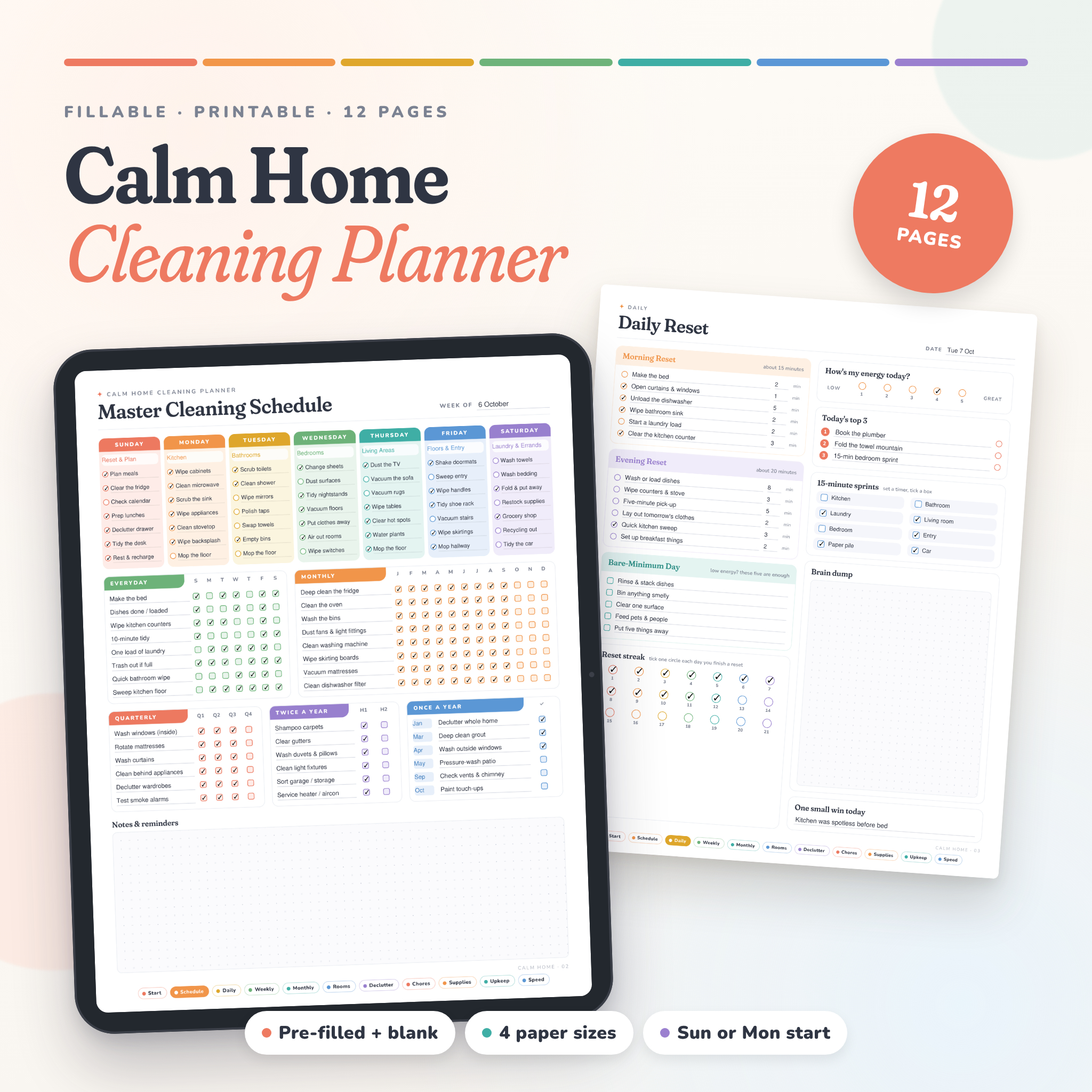
Writing all of this out yourself works. But if you’d like it ready to go, the Calm Home Cleaning Planner is built on the same idea: small, doable pieces instead of a Saturday marathon.
The Daily Reset page has timed morning and evening routines, a Bare-Minimum Day list of five tasks for low-energy days, an energy check, a top 3, 15-minute sprints, a brain dump and a 21-day streak. Minutes sit next to each routine task, so you can see a reset really is only 15 minutes.
The rest of its 12 pages cover a master schedule with a zone for each day, a weekly planner, a room-by-room deep clean with 84 tasks, a 30-day declutter challenge, a family chore chart for four people, a supplies inventory, a home upkeep log, and a Speed Clean and Laundry page with a 20-minute guest-ready list and a quick stain guide.
Every pre-filled task is editable, so if you don’t have a garage or you do have a dog, change the list to fit. You can type and tick in the free Adobe Acrobat Reader on a computer, tablet or phone, or print it and stick it on the fridge. It comes in US Letter, A4, A5 and Half Letter, pre-filled or blank, with Sunday or Monday start.
Who it suits
People with ADHD or low-energy days who want a routine they can actually keep, families sharing chores, and anyone who’d like the lists without writing them out. If you only want one checklist on the fridge, the free lists above are enough.
FAQ
How long should an ADHD cleaning checklist be?
Short. Five to eight items per list is plenty. Longer lists are fine for a deep clean, but daily lists should fit into 15 minutes or so.
What if I miss a few days?
Do the bare-minimum list today and carry on. Skip the missed zones instead of trying to catch up. The point is keeping things steady, not perfect.
Should I clean a whole room at once?
Not on a normal day. Pick one zone and a time limit. Whole-room deep cleans work better spread across the year, one at a time.