Nobody sits you down at 18 and explains that rent, car insurance and Christmas all come out of the same paycheck. You learn it the hard way, usually around the third time your account dips below zero before payday. If that sounds familiar, you are in good company, and none of it means you are bad with money.
This is budgeting 101 for grown-ups who skipped the class. It covers the ten lessons that make the biggest difference, in plain language, with real numbers. You will also get a walkthrough of your first month, a list of the mistakes almost everyone makes early on, and a few printable tools if you like working on paper. No spreadsheets required to start. A pen and a bank statement will do.
Quick picks: simple tools for first-time budgeters
| Product | Best for | Price | Link |
|---|---|---|---|
| Soft Ledger Budget Planner Printable | A step-by-step monthly budget with Excel totals | Original price was: $12.99.$8.99Current price is: $8.99. | View |
| Quiet Coin Kakeibo Money Journal | A slow, handwritten way to notice spending | $5.99 | View |
| Penny Pathfinders Kids Money Workbook | Teaching kids ages 7 to 12 the basics you missed | $10.49 | View |
| Home Maintenance Tracker Spreadsheet | Homeowners planning for repairs before they happen | $6.99 | View |
Start here: what a budget really is
Lesson 1: a budget is a plan, not a punishment
Most people hear the word budget and picture a list of things they are not allowed to buy. No coffee. No takeout. No fun. That picture is why so many budgets get abandoned by the second week.
A budget is just a decision, made in advance, about where your money will go. That is it. If you decide $120 a month goes to eating out, then eating out is part of the plan. You are not cheating when you order pizza on Friday. You are following the plan.
Thinking of it this way changes how it feels. You are not restricting yourself. You are choosing. And there is real relief in choosing once, at the start of the month, instead of agonizing over every purchase at the checkout.
Lesson 2: track for 30 days before you plan anything
Here is the step most beginners skip. Before you write a single budget number, find out what you actually spend now. Go through last month’s bank and card statements and write every transaction into rough groups: housing, food, transport, bills, shopping, other.
Most people get a shock somewhere. For one person it is food delivery: $340 across 19 orders, when they would have guessed $100. For another it is subscriptions, seven of them, two forgotten. You cannot plan well until you know where you are starting from.
This is also where handwriting helps. Typing numbers into an app is quick, but writing them by hand makes each one land. That is the whole idea behind kakeibo, a Japanese household account book method that has been around for more than a century.
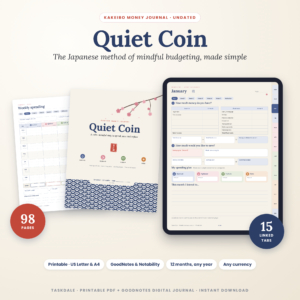
Quiet Coin Kakeibo Money Journal
Price: $5.99 | Best for: people who find budget apps overwhelming
Quiet Coin is an undated kakeibo journal in printable US Letter and A4, plus a hyperlinked digital version for GoodNotes and Notability. Each month you answer four questions, log purchases on weekly pages in four categories, and finish with a short reflection and one gentle change. Start by filling in this month’s income and fixed costs on the opening page, then log every purchase for the next week.
Timing and the costs that sneak up on you
Lesson 3: budget around paydays, not calendar months
Nobody explains this, but it fixes a huge number of budgets. Bills come on set dates. Pay comes on set dates. If those dates do not line up, a budget that balances on paper for the whole month can still leave you broke on the 12th.
Take someone paid $1,700 every other Friday. Rent of $1,200 is due on the 1st. If the first paycheck of the month lands on the 2nd, rent eats most of the previous check, and the two weeks before that feel very lean. Splitting the bills across both paychecks, on paper, fixes this.
- Write your pay dates for the month.
- Under each payday, list the bills due before the next one.
- Subtract. Whatever is left from each paycheck is for food, gas and everything else until the next one.
It takes ten minutes, and the relief of knowing the rent money is already set aside is huge.
Lesson 4: the costs that break budgets are the ones you forget
Monthly bills are easy. You see them every month. The trouble comes from costs that show up once or twice a year: car registration, the dentist, back-to-school shopping, birthday gifts, the annual software renewal, the water heater that gives up in February.
These are not really emergencies. You know they will happen. You just do not know exactly when. So budget for them every month in small amounts. Add up last year’s irregular costs, divide by 12, and move that amount to a separate savings account every payday.
Homeowners get hit hardest here. Gutters, HVAC filters, smoke alarm batteries and appliance repairs add up, and they always seem to arrive at the worst moment. Knowing what is due, and when, means you can put money aside before the bill lands rather than after.
A simple tracker that tells you what is coming due and what you spent on the house last year turns that guesswork into a number you can actually budget for. The Sill & Season Home Maintenance Tracker in the quick picks table does exactly that in Excel, with 60 common jobs already listed and a dashboard that shows spending by area and by month.
Setting up a budget that holds
Lesson 5: fewer categories, better results
A first budget with 40 categories is a budget you will stop using. Too many decisions, too many lines to update. Start with eight to ten categories at most:
- Housing (rent or mortgage, insurance)
- Utilities and phone
- Groceries
- Transport
- Debt payments
- Savings
- Irregular costs fund
- Eating out and fun
- Personal and household shopping
- Buffer
You can split categories later if one turns out to be hiding something. If “personal and household” keeps running $150 over, break it into clothing, toiletries and home goods for a month to find the leak. Most people never need more than 15 categories, even years in.
Lesson 6: overspending is information, not failure
You will go over in some categories. Everyone does, especially in the first three months. The question is what you do next.
When groceries run $60 over, you have two options. Move $60 from another category this month, or raise the grocery line next month because the original number was unrealistic. Both are fine. What does not work is ignoring it, or deciding budgeting is not for you.
A useful habit: at the end of each month, write one sentence about what happened. “Groceries over because of the birthday party.” “Gas over because of the road trip.” Three months of those sentences tell you exactly where your plan needs to change. That small end-of-month note is part of why kakeibo journals work so well for people who have quit apps before.
Lesson 7: always budget a buffer
A buffer is a small line of money with no job except catching surprises. A $9 parking ticket, a forgotten school fee, a friend’s last-minute birthday dinner. Without a buffer, each of those comes out of groceries or goes on a credit card.
Start with $50 to $150 a month, depending on income. If it is unused at the end of the month, move it to savings. It is a small thing that makes the whole budget feel less fragile.
Saving first and choosing a method
Lesson 8: savings come first, not last
If you save whatever is left at the end of the month, you will save nothing most months. That is just how spending works. Money that is sitting in a checking account tends to find a use.
Flip it. Decide your savings amount when you plan the month, and move it the day you get paid. Even $25 per paycheck adds up to $650 in a year, which covers a lot of small emergencies. Set up an automatic transfer and you never have to think about it again.
If you are juggling debt as well, a common approach is a small starter emergency fund first, then extra payments on debt, then bigger savings. The point is that savings has a line in the budget from day one, even if the line is small.
Lesson 9: pick a method, but do not worship it
You will hear about many budgeting methods: zero-based, 50/30/20, envelopes, pay-yourself-first, kakeibo. They all work for someone. None of them works for everyone.
The 50/30/20 rule is a nice quick check on a moderate income, and our look at whether the 50/30/20 budget works on a real income goes into where it bends. Zero-based budgeting suits people who like detail. Envelopes suit people who overspend with cards. Try one for three months. If it does not fit, switch. The method matters far less than checking in every week.
If you want a clear first structure to follow, a printed planner that walks you through each step of the month is a good place to begin.
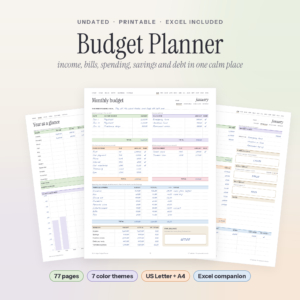
Soft Ledger Budget Planner Printable
Price: Original price was: $12.99.$8.99Current price is: $8.99. | Best for: first-time budgeters who want clear steps
Soft Ledger has 77 undated printable pages and an Excel spreadsheet that totals everything for you. Each month uses four linked pages: plan on Budget, see your weekly and daily spending number on Overview, log purchases on the Daily log, and wrap up on Review. Print one month’s set first and fill in the Budget page using the numbers from your 30-day tracking.
Lesson 10: teach the next generation what you missed
Many adults learned money from watching their parents argue about it, or from never hearing it mentioned at all. You can change that for your own kids, and it is easier than it sounds.
Children as young as seven can grasp needs versus wants, saving for a goal and the idea that money is earned. A weekly allowance split into spend, save and share jars is budgeting 101 in miniature. A child who saves eight weeks for a $40 toy learns more about money than many adults ever did in school.
A structured workbook helps if you are not sure where to start, or if you want to learn alongside them.

Penny Pathfinders Kids Money Workbook
Price: $10.49 | Best for: parents and homeschoolers with kids 7 to 12
Penny Pathfinders is a printable financial literacy unit for ages 7 to 12, built around a trail map with six themed trails, badges, a quiz and a certificate. Activities take 10 to 20 minutes each and cover money basics, earning, needs versus wants, saving and planning, with a Talk It Over question to end each one. Print the trail map first and let your child color the first badge after one activity.
Your first month, step by step
Here is how the ten lessons turn into an actual first month.
- Day 1: Pull last month’s statements. Sort every transaction into rough groups. Note the totals.
- Day 2: Write your pay dates and bill due dates on one page.
- Day 3: List last year’s irregular costs. Divide by 12.
- Day 4: Write your plan in eight to ten categories, including savings, irregular costs and a buffer. Make income minus plan equal zero.
- Days 5 to 30: Log spending once a week. Move money between categories when you need to.
- Day 31: Compare plan with actual. Write one sentence about what happened. Adjust next month.
For a deeper walkthrough of building that very first plan, see our guide on how to make a budget when you have never made one. Most people find month three is when it clicks. The numbers start to look familiar, the weekly check takes ten minutes, and there is money in savings that was not there before. That moment is worth the effort.
Common first-budget mistakes
- Guessing instead of tracking. Your memory of spending is always lower than the truth.
- Setting a grocery budget from the cheapest week ever. Use an average month, not a perfect one.
- Leaving out fun money. A budget with no joy gets abandoned.
- Waiting for a fresh start. Starting on the 17th is fine. Waiting for January wastes months.
- Doing it alone when you share money. If a partner shares the bills, plan together, even for 15 minutes.
Frequently asked questions
What are the basic steps of budgeting for beginners?
Track a month of spending, list income and pay dates, plan eight to ten categories including savings, then check in weekly and adjust at month end.
How do I start a budget if I live paycheck to paycheck?
Budget each paycheck separately. List the bills due before the next payday, subtract, and plan the rest. Add a small buffer as soon as you can, even $20.
Is it better to budget on paper or with an app?
Whichever you will actually open each week. Paper suits people who want to slow down and notice spending. Apps and spreadsheets suit people who want automatic totals.
How long does it take for a budget to start working?
Most people need about three months. The first month shows you reality, the second fixes the obvious gaps, and by the third the numbers start to hold.
What should I do if I keep going over budget?
Check whether the category was set too low. If it was, raise it and trim somewhere else. If it was realistic, look at what triggered the extra spending and plan around it.
Your next step
Today, pull up last month’s bank statement and total what you spent on food, both groceries and eating out. Just that one number. It is the quickest way to see why lesson 2 matters. When you are ready to plan a full month on paper, print the first month of the Soft Ledger Budget Planner and fill in the Budget page this weekend.