A tight month has its own feeling. The car needed tires, the electric bill came in high, and there are still eleven days until payday. You do not need a lecture right now. You need a way to see exactly what has to be paid, what you can stretch, and how to feed everyone until the next deposit lands.
This guide is for households going through a lean stretch, whether it is one bad month or a season of them. You will find the order to pay things in, the free tools you already own, a worked plan for closing a real gap, a ten-day food plan built from the pantry, a cash envelope setup for the last stretch, and three low-cost printables and spreadsheets that make the next tight month less of a scramble.
Quick picks: tools that help in a lean month
| Product | Best for | Price | Link |
|---|---|---|---|
| Moneybloom 6-Month Budget Binder | Paycheck plans and cash envelopes on paper | Original price was: $11.99.$8.99Current price is: $8.99. | View |
| Spoonwise Meal Planner Spreadsheet | Cooking from the pantry on a grocery budget | $17.99 | View |
| Sill & Season Home Maintenance Tracker | Seeing repair costs before they arrive | $6.99 | View |
| Penny Pathfinders Kids Money Workbook | Helping kids understand needs and wants | $10.49 | View |
First, get the whole picture on one page
Panic makes everything look bigger. A single page with every number on it shrinks the problem back to its real size. Before you buy anything, grab a sheet of paper and write three short lists.
- Money you have now. Checking balance, cash in your wallet, anything in savings. Say $412.
- Money coming before the month ends. The paycheck on the 26th, a small refund, $60 owed by a friend who has promised it. Only count what is certain.
- Everything due before that money lands. Every bill with its date and amount.
Subtract list three from list one. If the answer is positive, even by $40, you are tight but covered. If it is negative, you now know the exact gap, maybe $185, and a known gap is something you can work on. An unknown gap just keeps you awake.
Which bills to protect first
When there is not enough for everything, order matters. Most money guides agree on roughly the same priority list for a household, and it is worth having it written down before you are in the middle of a hard week.
- Food and essential medicine. People first.
- Housing. Rent or mortgage.
- Utilities. Power, water, heat.
- Transport to work. Fuel, a bus pass, the car payment if losing the car means losing the job.
- Minimum payments on debts. Cards, loans, buy-now-pay-later plans.
- Everything else. Streaming, gym, subscriptions, extras.
If something on that list cannot be paid in full, call the company before the due date, not after. Many utility providers, landlords and lenders would rather agree a short delay or a payment plan than chase a missed payment. It is an awkward phone call. It is also usually a short one, and the relief afterwards is real.
A worked example: closing a $185 gap
Numbers make this easier to picture. Meet the Reyes household: two adults, one child, eleven days to payday, $412 in the bank. Due before payday: the electric bill at $164, a car insurance payment of $118, a phone bill of $70, a credit card minimum of $45, and roughly $200 needed for food and fuel. That is $597 against $412. A gap of $185.
Here is how they closed it, one line at a time:
- Called the power company. They agreed to split the $164 bill over two months. Gap shrinks by $82.
- Paused two streaming services and a meal kit. The meal kit alone was due at $59 that week. Gap shrinks by $59.
- Cooked from the freezer for a week. Food and fuel came in at $160 instead of $200. Gap shrinks by $40.
- Sold an outgrown car seat online for $30. Gap closed, with $26 to spare.
Nothing dramatic. Four phone calls, one listing and a week of simple dinners. That is what most tight months come down to: several small moves rather than one big rescue.
Free tools you already have
A lean month is not the time to buy a stack of new things. Several of the best budgeting tools cost nothing.
- Your banking app’s alerts. Set a low-balance alert at $100 and a notification for every card payment. You will see each purchase within seconds.
- A phone calendar. Add every bill as an event two days before it is due. The reminder pops up while you can still move money.
- Envelopes from the junk drawer. Label them Groceries, Fuel and Other, and run the last ten days on cash.
- A notebook. Write down every purchase, however small. The $3 here and $6 there are often the leak.
- The cupboard and freezer. More on this below, because it is the biggest money-saver of all.
These will get you through this month. Ready-made tools earn their place later, when you want to stop the next tight month before it starts.
Running the last ten days on cash envelopes
Cards make it hard to feel money leaving. Cash makes it obvious. When the gap before payday is short and the margin is thin, a few envelopes are one of the most effective tools there is.
Here is how it might look for a family of three with $260 to last ten days:
| Envelope | Amount | Rule |
|---|---|---|
| Groceries | $150 | Two shops, $75 each, with a list |
| Fuel | $70 | Work and school runs only |
| School and kids | $25 | Lunch top-ups, a field trip form |
| Just in case | $15 | Untouched unless truly needed |
When an envelope is empty, that category is done until payday. It sounds harsh. In practice, people find it calming, because there is no math to do in the store. You just look in the envelope. For a fuller walk-through of the method, see our beginner’s guide to cash stuffing.
If you like the envelope idea and want to plan future months the same way, a printed binder keeps everything together.
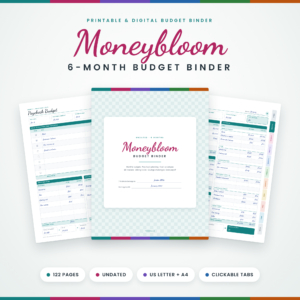
Moneybloom 6-Month Budget Binder
Price: Original price was: $11.99.$8.99Current price is: $8.99. | Best for: paycheck-to-paycheck households
Moneybloom is an undated printable budget binder with 122 pages covering six months, in US Letter and A4 with clickable tabs for tablet use. It includes zero-based monthly budgets, five paycheck pages a month for weekly, biweekly or twice-monthly pay, bill trackers, cash envelope pages, sinking funds, savings challenges and debt payoff trackers. Print the first month’s budget and paycheck pages and plan the next payday before it arrives.
Feeding the family from the pantry
Food is the one big category you can bend quickly. Rent is fixed. Groceries are not. A household that usually spends $180 a week can often get through a week on $90 by cooking from what is already in the cupboards.
Step 1: Take stock
Write down what you have: the rice, the half bag of pasta, two cans of beans, the frozen chicken thighs, the eggs, the wilting carrots. Most kitchens hold more meals than people think.
Step 2: Build meals around what is there
Chicken and rice with carrots. Bean chili over rice. Pasta with eggs and whatever cheese is left. Fried rice from the leftovers. Write a simple plan for the next five dinners.
Step 3: Shop only for the gaps
Make a list of the few items needed to finish those meals, often onions, a tin of tomatoes, milk and bread. Stick to it. The list is your armor in the store.
Doing this by hand works. A meal planning spreadsheet that subtracts what you already have and estimates the cost makes it faster, and it keeps working in the good months too. Our post on lowering your grocery bill without coupons has more ideas for the shopping side.
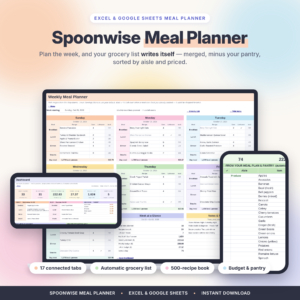
Spoonwise Meal Planner Spreadsheet
Price: $17.99 | Best for: families cooking on a grocery budget
Spoonwise is a weekly meal planner spreadsheet for Excel and Google Sheets with a recipe book, pantry inventory and grocery budget tracker. Pick the week’s recipes and it builds the shopping list for you: adding up ingredients, merging duplicates, subtracting what is already in your pantry, sorting by store aisle and estimating the cost against your budget. Enter what is in your cupboards first, then plan five dinners around it.
Talking to the kids about a tight month
Children pick up on stress even when nobody says a word. A short, calm explanation usually helps more than silence. Something like: “This month we are being careful with money until payday, so we are eating at home and skipping the trampoline park. Next month we will plan something fun.”
Give them a small job. A nine-year-old can tick items off the grocery list or count the change in the Fun envelope. Kids who feel part of the plan complain less, and some of them become fierce little bargain hunters. If you want structured lessons on needs and wants for later, the Penny Pathfinders workbook in the table above covers it in short activities for ages 7 to 12.
Stopping repairs from wrecking the next month
A lot of tight months start with a repair. The furnace stops on a cold night, the washing machine leaks, the gutters overflow and stain a ceiling. Some of those are bad luck. Plenty are maintenance that slipped, like a $15 furnace filter left too long or a dryer vent that never got cleaned.
Two habits help. First, a small monthly home repairs line, even $25, that builds up between problems. Second, a simple schedule of the jobs a house needs and when, so the cheap fix happens before the expensive one.
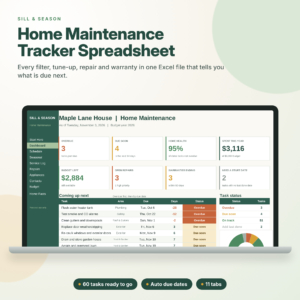
Sill and Season Home Maintenance Tracker
Price: $6.99 | Best for: homeowners tired of surprise repairs
Sill and Season is a home maintenance tracker spreadsheet for Excel with 60 common jobs already listed, from changing the HVAC filter every three months to cleaning the dryer vent once a year. Enter the date you last did each task and it shows the next due date, flags Overdue, Due soon or On track, and logs repairs, warranties and spending by area and month. Delete the jobs that do not fit your home, then fill in last-done dates for the rest.
Renters can still use the idea. Keep a list of what the landlord is responsible for, and report problems early in writing.
Small moves that add up fast
None of these will fix a big gap alone. Together, they often cover $100 to $300 in a single month.
- Pause subscriptions. Streaming, apps, boxes. Most can be restarted next month in one click.
- Sell one thing. The bike in the garage, a baby seat the kids have outgrown, a gaming console nobody uses.
- Have a no-spend weekend. Parks, library, a board game night, a picnic with sandwiches from home.
- Batch errands. One car trip for three errands instead of three trips saves fuel.
- Check for refunds. A return you never took back, a deposit owed, an overcharge on a bill.
- Ask about local help. Food pantries, school meal programs and utility assistance exist for months like this. Using them is sensible, not shameful.
After payday: building a buffer for next time
The most useful thing to do once money arrives is to set aside a little before anything else gets spent. Even $20 a paycheck. A $200 buffer by spring turns the next $180 surprise from a crisis into an inconvenience.
Then look back at what caused this month. Was it one big bill you could have seen coming, like car registration? Add a small monthly line for it. Was it groceries creeping up? Plan meals a week ahead. Each tight month carries a lesson, and writing it down while it still stings is how you make the next one less likely. The first month you get to the 25th with money still in the account feels like a small victory. It is one.
Frequently asked questions
What should I pay first when I cannot pay all my bills?
Food and essential medicine, then housing, utilities and transport to work, then minimum debt payments. Call any company you cannot pay in full before the due date and ask about a delay or plan.
How do I make money last until payday?
List what you have, what is coming and what is due. Put the remaining cash into a few envelopes for food, fuel and essentials, and spend only from those until payday.
What is the cheapest way to budget?
A notebook, envelopes and your banking app’s alerts cost nothing and work well. Ready-made planners and spreadsheets help once you want to plan months ahead.
How can I cut my grocery bill quickly?
Cook from what is already in your cupboards and freezer for a week, and shop only for the few items needed to finish those meals.
How do I explain a tight budget to my kids?
Keep it short and calm, explain what changes and for how long, and give them a small job like checking the shopping list. Most children cope well when they understand the plan.
Your next step
Today, write your three lists: money you have, money coming, and bills due before it arrives. That single page tells you exactly where you stand. When payday comes, start next month’s plan in the Moneybloom 6-Month Budget Binder, beginning with the paycheck page.