Profit tells you whether your business makes money. Cash flow tells you whether you can pay rent next Friday. They are not the same, and the gap between them is where most small business and freelance stress lives. A cash flow budget closes that gap by planning when money actually arrives and when it actually leaves, week by week.
This guide is for freelancers, consultants, tradespeople, makers and small business owners whose income does not arrive in neat, equal paychecks. You will learn what a cash flow budget tracks, how to build one in an afternoon, how to set up your accounts so tax and your own pay are never a scramble, and what to do when the numbers show a dip coming. There is a full three-month example from a freelance designer, with every figure shown.
Quick picks: cash flow and budget tools
| Product | Best for | Price | Link |
|---|---|---|---|
| Small Business Finance HQ | Bookkeeping, invoices, tax reserve and a cash flow forecast in one workbook | $7.99 | View |
| Moneybloom 6-Month Budget Binder | A printable paycheck-by-paycheck plan for your household | Original price was: $11.99.$8.99Current price is: $8.99. | View |
| Lantern Budget System | Personal cash envelopes and sinking funds in Excel | $12.99 | View |
| Calm Cash Budget & Goal Planner | A yearly household budget with bill calendar and goals | $19.00 | View |
How a cash flow budget differs from a regular budget
A regular budget asks: over this month, what will I earn and what will I spend? A cash flow budget asks a sharper question: on each date, how much money will actually be in the account?
That difference matters most when income is lumpy. Picture a freelance copywriter who finishes $9,000 of work in March. On paper, March was a great month. But her clients pay on 30 and 45-day terms, so the money lands in late April and mid-May. Meanwhile her rent, software, insurance and grocery bills arrive on their usual dates in March and April. She was profitable and broke at the same time.
A cash flow budget would have shown that squeeze six weeks early. She could have chased a deposit, delayed a software renewal, or simply known to keep a bigger buffer. No panic, no overdraft fees, no late-night spreadsheet scramble.
Who needs one most
- Freelancers and consultants who invoice after the work is done
- Seasonal businesses that earn most of their money in a few months
- Makers and shops that buy stock before they sell it
- Trades that pay for materials up front and get paid on completion
- Anyone with one or two big clients whose payment dates drift
The four numbers every cash flow budget tracks
Strip away the jargon and a cash flow budget is four numbers for each period, usually a week or a month.
- Opening balance. What is in the account at the start.
- Cash in. Payments you expect to actually receive in that period. Not invoices sent. Money landing.
- Cash out. Every payment that will leave: business costs, tax set-aside, your own pay, loan payments, equipment.
- Closing balance. Opening plus cash in minus cash out. This becomes the next period’s opening balance.
That is the whole engine. The skill is in being honest about the dates. A client who has paid 20 days late on the last three invoices will probably pay 20 days late on the next one. Put the realistic date in your budget, not the date on the invoice.
Weekly or monthly?
Monthly works for steady businesses with predictable income. Weekly is better for anyone whose bank balance swings a lot, or who has big bills on specific days. A common approach is a rolling 13-week view: the next quarter, broken into weeks, updated every Monday. It is short enough to be accurate and long enough to see trouble coming. Our guide on why you need a cash flow forecast template goes deeper on the longer-range version.
How to build your cash flow budget in one afternoon
Set aside two to three hours, pull up your bank statements and invoice list, and work through these steps.
- Write today’s bank balance. Business account, and personal if you have not separated them yet.
- List every unpaid invoice with the date you realistically expect payment, based on that client’s history.
- Add expected new work for the next 13 weeks: signed contracts first, likely work second. Mark the likely work clearly so you do not count on it.
- List every recurring business cost with its date: software, phone, rent, insurance, subscriptions, loan payments.
- Add the lumpy ones: annual renewals, quarterly tax payments, equipment you plan to buy, a conference.
- Add your own pay as a fixed outgoing amount on set dates. More on this below.
- Add a tax set-aside as a share of each payment you receive. Agree the percentage with an accountant, because it depends on your location and structure.
- Run the balance forward week by week. Circle the lowest point.
The lowest point is the most important number on the sheet. If it dips below about one month of total outgoings, you have a cushion problem to solve now, while it is still weeks away.
A workbook that already links your income log, invoices, tax reserve and forecast saves you from building all of this from scratch.
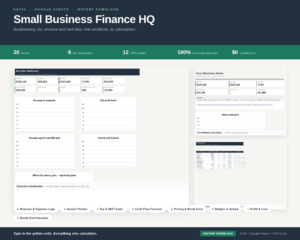
Small Business Finance HQ
Price: $7.99 | Best for: freelancers and small firms doing their own books
Small Business Finance HQ is a 20-sheet bookkeeping workbook for Excel and Google Sheets: revenue and expense logs, an invoice tracker where overdue rows turn red, recurring costs, profit and loss, a tax and VAT centre with a monthly reserve plan, pricing and break-even, a cash flow forecast with a lowest-point warning, and six dashboards. Type in the yellow cells only. Start by entering your open invoices and recurring costs, then check the forecast’s lowest point.
Worked example: a freelance designer’s quarter
Maya is a freelance brand designer. She sets aside 25 percent of every payment for tax, a rate her accountant suggested for her situation. She pays herself $3,200 a month from the business account and runs about $650 a month in business costs. Here is her cash flow budget for July to September.
| Month | Opening | Cash in | Business costs | Tax set-aside | Owner pay | Closing |
|---|---|---|---|---|---|---|
| July | $6,200 | $4,800 | $650 | $1,200 | $3,200 | $5,950 |
| August | $5,950 | $2,100 | $650 | $525 | $3,200 | $3,675 |
| September | $3,675 | $8,400 | $1,250 | $2,100 | $3,200 | $5,525 |
August is the tight one. A big client moved their payment from August to September, so only $2,100 came in. Because Maya keeps a cushion of a little over one month of outgoings, her balance dipped to $3,675 but never came close to zero. She still paid herself on the 1st. In September, two large invoices landed together, and an annual software renewal of $600 pushed business costs to $1,250. The cushion refilled.
Without the cushion and the plan, August would have meant skipping her own pay or putting rent on a credit card. With it, August was just a quieter month. That is the real payoff of a cash flow budget: the bad months stop feeling like emergencies.
The three-account setup for uneven income
The simplest way to smooth lumpy income is to stop spending from the account where it lands. Use three accounts instead.
- Business income account. All client payments land here. Business costs leave from here.
- Tax account. The moment a payment lands, move your tax percentage here. Do not touch it except to pay tax.
- Personal account. On set dates, pay yourself a fixed amount from the business account. Your household budget runs from this account only.
This turns irregular business income into a steady personal paycheck. Good months build up the business account. Slow months draw it down. Your household sees the same amount on the same dates either way, which makes the personal side far calmer.
Setting your owner pay
Look at your last 12 months of income after business costs and tax. Take the lowest three-month stretch and use that as your monthly pay to start. It feels conservative. It is meant to. Once the business account holds three months of your pay plus costs, you can raise it.
Then plan your household around that fixed amount, paycheck by paycheck. A printable binder that walks through each pay period suits people who like to see it on paper.
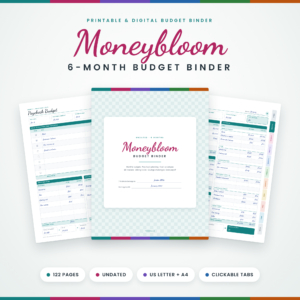
Moneybloom 6-Month Budget Binder
Price: Original price was: $11.99.$8.99Current price is: $8.99. | Best for: households living on a set owner paycheck
Moneybloom is a 122-page undated printable budget binder in US Letter and A4, with clickable tabs for tablet use. It covers six months of zero-based monthly budgets, paycheck plans, bill trackers, cash envelopes, sinking funds, savings challenges and debt payoff trackers. Enter your fixed owner pay as each paycheck, then split your household bills across those dates on the paycheck plan pages.
Getting paid faster without being pushy
The cash-in line is the one you have most control over, and small changes make a big difference.
- Take deposits. Ask for 30 to 50 percent before work starts on any project over a set size. Many clients expect it.
- Invoice the same day. Every day you wait to send an invoice is a day added to your cash gap.
- Shorten terms. Net 14 instead of net 30 halves the wait, and most clients accept it without comment.
- Bill in stages. For long projects, invoice at milestones rather than at the end.
- Make paying easy. Include a payment link or clear bank details on every invoice.
- Send polite reminders. A short note three days before the due date, and again a few days after, catches most late payments.
A plumber who switched from billing on completion to a 40 percent deposit and balance on completion described it as the single change that took the stress out of buying materials. The work was the same. The cash arrived three weeks sooner.
The owner’s personal side: envelopes and sinking funds
Your business cash flow budget protects the business. Your household still needs its own plan, especially for the irregular costs self-employed people carry: health insurance, retirement contributions, equipment you use at home, and the usual car repairs and holidays.
Many freelancers find cash envelopes or digital envelopes work well on the personal side, because they put a hard limit on variable spending when income feels uncertain. Our guide to cash stuffing for beginners explains how to run an envelope budget step by step. Sinking funds for the yearly costs keep those surprises out of the business account.
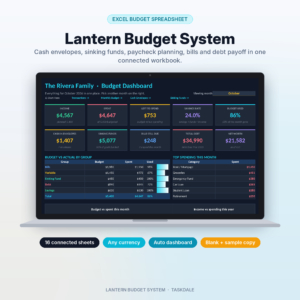
Lantern Budget System
Price: $12.99 | Best for: self-employed households using envelopes
The Lantern Budget System is a cash envelope budget spreadsheet for Excel with a sinking funds tracker, paycheck budget, bill calendar and debt snowball. One transaction log feeds the monthly budget, envelope balances, annual view and a dashboard with 10 KPI cards. It works with real cash or fully digital categories. Set your owner pay as the paycheck, then create envelopes for groceries, gas and personal spending.
If you prefer a straightforward yearly household budget with a bill calendar and goals instead of envelopes, the Calm Cash Budget & Goal Planner in the quick picks table covers that in Excel and Google Sheets.
When the forecast shows a dip coming
A cash flow budget is only useful if you act on what it shows. When you spot a low point several weeks out, work through these options in order, from easiest to hardest.
- Chase what you are owed. Follow up on every overdue invoice this week.
- Ask for deposits on new work. Even one deposit can fill a small gap.
- Move a cost. Delay an equipment purchase or switch an annual renewal to monthly billing.
- Talk to suppliers. Many will agree to later payment if you ask before the bill is due, not after.
- Trim your own pay temporarily. Only if the cushion cannot cover it, and with a plan to restore it.
- Use credit as a last resort. A short-term line can bridge a known gap, but only when the money to repay it is already on the forecast.
The earlier you see it, the gentler the fix. That is the whole argument for checking the numbers every week.
A 20-minute Monday routine
- Update the opening balance from your bank.
- Mark any invoices paid last week and adjust dates for any still waiting.
- Add any new work or costs that came up.
- Check the lowest point in the next 13 weeks.
- Pick one action if it looks tight.
Frequently asked questions
What is a cash flow budget for a small business?
A plan showing when money will actually arrive and leave, period by period, so you can see your bank balance ahead of time and spot shortfalls before they happen.
How do freelancers budget with irregular income?
Let all income land in a business account, move a tax percentage out immediately, and pay yourself a fixed amount on set dates. Base that amount on your lowest recent stretch of income.
How much cash should a small business keep in reserve?
A common starting target is one month of total outgoings, building toward three. Seasonal businesses often need more to cover the quiet months.
How far ahead should a cash flow budget look?
A rolling 13 weeks suits most freelancers and small firms. Seasonal businesses benefit from a full 12-month view as well.
What is the difference between cash flow and profit?
Profit is income minus costs for a period, whenever the money moves. Cash flow is the actual movement of money in and out of the bank. You can be profitable and still run short of cash if clients pay late.
Should I use a spreadsheet or accounting software for cash flow?
A spreadsheet is plenty for most freelancers and small businesses with a modest number of transactions. Larger firms with staff and stock often move to accounting software as they grow.
Your next step
Today, write your current bank balance and list every unpaid invoice with the date you honestly expect it to arrive. Add your bills for the next four weeks and run the balance forward. If one week looks tight, you just found it a month early. When you want the forecast, invoices and tax reserve working together, set them up in Small Business Finance HQ and start the Monday routine next week.