A coloring sheet on its own keeps a preschooler busy for ten minutes. A coloring sheet with a tiny game attached can teach colors, counting, shapes and new words in the same ten minutes, and the child just thinks they are playing.
This guide is for parents, preschool teachers, childminders and homeschool families with children aged about three to five. You will find ten simple activities that turn any coloring sheet into early learning, ideas sorted by skill, a sample week, a quick setup for a coloring station, and a few printable sets made for small hands.
None of it needs special training or supplies. A sheet, a few crayons and two minutes of your attention.
Quick picks: preschool coloring sets
| Product | Best for | Price | Link |
|---|---|---|---|
| Crayon Campus Preschool Learning Coloring Worksheets | Shapes, numbers, colors and science, with a classroom license | $4.99 | View |
| Little Explorers Preschool Coloring Book | Ages 2 to 5, animals, vehicles and early learning | $3.49 | View |
| Roar to Z Dinosaur Coloring Book A to Z | Letters and big words for dinosaur fans | $4.49 | View |
| Indoor Activities Coloring Book Adventure | Rainy days, color then act it out | $2.99 | View |
What makes a good preschool coloring sheet
Preschool hands are still learning. Most three-year-olds grip a crayon in a fist, and most five-year-olds are only just starting to pinch it between finger and thumb. A good sheet works with that, not against it.
- Thick, dark outlines that act like walls and are easy to see.
- Big shapes, roughly the size of a child’s palm or larger.
- One main subject with plenty of white space around it.
- Something to talk about, like an animal, a vehicle or a face with a feeling.
- A name line, so they can practice writing or tracing their name.
If you are choosing between two sheets, pick the simpler one. A child who finishes a page feels proud and asks for another. A child who gives up halfway avoids the crayon box for days. For more on picking pages with big shapes, see our guide to preschool coloring pages.
Ten simple activities for any coloring sheet
Each of these takes less than a minute to set up. Pick one per sheet and keep it light.
- Color hunt. Before coloring, ask your child to find three things on the page. “Where is the wheel? The sun? The dog’s tail?” Then color those first.
- Follow one instruction. “Color the hat red.” Just one. Listening and following directions is a real school skill, and a single step is perfect at this age.
- Count and color. On a page with ducks or balloons, count them together, then color one at a time while counting out loud.
- Big and small. Find the biggest thing on the page and the smallest. Color the big one blue and the small one yellow.
- Sound it out. Say the first sound of the main picture. “Duh, duh, duck.” Then hunt for other things in the room that start with the same sound.
- Feelings faces. On a page with a face, ask how the character feels. Happy? Sleepy? Grumpy? What color is a grumpy feeling?
- I spy colors. Once the page is done, play I spy with the colors they used. “I spy something green.”
- Tell the story. Ask what happens next. Where is the truck going? Who is the bunny meeting? Write one sentence at the bottom in their words.
- Cut and glue. For older preschoolers, cut out the finished picture with child-safe scissors and glue it onto a new sheet to make a scene.
- Sort the pile. At the end of the week, lay out all finished sheets and sort them: animals and vehicles, or happy and sleepy. Sorting is early math.
That is ten. You only need one a day. The learning comes from the small, repeated conversations, not from any single sheet.
Coloring for colors and shapes
Colors and shapes are the first two things most preschool programs teach, and coloring sheets are a natural fit. A child coloring a red circle is learning “red” and “circle” at the same time.
Keep each sheet focused on one idea. A page with three triangles to color and one instruction, “Color the triangles green”, teaches more than a page with ten different shapes and no direction. Say the shape name every time they finish one.
A simple trick: give only the crayons they need. Hand over red, blue and yellow for a primary colors sheet. Fewer choices means more focus, and the lesson sticks.
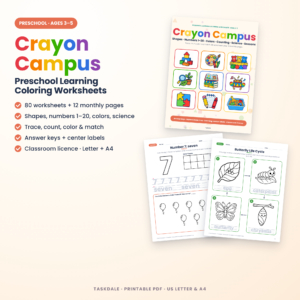
Crayon Campus Preschool Learning Coloring Worksheets
Price: $4.99 | Best for: preschool teachers and homeschool families
Crayon Campus has 80 learning coloring worksheets in seven sections, including Shapes, Numbers 1 to 20, Counting and Math, Colors, Matching and Science, plus 12 seasonal pages, one for each month. Each page has one simple job, a Name and Date line and an instruction you can read aloud. It comes with answer keys, a skills checklist, learning-center labels and a classroom license for one teacher, in US Letter and A4.
Planning a whole themed week around shapes or colors? Our preschool lesson plan template guide shows how to slot coloring into each day.
Coloring for letters and new words
Big, hollow letters are a joy for preschoolers. They can color the letter itself, which helps them notice its shape, and then color a picture that starts with that letter.
Here is a simple letter routine that works over a week:
- Monday: color the big letter and say its sound five times.
- Tuesday: color a picture that starts with that sound.
- Wednesday: find three things at home that start with that sound.
- Thursday: trace the letter with a finger, then a crayon.
- Friday: color a page of their choice and find the letter anywhere in the picture.
Long, silly words are a hit too. Preschoolers love saying “Stegosaurus” out loud, slowly, and they remember it far better than you might expect.
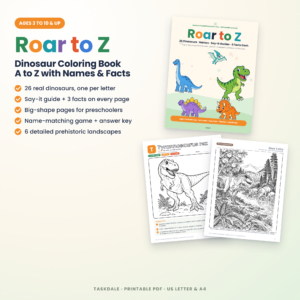
Roar to Z Dinosaur Coloring Book
Price: $4.49 | Best for: dinosaur fans learning their ABCs
Roar to Z has a real dinosaur or prehistoric reptile for every letter from A to Z, with the name in big outline letters to color, an easy say-it guide and three kid-friendly facts. Preschoolers get a big-shape section with extra-thick outlines, plus a name-matching game and six detailed landscapes for older kids and grown-ups. Print it on US Letter or A4 and color one letter a day.
Coloring for talk: animals and vehicles
Coloring is one of the easiest times to build vocabulary, because you are sitting side by side with nothing else to do. Animals and vehicles give you endless words to share: digger, bucket, tractor, trunk, shell, whiskers.
Try narrating gently while your child colors. “You are coloring the digger’s big bucket. It scoops up dirt.” You are not quizzing them. You are just filling the air with words they can borrow. Over a few weeks, you will hear those words come back.
Early learning pages that slip in counting, feelings or big and small make this even easier, because the topic is already on the page.
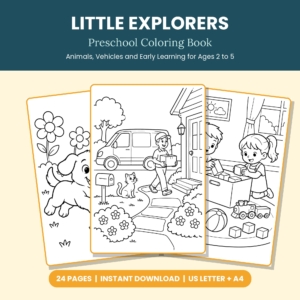
Little Explorers Preschool Coloring Book
Price: $3.49 | Best for: ages 2 to 5 and first coloring books
Little Explorers has 24 pages with thick outlines and open spaces in three themes: Friendly Animals, Busy Vehicles and Early Learning, with pages such as Counting Ducks, Shape Playground and Feelings Balloons. You get US Letter and A4 PDFs plus each page as a 300 DPI PNG, and the files cover personal, family and classroom use. Start with the Feelings Balloons page and talk about each face.
Rainy days: color it, then play it
On a day stuck indoors, coloring sheets can lead straight into play. Color a picture of a blanket fort, then build one. Color a tea party, then hold one with stuffed animals. Color a puzzle scene, then pull out a real puzzle.
This “color then do” pattern works because preschoolers learn through their bodies. The sheet gives the idea. The play makes it real. And it fills a long afternoon without a screen.
Scenes from everyday indoor life, like reading corners, block towers and cooking, are perfect for this. Older preschoolers can color the big shapes on busier pages while you color the small details beside them.
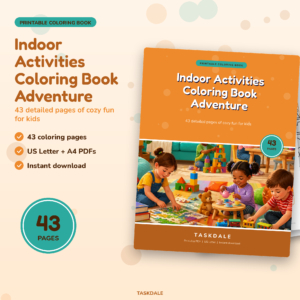
Indoor Activities Coloring Book Adventure
Price: $2.99 | Best for: rainy days and sick days at home
This book has 43 busy, friendly scenes of things kids do at home, such as a castle blanket fort, cooking help, a puppet show and a window garden. Each scene sits in a rounded frame with its title above, in US Letter and A4 PDFs, and only the cover uses color. Pages have big shapes plus small details, so color it together, then try the activity in real life.
A sample week of preschool coloring
Here is how the ideas above fit into a normal week. One sheet a day, about ten minutes, and a different skill each time.
| Day | Sheet | Mini activity | Skill |
|---|---|---|---|
| Monday | Shapes page | Color all the circles red | Shapes, following directions |
| Tuesday | Farm or pet animals | Count the legs, then color | Counting |
| Wednesday | Letter page | Say the sound, find it at home | Letter sounds |
| Thursday | Vehicles | Tell where the truck is going | Talking and storytelling |
| Friday | Child’s choice | Sort the week’s sheets into piles | Sorting, early math |
Over a month that is twenty sheets, twenty short conversations and twenty small wins. Write the date on each one. By the end of the school year you will have a stack that shows, in crayon, how much your child’s hands and words have grown. Flipping through it together in June is a lovely moment.
Adapting sheets for different learners
Not every preschooler comes to the table the same way. A few small changes help every child join in.
- For a child who tires quickly: tape the sheet to the table and offer chunky crayons or triangular ones, which are easier to grip.
- For a child who hates staying in the lines: trace over the outlines with a thick black marker first, so the walls feel bigger.
- For a child learning English: name each object as you point to it, and let them say it in their home language too. Two words for one duck is a win.
- For a child who will not sit: put the sheet on a clipboard and let them color standing up, or on the floor on their tummy.
The goal is the same for everyone: a few calm minutes, a crayon in hand and something to talk about.
Setting up a coloring station
A small, ready station makes coloring easy to start. Children can reach it on their own, which builds independence too.
- A low basket or tray with a stack of printed sheets.
- Chunky crayons in a cup, eight colors at most. Too many choices slows small kids down.
- A few washable markers for special days, with caps that click.
- A clipboard for coloring on the floor or outside.
- A “finished” folder where completed sheets go, with their name and date on the back.
In a classroom, the same station works as a quiet center. Many teachers keep one beside the calm-down area. Our guide to calm down corner ideas shows how to pair coloring with simple calming cards.
How long, and how often
Preschool attention spans are short, and that is normal. Plan on five to fifteen minutes per sheet. A three-year-old might color for three minutes and wander off. A five-year-old might sit for twenty.
Once a day is plenty. A sheet after breakfast or before quiet time builds a gentle routine. Stop while they are still enjoying it, so the next session starts with a yes. Watching a child walk to the basket on their own, pick a sheet and sit down to color is a small, lovely win.
Mistakes that take the fun out
- Correcting colors. A purple cow is fine. The goal is confidence, not accuracy.
- Insisting on inside the lines. Control comes with time. Praise effort instead.
- Handing over a stack. Ten sheets at once feels like a chore. Offer one, and another if they ask.
- Too many crayons. A giant box overwhelms. Eight colors is plenty.
- Turning every sheet into a lesson. Some days, just color. Play is learning too.
Frequently asked questions
What should a preschool coloring sheet look like?
Thick, dark outlines, big shapes and one main subject with lots of white space. A name line is a bonus. Avoid tiny details until children are closer to five or six.
How do coloring sheets help preschoolers learn?
They build hand strength and pencil control, and they are a natural time to practice colors, shapes, counting, letter sounds and new words through short, playful conversations.
How long should a preschooler color for?
Five to fifteen minutes is typical. Some three-year-olds stop after a few minutes and that is normal. Keep sessions short and end while they are still enjoying it.
What crayons are best for preschool coloring?
Chunky crayons are easiest to hold for small hands. Washable markers work for special occasions. Offer around eight colors so choosing stays simple.
Can I use preschool coloring sheets in my classroom?
It depends on the license. Some sets include classroom use or a one-teacher license, while others are for personal use only. Check the listing before printing copies for a class.
Your next step
Choose one activity from the list of ten, print one sheet, and try it with your child today. Keep it to ten minutes and notice what they talk about. For a set built around early learning with one simple job per page, start with Crayon Campus Preschool Learning Coloring Worksheets.