Applying for jobs before you have finished your course feels a bit like turning up to a party before the host is ready. You are not sure what to say about the degree you do not have yet, or when you can actually start, or whether that part-time job counts. The good news is that employers hire students who are still studying all the time. Graduate schemes are built around it.
This guide shows you how to use a CV student template for applying while still studying. It covers how to list a degree in progress, how to make your start date clear, how to present work you do alongside your course, and how to plan applications around deadlines and exams so nothing slips.
It suits final-year undergraduates, college students, part-time master’s students and anyone studying while working who wants a new role before the course ends.
Quick picks: CV templates for students still studying
| Product | Best for | Price | Link |
|---|---|---|---|
| Slatewell ATS Resume Template | Entry-level layout that leads with education | $7.49 | View |
| Marlowe Resume Template | Clean design with a writing playbook | $4.79 | View |
| Alder Resume Template with Photo | Students juggling many graduate applications | $4.79 | View |
| Sloane Resume Template | A modern look for new graduates | $4.49 | View |
The first question every employer asks: when can you start?
A hiring manager reading a student CV has one practical worry before anything else. If they offer you the job, when will you actually be at your desk? If your CV does not answer that, they have to guess, and a guessing recruiter tends to move on to the next application.
So make your timing obvious in two places.
- In your education section. Write the expected completion date right next to the degree: BSc Computer Science, University of Leeds, expected June 2027.
- In your profile. One short line does it: Final-year student available for full-time work from July 2027, or Available for 20 hours a week during term and full time from June.
If you are applying for a graduate scheme that starts in September, you do not need to spell it out, because everyone on the scheme is in the same boat. For a normal job with an immediate start, it matters a great deal.
Be honest about overlap. If your final exams finish on 6 June and the job starts on 1 June, say so. Many employers will happily wait a week or two. Very few enjoy finding out after the offer.
How to show a degree you have not finished
An unfinished degree is still your strongest qualification, so treat it that way. Put it near the top and give it a little detail.
What to include
- Degree title, university and expected completion month and year
- Current average or predicted classification, if it is good
- Three or four modules that relate to the job
- Your dissertation or final project title, with one line on what you found or built
- Any prize, scholarship or top mark worth naming
How it reads on the page
BA (Hons) Business Management, University of Nottingham, expected July 2027
Current average: 67 percent (predicted 2:1)
Relevant modules: Operations Management, Business Analytics, Employment Law
Dissertation: How small independent retailers in the East Midlands use social media to compete with chains, based on interviews with 14 shop owners.
That entry tells a recruiter what you know, how well you are doing and how you think. It also gives them a ready-made interview question.
An entry-level layout that puts education first does most of this work for you. Slatewell includes one.
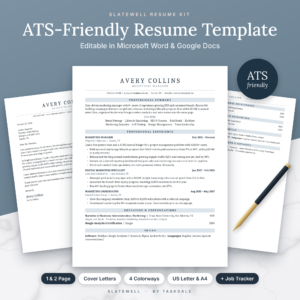
Slatewell ATS Resume Template
Price: $7.49 | Best for: final-year students and new graduates
Slatewell includes four single-column layouts, among them an Entry-Level version that puts Education and Projects first, plus two cover letters, a references page and a thank-you letter, in four colourways and both US Letter and A4. It uses Cambria, so there are no fonts to install, and the single column suits graduate scheme portals. Open the Entry-Level layout and fill in your degree, expected date and modules first.
Showing work you do alongside your studies
If you have held a job while studying, that is one of the most persuasive things on your CV. It shows you can manage your time, turn up when tired and keep two commitments going at once. Employers notice.
Make the overlap visible. A line in your profile such as Worked 16 hours a week in retail throughout my degree while keeping a 2:1 average says more about your work ethic than any adjective could.
For each job, keep the usual structure: title, employer, dates and two to four bullets with results. Then add one detail that shows the balance, if it fits naturally. Trained six new starters during exam season. Moved to a supervisor role in my second year. Kept the same weekend shift for three years.
Part-time master’s and working students
If you work full time and study part time, flip the order. Lead with your job, because that is your main experience. Put your course in the education section with the expected completion date and one line on how it relates to the role you want. A logistics coordinator halfway through a part-time MSc in Supply Chain Management, applying for a planning manager role, has a strong story: real experience now, formal training nearly done.
Education first or experience first?
Most students wonder which section should come first. Here is a simple way to decide.
| Your situation | Put first | Why |
|---|---|---|
| Final-year student, little work history | Education | Your degree is the strongest evidence you have |
| Student with a relevant part-time job | Education, then that job | Both matter, and the degree sets the context |
| Working full time, studying part time | Experience | Years in work outweigh a course in progress |
| Career changer retraining through a course | A short profile, then education | The new qualification explains the switch |
Whichever order you choose, keep it to one page if you are an undergraduate, and no more than two if you have several years of work behind you.
Marlowe works well for either order because its sections are built with real Word styles. Move a block up or down and the formatting comes with it.
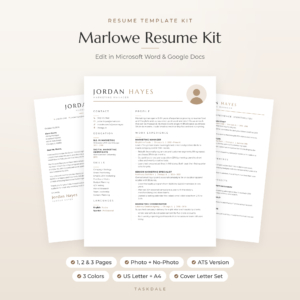
Marlowe Resume Template
Price: $4.79 | Best for: students who want writing help too
Marlowe includes 1, 2 and 3 page CVs with and without a photo, an ATS version, a cover letter, references page and thank-you letter, in Sand, Sage and Slate and both US Letter and A4. The 10-page Resume Playbook includes a three-sentence profile formula, before-and-after bullets and 120+ action verbs. Use the profile formula to write your available-from line before anything else.
Planning applications around deadlines and exams
Here is the tricky part of applying while studying: the busiest application season often lands on top of the busiest study season. Many graduate schemes open in the autumn and close before Christmas, right when coursework deadlines pile up. Spring brings more vacancies and also revision.
A simple plan stops the two from crashing into each other.
- List every deadline in one place. Coursework, exams and job closing dates, side by side.
- Block two application sessions a week. Tuesday and Sunday evenings, for example, 90 minutes each.
- Prepare a master CV early. Then each application is a 20-minute tailoring job, not a three-hour rewrite.
- Protect exam weeks. Apply before or after, not during, unless a dream role closes that week.
If you already track coursework in a spreadsheet, add your applications to it. Our guide on using a student planner spreadsheet for assignments and GPA shows one way to set that up. For a dedicated tracker, see our job application tracker guide.
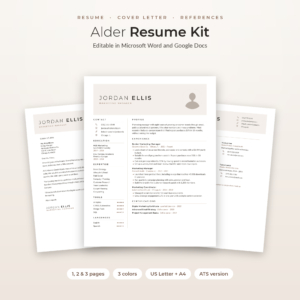
Alder Resume Template with Photo
Price: $4.79 | Best for: students applying through a busy term
Alder includes 1, 2 and 3 page CVs with and without a photo, a one-column ATS version, a cover letter, references page and thank-you letter, in Mocha, Sage and Slate and both paper sizes. The Excel Job Application Tracker holds 300 applications, colours each status and flags follow-ups two days before they are due. Enter every closing date the day you find the job, so none of them sneak up on you during exams.
Choosing referees while you are still studying
Most employers want two referees, and at least one should know your work. While you are studying, that usually means one academic and one employer.
- Academic referee. Your personal tutor, dissertation supervisor or a lecturer who taught you in a small group. A tutor who has seen you present or lead a seminar can say far more than one who only marked an exam script.
- Work referee. The manager at your part-time job, placement or volunteering role. They can speak to reliability and how you treat customers and colleagues, which an academic cannot.
Ask before you list anyone. Send a short email with the type of role you are applying for and a copy of your CV, so they know what to highlight. Tutors get dozens of these requests in the autumn, so a polite note in October goes down better than a panicked one in December. Thank them when you get an offer. It is a small thing, and they remember it.
What to say about finishing your course
Interviewers will ask about your studies. Expect questions like How is your final year going? or What if your exams clash with our start date? Prepare a calm, short answer for each.
On timing, be specific. My last exam is on 3 June and I could start any time from 10 June. On grades, be honest and positive. I am on track for a 2:1, and my dissertation is on X, which links to this role because Y. On workload, show you have a plan. I have kept a part-time job through my degree, so I am used to balancing both.
If you are offered a job before your results come out, many offers are conditional on finishing your degree. Read the offer letter carefully so you know what grade, if any, it depends on.
Two short examples
Priya, final-year chemistry student
Priya is applying to quality control roles at pharmaceutical firms. Her profile reads: Final-year MChem student at the University of Bath, predicted first, available full time from July 2027. Lab experience in HPLC and GC from a 12-month industrial placement. Her placement goes straight under education, with three bullets on the tests she ran and the reports she wrote. One page. Done in an evening.
Tom, working full time and studying at night
Tom is an HR administrator in the third year of a part-time CIPD qualification. His CV opens with his job, where he ran onboarding for 140 new starters in a year, and lists the qualification under education with an expected date and a note that he has passed four of six units. He is going for HR advisor roles, and the course explains why he is ready to step up.
Both CVs answer the same three questions: what are you studying, when will you finish, and what can you already do?
Mistakes students make on a CV mid-course
- Leaving out the expected date. The reader cannot tell if you finish in two months or two years.
- Listing every module. Pick three or four that link to the job.
- Writing Graduate when you have not graduated. Say final-year student or expected graduation instead.
- Hiding part-time work. It shows reliability, even if it is unrelated to your degree.
- One CV for everything. Tailor the profile and the module list for each role. Our guide to a cover letter that matches your resume helps you keep the pair consistent.
Frequently asked questions
How do I put an unfinished degree on my CV?
List the degree, university and expected completion date, for example expected June 2027. Add your current average or predicted grade if it is good, plus a few relevant modules.
Should I apply for jobs before I graduate?
Yes. Many graduate schemes recruit a year ahead, and plenty of employers will wait a few weeks for the right person to finish their course.
Do I put predicted grades on my CV?
If they are good, yes, labelled clearly as predicted. If not, leave them off and focus on modules, projects and experience.
Can I put a part-time job on a graduate CV?
Yes. It shows time management and reliability. Write it with results, just like any other job.
What if a job starts before my exams finish?
Say so early and give your exact availability. Many employers can adjust a start date by a week or two if they know in advance.
Who should be my referee as a student?
One academic, such as a tutor or supervisor, and one employer from a part-time job or placement. Ask both before you list them.
Your next step
Add your expected completion date and an available-from line to your CV today, then write your dissertation or final project into a single strong sentence. If you want a layout that puts education first, open the Entry-Level page of the Slatewell ATS Resume Template and start there.