Debt snowball vs avalanche is the oldest argument in personal finance, and both sides have a point. One method gets you a win fast. The other costs you less. If you are staring at three cards, a car loan and a medical bill, you want to know which one to start with tonight, not in theory.
So we ran the numbers on a real-looking set of five debts, showed exactly where the two methods split, and built a free planner you can use either way. Grab it below, then read on for the side-by-side math.

Free Debt Payoff Planner Sample (GoodNotes PDF)
8 hyperlinked pages from the Payridge debt payoff digital planner: Home, Debt List, Snowball Order, a full Debt 1 tracker with color-in grid, January 2027 check-in and the Climb the Ridge color-in page.
Want everything unlocked?
The free file is a sample. The full version has every page, tab and feature, plus the user guide.
See the full versionThe short answer
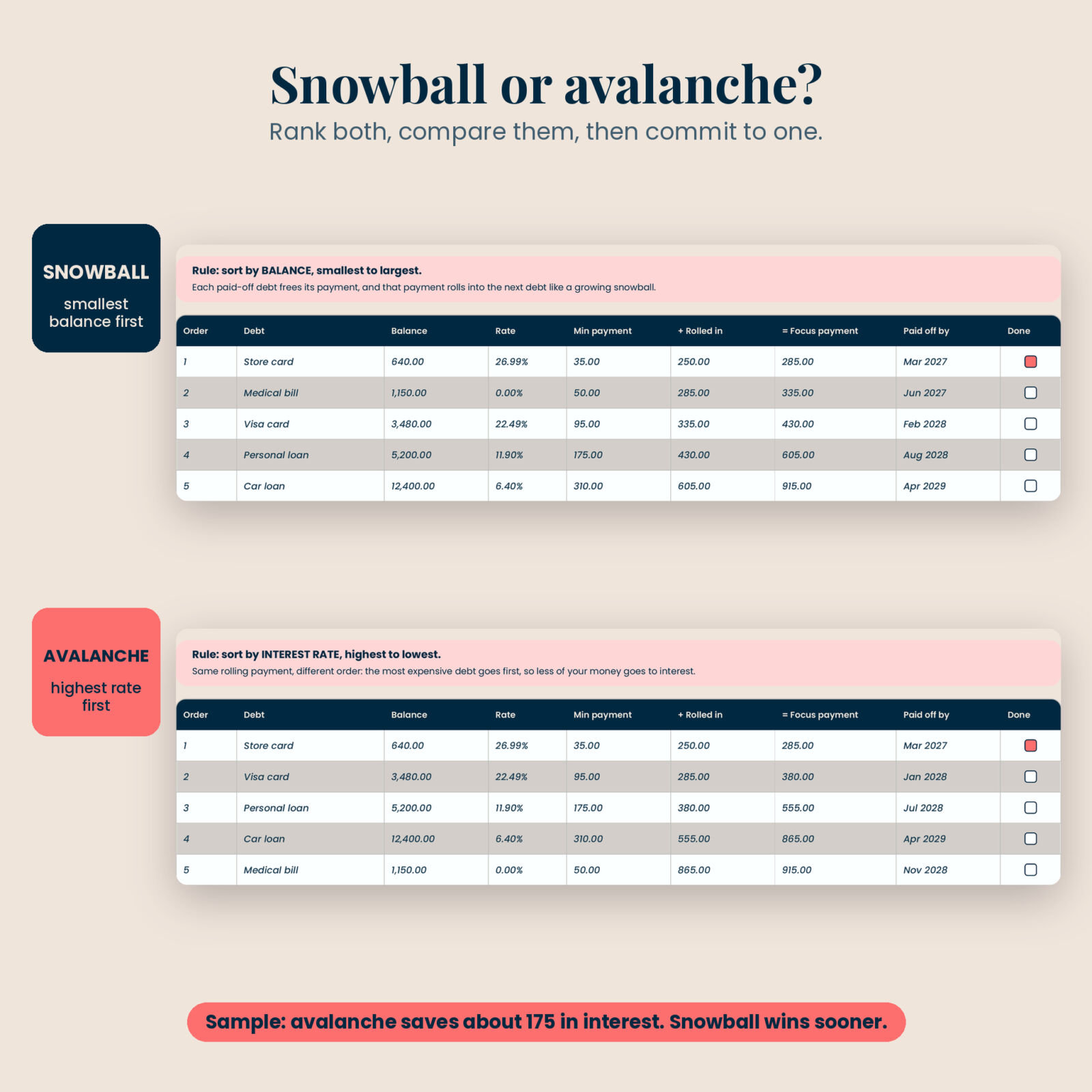
Avalanche (highest interest rate first) almost always costs less in total interest. Snowball (smallest balance first) almost always gives you your first paid-off debt sooner. In our example below, both reach debt-free in the same month, and avalanche saves about $175 in interest. That gap can be a lot bigger when your rates are far apart, and close to zero when they are not.
The best method is the one you will follow for two or three years. A plan you quit in month four saves nothing.
How the debt snowball method works
List your debts from the smallest balance to the largest. Ignore the interest rates. Pay the minimum on everything, then throw every extra dollar at the smallest one. When it is gone, take the whole payment you were making on it and add it to the next debt’s minimum. The payment grows each time, like a snowball rolling downhill.
- Why people love it: you clear a whole debt quickly, often in the first few months. One less bill, one less due date, one less login.
- The catch: a big, high-rate card can sit near the bottom of the list collecting interest while you knock out a small 0% medical bill.
How the debt avalanche method works
List your debts from the highest interest rate to the lowest. Ignore the balances. Pay every minimum, send all the extra to the most expensive debt, and roll its payment into the next highest rate when it is paid off.
- Why people love it: less of your money goes to interest, so you usually finish a little sooner or pay a little less.
- The catch: if your highest rate sits on your biggest balance, it can take a long time to see the first debt disappear. That is where many people lose steam.
Snowball vs avalanche: a real example
Here are the five debts we used. They are the same sample debts you will see filled in on the Payridge pages.
| Debt | Balance | APR | Minimum |
|---|---|---|---|
| Store card | $640 | 26.99% | $35 |
| Medical bill | $1,150 | 0% | $50 |
| Visa card | $3,480 | 22.49% | $95 |
| Personal loan | $5,200 | 11.90% | $175 |
| Car loan | $12,400 | 6.40% | $310 |
| Total | $22,870 | $665 |
On top of the $665 in minimums, our borrower can find an extra $250 a month, for a monthly attack amount of $915. We charged interest monthly at the APR divided by 12 and rolled every freed-up payment into the next debt.
| Snowball | Avalanche | |
|---|---|---|
| Order | Store card, Medical bill, Visa, Personal loan, Car loan | Store card, Visa, Personal loan, Car loan, Medical bill |
| First debt paid off | Store card, March 2027 | Store card, March 2027 |
| Second debt paid off | Medical bill, June 2027 | Visa card, January 2028 |
| Debt-free | April 2029 (28 months) | April 2029 (28 months) |
| Total interest | $2,618 | $2,444 |
Notice what happened. The store card is both the smallest balance and the highest rate, so both methods start in the same place. After that they split. Snowball clears the medical bill in June 2027, which feels great, but that bill was charging 0%. Avalanche goes after the 22.49% Visa instead, and that is where the $175 comes from.
The extra payment matters more than the method
We ran the same five debts with different extra amounts. Look at the months column before you look at the interest gap.
| Extra each month | Debt-free in | Interest (snowball) | Interest (avalanche) | Avalanche saves |
|---|---|---|---|---|
| $0 (minimums, rolled over) | 42 months | $4,547 | $4,547 | $0 |
| $100 | 35 months | $3,427 | $3,284 | $143 |
| $250 | 28 months | $2,618 | $2,444 | $175 |
| $500 | 22 months | $1,926 | $1,768 | $158 |
Going from $0 to $250 extra cuts 14 months and about $1,900 in interest. Switching methods saves under $200. So yes, pick a method, but spend most of your energy finding the extra money. Even $100 a month moves your debt-free date by more than half a year here.
Which method should you choose?
Choose snowball if
- You have tried to pay off debt before and stopped.
- You have several small balances that you could clear in a few months.
- Your interest rates are fairly close together.
- You want fewer bills to manage as soon as possible.
Choose avalanche if
- One or two debts have much higher rates than the rest, such as credit cards above 20%.
- You are motivated by numbers and can stay patient without a quick win.
- Your smallest balances happen to have low or zero rates.
Or use a hybrid
Plenty of people clear one or two tiny debts first for the win, then switch to highest rate for everything else. It is a sensible middle path, and the Payridge My Method page has a column for it.
How to start either method this week
- Gather every balance. Log in to each account and write the balance, APR, minimum payment and due day. Include medical bills and buy now pay later plans.
- Rank your debts both ways. One list by balance, one by rate. Seeing both orders side by side makes the choice obvious for most people.
- Find your extra. Cancel what you do not use, trim one or two big categories, sell something. Write the number down.
- Set your monthly attack amount. Total minimums plus extra. This number stays the same until you are debt-free, even as individual debts disappear.
- Automate the minimums. Set autopay for every minimum so nothing slips, then pay the extra to your focus debt by hand.
- Check in monthly. Update each balance, color your progress and roll any freed-up payment to the next debt the same month.
What’s in the free debt payoff planner
The free sample is 8 pages taken straight from Payridge, and every tab still works in GoodNotes and Notability:
- Home with buttons to every page
- Debt List for up to 10 debts with a totals row
- Snowball Order with rolled-in and focus payment columns
- Debt 1 tracker with a 50-block color-in grid and balance checkpoints
- January 2027 check-in with a real calendar for circling due dates
- Climb the Ridge, a 40-step color-in page for your total debt
Import it as one document, use read-only mode to tap the tabs, then switch back to your pen to write.
Our pick for tracking either method

Payridge Debt Payoff Digital Planner
57 linked pages for GoodNotes and Notability. Rank your debts both ways, pick one, then track every debt and every month of 2027.
- Snowball Order, Avalanche Order and My Method pages
- 10 debt trackers with tap-through tabs and 50-block color-in grids
- 12 monthly check-ins for 2027 with real calendars
- Climb the Ridge, 100 Squares, Payment Streak and a Paid-Off Wall
Free sample vs the full Payridge planner
| Feature | Free sample | Payridge full |
|---|---|---|
| Debt List (10 debts) | ✓ | ✓ |
| Snowball Order page | ✓ | ✓ |
| Avalanche Order page | ✗ | ✓ |
| My Method comparison and attack amount | ✗ | ✓ |
| Debt trackers | 1 overview page | 10 debts, 2 pages each, tap-through tabs |
| 24-row payment logs | ✗ | ✓ |
| 2027 monthly check-ins | January only | All 12 months plus Year in Review |
| Color-in progress pages | Climb the Ridge | Ridge, 100 Squares, Payment Streak, 2 Thermometers |
| Milestones, Paid-Off Wall, Debt-Free Day | ✗ | ✓ |
| Extra payments log, Find Extra Money, Payoff Math, call log | ✗ | ✓ |
| Starting Line, notes pages, DOCX user guide | ✗ | ✓ |
| Total pages | 8 | 57 |
See the full Payridge debt payoff digital planner on Taskdale
Why tracking by hand keeps you going
Calculators tell you a date. They do not keep you motivated in month eleven, when the car loan has barely moved and a friend is planning a trip. Writing each balance by hand once a month makes you look at it. Coloring a block when a payment posts gives your brain a small reward for a boring task.
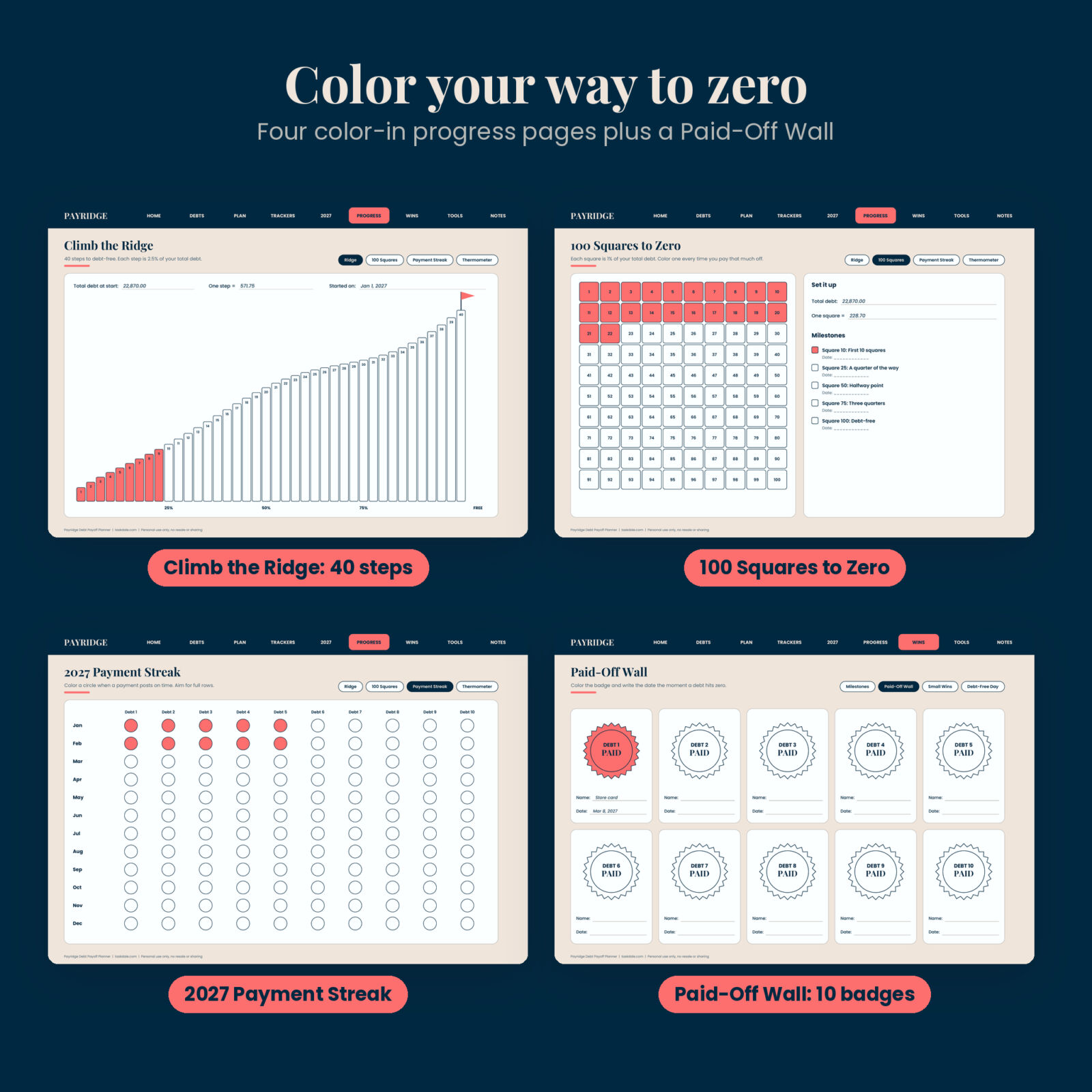
That is why Payridge pairs the plan pages with color-in pages. Each debt has 50 blocks, each worth 2% of its starting balance. Your total debt gets 40 steps on the Ridge and 100 squares on its own page. The Payment Streak page has a circle for every debt in every month of 2027. When a debt hits zero, you color its badge on the Paid-Off Wall.
What if there is no extra money right now?
Then start with the order anyway. Even with zero extra, rolling each freed-up payment into the next debt is a plan, and in our example it still finished in 42 months. Meanwhile, look for small, repeatable amounts rather than one big sacrifice you cannot keep up:
- Subscriptions: list every recurring charge from your last two statements. Most people find at least one they forgot about.
- Phone and insurance: a quick quote comparison once a year often frees $20 to $60 a month.
- Food: cooking two more dinners a week at home is one of the fastest wins for most households.
- Windfalls: decide now that tax refunds, bonuses and cash gifts go straight to the focus debt. Writing that rule down makes it easier to follow when the money shows up.
- Side income: a few overtime shifts or selling things you no longer use can fund a whole month of extra payments.
Payridge has a Find Extra Money page with a trim-or-cut list and an earn-more list, each with a monthly total you carry over to your attack amount.
Common mistakes with snowball and avalanche
- Forgetting to roll the payment. When a debt is paid off, its payment has to move to the next debt that same month. If it drifts into everyday spending, neither method works.
- Missing a minimum while chasing the focus debt. A late fee or a penalty APR can wipe out months of progress. Autopay the minimums.
- Adding new debt. Put the cards somewhere inconvenient. A payoff plan only works if the list stops growing.
- Not asking for a lower rate. A five-minute call to a card issuer sometimes cuts the APR. Write down who you spoke with and what they agreed.
- Switching methods every few weeks. Pick one, give it at least six months, and judge it by your balances, not your mood.
- Having zero savings. A small starter fund for surprises keeps a flat tire from going on a credit card. Many people keep a few hundred dollars aside before going all in.
More debt payoff tools on Taskdale
| Tool | Best for |
|---|---|
| Payvane Debt Snowball vs Avalanche Calculator | Exact month-by-month schedules in Excel or Google Sheets |
| Hueclear Color-In Debt Trackers | Printable coloring trackers for the fridge |
| Cardquell Credit Card Payoff Planner | Credit card balances, APRs and minimum payment traps |
| Waymend Debt-Free Journey Workbook | Money story, budget and a setback plan in a fillable PDF |
| Tallyfern 2027 Digital Budget Planner | Finding your extra payment money in a GoodNotes budget |
| Kettlefund Sinking Funds Tracker | Saving for irregular bills so they stop landing on a card |
Frequently asked questions
Is debt snowball or avalanche faster?
Avalanche is usually equal or slightly faster because less money goes to interest. In our example both finished in 28 months, but avalanche paid about $175 less interest.
Which debt do I pay first if two have the same balance?
Pay the one with the higher interest rate first. That is the tie-breaker for both methods.
Do 0% debts belong on the list?
Yes. List every debt. With avalanche a 0% debt goes last. With snowball it goes wherever its balance puts it. Watch promotional 0% end dates, because a jump in rate can change your order.
Should I include my mortgage?
Most people leave the mortgage out and focus on consumer debt first, then decide what to do about the mortgage later.
Is the planner really free?
Yes. Enter your email in the download box and the PDF is yours. It works in GoodNotes and Notability.
Can I switch methods halfway?
You can. Re-rank your remaining debts and keep the same monthly attack amount. The total you pay each month matters more than the order.
Your next step
Pick a method tonight. Write down every debt, rank them both ways, and decide on your extra. If you want a place to do it, the free planner has the Debt List, the Snowball Order page and your first tracker ready to go. Jump back to the free download, and when you want avalanche, all ten trackers and the whole of 2027 in one linked file, Payridge is waiting on Taskdale.
This article is for general education, not financial advice. Check balances, rates and payoff amounts with each lender.